Foucault News

News and resources on French thinker Michel Foucault (1926-1984)

stuartelden's avatarProgressive Geographies

University of Chicago Press finally have a page up for the translation of Foucault’s 1981 lectures at Louvain – Wrong-Doing, Truth-Telling. They are due out in January 2013.

Three years before his death, Michel Foucault delivered a series of lectures at the Catholic University of Louvain that until recently remained almost unknown. These lectures—which focus on the role of avowal, or confession, in the determination of truth and justice—provide the missing link between Foucault’s early work on madness, delinquency, and sexuality and his later explorations of subjectivity in Greek and Roman antiquity.

View original post

McConnell, Fiona (2012). “Governmentality to practise the state? Constructing a Tibetan population in exile”. Environment and planning. D, Society & space, 30 (1), p. 78-95.
https://doi.org/10.1068/d0711

Abstract
Drawing on the extraterritorial and nonstate centric form of power found in Foucault’s notion of governmentality, I contribute to three emerging debates: the extent to which governmentality is a state or nonstate practice, the question of what is being governed, and the relationship between biopolitics and cultural politics. Focusing on the governance strategies of the Tibetan Government-in-Exile (TGiE) based in India, I explore how ideas of governmentality inform an understanding of what kind of polity this is and, in turn, how this case both confirms and challenges understandings of governance practices and the construction of a population. As I examine the range of techniques used by TGiE to bring into visibility the exile Tibetan population, my attention focuses on the simultaneous totalising and individualising strategies of biopolitics, the importance of population given the lack of territory, and the intersection of exile realities with such practices of governmentality. Taking as a framework Hannah’s three ‘moments’ in the cycle of social control observation, normalising judgment, and regulation-I examine how TGiE seeks to know its population through technologies, imagines and normalises the population through discourses, and manages the population by regulating conduct. Finally, in analysing TGiE’s creation of the ‘population’ as a strategy to legitimise its governance, I conclude by outlining how this study informs debates regarding the cultural context of governmentality and its relationship to territory.

Heterotopia
May 31, 2012 – June 29, 2012
Opening reception May 31 2012 5:30 – 9:00PM

LA JOLLA–The UCSD University Art Gallery and Visual Arts Department are pleased to announce Heterotopia, an exhibition featuring the work of this year’s graduating MFA students. Conceived by Michel Foucault, “heterotopia” describes non-hegemonic conditions of human geography. Heterotopias consist of socially-elaborated counter-sites, or places where the real sites within and between cultures are simultaneously represented, contested, and upended. Consistent with Foucault’s heterotopia, the conditions of a fine arts program are apt to be likewise non-hegemonic and discursive – a space of critical deliberation, evolution, and a plurality of ideas. We have expanded this notion to encompass the various trajectories and coexistent practices of this widely diverse graduating class.

Le sexe sous tous ses rapports 4/4: L’émergence de la sexualité selon Michel Foucault

Adèle Van Reeth reçoit Arnold Davidson pour évoquer l’émergence de la sexualité selon Michel Foucault.

Radio interview on France Culture broadcast 31 May 2012

Update August 2025. The link above is to the Wayback Machine, which preserves the text but not the original podcast.

Extraits :

– Crank Two, Johnny Trunk
– Archive Foucault, interviewé par Paula Jacques le 10/01/1977
Tout ce que vous avez toujours voulu savoir sur le sexe… de Woody Allen (1972)
– “A good man is hard to find”, Big Maybelle
– “95%”, Georges Brassens

Lectures :

– Foucault, La volonté de savoir (Histoire de la sexualité, I), Gallimard, 1976, p.59-60
– Foucault, “Le pouvoir est une bête magnifique”, entretien avec M.Osorio, in Dits et écrits, III, texte 212, Gallimard, coll. “bibliothèque des sciences humaines”, 1994, p.380

With thanks to Nicolae Morar for this link

CFP: Expanded Second Edition of Foucault and the Government of Disability

Submission deadline: Saturday, June 30 2012

The University of Michigan Press considers Foucault and the Government of Disability to be a “classic” in Disability Studies and the book continues to sell well.  For these reasons, the U of M Press is publishing an updated and expanded second edition of the book to mark the ten-year anniversary (in 2015) of the first edition’s publication in 2005. The new edition will include a new introduction by me, some new chapters, and an updated index.

Thus, I am seeking proposals for the new chapters of the book. These proposals can be brief (approximately 200-300 words), but should provide evidence of significant familiarity with and relevance to Foucault’s work. I wish to avoid replication of topics and themes treated in the first edition. Furthermore, I am especially interested in proposals that will fill gaps in the first edition of the book and/or indicate newer or more recent concentrations within Disability Studies that are influenced by Foucault’s approach such as: sexuality and disability, globalization and disability, disability and racism/neo-colonialism, autism, philosophy and disability, media and disability, ethics and disability, bioethics and disability, performance (to name only a few). In short, you should only submit a proposal if your chosen topic is not already covered in the first edition of the book, or if your proposal adds new dimensions to a topic treated in the first edition.

Given that only a few slots are available for the second edition, and given the attention this book is likely to get, competition for inclusion in the second edition will be very high; however, that shouldn’t be taken as discouragement or as code to suggest that the most prominent writers in the field will be given priority. Once I have reviewed the proposals submitted, I will ask a select number of authors to provide me with chapter-length samples of their work on disability and Foucault. From these submissions, I will in turn select authors to write for the book.

If you would like your work to be considered for this exciting second edition of Foucault and the Government of Disability, please send a brief preliminary proposal to Shelley Tremain at s.tremain@yahoo.ca by June 30 2012 or sooner.

stuartelden's avatarProgressive Geographies

Audio recording of a lecture with response and discussion, here. (Thanks to Sam Kinsley for the link)

The controversy opposing “humanism” and “anti-humanism” was especially virulent in the 1960s and 70s in France, involving different tendencies of Phenomenology, Marxism, Structuralism and Hegelianism, around such issues as the meaning of history and the agency (or praxis) of the individual and collective subject. In order to trace its genealogy, the lecture will begin with a presentation of the “two scenes” on which the “dispute of humanism” (Althusser) was fought in the 20th century as a debate involving the redefinition of philosophy as “anthropology”, which were dominated by the works of Heidegger and Lévi-Strauss, respectively. It will then focus on Michel Foucault’s “intervention” in The Order of Things (Les mots et les choses, 1966), where the two debates are merged into a single attempt at divorcing the “quasi-transcendental” objects of anthropology from…

View original post 45 more words

National treasure: writings by philosopher Michel Foucault

A news report in English about recent events in relation to the recent designation of Foucault’s archives as a national treasure. Source: Arts Media Agency site, 5 June 2012

The partner of famous French philosopher Michel Foucault putting some 37,000 pages of the late thinker’s writings up for auction. According to the Government, they are a national treasure. Consequently, they cannot leave the country.

Valued at €3.8m, the State has to gather this sum for 2015 as numerous American universities have stated their intention to buy these writings. The French Government told the Journal Officiel that it considered these archives as “essential for the study and comprehension of Michel Foucault’s work.” These writings, dating from the middle of the 1960s until the philosopher’s death in 1948, include lecture notes, manuscripts copies, and studies necessary to the writing of his books.

The Bibliothèque Nationale de France asserted that it was confident and would be able to raise the required funds, notably through its numerous sponsors. The Musée des lettres et des manuscrits may also contribute to this acquisition.

In an interview with the French newspaper Le Monde, Daniel Defert explained that “he and the philosopher’s family would prefer to see the archives staying in France […] However, should it be impossible, he will not object to have them stored in the United States, a country which provided a lot to him.”

Rose-Redwood, Reuben (2012). “With Numbers in Place: Security, Territory, and the Production of Calculable Space”. Annals of the Association of American Geographers , 102 (2), 295-319.
https://doi.org/10.1080/00045608.2011.620503

Abstract
Recent geographical scholarship on the politics of calculation has led to a reevaluation of the role of statistics, census-taking, and mapping as calculative techniques that have been of primary importance to the rise of the modern territorial state. The current study contributes to this literature by examining how the political technologies of street addressing have been employed to reconfigure the territory of the United States as a calculable space of security. Drawing on extensive archival research and thirty semistructured, in-depth interviews, this study provides a genealogy of calculable space, focusing particularly on the extension of city-style street addressing systems into rural communities to aid emergency management, homeland security, and various other governmental measures as part of the general process that Foucault (2007) has referred to as the “urbanization of the territory.” As a case study, I consider the campaign to readdress rural areas in West Virginia to illustrate the social and political processes at work in remaking the territory into a space of calculation by encoding the landscape with a spatial regime of inscriptions. The results presented here show how 911 addressing systems have been central to the reorganization of political space at a time when the apparatuses of security are being “enhanced” by the apparent marvels of geospatial technology. To the extent that such technologies are themselves implicated in reshaping the very spaces that they are designed to represent, this study calls our attention to the pervasive role that spatial calculation plays in the production of a geo-coded world.

Boedeltje, Freerk (2012). “The Other Spaces of Europe: Seeing European Geopolitics Through the Disturbing Eye of Foucault’s heterotopias”. Geopolitics , 17 (1), 1-24.

DOI:10.1080/14650045.2010.504762

Abstract
Despite the fact that Europe and the EU are two different concepts, they increasingly seem confused within EU policy discourse. By means of the European Neighbourhood Policy (ENP) the EU drafts a desired future of a peaceful and prosperous Europe with recognisable imaginative symbolic and cultural characteristics. In the ENP documents the EU imagines its neighbouring countries as possible European space of influence, yet to be Europeanised. This rather Eurocentric belief that neighbouring states can be ‘Europeanised’ through the idea of conditionality and socialisation but without the prospective of becoming EU member has provoked an appeal for a different and more critical geopolitical perspective.

This article takes Michel Foucault’s concept of heterotopias as inspiration for an alternative geopolitical view on Europe. Foucault’s concept of heterotopic spaces provides a critical framework that is capable of countering the geo-political imaginations of a universal Europe. Foucault has used the idea of a mirror as metaphor for the contradictions between the image and reality. In this context heterotopias are considered places that disturb the utopian image by means of complexity, contradiction and diversity. This article is in search of heterotopic spaces of resistance, that I have titled ‘The Other Spaces of Europe’. They are other spaces and seemingly resist the utopian projections of a common European neighbourhood. The drafts and ideas of the ENP gain new light against the background of these places of resistance that each in their own distinctiveness represents a certain impossibility of a final version of Europe.

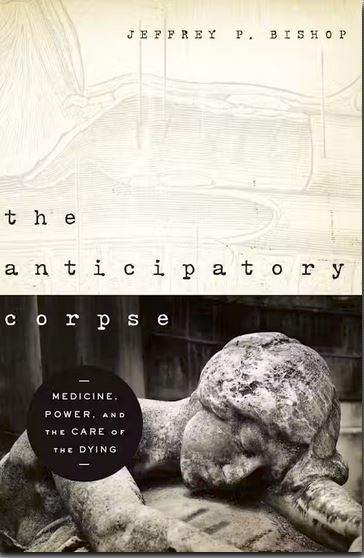
Jeffrey P. Bishop, The Anticipatory Corpse. Medicine, Power, and the Care of the Dying, University of Notre Dame Press. 440p $35

Description
In this original and compelling book, Jeffrey P. Bishop, a philosopher, ethicist, and physician, argues that something has gone sadly amiss in the care of the dying by contemporary medicine and in our social and political views of death, as shaped by our scientific successes and ongoing debates about euthanasia and the “right to die”—or to live. The Anticipatory Corpse: Medicine, Power, and the Care of the Dying, informed by Foucault’s genealogy of medicine and power as well as by a thorough grasp of current medical practices and medical ethics, argues that a view of people as machines in motion—people as, in effect, temporarily animated corpses with interchangeable parts—has become epistemologically normative for medicine. The dead body is subtly anticipated in our practices of exercising control over the suffering person, whether through technological mastery in the intensive care unit or through the impersonal, quasi-scientific assessments of psychological and spiritual “medicine.”

The result is a kind of nihilistic attitude toward the dying, and troubling contradictions and absurdities in our practices. Wide-ranging in its examples, from organ donation rules in the United States, to ICU medicine, to “spiritual surveys,” to presidential bioethics commissions attempting to define death, and to high-profile cases such as Terri Schiavo’s, The Anticipatory Corpse explores the historical, political, and philosophical underpinnings of our care of the dying and, finally, the possibilities of change.

This book is a ground-breaking work in bioethics. It will provoke thought and argument for all those engaged in medicine, philosophy, theology, and health policy.

Review by David P. Sulmasy

extract..

Bishop takes his central thesis from the observation of the French philosopher Michel Foucault that medicine made a dramatic turn in the late 18th century. In a particularly striking chapter of his masterful book The Birth of the Clinic, entitled “Open Up a Few Corpses,” Fou-cault wryly observes that with the development of pathological anatomy, the primary subject of medicine, concerned as it is with the care of the living, paradoxically became the dead human body. What doctors began to see when they saw living patients, Foucault argues, was what could be seen only at autopsy. Bishop skillfully portrays how this conception has played itself out into the 21st century, focusing on how medicine cares for the dying.
