Foucault News

News and resources on French thinker Michel Foucault (1926-1984)

Caroline Bath, Conceptualising listening to young children as an ethic of care in early childhood education and care (2013) Children and Society, 27 (5), pp. 361-371.
https://doi.org/10.1111/j.1099-0860.2011.00407.x

Abstract
This paper focuses on recent discourses and practices of listening to young children, in order to highlight listening as an ethical practice in early childhood education and care settings. The paper asks how discourses of listening should be viewed in theoretical terms and explores the work of a diverse range of authors who define autonomy and rights issues as relational. Central to the paper is a consideration of feminist critique of Foucault’s ethics of care argument. To contextualise this, the paper discusses examples of recent research in the field of listening to young children and highlights issues facing the status of the early years workforce. In summary, the paper contends that an ethical view of listening can bring adults and children together in democratic care practices which challenge conceptions of childhood and reconnect ideas of care and education.

Author Keywords
Childcare; Early years; Education; Ethics; Participation

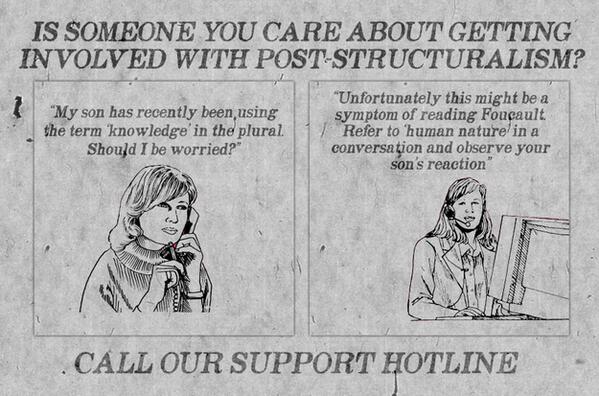
structuralism

This strip was created by David and appears on his blog Hugging the Horse

Update October 2025: The link above is to the the archived page on the Internet Archive Wayback Machine.

With thanks to Dirk Felleman for this item and also to Philippe Theophanidis for alerting me to the original source

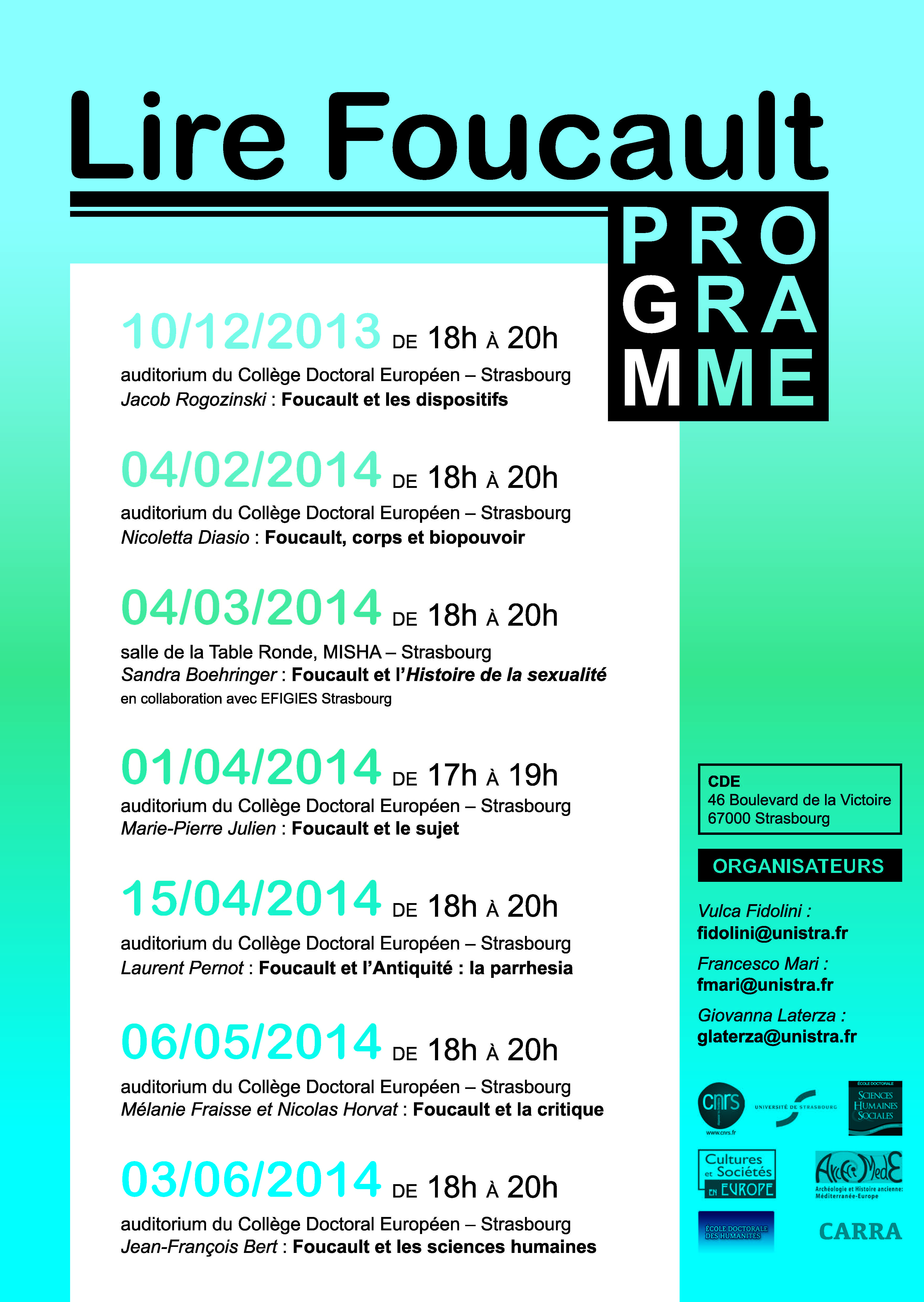
PDF of flyer

LireFoucaultProgramme

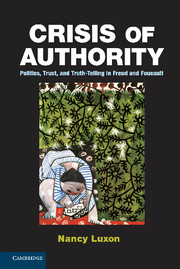
luxon Nancy Luxon, Crisis of Authority. Politics, Trust, and Truth-Telling in Freud and Foucault, Cambridge University Press, 2013

Description
Contemporary social and political theory has reached an impasse about a problem that had once seemed straightforward: how can individuals make ethical judgments about power and politics? Crisis of Authority analyzes the practices that bind authority, trust, and truthfulness in contemporary theory and politics. Drawing on newly available archival materials, Nancy Luxon locates two models for such practices in Sigmund Freud’s writings on psychoanalytic technique and Michel Foucault’s unpublished lectures on the ancient ethical practices of “fearless speech,” or parrhesia. Luxon argues that the dynamics provoked by the figures of psychoanalyst and truth-teller are central to this process. Her account offers a more supple understanding of the modern ethical subject and new insights into political authority and authorship.

  • Offers a novel reading of Freud and Foucault alongside, rather than against, one another
  • Recovers resources for ethical and political agency
  • Draws on newly available archival materials

Shira Wolosky, Foucault at School: Discipline, Education and Agency in Harry Potter, Children’s Literature in Education, 45, 285–297 (2014)
https://doi.org/10.1007/s10583-013-9215-6

Abstract
The formative power of children’s literature is both great and suspicious. As a resource of socialization, the construction and experience of children’s literature can be seen as modes of disciplinary coercion such as Michel Foucault has anatomized. Harry Potter, as a “craze” phenomenon, has attracted particular controversy due to its intense commercialization and dissemination, raising questions about its socializing roles. Here I argue that Harry Potter itself addresses, represents, and reflects on socializing disciplines as both psychological and socio-historical processes, with special focus on and implications for educational scenes and methods. Discipline is shown to be inevitable and necessary, but not only in the coercive ways of Foucault. It is no less important for constructing the self in positive senses. Hogwarts, as the central site of action, becomes a stage for a wide variety of educational models and disciplinary modes and goals. These range from Dolores Umbridge, whose classroom is coercively disciplinary in full Foucauldian sense; through Snape’s abuses of power, Albus Dumbledore’s modelling of educational and moral values, and Harry’s own role as student-teacher exemplifying educational principles which Jerome Bruner and others have called a “community of learning.” This variety of educational experiences explores the possibilities through which discipline emerges not only as coercive, but also as formative in ways that are maturing, strengthening, and rewarding: a possibility with strong implications for questions of socialization and creativity in general. Harry Potter concludes with a reconstitution of self and society, in a way that endorses discipline even as it suspects its coercive abuses. This becomes not only a personal project but an explicitly social and political one, requiring both critique and investment in culture. Socialization then is shown to be a process of formation that is not merely coercive but creative.


Shira Wolosky
received her Ph.D. from Princeton University and was Associate Professor of English at Yale before moving to the Hebrew University of Jerusalem. Her books include Emily Dickinson: A Voice of War, Language Mysticism, Poetry and Public Discourse, The Riddles of Harry Potter and Feminist Theory across Disciplines. Her awards include a Guggenheim, ACLS and Fulbright Fellowship, a Fellowship at the Institute of Advanced Studies of Princeton University and a Drue Heinz Visiting Professorship at Oxford University.

Florence Hulak, « Michel Foucault, la philosophie et les sciences humaines : jusqu’où l’histoire peut-elle être foucaldienne ? », Tracés. Revue de Sciences humaines [En ligne], #13 | 2013, mis en ligne le 21 octobre 2013,
https://doi.org/10.4000/traces.5718

Résumé

L’œuvre de Michel Foucault a pu être lue comme inaugurant une pratique révolutionnaire de l’histoire. Toutefois, les historiens qui se sont inspirés de ses travaux n’ont pas poussé jusqu’au bout la transformation de l’écriture de l’histoire qu’impliquait ce modèle. S’il revient à l’historiographie d’examiner les difficultés conjoncturelles qu’a pu connaître la réception de Foucault, cet article se propose d’analyser les obstacles proprement épistémologiques à la pleine introduction de sa pensée en histoire. Il montre que, pour devenir véritablement foucaldienne, l’histoire devrait renoncer à son appartenance aux sciences humaines, c’est-à-dire à la fois à son statut de science, à l’étude du social et à la référence au réel. Le diagnostic que porte Foucault sur les sciences humaines ne saurait en effet épargner l’histoire, même s’il n’a jamais insisté sur ce point, préférant défaire l’ancrage de l’histoire dans les sciences humaines pour mieux l’associer à l’archéologie puis à la généalogie. Mais cette nouvelle alliance prive alors l’histoire de son propre régime de vérité, en la faisant dépendre de celui d’un discours philosophique.

In English

According to some readings, Michel Foucault has invented a revolutionary way to write history. However, even the historians who have drawn from his work have not accomplished the full transformation of their practice that was required by the foucaldian paradigm. While historiography explores the circumstantial reasons for this limited scope, this article focuses on the epistemological obstacles to a full integration of Foucault’s thought in historical works. It shows that a fully foucaldian history could not belong to the human sciences any more, which means it should give up at once its scientific status, the study of the social, and the reference to reality. The diagnosis that Foucault makes on the human sciences does not indeed spare history, even if he never laid emphasis on this point. He prefers to remove history out of the human sciences, so as to connect it better with archeology and then genealogy. Yet this new alliance deprives history of its own regime of truth, and makes it dependent on a philosophical one.

Foucault, Neoliberalism and Global Post-Politics

Canadian Centre for German and European Studies site at the University of Montreal

Les films de l’atelier du CCEAE tenu à Berlin en mai 2012

Vous trouverez ici tous les films réalisés pendant l’atelier sur Foucault qui s’est tenu à Berlin en mai 2012 sur le thème :

Using and Reading Foucault in Europe, Asia, and America

Il s’agissait d’un atelier sponsorisé par :

Deutscher akademischer Austauschdienst (DAAD)
Centre canadien d’études allemandes et européennes (CCEAE)
Centre d’études et de recherches internationales de l’Université de Montréal (CERIUM)
European School of Management and Technology (ESMT)

Mark Duffield

“How Did we Become Unprepared ? From modernist to post-modernist conceptions of disaster”

Didier Bigo

“Security, a Field Left Fallow : towards a governmentality of (un)freedom”

James Faubion

“Scenario Planning and the Rhetoric of Risk”

Susanne Krasmann

“Foucault’s Law ? The case of targeted killing”

Alessandro dal Lago

“Foucault in the Age of Globalisation : the governmentality of war”

Luis Lobo-Guerrero

“Using Foucault to Problematize the Uncertainties of the Insured World”

Update on Stuart Elden’s work on his book on Foucault with lots of links to his other work on Foucault

stuartelden's avatarProgressive Geographies

Foucault 24 Nov

Having put together rough drafts of chapters 1 and 2 (see previous update), I was now able to move to the real focus of the book. But there is no simple break, and even as I go onto these chapters there was some material from previous courses that was best discussed here. This was especially the case with the material on hysterics and children in Psychiatric Power. While the primary aim of the book is a chronological exposition, it’s not slavishly so.

The idea was that the next chapter (number 3 on the new plan), under the working title of ‘Pervert, Hysteric, Child’, incorporates material from Psychiatric Power and Abnormal into a coherent whole. The next step was, of course, the 1974-75 course Abnormal (incidentally I don’t know why it has this title instead of the more literal The Abnormals). Again, I wrote a piece on this when it…

View original post 398 more words

Lecture by Hannah Chapelle Wojciehowski (UT Austin) : Michel Foucault’s 1968: Tunis, Sidi Bou Said, Paris

Department of English, University of Texas at Austin, USA
Tuesday, October 29, 2013 at 4:30pm
Goldwin Smith Hall, GS 258, English Lounge 232 East Ave, Central Campus

PDF flyer

Focusing on the two drafts of L’Archéologie du savoir, this talk will explore the political and personal events that influenced Michel Foucault’s transition from Structuralist guru to activist critic of modernity.


Diogo Sardinha, L’Emancipation de Kant à Deleuze, Hermann éditeurs des sciences et des arts, Collection / Série : Hermann Philosophie, 2013

248 pages ; 21,00 x 14,00 cm
ISBN 978-2-7056-8757-1

Sommaire
Plus que jamais, sans doute, nous avons besoin de stratégies critiques pour l’émancipation. Or, lisant la philosophie des deux derniers siècles, on découvre les attitudes les plus contrastées dans ce domaine. Kant, qui définit les Lumières comme « la sortie de l’homme de la minorité dont il est lui-même responsable », incite son lecteur à devenir adulte. Par contre, Deleuze (seul ou avec Guattari) met en avant un devenir-mineur et insiste sur un devenir-enfant qui soit un devenir-force.

En même temps, cette opposition immédiate de Kant et Deleuze esquive tout ce qui a mené de l’un à l’autre. Lorsqu’on reprend le fil qui les lie, des figures inattendues surgissent : Sartre, Bataille et Foucault deviennent alors les personnages d’une histoire tissée autour de Baudelaire, par rapport auquel les trois philosophes écrivains prennent des positions radicalement divergentes. Si on veut donc comprendre ce qui semble être le renversement du devenir-majeur kantien par le devenir-mineur deleuzien, c’est ce parcours qu’il devient nécessaire de reconstituer. À la fin, on aura reconstruit quelques stratégies émancipatrices, utiles pour nous aujourd’hui.

Summary in English

In the history of emancipation over the past two centuries, two philosophers are situated at extreme opposites from one another: Kant and Deleuze. The former launched an appeal to become adult, while the latter argued the case for a becoming-child. Do they represent, besides theoretical extremes, the temporal extremities of a period marked at its end by the reversal of its inaugural principle?

Kant defines the Enlightenment as ‘the human being’s emergence from his self-incurred minority’, and his motto of Enlightenment thus rings like an incentive to become major: ‘Sapere aude! Have the courage to make use of your own understanding!’. It is on this very point that Deleuze, alone or with Guattari, is of interest. Do they not insist on a becoming-child, even though the child is the minor par excellence? Do they not alert their readers to the possibility of a becoming-minor, which is a becoming-force?

Such an immediate confrontation between Kant and Deleuze omits that which led from one to the other. If we want to retrace the thread that links them, unexpected figures come to the fore: Baudelaire, Sartre, Bataille and Foucault. Through them, and in a movement that started with Baudelaire, the heritage of dandyism unfolds. In order to understand the significance of Deleuze’s reversal of Kant’s principle, we must retrace this journey.