Foucault News

News and resources on French thinker Michel Foucault (1926-1984)

Hans-Martin Jaeger, Governmentality’s (missing) international dimension and the promiscuity of German neoliberalism (2013) Journal of International Relations and Development, 16 (1), pp. 25-54.
https://doi.org/10.1057/jird.2012.6

Abstract
An important insight from the recent publication of Foucault’s governmentality lectures for International Relations (IR) is that international manifestations of governmentalities such as police and liberalism, rather than constituting mere domestic analogies, have inherently international dimensions. Police and liberalism are both constituted by and constitutive of the international contexts in which they emerge: historically, the European balance of power and a ‘globalisation’ of markets, respectively. However, Foucault’s account of German and American neoliberalism in the twentieth century omits references to the international context. This article first reconstructs the ‘domestic-international nexus’ in Foucault’s account of police and liberalism, and then recovers aspects of the missing international dimension of his analysis of German neoliberalism with recourse to Wilhelm Röpke’s writing on IR. The upshot of this recovery effort is threefold. First, the international remains pivotal to (mid-) twentieth-century neoliberal governmentality. Second, (German) neoliberalism’s association with multiple ‘international’ governmentalities, including liberal and non-liberal ones, exposes neoliberalism as a ‘promiscuous’ mode of governance. Third, German neoliberalism’s promiscuity is underwritten by (though not reducible to) a conservative ethos of moderation. More broadly, this article contributes to efforts to theorise the relationship between domestic and international politics, and to understand neoliberalism as a ‘variegated’ phenomenon.

Author Keywords
domestic-international nexus; Foucault; international governmentality; ordoliberalism; variegated neoliberalism; Wilhelm Röpke

Index Keywords
globalization, governance approach, government, international relations, neoliberalism, political power, twentieth century; Germany


Update September 2025 See this page on Progressive Geographies for a more updated list

stuartelden's avatarProgressive Geographies

There are audio recordings of Foucault at various places online. This post attempts to make sense of them. Comments and additions gratefully received.

update 9 Dec 2014 – see this page for a better, reorganised chronological list.

Ubuweb has the following:

‘Discourse and Truth: Parrhesia’, UC Berkeley, October 24-November 21 1983 – these were transcribed as the Fearless Speech book.

‘Truth and Subjectivity’, Howison lectures, UC Berkeley, October 20-21 1980 – not published, but later versions were given on November 17 and 24 at Dartmouth, which were published in The Politics of Truth and in Political Theory. Variants between the Berkeley and Dartmouth versions are noted.

The Culture of the Self, UC Berkeley, April 12 and 19 1983

They then have some radio broadcasts from the 1960s – on Histoire de la folieRaymond Roussel, and one from 1966 entitled ‘Le corps, lieu d’utopies’…

View original post 318 more words

ON FOUCAULT’S OBSCURITY: informational prosaicity vs transformational poeticity
Posted on July 19, 2013 by terenceblake
From the Agent Swarm blog

Possible sources of the appearance of obscurity:

1) Vocabulary: French being Latin based looks more complicated than it is when viewed by an English speaker. I remember my surprise when I first arrived in France and a fairly unintellectual friend said “I just want to deculpabilise him”. In English that would sound highbrow, in French not so much. Another lexical factor giving the appearance of abstraction is the tendency, contrary to English, to prefer nominal expressions to verbal ones. “Natation” means “swimming”, and is an ordinary word in French, but it has an abstract feel to an English speaker. Further, at the level of meaning the suffix “-ation” seems more reified and static compared to the processual “-ing”.

read more

With thanks to Dirk Felleman for this link

Stuart Elden ends this entry with a request for information:

So, does anyone know about Annuaire du Centre coordinateur de la recherche urbaine pour la France, or what that might be a reference to?

stuartelden's avatarProgressive Geographies

In Daniel Defert’s ‘Chronologie’/’Chronology’ in Dits et écrits/A Companion to Foucault, he makes reference to a publication entitled Annuaire du Centre coordinateur de la recherche urbaine pour la France. This is in the entry for October 1973  (p. 44/55), and Defert suggests that it published some of the results of research projects conducted by CERFI under Foucault’s sponsorship – the particular project was on “the role of urban facilities in town planning”.

I’ve written about the CERFI projects in some detail, but I can find no trace of this publication. It doesn’t come up in library databases, google, etc. I know about other publications that came from this, and related, work, including François Fourquet and Lion Murard, Les équipments du pouvoir: Villes, Territoires et équipements collectifs, Paris: Union Générale d’Éditions, 1976 (originally an issue of Recherches in 1973). But this publication escapes me.

So, does anyone know about 

View original post 20 more words

Call for Papers

 Origins of Truth: Foucault’s Lectures on the Will to Know

 November 8-9, 2013

A conference presented by

the Foucault Society

and

Stony Brook University Department of Philosophy

Location:

Stony Brook Manhattan

387 Park Avenue South

New York, NY

Keynote: Todd May, Clemson University: “The Will to Know”

Guest Speaker: Eduardo Mendieta, Stony Brook University

In celebration of the publication of Michel Foucault’s Lectures on the Will to Know: Lectures at the Collège de France, 1970-1971

(Palgrave Macmillan, 2013), we invite participants to a conference in New York City.

 As the first of Foucault’s annual courses, Lectures on the Will to Know set an agenda for his intellectual journey of the 1970s and 1980s. Its publication in English translation opens up new directions for research into power, knowledge and the “formation of discourses.”

Papers are invited which analyze Lectures on the Will to Know – its sources, themes and intellectual, historical or political contexts.  What are the multiple ways that “truth” and “origins” are developed in Foucault’s work?  How do philosophy and history intersect in this text?  What is “will” in a Foucaultian context and how can we think of “the will to know” without reinstalling sovereign subjectivity?  How do Foucault’s encounters here with Aristotle, the Sophists, Nietzsche, Deleuze  indeed, with the possibility of an origin of Western knowledge — complicate our understanding of his genealogical approach?

Suggested Topics:

 The Lecture Courses

“The Will to Know” and “The Order of Discourse”

 ▪ Issues of translation and transcription ▪

 ▪ Continuities and disjunctions among the Lecture Courses ▪

Thematic connections to Foucault’s earlier or later works

Intellectual History

Foucault and Deleuze ▪ Foucault and Nietzsche ▪ Foucault on Aristotle and the Sophists ▪ Foucault and Eastern Knowledge

 Forms of Knowledge

Connaissance, Savoir and Truth ▪ Judgment ▪ Justice

 Measurement (Being) ▪  Repetition and Becoming ▪ The Event

 Truth and the City-State

Law ▪ Money ▪ Sovereignty

Political Economy ▪ Purity/Impurity ▪ Criminality

Please send 500 word proposals to:

foucaultsocietyorg@gmail.com

Deadline:

September 10, 2013. 

Accepted presenters will be notified by September 20, 2013.

About the Foucault Society:

The Foucault Society is an independent, nonprofit educational organization dedicated to the critical study of the ideas of Michel Foucault (1926-1984).  All of our events are open to the public. We welcome new participants who have an interest in Foucault’s work and its impact on diverse areas of inquiry, including critical social theory, philosophy, politics, history, culture, gender/sexuality studies, and the arts.

Website
Facebook

companion
Michael Maidan, Review of: A Companion to Foucault by Christopher Falzon,Timothy O’Leary, and Jana Sawicki (Editors) Wiley-Blackwell, 2013.

This companion to the work of French thinker Michael Foucault offers an overview of his work, and critical essays that explore Foucault’s insights and his influence on contemporary social and political thought.

Part I opens with the first English translation of the ‘Chronology’, a detailed summary of Foucault’s life and work with references to otherwise unpublished documents prepared by Daniel Defert for the French edition of Foucault’s shorter works and conferences. This is followed by studies of Foucault main works, starting with his History of Madness (1961) and to History of Sexuality vol. 1 (1976).  This section also includes a discussion of a few of the recently published Lectures at the Collège de France, and concludes with an essay by Paul Rabinow — one of the earliest and most influential Foucault scholars in the US —  presenting Foucault’s lectures and essays on ‘Care of the Self’.

read more

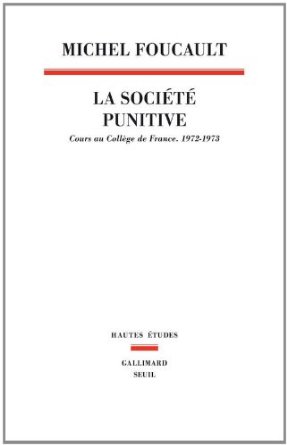
punitiveMichel Foucault (2013) La société punitive. Cours au collège de France 1972-1973, Paris: Gallimard Seuil. Ce livre paraîtra le 10 octobre 2013.

Frédéric Gros
Foucault et « la société punitive »
Compte rendu sur le site Cairn.info

Résumé

« Malheureusement, quand on enseigne la morale, quand on fait l’histoire de la morale, on explique toujours les Fondements de la métaphysique des mœurs et on ne lit pas [Colquhoun], ce personnage fondamental pour notre moralité. Inventeur de la police anglaise, ce marchand de Glasgow […] s’installe à Londres, où des sociétés de navigation lui demandent en 1792 de résoudre le problème de la surveillance des docks et de la protection de la fortune bourgeoise. » [C’est un] problème essentiel […] ; pour comprendre le système de moralité d’une société, il faut poser la question : Où est la fortune ? L’histoire de la morale doit s’ordonner entièrement à cette question de la localisation et du déplacement de la fortune. » Michel Foucault

Prononcées au Collège de France au premier trimestre 1973, ces treize leçons sur la « société punitive » examinent la façon dont se sont forgés les rapports de la justice et de la vérité qui président au droit pénal moderne, et questionnent ce qui les lie à l’émergence d’un nouveau régime punitif qui domine encore la société contemporaine.

Ce cours, supposé être préparatoire à l’ouvrage qui paraîtra en 1975, Surveiller et Punir, se déploie tout autrement, au delà du système carcéral, englobant l’ensemble de la société à économie capitaliste, au sein de laquelle s’innove une gestion particulière de la multiplicité des illégalismes et de leur imbrication.

Cet essai à part entière brasse un matériel historique jusque-là inédit, concernant l’économie politique classique, les Quakers et « Dissenters » anglais, leur philanthropie – eux dont le discours introduit le pénitentiaire dans le pénal –, puis la moralisation du temps ouvrier. Michel Foucault livre par sa critique de Hobbes une analyse de la guerre civile, qui n’est pas la guerre de tous contre tous mais une « matrice générale » permettant de comprendre le fonctionnement de la stratégie pénale dont la cible est moins le criminel que l’ennemi intérieur.

La Société punitive se place parmi les grands textes qui relatent l’histoire du capitalisme. Nos sciences de l’homme se révèlent être, au sens nietzschéen, toujours des « sciences morales ».

foucault-jagMichael C. Behrent, Foucault and Technology, History and Technology, Vol. 29, Iss. 1, 2013, 54-104
https://doi.org/10.1080/07341512.2013.780351

Abstract
This article offers the first comprehensive analysis of the ways in which the French philosopher Michel Foucault (1926-1984) employed the terms ‘technology’ and the ‘technique’ over the course of his intellectual career. His use of these words in his mature writings, it is argued, reflects a profound ambivalence: Foucault sought to denounce the pernicious effects of what he called modern ‘technologies of power,’ but also deliberately evoked the more positive values associated with ‘technology’ to develop a philosophical standpoint shorn of the ‘humanist’ values he associated with existentialism and phenomenology. The article situates Foucault’s condemnation of power technologies within the broader skepticism towards ‘technological society’ that pervaded French intellectual circles following World War II. In the first phase of his career (1954-1960), Foucault built on these attitudes to articulate a conventional critique of technology’s alienating effects. Between 1961 and 1972, the theme of ‘technology’ fell into abeyance in his work, though he often suggested a connection between the rise of technology and the advent of the ‘human sciences.’ Between 1973 and 1979, ‘technology’ became a keyword in Foucault’s lexicon, notably when he coined the phrase ‘technologies of power’. He continued to use the term in the final stage of his career (1980-1984), when his emphasis shifted from power to ‘technologies of the self.’ The essay concludes by addressing Paul Forman’s thesis on the primacy of science in modernity and of technology in modernity, suggesting that in many respects Foucault is more of a modernist than a postmodernist.

DOI: 10.1080/07341512.2013.780351

With thanks to Philippe Theophanidis for this item

Isacco Turina, Vatican biopolitics (2013) Social Compass, 60 (1), pp. 134-151.
https://doi.org/10.1177/0037768612471776

Abstract
The author argues that the Vatican’s teaching on family, sexuality and human life is best understood within the frame of Foucault’s concept of biopolitics. His hypothesis is based on two major claims: first, that in the 20th century the Pope took on a new role, that of manager of populations of believers; and second, that a number of essential functions for the Church as an organization, such as the recruitment of members and of clergy, the maintaining of a distinctive Catholic identity, competition with other faiths and competition with nation states, have increasingly revolved around biopolitical issues, particularly around contraception and human life. Therefore, religious teaching on these topics should be read as a discourse where power and morals intertwine.

Author Keywords
biopolitics; Catholic doctrine; contraception; family; human life

Jean-Philippe Cazier, Deleuze, Foucault et la littérature
On the Mediapart site 06 mars 2013.

Lire une œuvre ne consiste pas à lui appliquer une grille théorique, à la placer dans des cadres conceptuels a priori, à expliquer ce que l’auteur a voulu dire mais sans le dire, à extraire de l’œuvre une signification enfin claire et articulée : « l’œuvre tient à distance toute interprétation extrinsèque » (Critique et clinique, p.71). Lire une œuvre ne peut se résumer à en faire le support d’un commentaire philosophique ou d’une herméneutique, puisque ces approches reposent sur un faux rapport excluant la singularité de l’œuvre littéraire. Pour Foucault et Deleuze, la littérature est en elle-même une pensée qui ne se distingue pas de sa forme, de sa pratique, qui dit dans un langage qui lui est propre ce qu’elle a à dire, sans nécessiter de traduction. De même, l’écrivain n’a pas besoin du philosophe pour penser la littérature, pour réfléchir à sa propre pratique.

Dans ces conditions, quel peut être le rapport de la philosophie à la littérature ? Pour Deleuze et Foucault, ce rapport maintient celle-ci dans sa singularité et son originalité, puisqu’il nécessite cette singularité. Si Deleuze et Foucault prennent réellement la littérature au sérieux c’est d’abord parce qu’ils y reconnaissent une pensée singulière, autonome, mais c’est aussi parce qu’ils la considèrent comme une affaire sérieuse pour la philosophie elle-même : la philosophie a quelque chose à faire avec la littérature, quelque chose qui concerne immédiatement la pensée philosophique. Il y aurait là un paradoxe (pour la doxa philosophique) : la philosophie, en un sens, aurait besoin de la littérature.

suite