Foucault News

News and resources on French thinker Michel Foucault (1926-1984)

Roland Sintos Coloma, Ladlad and Parrhesiastic Pedagogy: Unfurling LGBT Politics and Education in the Global South (2013) Curriculum Inquiry, 43 (4), pp. 483-511.
https://doi.org/10.1111/curi.12020

Abstract
This article examines the political and educational activism of Ladlad, the first lesbian, gay, bisexual, and transgender (LGBT) political party in the Philippines and the only existing LGBT political party in the world. Founded in 2003, Ladlad fielded candidates for the 2010 national election in the Philippines, amidst seemingly insurmountable institutional and societal barriers. Audaciously visionary and fiercely resilient, Ladlad’s leaders enacted what can be called “parrhesiastic pedagogy,” a juxtaposition of Michel Foucault’s notion of parrhesia and of activism as public pedagogy. Parrhesiastic pedagogy is an oppositional form of teaching by subordinated subjects who assert their freedom to tell truths that challenge hegemonic understandings, in this case regarding non-normative sexual orientations and gender identities. Ladlad utilized the fearless tactics of scandalous behavior, critical preaching, and provocative dialogue not to alter people’s opinions, but to grapple with self-reflexive accounts of their contradictions and inconsistencies. Ladlad’s politics and practices also offer new ways of conceptualizing queer of color epistemology from the vantage point of LGBTs from the Global South. They provide insights into LGBT civic engagement with dominant institutions like the federal government, organized religion, and mainstream media, and with a general populace that considers LGBTs as immoral, second-class citizens. The article’s focus on LGBTs in the Global South serves to caution queer of color scholarship of its potential imperialist slippage if the latter remains embedded within a Global North logic, yet asserts itself as universal and applicable to all racialized and sexual minority others around the world.

Interview: William Davies and Nicholas Gane on Neoliberalism

Neoliberalism and the Ethos of Competition:
William Davies and Nicholas Gane in discussion

In this interview for the TCS Website (18 December 2013), William Davies and Nicholas Gane discuss competition, monopoly, markets, neoliberalism and Foucault.

NG: You have a forthcoming book in the TCS book series called The Limits of Neoliberalism. Could you tell us what this book is about?

WD: Initially my interest which led to the book came from when I was working in a policy think-tank – the Institute for Public Policy Research – about nine years ago now. I became very interested in the notion of competitiveness as a concept within public policy discourse because it struck me that nearly any policy could be justified on the basis that it was good for national or urban competitiveness or the competitiveness of communities or regions. One of the things that interested me about that was that clearly it wasn’t simply about opening up the market. It wasn’t simply just about saying that we must have more free trade or deregulation, but that there was a positive aspect of competitiveness. This is what Jamie Peck calls the ‘roll-out’ aspect of neoliberalism, for instance that we should invest in things like broadband infrastructure and other facilities and public spaces which are pro-competitiveness. Clearly this has big implications for universities as well in terms of the knowledge economy and so on. So, in quite a naive, untheorized way, it struck me that something was going on that only much later did I refer to as neoliberalism: that an ethos of competition and competitiveness was an organizing principle and driver for a lot of public policy decision making in ways that weren’t simply about the market in a simpler liberal, classical, Adam Smith sense of the market. That is what led me to do a PhD, which initially looked at discourses of competitiveness. I was particularly interested in notions of competitiveness as developed by the Harvard Business School guru Michael Porter. I then became more interested in how other traditions of economics conceived of competition and competitiveness, such as in the Chicago School, and then how these different concepts fed into policy making apparatuses, regulators and state agencies. This research, much of which has gone into this book, involved me going and meeting experts and economists who advised governments on competition and competitiveness, and then also trying to do more of a genealogical study of where these ideas came from. A crucial moment for me, and many of us who are interested in neoliberalism, was the English publication in 2008 of the Foucault lectures on neoliberalism. This happened just as I was completing my PhD but I had enough time to think hard about the implication of these lectures, particularly what Foucault said about the connection between economics and sovereignty. This really helped to shape my thinking and the focus the book.

more

Fadyl, J.K., Nicholls, D.A., McPherson, K.M.
Interrogating discourse: The application of Foucault’s methodological discussion to specific inquiry (2013) Health (United Kingdom), 17 (5), pp. 478-494.

Abstract
Discourse analysis following the work of Michel Foucault has become a valuable methodology in the critical analysis of a broad range of topics relating to health. However, it can be a daunting task, in that there seems to be both a huge number of possible approaches to carrying out this type of project, and an abundance of different, often conflicting, opinions about what counts as ‘Foucauldian’. This article takes the position that methodological design should be informed by ongoing discussion and applied as appropriate to a particular area of inquiry. The discussion given offers an interpretation and application of Foucault’s methodological principles, integrating a reading of Foucault with applications of his work by other authors, showing how this is then applied to interrogate the practice of vocational rehabilitation. It is intended as a contribution to methodological discussion in this area, offering an interpretation of various methodological elements described by Foucault, alongside specific application of these aspects.

Author Keywords
Discourse analysis; issues in research methodology; post-structuralism/post-modernism; research methodology

DOI: 10.1177/1363459312464073

hoffman Marcelo Hoffman Foucault and Power: The Influence of Political Engagement on Theories of Power, Bloomsbury, 2013

publisher’s page

About Foucault and Power
Michel Foucault is one of the most preeminent theorists of power, yet the relationship between his militant activities and his analysis of power remains unclear. The book explores this relationship to explain the development of Foucault’s thinking about power.

Using newly translated and unpublished materials, it examines what led Foucault to take on the question of power in the early 1970s and subsequently refine his thinking, working through different models (war and government) and modalities (disciplinary, biopolitical and governmental). Looking at Foucault’s political trajectory, from his immersion in the prisoner support movement to his engagements with the Iranian revolution and Solidarity in Poland, the book shows the militant underpinning of his interest in the question of power and its various shifts and mutations.

This thorough account, which includes the first translation of a report edited by Foucault on prison conditions, will provide students in contemporary political theory with a better understanding of Foucault’s thinking about power and of the interplay between political activities and theoretical productions.

Table Of Contents
1. Foucault: Militant Analyst of Power
2. Foucault, the Prisoner Support Movement and Disciplinary Power
3. Beyond the Bellicose Model of Power?
4. People Versus Population: Foucault on the Iranian Revolution
5. Foucault, Poland and Parrhesia
6. Conclusion
Appendix: Investigation in 20 Prisons by the Information Group on Prisons

Reviews

“This is the kind of reading and appraisal of Foucault’s thinking on power I have long waited for. It strikes a stark contrast with the overwhelmingly depoliticized engagements which have dominated the Anglo-American reception of his thought. For here, finally, and substantially, we read an author taking Foucault’s militancy seriously, and contextualizing it brilliantly, within the larger problems of his analyses and theories of biopower and population, to produce an account of how Foucault helps us to think beyond the biopolitical subject of liberal modernity. Hoffman has done Foucault a great service in writing this book.” – Julian Reid, Professor of International Relations, University of Lapland, Finland and author of The Biopolitics of the War on Terror.

“A powerful reinterpretation of Foucault’s work and his political activism. It contains the best account in English of his work with the Group for Information on Prisons, and pairs an analysis of his well-known writings on Iran with his neglected writings and actions in relation to Poland at the time of Solidarity and martial law. The integration of these engagements with his published works and lecture courses sheds new light on many of his concerns.” – Stuart Elden, Professor of Political Theory and Geography, University of Warwick, UK, and editor of the journal of Society and Space

Source: Stuart Elden’s Progressive geographies blog

Nicolas Thirion, Des rapports entre droit et vérité selon Foucault : une illustration des interactions entre les pratiques juridiques et leur environnement, Revue interdisciplinaire d’études juridiques, 2013/1 (Volume 70), pp. 180-88

Further info

Premières lignes
Les deux questions posées aux contributeurs de la présente livraison de la Revue interdisciplinaire d’études juridiques sont d’une ampleur telle qu’il serait présomptueux de prétendre y apporter une réponse générale en quelques paragraphes. Tout au plus, peut-on en souligner l’intérêt dans une perspective de renouvellement de la recherche dans…

PLAN DE L’ARTICLE

1 – Des véridictions du droit aux véridictions des savoirs
2 – Des véridictions extra-juridiques aux véridictions juridiques
Conclusion

Matthew Ball,
Queer Criminology, Critique, and the “Art of Not Being Governed” (2013) Critical Criminology, pp. 1-14.

https://doi.org/10.1007/s10612-013-9223-2

Abstract
This article builds on previous work that argues that a useful path for a “queer/ed criminology” to follow is one that takes “queer” to denote a position. It suggests that one way of developing such an approach is to adopt a particular understanding of critique-specifically one that draws from Michel Foucault’s view of critique as “the art of not being governed.” It then charts some of the possible directions for such a “queer/ed criminology.” While such an approach to critique has previously been discussed within critical criminologies, this article suggests that it is useful for queer criminologists to explore the opportunities that it affords, particularly in order to better appreciate how “queer/ed criminology” might connect to, draw from, or push against other currents among critical criminologies, and help to delineate the unique contribution that this kind of “queer/ed criminology” might make.

DOI: 10.1007/s10612-013-9223-2

Antoine Doré, L’exercice des biopolitiques Conditions matérielles et ontologiques de la gestion gouvernementale d’une population animale, Revue d’anthropologie des connaissances, 2013/4 (Vol. 7, n° 4), pp. 837-855

Full article

À partir de ses recherches consacrées à l’histoire des formes de gouvernement dans les sociétés occidentales, Michel Foucault décrit une forme de pouvoir spécifique de la modernité qu’il nomme « bio-pouvoir » et qu’il définit comme une « gestion calculatrice de la vie » (Foucault, 1976, p. 184) où « des procédés de pouvoir et de savoir prennent en compte les processus de la vie et entreprennent de les contrôler et de les modifier » (Foucault, 1976, p. 187). La biopolitique devient alors, chez cet auteur, un concept analytique central pour penser la naissance de la société libérale marquée par le développement des techniques de gestion à distance des individus ou, pour reprendre les mots de Gilles Deleuze (Deleuze, 1990), des techniques de « contrôle à l’air libre ». L’invention des dispositifs d’identification et de suivi des individus, associée à la généralisation des techniques administratives et statistiques de calcul et de prévision des conduites, marquent le passage d’un régime de pouvoir à un autre : avec l’articulation d’une discipline des individus-corps à une régulation des individus-population, le pouvoir souverain de l’âge classique laisse progressivement place au biopouvoir.

suite

Marianne Dortants and Annelies Knoppers,
Regulation of diversity through discipline: Practices of inclusion and exclusion in boxing (2013) International Review for the Sociology of Sport, 48 (5), pp. 535-549.

https://doi.org/10.1177/1012690212445279

Abstract
Boxing gyms in the Netherlands, which were traditionally bastions of ‘white’ men, have become more and more diverse. Since boxers with different ethnic backgrounds and women have joined boxing clubs, trainers need to manage this emerging diversity in their gyms. This empirical study of a gym in the Netherlands, where full participation of women is the norm, attempts to gain insights about practices of and experiences in the regulation of social inclusion and exclusion. We explore points of connection between Foucault’s conceptualization of regulation and disciplinary techniques and the regulatory and embodied practices of boxing. In this case study, observations and interviews were conducted to explore how trainers address diversity of members in training sessions and at matches. The results show how the participation of male and female boxers with different ethnic backgrounds was normalized by trainers. The gym, with a traditional hierarchical and patriarchal culture, enabled trainers to use disciplinary techniques to normalize their construction of what is normal in the gym. These trainers are not all-powerful, however, and had to negotiate their construction of boxers in interaction with others. The use of disciplinary techniques produced both uniformity and differentiation and, through an on-going process of negotiation, they defined who would be included or excluded. © The Author(s) 2012.

Author Keywords
boxing; discipline; diversity; inclusion and exclusion; normalization

DOI: 10.1177/1012690212445279

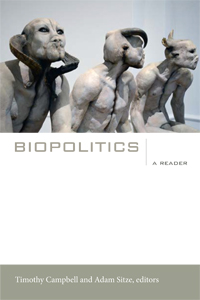
campbellTimothy Campbell, Adam Sitze (eds.), Biopolitics: A Reader, Duke University Press, 2013

Description
This anthology collects the texts that defined the concept of biopolitics, which has become so significant throughout the humanities and social sciences today. The far-reaching influence of the biopolitical—the relation of politics to life, or the state to the body—is not surprising given its centrality to matters such as healthcare, abortion, immigration, and the global distribution of essential medicines and medical technologies.

Michel Foucault gave new and unprecedented meaning to the term “biopolitics” in his 1976 essay “Right of Death and Power over Life.” In this anthology, that touchstone piece is followed by essays in which biopolitics is implicitly anticipated as a problem by Hannah Arendt and later altered, critiqued, deconstructed, and refined by major political and social theorists who explicitly engaged with Foucault’s ideas. By focusing on the concept of biopolitics, rather than applying it to specific events and phenomena, this Reader provides an enduring framework for assessing the central problematics of modern political thought.

Contributors. Giorgio Agamben, Hannah Arendt, Alain Badiou, Timothy Campbell, Gilles Deleuze, Roberto Esposito, Michel Foucault, Donna Haraway, Michael Hardt, Achille Mbembe, Warren Montag, Antonio Negri, Jacques Rancière, Adam Sitze, Peter Sloterdijk, Paolo Virno, Slavoj Žižek

Table of contents
Introduction. Biopolitics: An Encounter / Timothy Campbell and Adam Sitze 1
1. Right of Death and Power over Life / Michel Foucault 41
2. “Society Must Be Defended,” Lecture at the Collége de France, March 17, 1976 / Michel Foucault 61
3. The Perplexities of the Rights of Man / Hannah Arendt 82
4. Selections from The Human Condition / Hannah Arendt 98
5. Introduction to Homo Sacer: Sovereign Power and Bare Life / Giorgio Agamben 134
6. The Politicization of Life / Giorgio Agamben 145
7. Biopolitics and the Rights of Man / Giorgio Agamben 152
8. Necropolitics / Achille Mbembe 161
9. Necro-economics: Adam Smith and Death in the Life of the Universal / Warren Montag 193
10. Biopolitical Production / Michael Hardt and Antonio Negri 215
11. Biopolitics as Event / Michael Hardt and Antonio Negri 237
12. Labor, Action, Intellect / Paolo Virno 245
13. An Equivocal Concept: Biopolitics / Paolo Virno 269
14. The Biopolitics of Postmodern Bodies: Constitutions of Self in Immune System Discourse / Donna Haraway 274
15. The Immunological Transformation: On the Way to Thin-Walled “Societies” / Peter Sloterdijk 310
16. Biopolitics / Roberto Esposito 317
17. The Enigma of Biopolitics / Roberto Esposito 350
18. The Difficult Legacy of Michel Foucault / Jacques Rancière 386
19. From Politics to Biopolitics . . . and Back / Slavoj Zizek 391
20. What Is It to Live? / Alain Badiou 412
21. Immanence: A Life / Gilles Deleuze 421

With thanks to the Critical Theory blog for this item

Foucault and Education: retrospect and prospect

29 January 2014,
ICOSS, University of Sheffield

Conference website

Update September 2025. Conference site as it is archived on the Wayback Machine

Conference Program

10:00am REGISTRATION AND COFFEE
10:30am INTRODUCTION:
Ansgar Allen, University of Sheffield,
Carrie Paechter, Goldsmiths, University of London

10:45am KEYNOTE:
‘The Use and Abuse of Michel Foucault in Educational Studies’
Stephen Ball, Institute of Education, University of London

11:45am COFFEE

12:00am DISCUSSION PAPERS (2 parallel streams, 2 papers per stream, 35 min per paper)
CONFERENCE ROOM BOARDROOM GLASS ROOM

‘Not reform but resistance: Foucault, education and ontology’
Nick Peim, University of Birmingham

‘A genealogy of the struggle over school education in Chile: Allende’s last months’
Paula Mena, University of London

‘Biopower and Border Control: The Banning of the Hijab in French Schools’
Emily Berckley, University of Leeds,

‘Educational places: mobilising Foucault’s heterotopoanalysis for 21st century education’
Philip Tonner, University of Oxford

‘From a disciplinary school to a school of control: Foucault and education after Deleuze’
Samuel Matuszewski, University of Nottingham

‘Moving away from Bourdieu and reproduction: Foucault, resistance and gender in secondary school’
Ali Meghji, University of Cambridge

1:10pm LUNCH

2:00pm KEYNOTE:

‘Knowing Foucault, Knowing You’
Erica Burman, School of Education, University of Manchester

3:00pm COFFEE

3:15pm DISCUSSION PAPERS (3 parallel streams, 3 papers per stream, 35 min per paper)
CONFERENCE ROOM BOARDROOM GLASS ROOM

‘Post-Foucault, Posthuman: The case of dis/ability’
Dan Goodley, University of Sheffield

‘Foucault and the educational field: the French case as mirror’
Luca Paltrinieri, Collège Internationale de Philosophie, Paris

‘Disruptive technologies in higher education: innovation and the episteme’
Michael Flavin, King’s College London

‘Removing the ‘bias’ towards inclusion: the on-going relevance of disciplinarity in relation to the Coalition Government’s approach to Special Educational Needs’
Jane McKay, University of Chester

‘Substituting ‘Lemon and Milk’: The peculiar legacy of Foucault to the 21st century university’
Mujadad Zaman, University of Cambridge

‘Toward a New Concept of Education’
Iuliia Reshetnikova, Slovenian Academy of Sciences & Arts.

‘What does Foucault have to say about an individual with autism?’
Hui-Fen Wu, University of Sheffield

‘Foucault: relevant since 1784’
Peter Harrison, University of Sheffield

5:00pm PANEL DISCUSSION:
Stephen Ball, Erica Burman, Carrie Paechter, Ansgar Allen

5.30pm CONFERENCE CLOSES

5.45pm RETIRE TO THE RED DEER
(just round the corner at 18 Pitt St)

A note for presenters: Individual papers are allocated 35 minutes. We encourage presenters to leave time for discussion. Please could you let the chair of your session know in advance how much time you want to leave. We would be grateful if you would also act as chair for a presentation in your session.

Keynotes:

‘The Use and Abuse of Michel Foucault in Educational Studies’
Professor Stephen J Ball
Institute of Education, University of London
S.Ball@ioe.ac.uk

ABSTRACT
Michel Foucault is a stimulating, frustrating and elusive scholar. He systematically evaded the sort of categories and identities that we are used to using in the western academic tradition.
I don’t feel that it is necessary to know exactly what I am. The main interest in life and work is to become someone else that you were not in the beginning … My field is the history of thought. Man is a thinking being. (25 October 1982)
Indeed his work is defined by his attempts to find a position outside of the human sciences from which to see the social world and to see the human sciences themselves as a part of that social world – a space that is both liberating and perhaps impossible. His work is extensive, complex and often difficult and it is not of a piece, although he did make claims about the integrating principles of his work, which rest on the topics and questions that preoccupied him rather than the ideas he brought to bear. In 1983 Foucault described his work of the previous 20 years as having been ‘to create a history of the different modes by which, in our culture, human being are made subjects’ (Dreyfus and Rabinow 1983 p. 208). Prado (1995 p. 56) however, cautions that ‘Foucault’s efforts to present his work as more homogenous, coherent, and focused than it was should be judiciously assessed’. His work has a developmental trajectory in the sense of building, moving, changing overtime, with distinctive points of transition, although also some lines of thought were abandoned and dead ends reached. In part in this presentation I want to talk about the style of Foucault’s scholarship and about his anti-essentialism – no truth, no freedom, no subject – and about what happens if we take Foucault really seriously.
Educational studies has taken up Foucault’s work primarily in two respects – the work on power and discipline drawing on Discipline and Punish and The History of Sexuality Volume 1, and the work of governmentality, mainly drawn from secondary sources, in what is called the British school of governmentality studies – Rose, Burchell and others. Most of this latter originates in his 1978-79 College de France Lectures The Birth of Biopolitics. Peters and Besley (Peters and Besley 2007 p. 3) say ‘in the field of education scholars and theorists deform him … they abuse him in countless ways; they unmake and remake him; they twist and turn him and his words…’ or as Marshall (Marshall 1989 p. 98) puts it: ‘it is far from clear that the theoretical radicalness of the work has been grasped’. The earlier work on discourse and the later work on truth are much less often attended to, although many claim to use Foucauldian discourse analysis, and attempts at genealogical work are few and far between. I want to suggest some ways in which discourse, truth and genealogy may be of use to us.

Dreyfus, H. L. and P. Rabinow (1983). Michel Foucault: Beyond Structuralism and Hermeneutics. Chicago, University of Chicago Press.
Marshall, J. (1989). “Foucault and education.” Australian Journal of Education 2(1): 97-111.
Peters, M. and T. Besley, Eds. (2007). Why Foucault? New Directions in Educational Research. New York, Peter Lang.
Prado, C. G. (1995). Starting with Foucault: An Introduction to Genealogy. Boulder: Co, Westview Press.

BIOGRAPHY
Stephen J Ball is Karl Mannheim Professor of the Sociology of Education at the Institute of Education, University of London since 2001 (and previously taught at Sussex University 1975-1985 and King’s College London 1985-2001) and Editor of the Journal of Education Policy since 1985. His work is in ‘policy sociology’ and he has conducted a series of 12 ESRC funded studies which focus on issues of social class and policy and has received research funding also from Leverhulme, Joseph Rowntree, Education International, British Academy, Department for Health, Cancer Relief Macmillan and others.
Recent books include: Global Education Inc. (Routledge 2012); How Schools do Policy (with Meg Maguire and Annette Braun) (Routledge 2012); Networks, New Governance and Education (with Carolina Junemann) (Policy Press 2012), Foucault, Power and Education (Routledge 2012), The Education Debate (2nd Edition 2013). He is author of 19 books, mainly in the field of education policy analysis, and more than 150 journal articles. His work has been translated into nine languages. He has given numerous keynote and public lectures around the world (most recently the Vere Foster Lecture in Dublin), and has been interviewed on radio and television many times in relation to educational issues.
He has an honorary doctorate from Turku University, Finland, and the University of Leicester, and is visiting professor at the University of San Andres, Argentina. He was elected as an Academician of Social Science in 2000 and a Fellow of the British Academy in 2006, the first sociologist of education to be so recognised.

‘Knowing Foucault, Knowing You’
Professor Erica Burman
Manchester Institute of Education, University of Manchester
Erica.Burman@manchester.ac.uk

ABSTRACT
This paper evaluates the continuing contemporary relevance of Foucauldian analyses for critical educational and social research practice. Framed around examples drawn from everyday cultural and educational practices, I argue that current intensifications of psychologisation under neoliberal capitalism not only produce and constrain increasingly activated and responsibilised educational subjects but do so via engaging particular versions of feminisation and racialization. Like Hacking’s ‘looping effect’, Foucauldian ideas may themselves now figure within prevailing technologies of subjectivity but this means we need more, as well as more than, Foucault.