Foucault News

News and resources on French thinker Michel Foucault (1926-1984)

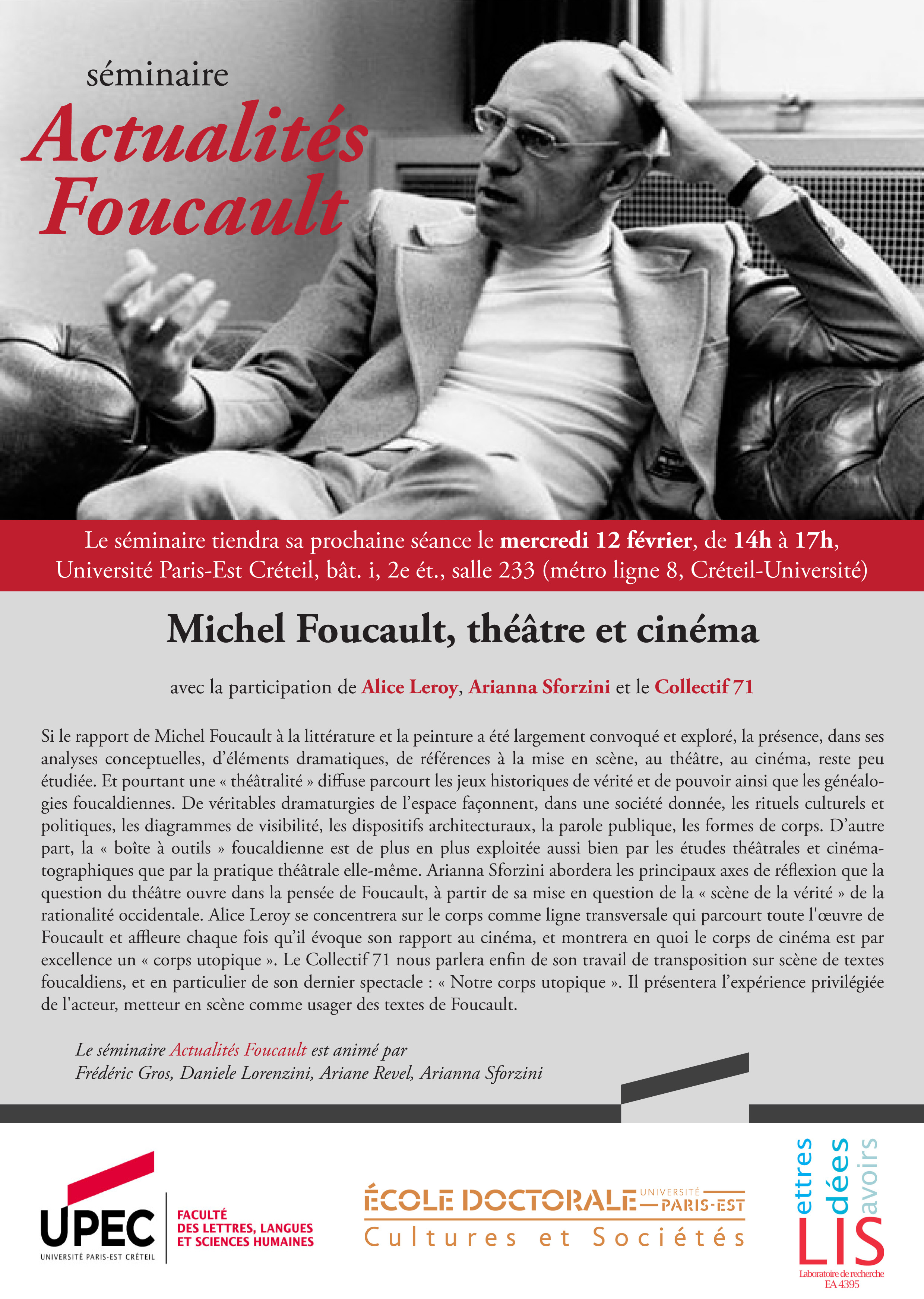
Séminaire Actualités Foucault s4

PDF flyer

Editor: Update June 2023. A reader has alerted me that this directory no longer exists. For a useful list of organizations relating to Women in Philosophy, see this University of Colarado library list

A new US based directory of women philosophers has been set up.

Below is a description and invitation to join circulated by one of the organisers.

This is a crowd-sourced database searchable by 1) name, 2) school, 3) faculty position, 4) areas of specialization, 5) primary research interests, and 6) geographical location. It currently contains over 650 names of women philosophers working on faculties of higher education across the world. As it stands, the listing is far from comprehensive, and we are relying on the goodwill of members of the profession to keep the database up-to-date and as comprehensive as possible.

Women with a Ph.D. in philosophy holding a faculty position (e.g., post-doc, adjunct, tenure-track, tenured, etc.) should check if they have an entry in the database and send any additions or corrections under the ‘Submit’ tab. Please use that tab to add yourself if you are not currently listed. We invite anyone to submit a name, including names of women in philosophy outside of the U.S.

The database should be an invaluable resource for conference organizers, editors, hiring committees, and anyone interested in learning more about the work of women in the profession.   Please spread the word!

Stephen Graham, Foucault’s Boomerang: the New Military Urbanism
OpenDemocracy, 14 February 2013.

According to Stephen Graham, a new set of ‘Foucauldian boomerang effects’ are shaping how states apply ‘tactics of control’ over everyday urban life. Today, he traces the emergence of what he calls a new military urbanism, which applies to cities both in the Global North and South.

On 4 February 1976, Michel Foucault, the eminent French social theorist, stepped gingerly down to the podium in a packed lecture at the Collège de France in the Latin Quarter on Paris’s South Bank. Delivering the fifth in a series of 11 lectures under the title ‘Il faut défendre la société’ (‘Society must be defended’), for once Foucault focused his attention on the relationships between western societies and those elsewhere in the world. Moving beyond his legendary re-theorisations of how knowledge, power, technology and geographical space were combined to underpin the development of modern social orders within western societies, Foucault made a rare foray into discussions of colonialism.

Rather than merely highlighting the history through which European powers had colonised the world, however, Foucault’s approach was more novel. Instead, he explored how the formation of the colonies had involved a series of political, social, legal and geographical experiments which were then actually often bought back to the West in what Foucault – drawing possibly on Hannah Arendt’s famous work on totalitarianism – called ‘boomerang effects’. ‘It should never be forgotten,’ Foucault said:

that while colonization, with its techniques and its political and juridical weapons, obviously transported European models to other continents, it also had a considerable boomerang effect on the mechanisms of power in the West, and on the apparatuses, institutions, and techniques of power. A whole series of colonial models was brought back to the West, and the result was that the West could practice something resembling colonization, or an internal colonialism, on itself

read more

Stephen Graham is Professor of Urban Technology at the School of Architecture, Planning and Landscape, Newcastle University

panoptic-prison

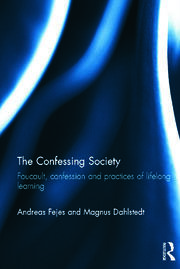
Andreas Fejes, Magnus Dahlstedt (2014) The confessing society: Foucault, confession and practices of lifelong learning. London: Routledge. Paperback version. Originally published in 2012

Publisher’s page
PDF flyer with 20% discount

“I highly appreciate the quality of Fejes’ and Dahlstedt’s research and writing. They manage to present in a comprehensible way some essential concepts of Foucault that help us to understand better what practices of lifelong learning, in a broad sense, are emerging nowadays in advanced liberal societies. In doing so, they contribute to the renewal of critical thinking in education. They convince me that such renewal is important and necessary… and I think both theoreticians and practitioners of lifelong learning will equally recognize and value this analysis, particularly also, because they present a good mix of theory and practice.” -Professor Danny Wildemeersch

Today, people are constantly encouraged to verbalise and disclose their “true” inner self to others, whether on TV shows, in newspapers, in family life or together with friends. Such encouragement to disclose the self has proliferated through discourses on lifelong learning through which each citizen is encouraged to become a constant learner. The Confessing Society takes a critical stance towards the modern relentless will to disclose the self and argues that society has become a confessing society. Drawing on Foucault’s later work on confession and governmentality, this bookcarefully analyses how confession operates within practices of lifelong learning as a way to shape activated and responsible citizens and provides examples of how it might be possible to traverse the confessional truth of the present time. Chapters include:

  • Reflection and Reflective Practices
  • Deliberation and Therapeutic Intervention
  • Lifelong Guidance
  • Medialised Parenting

This controversial book is international in its scope and pursues current debates regarding trans-national policy and to research discussions on education, lifelong learning and governance, and it will provoke lively debate amongst educational practitioners, academics, postgraduate and research students in education and lifelong learning in Europe, North America and Australasia.

Stephen Brookfield, Review of: The Confessing Society: Foucault, Confession and Practices of Lifelong Learning, Studies in the education of adults, 2013, 45(1), 105-107

In the terms in which it sets for itself – explicating a technology of confessional practices embedded in lifelong learning – the book is undoubtedly successful. Fejes and Dahlstedt deal with provocative and complex ideas and render them accessible, often by providing apposite examples. This is no mean feat. Foucault is opaque at times, maddeningly contradictory at others, and, as I know from asking students to read him, he can be intimidating. The Confessing Society is an excellent introduction to one major strand of Foucault’s thinking, and its practicality and clarity will be appreciated…Adult education students, and practitioners in the field, would benefit enormously from reading such a clear exposition of Foucault’s ideas, and I shall certainly be using it in my own postgraduate seminars.

Danny Wildemeersch, ‘Review’ International journal of lifelong education, 2014, forthcoming
The readers of this book review probably have by now noticed that I highly appreciate the quality of Fejes’ and Dahlstedt’s research and writing. They manage to present in a comprehensible way some essential concepts of Foucault that help us to understand better what practices of lifelong learning, in a broad sense, are emerging nowadays in advanced liberal societies. In doing so, they contribute to the renewal of critical thinking in education. They convince me that such renewal is important and necessary, since the older forms of critical thinking in the tradition of the Frankfurt school do no longer address well enough the transformations that have taken place in neo-liberal societies in the past decades….I think both theoreticians and practitioners of lifelong learning will equally recognize and value this analysis, particularly also, because they present a good mix of theory and practice.

Liselott Aarsand, ‘Review’ European Journal for Research on the Education and learning of Adults, Pre-published

I really enjoyed the book. It is definitely a timely contribution to the field of adult learning and education. First, the analysis of various lifelong learning practices through the lens of confession is compelling. Second, the use of different empirical material promoting multiple rather than uniform readings is inspiring. Third, the emerging picture of how learning has become a vital part of the various examined sites is valuable. Fourth, the finding of how several practices, spread from formal to informal, in fact seem to consolidate what appears to be a hegemonic, unquestionable truth is important…Indeed, the critical ambition is also addressed and hopefully encourages educators, counsellors and other professional groups to pursue further discussions on how to stage lifelong learning…I recommend it – not just for readers concerned with lifelong learning, but also anyone interested in critical analysis of adult everyday practices.

Philippe Sabot, Foucault et Merleau-Ponty : un dialogue impossible ? Les Études philosophiques, 2013/3 (n° 106), pp. 317-32

DOI : 10.3917/leph.133.0317.

Résumé
La relation de Foucault à Merleau-Ponty semble avant tout marquée par les critiques que le premier adresse au profil général de l’analyse phénoménologique dont le second peut apparaître au début des années soixante comme un représentant exemplaire. Nous montrons dans cet article que ces critiques concernent plus précisément la corrélation, établie « archéologiquement », entre les présupposés anthropologiques de la phénoménologie et le développement des sciences humaines. Il apparaît néanmoins qu’en contrepoint de ces critiques, une certaine équivocité définit de manière persistante la relation de Foucault à Merleau-Ponty, notamment en ce qui concerne certaines analyses qu’ils consacrent au statut du corps.

English
The relationship between Foucault and Merleau-Ponty seems to be characterized above all by the critics the first one addresses to the general profile of phenomenological analysis, the second one is considered in the early sixties as exemplary representative. In this paper, we aim to point out that these critics concern more precisely an “archeologically” established correlation between the anthropological presuppositions of Phenomenology and the development of Human sciences. However, despite those critics, the relationship between Foucault and Merleau-Ponty stays equivocal, especially in regards to some of their analysis of the body status.

PLAN DE L’ARTICLE

Merleau-Ponty et Canguilhem
L’empirique et le transcendantal
Le corps et mon corps

Critique de la participation et gouvernementalité, Participations N° 6, 2013/2, 228 pages
Special Issue

Further info

SOMMAIRE
Dossier : Critique de la participation et gouvernementalité
Page 5 à 33
Guillaume Gourgues et al. Gouvernementalité et participation Lectures critiques

Page 35 à 63
Pierre Sauvêtre La problématisation de la participation à travers l’histoire de la gouvernementalité

Page 65 à 86
Sandrine Rui « Où donc est le danger ? » Participation et usages de Foucault

Page 87 à 118
Luigi Pellizzoni Une idée sur le déclin ? Évaluer la nouvelle critique de la délibération publique

Page 119 à 139
Doris Buu-Sao « Perúpetro est ton ami » : un gouvernement des contestataires en Amazonie péruvienne

Page 141 à 165
Alicia Márquez Murrieta Quand participation rime avec institutionnalisation Société civile, santé reproductive et critiques féministes au Mexique

Page 167 à 189
John Clarke L’enrôlement des gens ordinaires L’évitement du politique au cœur des nouvelles stratégies gouvernementales ?

Jean-Claude Monod, La méditation cartésienne de Foucault, Les Études philosophiques, 2013/3 (n° 106), pp. 345-58

DOI : 10.3917/leph.133.0345.

Résumé

Foucault a souligné l’importance, pour la philosophie française du xxe siècle, des Méditations cartésiennes de Husserl, prononcées à la Sorbonne en 1929. Contrairement à Husserl, Foucault n’a pas réactivé le geste cartésien de l’auto-méditation et de la refondation du savoir philosophique sur des bases sûres. Mais il n’a cessé de revenir sur les Méditations métaphysiques de Descartes comme moment décisif pour l’apparition du sujet moderne – d’abord dans la fameuse lecture du « Mais quoi ! ce sont des fous » dans l’Histoire de la folie. Mais Foucault ne s’en est pas tenu à cette interprétation, discutée par Derrida, qui reliait la construction du sujet rationnel à l’exclusion des fous. On trouve dans L’Herméneutique du sujet une nouvelle approche des Méditations métaphysiques, cette fois démarquée de Heidegger, qui les restitue dans l’histoire des « techniques de soi » et situe la rupture décisive au plan même de la dissociation entre technique spirituelle, accès à la connaissance et transformation éthique de soi. Cet article suit ainsi « la méditation cartésienne de Foucault » en mettant en lumière le constant débat sous-jacent avec les lectures de Descartes produites par la phénoménologie et la déconstruction de la métaphysique.

English

Foucault has stressed the importance, in the French philosophy of the xxth century, of the Cartesian Meditations, lectures given by Husserl in the Sorbonne in 1929. Unlike Husserl, Foucault has not reactivated the cartesien attempt of a refunding of knowledge through a self-meditation. But he returned many times to Descartes’Metaphysical meditations, seen as a major shift in the history of the modern subject. First, with the famous reading of the “Mais quoi ! ce sont des fous” in History of madness. This interpretation, which tied the construction of the rational subject to the exclusion of the “mad” people, was discussed by Derrida, but it was not Foucault’s last word about Descartes. In The Hermeneutics of the Self, a new approach, both inspired by Heidegger and distinct from Heidegger’s view of modernity, situates the Metaphysical meditations in the history of the “technics of the self” and places the most important rupture at the level of the dissociation between spiritual technics, access to knowledge and ethical transformation of the self. This paper follows “Foucault’s cartesian meditation” and sheds light on the underlying debate with the readings of Descartes which were produced by phenomenology and deconstruction of metaphysics.

PLAN DE L’ARTICLE

Les Méditations de Descartes dans l’Histoire de la folie
Le sujet connaissant, les pratiques de soi et le tour cartésien de la phénoménologie
« Retournons la question » : dettes et écarts vis-à-vis Heidegger

Adam Davidson-Harden, What is social sciences and humanities research ‘Worth’? Neoliberalism and the framing of social sciences and humanities work in Canada (2013) Policy Futures in Education, 11 (4), pp. 375-386.
https://doi.org/10.2304/pfie.2013.11.4.387

Abstract
This article offers a critique of the discursive politics represented in attempts to frame social sciences and humanities work in the mould of neoliberal knowledge capitalism. The critique offered is inspired by Foucault’s critical thought on neoliberalism and an interpretation of ‘neoliberal governmentality’ that flows from his Collège de France lectures on ‘the birth of biopolitics’. As a launching point, a particular document is explored – a 2008 report from a private consulting firm called the Impact Group, commissioned by the Social Sciences and Humanities Research Council of Canada (the benefactor of the postdoctoral research fellowship from which this present inquiry emerges). The author explores here the significance of how a deeply economic-reductionist – or, in the author’s terms, neoliberal – way of looking at social sciences and humanities work can find utterance in a context of a hegemonic discourse of what the author (and others) terms ‘neoliberal knowledge capitalism’. As one particular – if dominant at present – ‘regime of truth’ in Foucault’s terms, this discourse represents well the imperatives of neoliberalism, which are construed here as imperialistic and colonising. From a neoliberal perspective, anything and everything in society ought to be perceived as a commodity, to be privatised, bought and sold, and considered solely within a framework of utility towards driving ‘economic growth’ in the most raw and disembedded sense of market relations, working over and above, and outside any category of critical comment or influence. This trend, in turn, is put under scrutiny here towards suggesting the necessary political task of interrupting this particular regime of truth and asserting others based on frames of reference and value not associated with a narrow, myopic neoliberalism, but rather with forms of knowledge socialism.

DOI: 10.2304/pfie.2013.11.4.375 (wrong doi)

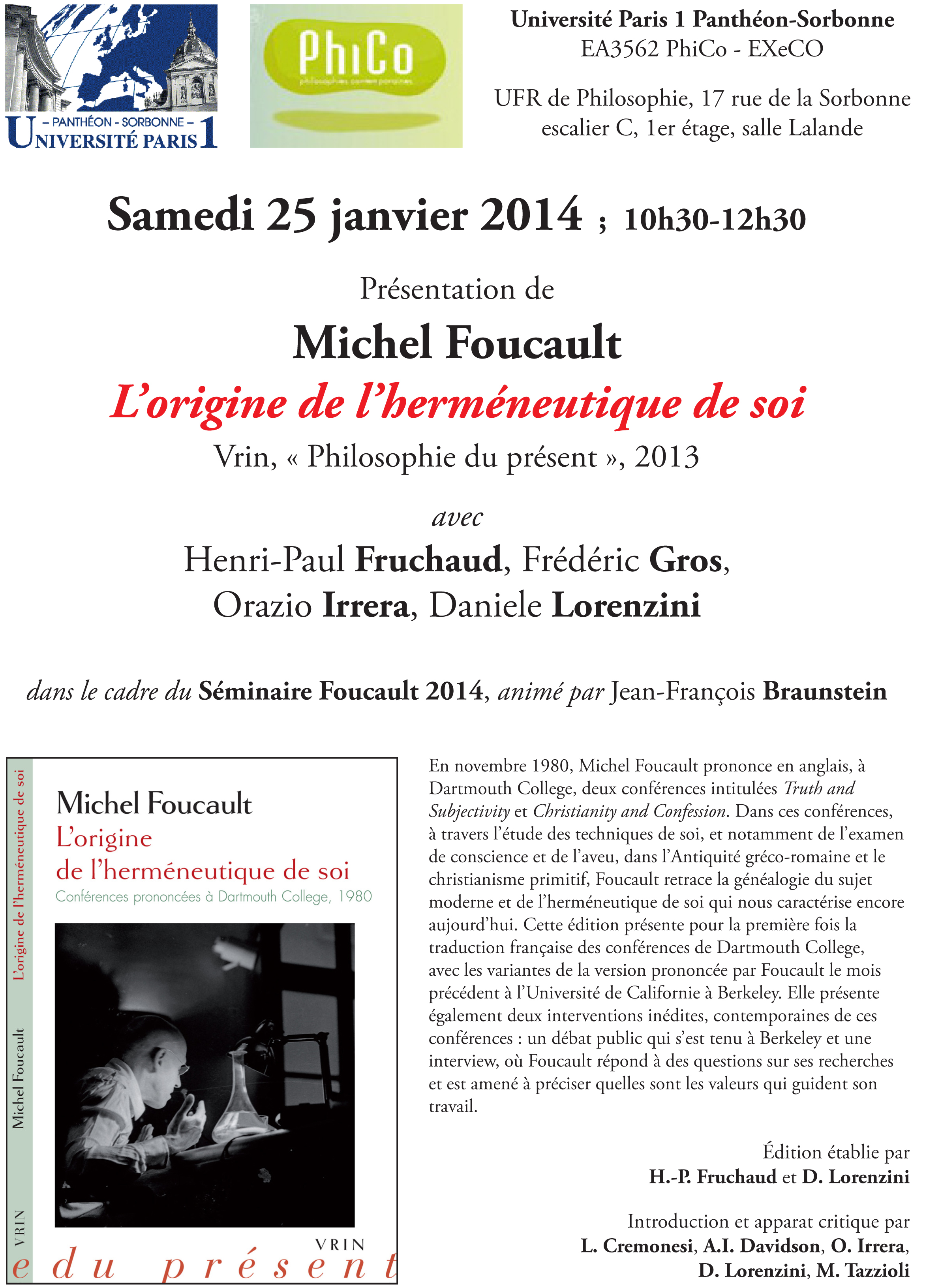
Pres 25 jan 2014

PDF of flyer

Erzsébet Strausz, Being in Discourse with Foucault:The Practice of Life, Theory & Event, Volume 16, Issue 4, 2013

Further info

Abstract
This article performs an experimental reading of Foucault’s selected writings as a creative intervention into the operation of “discourse” and our formation in it both as academic “knowers” and subjects of contemporary government. Drawing inspiration from Foucault’s intellectual project read as a series of responses to his diagnoses of “our historical present”, it seeks to develop a practice of writing and scholarly discussion that provides alternative vistas of engagement between writer, reader and text. Ultimately, the project sets out to re-politicize everyday practices of academic life, (in the hope of) enabling the emergence of new experiences of both discourse and self.

This article is part of a symposium titled: The Power of Life’s Excess: Contesting Sovereignty from Sites that do not exist
Editors: Andreja Zevnik, Erzsébet Strausz, and Simona Rentea