Foucault News

News and resources on French thinker Michel Foucault (1926-1984)

Cycle Foucault: psychiatrie et psychanalyse (II). Journée d’étude internationale (15 mars 2014)

31 janvier 2014

Université Paris 1 Panthéon-Sorbonne
Centre de philosophie contemporaine de la Sorbonne (PhiCo EA3562)

Further info

Organisation: Judith Revel et Pascale Gillot

Date et horaires: 15 mars 2014, 9h15-18h

Lieu: salle Lalande, UFR de philosophie – 17, rue de la Sorbonne, 75005 Paris, 1er étage, esc. C

Entrée libre dans la mesure des places disponibles

Matinée :

9h15 : Accueil des participants et présentation

9h30 : Jean Allouch, (Ecole lacanienne de psychanalyse), « Ce que Foucault apprend à l’analyse »

10h30 : Elisabetta Basso (Technische Universität Berlin, Institut für Philosophie), « L’archéologie foucaldienne de la folie entre psychiatrie et psychanalyse »

11h30 : Pause

11h45 : Mario Colucci (psychiatre au département de santé mentale de Trieste, psychanalyste, rédacteur de la revue de philosophie aut aut) : « Foucault et Basaglia : une critique de la psychiatrie est-elle encore possible ? »

Après-midi :

15h : Michel Tort (psychanalyste, ancien professeur à l’université Paris VII, Sciences humaines cliniques) « Michel Foucault chez les psychanalystes »

16h : Eric Fassin, (département de science politique et Centre d’études féminines et de genre, Université Paris 8 LabTop/CRESPPA) : « ’La science s’inclina convaincue.’ Pouvoir médical et agency dans les ‘Souvenirs’ d’Herculine/Abel Barbin ».

Contacts : Judith Revel (judith.revel@univ-paris1.fr), Pascale Gillot (gillot.pascale@wanadoo.fr)

With thanks to Alexandre Klein for this link

Stuart Elden (2014), Discipline, Punish, Examine and Produce: Foucault’s La société punitive, Review of La société punitive: Cours au Collège de France 1972-1973, by Michel Foucault, edited by Bernard E. Harcourt, Seuil/Gallimard: Paris.

Update September 2025. This review originally appeared on the now defunct Berfrois site and is now held on Stuart Elden’s Progressive Geographies site

Delivered between January and March 1973, La société punitive was Foucault’s third annual course at the Collège de France. It is the eleventh of his thirteen courses there to be published, in what have been uniformly excellent editions under the general editorship of François Ewald and the recently deceased Alessandro Fontana. This course has been edited by Bernard E. Harcourt, Julius Krieger Professor of Law and Political Science at the University of Chicago. Harcourt previously co-edited Foucault’s lectures at the University of Louvain from 1981, Mal faire, dire vrai with Fabienne Brion; a course soon to be published as Wrong-Doing, Truth-Telling.

read more

With thanks to Daniele Lorenzini for this link

Angèle Kremer Marietti, Repenser Foucault, Propos recueillis par Bencherki Benmeziane et publiés dans la revue de l’Université d’Oran At-Tadwin de décembre 2012, Dogma : Revue de Philosophie et de Sciences Humaines, octobre 2013

Full PDF

Editor’s note: Angèle Kremer Marietti’s 1974 book Michel Foucault et l’archéologie du savoir, was amongst the very first books to be published on Foucault’s work.

Que reste-t-il aujourd’hui de la pensée de Foucault ? Pensez-vous que les problématiques discutées dans l’œuvre de Foucault soient toujours d’actualité ?

Je vous remercie de me permettre d’évaluer l’héritage Foucault dans sa réception actuelle. Sans doute, la richesse de l’œuvre de Foucault explique que soient abordés, sous son égide, des thèmes tels que « gouvernement et société », « les maladies du pouvoir », ou « le rôle de la vérité dans la généalogie foucaldienne », qui sont traités actuellement dans le séminaire de mon ami le professeur Jean-François Braunstein à la Sorbonne. Mais il reste que l’actualité historique pourrait bénéficier d’une œuvre particulièrement exigeante comme l’est celle de Foucault. Tout comme l’essence du pouvoir, l’essence des forces sociales en action est à la fois permanente et tacite, relevant à la fois d’une microphysique autant que d’une globalité transparente. Nous ne devons pas oublier qu’immanent et variable, le pouvoir lié au savoir a été la cible de Michel Foucault.

Suite

With thanks to Alexandre Klein for this info.

Ali Meghji (2014), Moving away from Bourdieu and reproduction: Foucault, resistance and gender in secondary school, Paper for ‘Foucault and education: Retrospect and Prospect‘ conference (University of Sheffield).

Paper available on Academia.edu site

Abstract
The way in which I will be defending the utility of Foucault’s works for educational research is through the idea that Foucault’s analytics of power enables us to analyse resistance in schools. Many Foucauldians analyse how educational systems create particular subjectivities, however I wish to put Foucault on a spectrum with Bourdieu; with Bourdieu on the one side illuminating reproduction and focusing on the macro, and Foucault on the other side emphasising resistance and focusing on the micro in educational institutions. My example of resistance will be homosexuals and masculinity – how dominant masculine-gender norms are challenged in educational institutions. This will draw on a series of in-depth qualitative interviews demonstrating how particular homosexual individuals constructed their identities through resistance to hegemonic discourses and practices. This way of using Foucault also answers the Habermasian critique that Foucault never offers any examples of resistance in his ‘analytics’ of power.

I will thus strongly disagree with Marshall’s comment that ‘Foucault has little to offer to practising educators’.

will-to-know-book-jacketOrigins of Truth: Foucault’s Lectures on the Will to Know

February 21-22, 2014
Stony Brook Manhattan
387 Park Avenue South
New York, NY 10016

A conference presented by The Foucault Society and the Department of Philosophy at Stony Brook University

In celebration of the publication of Michel Foucault’s Lectures on the Will to Know: Lectures at the Collège de France, 1970-1971 (Palgrave Macmillan, 2013), we invite participants to a conference in New York City.

As the first of Foucault’s annual courses, Lectures on the Will to Know set an agenda for his intellectual journey of the 1970s and 1980s. Its publication in English translation opens up new directions for research into power, knowledge and the “formation of discourses.”

This conference gathers a group of established and emerging scholars to analyze Lectures on the Will to Know – its sources, themes and intellectual, historical or political contexts. What are the multiple ways that “truth” and “origins” are developed in Foucault’s work? How do philosophy and history intersect in this text? What is “will” in a Foucaultian context and how can we think of “the will to know” without reinstalling sovereign subjectivity? How do Foucault’s encounters here with Aristotle, the Sophists, Nietzsche, Deleuze – indeed, with the possibility of an origin of Western knowledge — complicate our understanding of his genealogical approach?

Keynote: Todd May, Clemson University: “Michel Foucault’s Will to Know”
Guest Speaker: Eduardo Mendieta, Stony Brook University

Paper Presentations:

Bernard Gendron, University of Wisconsin-Milwaukee:
“Foucault in 1971: Turbulence, Discontinuity, Uncertainty”

Verena Ehrlenbusch, University of Memphis:
“Foucault’s History of Sovereignty”

Neil Brophy, Villanova University:
“Will, Knowledge and Truth in Aristotle, Nietzsche and Foucault”

Johan Boberg, Uppsala University:
“Writing the History of Truth: Foucault & Heidegger”

Maxime Lallement, Manchester Metropolitan University:
“Justice, Judgment, Positivity and Discourse in Michel Foucault’s Lectures on the Will to Know“

Daniel Schultz, Yale Divinity School, and University of Chicago:
“The Will to Know: The Ethics of Genealogy”

Kerem Eksen, Istanbul Technical University:
“The ‘Event’ Called Philosophy: From the Lectures on the Will to Know to Hermeneutics of the Subject”

Abubakr Khan, State University of New York–Binghamton:
“To Will the Event: Nietzsche, Foucault & Deleuze”

Corey McCall, Elmira College:
“Foucault’s Faust and Saint Anthony”

Dean Casales, Kean University:
“A Third Way of Knowing: A Critique of Foucault’s ‘Oedipal Knowledge’”

Wai Kit Choi, California State University, Los Angeles:
“Theorizing Money and Modernity: Implications from Foucault’s Lectures on the Will to Know“

Peter Macapia, Pratt Institute:
“Distributions: Ceramics, Money, and Events”

tweetsDeleuze / Foucault: A Neoliberal Diagram, Mediatropes Vol 4, No 1 (2013)

Link to issue. Full PDFs available

Table of Contents

Editorial Introduction: Neoliberal Diagrammatics and Digital Control
Matthew Tiessen, Greg Elmer

IPO 2.0: The Panopticon Goes Public
Greg Elmer

Resilience versus Resistance: Affectively Modulating Contemporary Diagrams of Social Resilience, Social Sustainability, and Social Innovation
Petra Hroch

Monetary Mediations and the Overcoding of Potential: Nietzsche, Deleuze & Guattari and How the Affective Diagrammatics of Debt Have Gone Global
Matthew Tiessen

Info Nymphos
Erika Biddle

A New Individuation: Deleuze’s Simondon Connection
Andrew Iliadis

Special Semiotic Characters: What is an Obstacle-Sign?
Gary Genosko

Tweets Speak: Indefinite Discipline in the Age of Twitter
Steven James May

Philippe Theophanidis, Michel Foucault and “the problem of war”, 1981

From Philippe Theophanidis’ blog Aphelis

Therefore, if you like, I never stop getting into the issue of law and rights without taking it as a particular object. And if God grant me life, after madness, illness, crime, sexuality, the last thing I would like to study would be the problem of war and the institution of war in what one could call the military dimension of society. There again, I would have to cross into the problem of law, the rights of people and international law, etc… as well as the question of military justice: what makes a Nation entitled to ask someone to die for it.

☛ “What Our Present Is?” an interview with Michel Foucault by André Berten, tr. by Lysa Hochroth, Politics of Truth, ed. Sylvère Lotringer, New York: Semiotext(e), 1997, pp. 167-168. For more detail about the source of this interview, see below.

By the time he did this interview, Michel Foucault had already explored the problem of war in two of his lectures at the Collège de France. First in a discussion of civil war during the 1973 course La Société punitive. Second, in a more exhaustive analysis of the concept of war in his 1975-76 course Il faut défendre la société (translated as Society Must Be Defended, 2003).

In an entry he wrote for The Foucault Lexicon (forthcoming April 2014), John Protevi provides an excellent synthesis of Foucault’s views on war, especially in the 70s:

In Discipline and Punish (1975), Foucault uses “war” (or at least “battle”) as a “model” for understanding social relations. But this epistemological use of “war” did not last. In consulting the Collège de France lecture courses, we see him conduct a genealogy of the war model in “Society Must be Defended” (1975-76). As a result of this investigation, the use of “war” in History of Sexuality, volume 1 (1976) is no longer epistemological, but practical: “war” is seen as a “strategy” for integrating a differential field of power relations. Then, toward the end of the 1970s, perhaps in dismay at discovering in his genealogical investigation a deep relation of the war model and state racism, in Security, Territory, Population (1977-78) Foucault drops “war” to move to “governmentality” as the “grid of intelligibility” of social relations. (“War” in The Foucault Lexicon, ed. Leonard Lawlor and John Nale, Cambridge: Cambridge University Press, forthcoming 2014; PDF, cited with permission)

In the second volume Dits et écrits (Paris: Gallimard, 2001), war is hardly mentioned by Michel Foucault after 1976, especially has the main topic of his research. In 1977, when he mentions it in interviews, it is in relation to the problem of the meaning of “struggle” and “class struggle” (item 195, p. 206; item 206, p. 311; item 215, p. 391). In 1980, it is in relation with his dislike for polemics (item 281, p. 914), and in 1983 with his childhood and also in relation with pacifism (item 336, p. 1347; item 337, p. 1357). Finally, in 1984, he commented again on why he was not fond of polemics (item 342, p. 1410-1411). This brief list is based on the edition’s index, which I know not to be perfectly reliable (few are).

read more

moi_pierre_riviereUne exposition-dossier à l’université Lille 3 en mars 2014
«Michel Foucault: auteur, lecteur, archiviste »

Exposition du 11 au 27 mars 2014
Hall d’exposition de la Bibliothèque universitaire centrale de Lille 3
de 8h30 à 20h du lundi au jeudi
de 8h30 à 19h le vendredi
et de 9h à 12h le samedi
Y aller

Further info
Site à l’université Lille 3

Michel Foucault a été enseignant à la Faculté des lettres de Lille de 1952 à 1955. À l’occasion du soixantième anniversaire de sa venue à Lille, du trentième anniversaire de sa mort (1984) et dans le cadre des manifestations commémorant les 40 ans de l’ouverture du campus de Lille 3 à Villeneuve d’Ascq, une exposition est consacrée au philosophe, du 11 au 27 mars 2014. Présentée dans le hall de la Bibliothèque centrale, cette exposition-dossier privilégie le thème de Michel Foucault − « archéologue du savoir » − comme auteur, lecteur et archiviste.
[…]

L’exposition-dossier

Bénéficiant du soutien du Centre Michel Foucault ainsi que des riches collections documentaires de l’Université Lille 3, cette exposition doit donc permettre de retracer les grandes étapes de la trajectoire intellectuelle, personnelle et militante, de Michel Foucault à travers la présentation de ses ouvrages, mais aussi de manuscrits, de photographies, d’archives audio-visuelles.

L’exposition, organisée à partir de panneaux thématiques et de la présence de livres, de photographies, de vidéos et d’archives, abordera notamment les aspects suivants de la vie et du travail intellectuel de Michel Foucault :

  1. « Quelques fragments d’autobiographie » – Michel Foucault : une vie (1926-1984), une œuvre : Folie, crime, sexualité, soi
  2. Un penseur dans et avec son époque
  3. Foucault à Lille (1) : portrait du philosophe en psychologue
  4. Foucault à Lille (2) : de la critique de la psychologie à l’archéologie de l’anthropologie
  5. Qu’est-ce qu’un livre, qu’est-ce qu’un auteur ?
  6. Archives du savoir : le philosophe et l’histoire
  7. Archives de l’infamie : documenter des vies « négatives »
  8. Archives de luttes singulières : l’intellectuel spécifique dans l’actualité
  9. L’écriture et le souci de soi
  10. Dire-vrai

Partenaires de l’exposition

Réalisée sous le commissariat de Philippe Sabot, Professeur de philosophie à l’Université Lille 3 (Philosophie contemporaine et sciences humaines : éthique et société), spécialiste de Michel Foucault, l’exposition « Michel Foucault (1926-1984) : auteur, lecteur, archiviste » bénéficie de nombreux partenariats :

l’Université Lille 3, l’UFR Humanités de Lille 3, le Service commun de la documentation de Lille 3 (Bibliothèque universitaire centrale, Bibliothèque de philosophie, Bibliothèque des sciences de l’Antiquité), le Learning Center archéologie/égyptologie/SHS, l’Unité Mixte de Recherche 8163 « Savoirs, textes, langage » (CNRS, Lille 3, Lille 1), Action culture, l’Association Le Kino, le Conseil régional Nord-Pas de Calais, le Centre Michel Foucault.

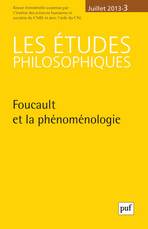
LEPH_133_L148 Foucault et la phénoménologie, Les Études philosophiques, n° 106, 2013/3, 152 pages. Special Issue

Further info

SOMMAIRE
Page 311 à 315
Jean-Claude Monod Présentation

Page 317 à 332
Philippe Sabot Foucault et Merleau-Ponty : un dialogue impossible ?

Page 333 à 344
Natalie Depraz De Husserl à Foucault : la restitution pratique de la phénoménologie

Page 345 à 358
Jean-Claude Monod La méditation cartésienne de Foucault

Page 359 à 368
Felix Heidenreich Une archéologie de l’« archéologie ». Sur une parenté rhétorique entre Husserl et Foucault

Page 369 à 371
Edmund Husserl Archéologie phénoménologique (1932)

Page 373 à 381
Guillaume Le Blanc Se moquer de la phénoménologie, est-ce encore faire de la phénoménologie ?

Sandrine Rui « Où donc est le danger ? » Participation et usages de Foucault, Participations 2013/2 (N° 6), pp. 65-86

DOI : 10.3917/parti.006.0065.

Résumé
Peu mobilisée pour penser la sphère publique, la pensée de Foucault fait cependant l’objet d’usages diversifiés. Cet article propose un aperçu de cette diversité qui tient tout autant aux bifurcations et aux contradictions de son œuvre, qu’aux lectures différenciées. Si Foucault est volontiers convoqué pour penser les effets de pouvoir et de police, il l’est moins pour saisir les effets de subjectivation politique, individuels et collectifs. L’article insiste sur tout l’intérêt des travaux qui, sans occulter les premiers, ont su tirer profit d’intuitions heureuses pour penser les seconds au motif que là où il y a pouvoir, il y a résistance.

Mots clés
Foucault, gouvernementalité, participation, espace public, pouvoir, résistance

English
« Where is the danger? »
While Foucault’s work is little mobilized for thinking of the public sphere, it entails to various uses. This article proposes an outline of this diversity which proceeds as much from the breaks, changing stances and contradictions of his thought that from the differentiated readings. If Foucault is usually used to think of the effects of power and police, his work is less used to seize the effects of subjectivation, individual as well as collective. The article insists on all the interest of some works that benefit from foucaultian intuitions to think of the second without ignoring the first. Because where there is power, there is resistance.

Keywords
Foucault, governmentality, participation, public space, power, resistance

PLAN DE L’ARTICLE

Participation et extension du domaine de la police
Gouvernementalité et nouvelle rationalité politique
Parler, au piège de l’ordre du discours
Des raisons d’oublier Foucault
Insaisissable critique sociale des projets et des dispositifs
Avec quel Foucault penser ?
Pour une analytique des résistances
Le philosophe de la démocratie agonistique ?
Sphère publique et affrontement des stratégies

Maître de conférences au département de sociologie de l’Université de Bordeaux Segalen et chercheur au Centre Émile-Durkheim, Sandrine Rui s’intéresse aux formes participatives et délibératives de la démocratie contemporaine. Elle a récemment publié : « Participation, périphérie et infrapolitique », in R. Cortesero (dir.), La banlieue change ! Inégalités, justice sociale et action publique dans les quartiers populaires, Lormont, Le Bord de l’Eau, 2012. Ses travaux portent aussi sur les discriminations. Elle a publié avec F. Dubet, O. Cousin et É. Macé, Pourquoi moi ? L’expérience des discriminations, Paris, Seuil, 2013. Et avec O. Cousin, L’intervention sociologique. Histoire(s) et actualité d’une méthode, Presses Universitaires de Rennes, collection Didact, Rennes, 2010.