Foucault News

News and resources on French thinker Michel Foucault (1926-1984)

Governing Academic Life
Conference at the London School of Economics and British Library
25 & 26th June 2014

Deadline for Abstracts: 31st March 2014

Website

Details

June 25, 2014 is the thirtieth anniversary of the death of Michel Foucault. Governing Academic Life marks this anniversary by providing an occasion for academics to reflect on our present situation through our reflections on Foucault’s legacy. The focus of the conference, therefore, will be on the form of governmentality that now constitutes our identities and regulates our practices as researchers and teachers. However the event will also create a space for encounters between governmentality scholars and critics of the neoliberal academy whose critiques have different intellectual roots – especially Frankfurt school critical theory, critical political economy, feminism, Bourdieuian analyses of habitus, capital and field, and autonomist Marxism.

Proposals for papers and panels are welcome until March 15, 2014. Please refer to the guidelines below.


Background and context:

The impetus for this event is the set of changes currently sweeping across UK higher education, which include cuts in direct public funding, new financing arrangements that are calculated to bring private equity into the sector and foster competition between providers, the likely emergence of new corporate structures for HEI’s which will open the sector to commercial providers, the separation of elite from mass higher education and the globalization of ‘trade’ in HE services; but also (and relatedly) the continuing development of instruments for rendering student-teacher interactions visible and comparable, and for calculating and governing the impact, influence and value of academic research.

Governmentality research is featuring strongly in the debates around some of this. Yet though largely ‘diagnostic’ in nature, it is increasingly being enlisted as groundwork for the radical critiques and alternatives offered by autonomist Marxist theorists of cognitive capitalism and immaterial labour. Meanwhile, critical theorists who idealise a public sphere of rational-critical debate (with ‘the idea of the university’ at its heart) are struggling to re-define what makes the university (a) public and to re-think the terms of its engagement with the wider economy and society in less radical ways – often without problematising the forms of (Foucaultian) government, or of complicity with capitalism’s logic of accumulation, that are necessarily involved with these reconstructions.  This conference aims to bring together leading contemporary scholars and activists who draw on one or more of these traditions for a series of mutually challenging discussions.

In general, the conference will be oriented by the concern to think critically about the conditions of possibility of the academy today – where ‘conditions of possibility’ could mean governmental assemblages of one kind or another, capitalist production relations, the forces defining how different capitals (economic, social, cultural, symbolic) register within the academic field, or quasi-transcendental presuppositions of communication. Participants will ideally aim to explore how we might think across these usually distinct ways of both conceiving what the university is and contesting what it has become.

Specific foci of debate may include:

The idea of the university: ruined or redeemable? Social criticism in the age of the normalized academic

Beyond public v. private? Dimensions of corporatisation

The role(s) of (contract, competition, corporate, financial, intellectual property) law in constructing the market university

The government of academic freedom: constituting competition as a way of life

Markets, measurement and managerialism: rankings and ratings, rights and royalties, accounting and audit, metrics … and alt.metrics?

Academic career-ism and casualization; discipline and de-professionalisation

The conditions for the persistence in the university sector of relations of domination organised in particular around gender and ethnicity

Critical political economy and varieties of communicative capitalism

Entrepreneurial universities and enterprising academic subjects: personal branding as ‘technology of the self’?

What is an author, now? The future of academic authorship and the academic book

The potentials and pitfalls of ‘openness’ and ‘commons-ism’ in scholarly communication

The ‘technicity’ of academic forms of life: the potentials and pathologies of living with/in digitised work environments

The student as consumer – or as producer?

The rise of para-academic ‘outstitutions’ beyond the university’s (pay)walls

Other strategies for resisting the neoliberal academy

Envisioning and enacting alternative futures for the university

Additional ideas for panels and themes are welcome.


Proposal submission procedure:

Proposals should be submitted as e-mail attachments to A.Barron@lse.ac.uk or M.S.Evans@lse.ac.uk, or in hard copy form by mail to one of the conference coordinators (addresses below). The deadline for receipt of proposals is March 15, 2014.

Proposals for papers must include the working title of the proposed paper (which should be suitable for presentation in 20 minutes) together with the author’s name, affiliation, full contact information (including address, phone, fax and email), and a brief (500 words maximum) abstract or outline. Submissions are welcome from graduate students as well as from more established scholars.

Proposals for panels (of up to 4 speakers) must include the information indicated above for all papers that are expected to be part of the panel, together with an overview of the panel theme (max 300 words) and an indication of each proposed panellist’s willingness to participate.

Timetable:  Proposals will be reviewed by the conference co-ordinators, and notice of acceptance will be given by April 15 2014.

 Registration: A registration fee of £100 will be payable to cover costs. A limited number of places will be available at a concessionary rate for graduate students, adjuncts and scholars without an institutional affiliation. Please indicate if you wish to be considered for one of these places when sending your proposal.

Conference coordinators:

Anne Barron
Associate Professor (Reader)

Law Department
London School of Economics and Political Science
Houghton Street
London WC2A 2AE
UKTel +44 20 7955 7267
email: A.Barron@lse.ac.uk
http://www.lse.ac.uk/collections/law/staff/anne-barron.htm

Mary Evans

Centennial Professor

Gender Institute

London School of Economics and Political Science
Houghton Street
London WC2A 2AE
UK

Tel.: +44 (0)207 107 5301
email: M.S.Evans@lse.ac.uk
http://www.lse.ac.uk/researchAndExpertise/Experts/profile.aspx?KeyValue=m.s.evans%40lse.ac.uk

http://www.governing-academic-life.org/


stuartelden's avatarProgressive Geographies

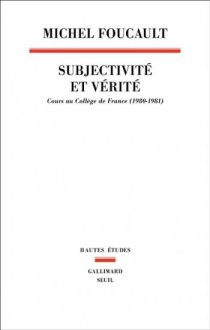
9782020862592Seuil now have a page up for Foucault’s 1980-81 lecture course Subjectivité et vérité, with a publication date of May 2014. Thanks to Chathan Vemuri for the link. No great surprises in the publicity text, except perhaps for the explicit link to Christianity, which makes sense given the content of the previous year’s course, Du gouvernement des vivants.

« L’hypothèse de travail est celle-ci : il est vrai que la sexualité comme expérience n’est évidemment pas indépendante des codes et du système des interdits, mais il faut rappeler aussitôt que ces codes sont étonnamment stables, continus, lents à se mouvoir. Il faut rappeler aussi que la façon dont ils sont observés ou transgressés semble elle aussi très stable et très répétitive. En revanche le point de mobilité historique, ce qui sans doute change le plus souvent, ce qui a été le plus fragile, ce sont les modalités de…

View original post 240 more words

John Iliopoulos, Foucault, Baudrillard and the History of Madness, International Journal of Baudrillard Studies, Volume 10, Number 2 (July 2013)

Extract
I. Introduction
Michel Foucault’s groundbreaking work altered our perception of psychiatry. Although generally labeled anti-psychiatric for its supposed narrative of exclusion of madness by the oppressive power of Enlightenment reason, its scope reaches far beyond the simple refutation of mental illness (Foucault, 1989: 418). It is a more radical cultural approach to the conditions of possibility of current psychiatric practice in the west. It is at once a historical, philosophical and anthropological endeavor which explores the foundations of psychiatric rationality and displays its epistemological, ethical and political limitations. Foucault’s historical analyses of madness havecreated a new type of critique which, instead of attacking the relations of domination inside the psychiatric institution or the objectivity of psychiatric discourse, they question the very conditions which shape our stable images of power relations and the universality of the medical model governing psychiatric practice.

In this paper I show how Baudrillard follows closely Foucault’s line of reasoning. He too carries out a cultural and anthropological study which repeats, revives and extends Foucault’s analyses of madness. Like Foucault, he performs a genealogy of western reason to illustrate the evolution of the prevalent rational schemas which have determined a specific relationship of western culture with its limits. Baudrillard’s sociological reflections are permeated by the social and cultural division between reason and madness, and, while less focused on the analysis of the psychiatric institution itself, they take up and deepen Foucault’s observations, exploring the fate of madness in contemporary societies of the west, contributing to critical psychiatry, which is not part of anti-psychiatry but a more radical type of critique of the psychiatric institution and its operation inside the wider context of today’s global rationality.

Read more

With thanks to Dirk Felleman for this link

Debates Actuales de la Teoría Política Contemporánea

El Objetivo de las jornadas es crear un espacio para un genuino debate en torno de problemas políticos reales realizando propuestas y contribuciones concretas. Buscamos desarrollar nuevas prácticas de análisis político a través de un ejercicio de pensamiento colectivo.

Seminario Deleuze-Foucault


7 encuentros semanales los días miércoles de 19 a 21:30 (22hs). A cargo de distintos expositores, que presentrán una propuesta durante una hora y realizaremos a continuación una discusión de una hora y media.
Buenos Aires, Argentina

Propuesta

Dentro del planteo general del programa de trabajo de Debates Actuales de la Teoría Política Contemporánea para el 2014, encontramos pertinentes las teorizaciones de Gilles Deleuze y Michel Foucault para abordar las problemáticas que consideramos cruciales para comprender nuestro presente.

Pensamos en estos dos autores como máquinas de guerra que nos permiten atravesar un territorio escarpado, habitado por problemas que hacen a la política, la vida, la soberanía, el control, el poder y las posibilidades de resistencia. Creemos necesario actualizar la mirada sobre el control y la disciplina en el siglo XXI con las nuevas tecnologías y dispositivos que han permitido, por un lado, crear y administrar la información y el conocimiento de formas singulares e inquietantes y, por otro, conformar nuevas subjetividades sujetas a dispositivos de saber-poder que establecen nuevos umbrales de normalidad.

Deleuze y Foucault pueden ser pensados -más allá de sus diferencias- como dos engranajes centrales que conforman este dispositivo teórico filosófico que, entre tantos otros campos, ha realizado una importante contribución al pensamiento político. La mirada que brindan para pensar la inmanencia y el acontecimiento funciona como un dispositivo que en sus múltiples lecturas, usos, adaptaciones y combinaciones, puede contribuir a conformar un saber que pueda brindar lo que llamamos “soberanías localizadas”.

Para poder conocer de manera más clara las obras de estos dos autores y las discusiones políticas que han abierto, invitamos en este seminario a seis expositores para actualizar y localizar este pensamiento. Nos proponemos valernos de sus aportes para pensar la política desde una perspectiva que pueda desafiar la mirada hegemónica de una “democracia global” y una gubernamentalidad neoliberal de las cuales pretendemos comprender las formas, los dispositivos, las tecnologías. Nos interesa abordar cómo y qué nuevos saberes han hecho proliferar estas tecnologías y dispositivos que en su promesa de favorecer una sociedad más democrática amenazan con controlar, ya no a los cuerpos confinados, sino sus vidas ordinarias, en el lugar o momento que se encuentren, conociendo información personal, contactos, conexiones, espacios, estratos, clase o ámbito de pertenencia.

En ese marco, invitamos a reflexionar tanto sobre las teorías de estos dos pensadores como los problemas políticos que nos permiten abordar y reconocer nuestras situaciones localizadas. Para ello, esperamos que las exposiciones de los distintos presentadores nos brinden una mirada amplia y compleja sobre estos pensamientos y sobre sus modos de operar en el campo de lo político. Cada propuesta particular encuentra su punto de conexión en la unidad del seminario, que busca abordar la dimensión de lo político o la política en Deleuze y Foucault. En ese sentido, más que introducciones biográficas, y ordenamientos y comparaciones cronológicas, buscamos lecturas singulares de estos autores que nos permitan pensar desde nuestro tiempo, nuestros espacios, nuestros problemas, formas de resistir o establecer fugas de las formas de control y disciplina que vemos derramarse por todo el espacio social

La propuesta de una lectura actual, diversa, amplia y por sobre todo localizada deDeleuze y Foucault, busca permitirnos descubrir a estos pensadores por primera vez o poder redescubrirlos de forma original, revelándonos algo nuevo y revitalizador que nos afecte para hacer proliferar éste pensamiento rizomático.

Redactado por: Matias Saidel y Ricardo Esteves. Corregido por Diego Demichelis. Para Debates Actuales de la Teoría Política Contemporánea

Fechas de la Actividad, Miercoles: 19 de Marzo – Primer Encuentro, 26 de Marzo – Segundo Encuentro, 9 de Abril – Tercer Encuentro, 16 de Abril – Cuarto Encuentro, 23 de Abril – Quinto Encuentro, 30 de Abril – Sexto Encuentro, 7 de Mayo – Séptimo Encuentro

Un cycle de conférences permettra de revenir sur le travail intellectuel de Foucault comme auteur, lecteur, archiviste.

“Michel Foucault, auteur, lecteur, archiviste. Dialogue avec Daniel Defert”, avec la participation de Philippe Sabot.

  • Le 12 mars 2014 à 17h (Salle de travail libre – Bibliothèque centrale de Lille 3)

Daniel Defert, philosophe et sociologue, président-fondateur de AIDES (1984-1991), a été le compagnon de Michel Foucault pendant plus de vingt ans. Co-éditeur des Dits et écrits de Michel Foucault (Gallimard, “Bibliothèque des sciences humaines”, 1984), il a également édité le premier cours de Foucault au Collège de France, Leçons sur la volonté de savoir (Gallimard – Le Seuil, “Hautes études”, 2011). Il participe à l’édition des Œuvres complètes de Michel Foucault dans la Bibliothèque de la Pléiade (2015).

“Foucault et les sciences humaines et sociales : entre dialogue et incompréhension” : conférence par Jean-François Bert.

  • Le 17 mars 2014 à 17h (Salle de travail libre – Bibliothèque centrale de Lille 3)

Jean-François Bert est maître d’enseignement et de recherche en sociologie à l’Université de Lausanne. Il a publié récemment Introduction à Michel Foucault (La Découverte, 2011) ; il a co-dirigé (avec P. Artières, J. Revel et F. Gros) le numéro des Cahiers de l’Herne consacré à Foucault (2011) ; il a édité, avec P. Artières, P. Chevallier et F. Gros un ouvrage collectif consacré à Histoire de la folie, 50 ans de réception (Presses Universitaires de Caen, 2011). Il participe à l’édition des Oeuvres complètes de Michel Foucault dans la Bibliothèque de la Pléiade (2015).

“Au sujet du pouvoir : réflexions sur l’assujettissement et la résistance” : conférence par Didier Eribon.

  • Le 20 mars 2014 à 17h (Salle de travail libre – Bibliothèque centrale de Lille 3)

Didier Eribon est Professeur à l’Université d’Amiens. Ses travaux concernent la philosophie, la sociologie, l’histoire des idées, la littérature, les études de genre. Auteur d’une biographie importante de Michel Foucault (Flammarion, 1989). il a également publié un ouvrage sur Michel Foucault et ses contemporains (Fayard, 1994) et dirigé ou co-dirigé deux volumes collectifs consacrés à Michel Foucault : L’Infréquentable Michel Foucault. Renouveaux de la pensée critique (EPEL, 2001) et, avec Roger Chartier, Foucault aujourd’hui. Actes des neuvièmes rencontres INA-Sorbonne (L’Harmattan, 2006). Il est également l’auteur de Réflexions sur la question gay (Fayard, 1999) et de La société comme verdict. Classes, identités, trajectoires (Fayard, 2013).

Pierre Rivière: le nom d’une dispute sans fin” : conférence par Alain Brossat.

  • Le 26 mars 2014 à 16h30 (Salle de travail libre – Bibliothèque centrale de Lille 3)

Alain Brossat est Professeur émérite de philosophie de l’université Paris 8. Spécialiste de philosophie politique, également journaliste et traducteur, son travail porte sur la généalogie des violences politiques modernes et contemporaines. Il a publié notamment Pour en finir avec la prison (La Fabrique, 2001), Le Serviteur et son maître. Essai sur le plébéien (Leo Scheer, 2003) et plus récemment Autochtone imaginaire, étranger imaginé (Le Souffle, 2012) et Le Plébéien enragé. Une contre-histoire de la modernité de Rousseau à Losey (Ed. Le Passager clandestin, 2013). Il a également co-dirigé avec Philippe Roy Tombeau pour Pierre Rivière (L’Harmattan, 2013).

Contacts :

christophe.hugot@univ-lille3.fr

aurore.larchier@univ-lille3.fr

Thomas Lemke, Biopolitics and Beyond: Vibrant Matter and the Political Economy of Life

Published on Jul 1, 2013

CELAB presents a public lecture by Professor Thomas Lemke, Goethe University, Frankfurt/Main in Germany.

With opening remarks by Professor Judit Sandor, Director of CELAB.

With thanks to Dirk Felleman for this link

oulchen Hervé Oulc’hen (dir.), Usages de Foucault, Paris, PUF, coll. « Pratiques théoriques », 2014, 406 p., avant-propos de Guillaume le Blanc, ISBN : 978-2-13-062110-2.

Further info
Compte rendu de Alexandre Klein

Sommaire
L’oeuvre de Foucault est toute entière traversée par la question théorique et pratique des usages. Question de méthode, d’abord : Foucault fait usage de l’archive à des fins de mise en intelligibilité du présent. Question thématique, ensuite : Foucault s’interroge sur la manière dont les individus font usage des normes qui les régissent dans un contexte historique donné. Question critique, enfin : le primat alloué à l’usage définit l’intellectuel non plus comme le détenteur d’un savoir réservé en position régalienne, mais comme un usager et un utilisateur des savoirs.

Lire Foucault aujourd’hui suppose de se saisir à nouveaux frais de ces dimensions multiples du motif de l’usage, ce qui implique de conjuguer la rigueur du commentateur et la liberté de l’utilisateur. Les contributions réunies dans le présent ouvrage donnent une vue d’ensemble des différents usages qu’il est possible de faire de Foucault aujourd’hui : tantôt en creusant des problèmes qu’il nous a légués et qui sont encore les nôtres (l’articulation du mental et du carcéral, la gouvernementalité, les régimes de vérité, la biopolitique), tantôt en mettant ses thèses à l’épreuve d’autres terrains, explorés notamment par les sciences sociales.

Avec les contributions de Philippe Artières, Thomas Benatouïl, Karine Bocquet, François Dubet, Emmanuel Gripay, Bruno Karsenti, Frédéric Keck, Hélène L’Heuillet, Didier Lapeyronnie, Christian Laval, Guillaume Le Blanc, Éric Macé, Todd Meyers, Maria Muhle, Hervé Oulc’hen, Luca Paltrinieri, Mathieu Potte-Bonneville, Sandrine Rui, Philippe Sabot, Michel Senellart, Shigeru Taga, Ferhat Taylan et Jean Terrel.

Hervé Oulc’hen (dir.) est agrégé de philosophie et enseigne en lycée. Actuellement doctorant et membre de l’équipe SPH à l’université de Bordeaux 3, il prépare une thèse intitulée “L’intelligibilité de la pratique : Entre Foucault et Sartre”. Il a publié plusieurs articles consacrés à Foucault, Sartre et Bourdieu.

Gouvernementalité et biopolitique : les historiens et Michel Foucault
Revue d’histoire moderne et contemporaine, 2013/4-5 (n° 60-4/4 bis). 208 pages.

Further info

Sommaire
Foucault historien ?

Michael C. Behrent
Penser le XXe siècle avec Michel Foucault

Paolo Napoli
Foucault et l’histoire des normativités

Luca Paltrinieri
Biopouvoir, les sources historiennes d’une fiction politique

Des outils pour l’histoire

Sezin Topçu
Technosciences, pouvoirs et résistances : une approche par la gouvernementalité

Luc Berlivet
Les ressorts de la « biopolitique » : « dispositifs de sécurité » et processus de « subjectivation » au prisme de l’histoire de la santé

Jean-Baptiste Fressoz
Biopouvoir et désinhibitions modernes : la fabrication du consentement technologique au tournant des XVIIIe et XIXe siècles

Parcours foucaldiens en histoire

Vincent Denis
L’histoire de la police après Foucault. Un parcours historien

Philippe Artières
Un historien foucaldien ?

binkleySam Binkley, Happiness as Enterprise: An Essay on Neoliberal Life, SUNY Press, 2014.

Publisher’s page

Summary
Examines the contemporary discourse on happiness through the lens of governmentality theory.

Recent decades have seen an explosion of interest in the phenomenon of happiness, as evidenced by self-help books, talk shows, spiritual mentoring, business management, and relationship counseling. At the center of this development is the expanding influence of “positive psychology,” which places the concern with happiness in a new position of professional respectability, while opening it to institutional applications. In settings as diverse as college education, business, military training, family, and financial planning, happiness has appeared as the object of a new technology of emotional self-optimization. As such, happiness has come to define a new mentality of self-government—or a “governmentality” as the concept is developed in the work of Michel Foucault—one that Sam Binkley demonstrates is aligned closely with economic neoliberalism. Happiness as Enterprise blends theoretical argumentation and empirical description in an engaging and accessible analysis that brings governmentality theory into contact with sociological theories of practice and temporality, particularly in the work of Pierre Bourdieu. This book invites readers not only to consider the new discourse on happiness for its relation to contemporary formations of power, but to rethink many of the assumptions of governmentality theory in a manner sensitive to the mundane practices and everyday agencies of government, and the unique and specific temporalities these practices imply.

Sam Binkley is Associate Professor of Sociology at Emerson College. He is the author of Getting Loose: Lifestyle Consumption in the 1970s and the coeditor (with Jorge Capetillo-Ponce) of A Foucault for the 21st Century: Governmentality, Biopolitics, and Discipline in the New Millennium.

Foucault-white

Edmund White, Edmund White recalls a night at the opera with Michel Foucault in 1981, The Telegraph, 28 Feb 2014

Author Edmund White looks back at his friendship with the late Michel Foucault

By the time this photo was taken in Paris in 1981 I knew Foucault fairly well. In the late Seventies I had been director of the New York Institute – a think tank involved with the university – where Foucault had lectured. I had taken him out for dinner while he was there, which was a pretty terrifying prospect. Although I had a grand title, I was really just making the coffee. But he was very friendly. He didn’t like to talk about his ideas unless he was in seminars; he talked about everyday life as anyone else would.

He was attracted to tough guys and liked young and effeminate gay boys as friends. I was neither young nor especially effeminate but somehow he liked me. I remember on this occasion in Paris he was very gracious. That evening he took me to the opera – something by Rameau, I think, and a very modern production with a lot of rubber on stage. It was a pretty big deal for him to take me. Sitting in the orchestra at the Paris opera house was terribly expensive. I do recall I made rather a faux pas: during the intermission I ordered a white wine, and Foucault told me you could order a white wine anytime in France except at the Paris opera bar. It wasn’t the done thing.

read more