Foucault News

News and resources on French thinker Michel Foucault (1926-1984)

Murray, S.J.
Allegories of the Bioethical: Reading J.M. Coetzee’s Diary of a Bad Year
(2014) Journal of Medical Humanities, February 2014

Abstract
This essay reads J.M. Coetzee’s novel, Diary of a Bad Year, as an occasion to problematize contemporary bioethical (and neoliberal) paradigms. Coetzee’s rhetorical strategies are analyzed to better understand the “scene of address” within which ethical claims can be voiced. Drawing on Foucault’s Socratic understanding of ethics as the self’s relation to itself, self-relation is explored through the rhetorical figure of catachresis. The essay ultimately argues that the ethical voice emerges when the terms-terms by which I relate to myself, to others, to my own body, and to the bodies of others-are themselves subject to catachrestic refiguration. © 2014 Springer Science+Business Media New York.

Author Keywords

Bioethics; Catachresis; J.M. Coetzee; Michel Foucault; Rhetoric

DOI: 10.1007/s10912-014-9273-9

One of those ubiquitous internet quizzes that circulate. This one’s on BuzzFeed: Which philosopher are you?, Buzzfeed, 1 March 2014

To tell the truth, I was surprised that I actually got Michel Foucault in response to the somewhat left field questions  – but years of exposure to his work is bound to rub off somehow!

Update September 2025. The images on the original page are no longer live but are archived on the Wayback machine. Linked to above.

Bowden, G.
Disorders of inattention and hyperactivity: The production of responsible subjects
(2014) History of the Human Sciences, 27 (1), pp. 88-107.

Abstract
This article explores some of the normative commitments which persist in the literature on behavioural interventions for disorders of inattention and hyperactivity. These programmatic texts grapple with a contradiction: on one hand, they posit individuals who cannot be held responsible for their behaviour on the grounds that it is pathological, rather than wilful; on the other hand, these texts are written for individuals diagnosed with these disorders and for related authorities, obliged to mitigate said behaviour on the grounds that it is disvalued and impairing. Facing the practical problem of alleviating impairing and disruptive behaviours, this literature has also consistently expressed a goal of producing individuals who demonstrate self-control. Self-control, in this context, however, is not simply the manifestation of wilful autonomy over one’s body, but the capacity to be ascribed responsibility for one’s actions. In the move from bodily control to self-control, institutions responsible for treating those diagnosed with these disorders produce what Foucault has called a ‘political economy of illegality’, where the management of disvalued behaviour is not the eradication of said behaviour, but a redistribution of the right to reward and punish based on the individualization of action.

Author Keywords
ADHD; disorder; Michel Foucault; responsibility; social control

DOI: 10.1177/0952695113503325

Séminaire Actualités Foucault s6PDF of flyer

Maier, H.O.
Soja’s thirdspace, Foucault’s heterotopia and de Certeau’s practice: Time-space and social geography in emergent Christianity
(2013) Historical Social Research, 38 (3), pp. 76-92.

Further info

Abstract
This essay uses analytical tools developed by Edward Soja, Michel Foucault, and Michel de Certeau to investigate time-space configurations in the religious movements inaugurated by Jesus and promoted by Paul. The article begins with an account of the domination of time as a conceptual tool for analyzing both figures and their teachings to establish the context for an alternative space-time reading of the data represented in the New Testament and extra-canonical sources. Jesus’ proclamation of the Kingdom of God is placed in the context of the monetization and hence disruption of traditional kinship and social structures. His parables, sayings, and the traditions associated with him represent thirdspace performances of his rural world. His proclamation of the Kingdom of God coheres with Foucault’s notion of heterotopia in that it places listeners in places outside of place. His articulation of behaviours coincides with de Certeau’s notion of tactics inserted within dominant social strategies. Through a reading of Paul’s message against the backdrop of urban poverty Paul’s motif of the church as body is seen as a thirdspace articulation of social groups, heterotopic place outside of place, and communal solidarity within the urban context of the Roman Empire.

Author Keywords
Galilee; Household; Jesus; Monetization; Paul; Roman city; Space-time

Didier Mineur, Après Foucault. La philosophie politique en France depuis les années 1980, Cités, 2013/4 (n° 56), Pages 51 – 76

DOI: 10.3917/cite.056.0051

Premières lignes
Il pourrait sembler paradoxal de faire de l’œuvre de Michel Foucault une borne dans l’histoire de la philosophie politique en France, et le point de fuite à partir duquel se lisent les différentes perspectives contemporaines, puisque Foucault, on le sait, récusait pour lui-même, à l’instar d’Hannah Arendt, le titre de philosophe. Pourtant, de son propre aveu, c’est bien de philosophie qu’il s’occupait….

Plan de l’article

Retour sur Foucault
La réévaluation de la démocratie depuis les années 1980
Aujourd’hui : revitaliser la démocratie
Demain : les enjeux à penser

Raby, R.
Children’s participation as neo-liberal governance?
(2014) Discourse, 35 (1), pp. 77-89.

Abstract
Children’s participation initiatives have been increasingly introduced within various institutional jurisdictions around the world, partly in response to Article 12 of the United Nations Convention on the Rights of the Child. Such initiatives have been critically evaluated from a number of different angles. This article engages with an avenue of critique which argues that children’s participatory initiatives resonate with a neoliberal economic and political context that prioritises middle class, western individualism and ultimately fosters children’s deeper subjugation through self-governance. Respecting these as legitimate concerns, this article draws on two counter-positions to argue that while children’s participation can certainly be conceptualised and practised in ways that reflect neo-liberal, individualised self-governance, it does not necessarily do so. To make this argument I engage, on the one hand, with Foucault’s work on the care of the self, and on the other, with more collective approaches to participation. © 2012 Taylor & Francis.

Author Keywords
childhood; governmentality; individualism; neo-liberalism; participation; school

DOI: 10.1080/01596306.2012.739468

barbinMichel Foucault, Herculine Barbin dite Alexina B.

Première parution en 1978

Postface d’Éric Fassin

Nouvelle édition suivie d’Un scandale au couvent d’Oscar Panizza en 2014, Gallimard, 2014

En 1868 à Paris, rue de l’École-de-Médecine, un homme se donne la mort en laissant à la postérité un manuscrit autobiographique. C’est l’«Histoire d’Alexina B.» que publiera en 1874 un grand notable de la médecine légale, Ambroise Tardieu. Pour celui-ci, il s’agit des «souvenirs et impressions d’un individu dont le sexe avait été méconnu», bref, d’un «pseudo-hermaphrodite». En 1860, à plus de vingt et un ans, Herculine Adélaïde Barbin, surnommée Alexina, devenait Abel en changeant de sexe à l’état civil. Sa plume passionnée raconte les tourments et les émois de la jeune fille, et s’achève sur l’amer désespoir de l’homme.

En 1978, Michel Foucault publie ce document remarquable, assorti d’un dossier historique, pour inaugurer une collection éphémère : «Les vies parallèles». À l’assignation médicale, depuis le XIXe siècle, d’un «vrai sexe», le philosophe de l’Histoire de la sexualité répond, dans la préface qu’il donne à la traduction américaine en 1980, en invoquant les «délices» d’une vie «sans sexe certain».

Pour la première fois sont inclus dans l’édition française d’Herculine Barbin dite Alexina B., épuisée depuis des années, ce texte important de Foucault ainsi que la nouvelle «Un scandale au couvent» du médecin allemand Oscar Panizza, qui en proposait une version romancée au tournant du XXe siècle. La postface d’Éric Fassin souligne enfin combien le développement des gender studies mais aussi celui du mouvement «intersexe» engagent aujourd’hui à relire ce récit remarquable où Herculine/Abel s’invente un «vrai genre».

Power in a World of Becoming, Entanglement & Attachment

Conference website

‘In every era the attempt must be made anew to rescue tradition from a conformism that is about to overpower it’ (Walter Benjamin) 

June 2-3, 2014. University of Warwick 

Confirmed Speakers:

  • ·         William Connolly (Johns Hopkins)
  • ·         Christian Borch (CBS, Copehagen)
  • ·         Costas Douzinas (Birkbeck)
  • ·         Amade M’charek (Amsterdam)
  • ·         Luciana Parisi (Goldsmiths)
  • ·         AbdouMaliq Simone (Goldsmiths)

Conference Organisers:

Claire Blencowe & Illan rua Wall – Authority & Political Technologies (APT) Warwick

Suggested Themes:

  • ·         Biopolitics and Political Spirituality/Religion
  • ·         Materialism and the Political Meaning of Entanglement
  • ·         Authority, Sovereignty and Becoming in the (Post) Colony
  • ·         Process and New Forms of Society(ism), Association and Being in Common
  • ·         Necropolitics and Human Rights

Recently, there have been various calls for a move beyond ‘post-structuralism’ (i.e. Foucault, Deleuze, cultural/critical theory), which had long been seen as the radical edge of the critical social sciences. Such calls are motivated in part by the sense that post-structuralist philosophies – which were forged against a backdrop of totalitarian rule and burgeoning welfare states in Europe – fail to offer moral or political purchase in the contemporary governmental landscape. Moreover, there is a sense that various concepts and theories have become reified and constraining – closing down the possibilities of critical thought. However, the issues that post-structuralist theory placed on the critical social science agenda have become more vital than ever – be that the concern for the complex and dispersed nature of power and agency; the imbrication of power and economics with knowledge and science; rethinking the relation between equality and difference; the political/contested/changing nature of embodiment, biology and ecology; or the efforts of states and others to establish and exercise power over life itself. We maintain that now is the time, not to reject post-structuralist perspectives, but to reinvigorate and transform those traditions through empirical and political work that is creatively engaged with current problems. The Authority & Political Technologies group at Warwick will host a series of annual events that bring together world leading, emerging and postgraduate scholars from across the social sciences whose work promises to renew post-structuralist critical thought through empirical scholarship. This year we invite papers on the theme ‘Power in a World of Becoming, Entanglement & Attachment’. Topics may include, but are not limited to, the suggested themes above.

Deadline for abstract submission March 10th 2014.

For further information and updates see the conference website http://www2.warwick.ac.uk/fac/soc/sociology/rsw/authorityandpoliticaltechnologies/apt2014/

APT Warwick:

Claire Blencowe; Miguel Beistegui; Will Davies; Stuart Elden; Nick Gane; Olga Goriunova; Amy Hinterberger; Hannah Jones; Cath Lambert; Nick Lee; Celia Lury; Alice Mah; Goldie Osuri; Maria Do Mar Pereira; Lynne Pettinger; Shirin Rai; John Solomos; Vicky Squire; Nathanial Tkacz; Emma Uprichard; Nick Vaughan-Williams; Illan rua Wall; Chiara Livia Bernardi; Sam Burgum; Rogan Collins; Esteban Damiani; Kathryn Medien; Marijn Nieuwenhuis; Hidefumi Nishiyama; Maurice Stierl; Lauren Tooker; Lorenzo Vianelli

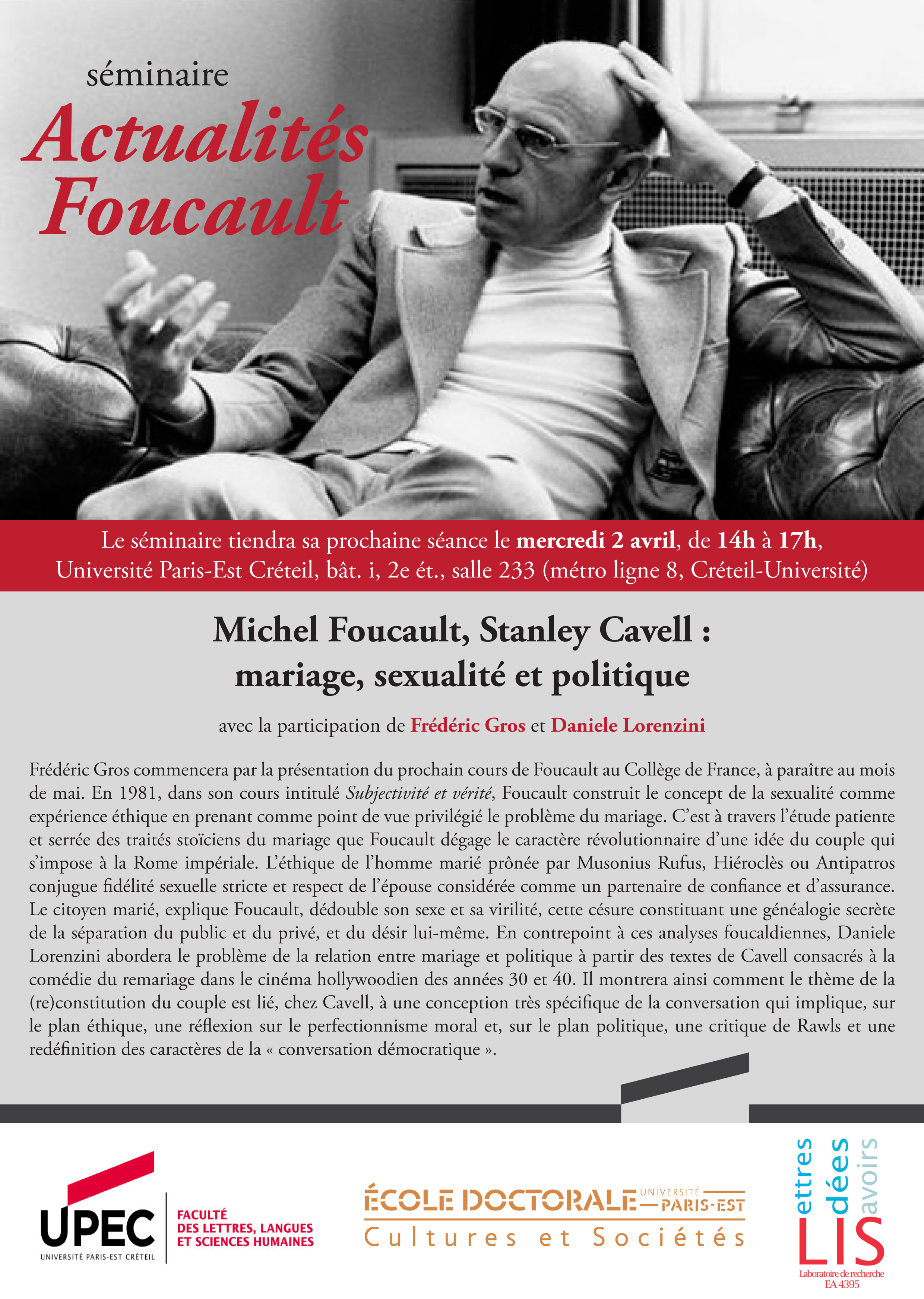
affiche_foucault

Foucault : la prison aujourd’hui
19-30 mars 2014
Lausanne

Dix jours d’événements autour des représentations de la pièce de théâtre FOUCAULT 71
Voir – télécharger le programme complet

Voir aussi: L’INTOLÉRABLE HIER ET AUJOURD’HUI
(Texte d’Anne-Catherine Menétrey-Savary, Le Courrier, 3 mars 2014)

et autour de la manifestation: La question de l’abolition de la prison