Foucault News

News and resources on French thinker Michel Foucault (1926-1984)

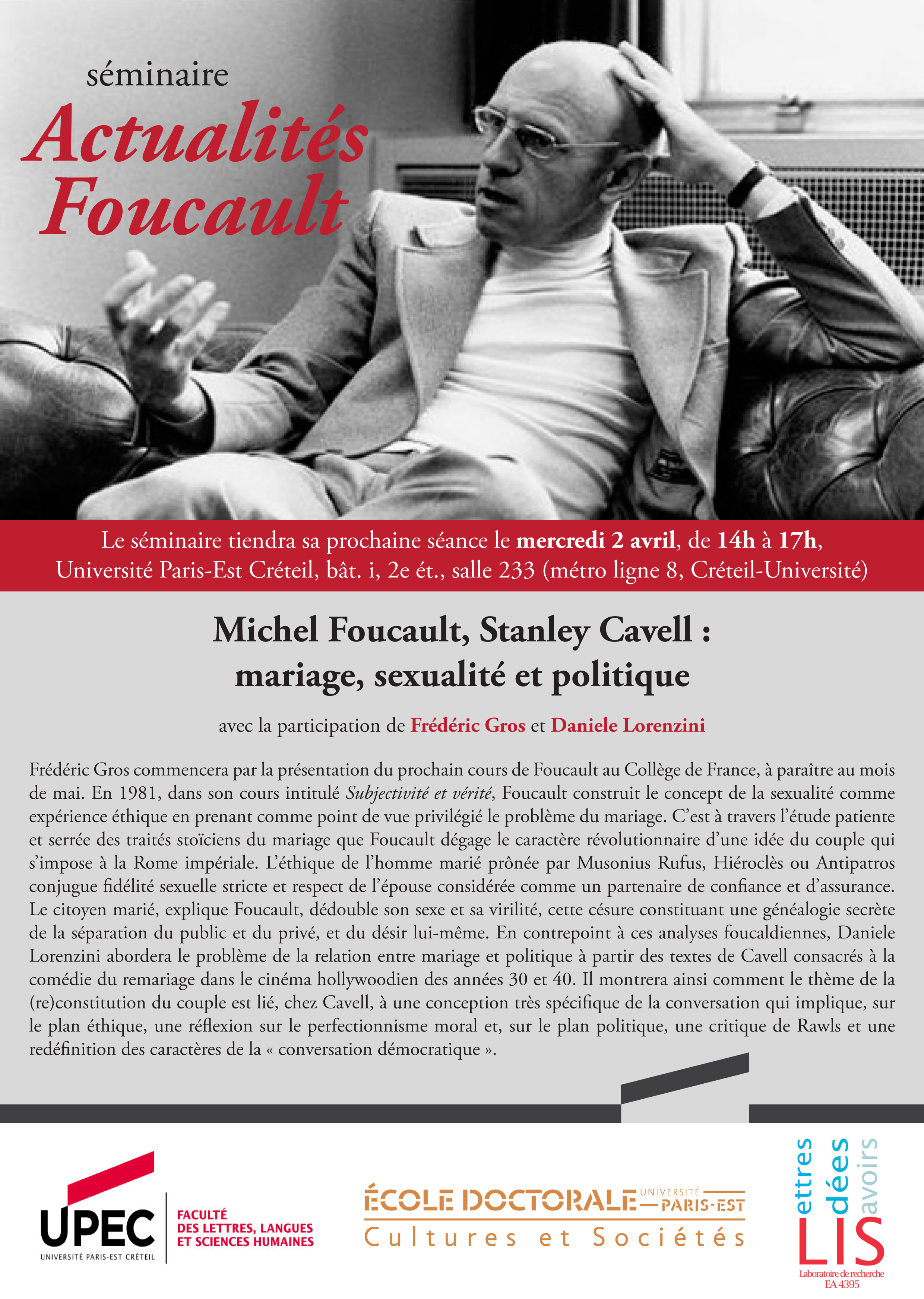
Séminaire Actualités Foucault s6PDF of flyer

Maier, H.O.
Soja’s thirdspace, Foucault’s heterotopia and de Certeau’s practice: Time-space and social geography in emergent Christianity
(2013) Historical Social Research, 38 (3), pp. 76-92.

Further info

Abstract
This essay uses analytical tools developed by Edward Soja, Michel Foucault, and Michel de Certeau to investigate time-space configurations in the religious movements inaugurated by Jesus and promoted by Paul. The article begins with an account of the domination of time as a conceptual tool for analyzing both figures and their teachings to establish the context for an alternative space-time reading of the data represented in the New Testament and extra-canonical sources. Jesus’ proclamation of the Kingdom of God is placed in the context of the monetization and hence disruption of traditional kinship and social structures. His parables, sayings, and the traditions associated with him represent thirdspace performances of his rural world. His proclamation of the Kingdom of God coheres with Foucault’s notion of heterotopia in that it places listeners in places outside of place. His articulation of behaviours coincides with de Certeau’s notion of tactics inserted within dominant social strategies. Through a reading of Paul’s message against the backdrop of urban poverty Paul’s motif of the church as body is seen as a thirdspace articulation of social groups, heterotopic place outside of place, and communal solidarity within the urban context of the Roman Empire.

Author Keywords
Galilee; Household; Jesus; Monetization; Paul; Roman city; Space-time

Didier Mineur, Après Foucault. La philosophie politique en France depuis les années 1980, Cités, 2013/4 (n° 56), Pages 51 – 76

DOI: 10.3917/cite.056.0051

Premières lignes
Il pourrait sembler paradoxal de faire de l’œuvre de Michel Foucault une borne dans l’histoire de la philosophie politique en France, et le point de fuite à partir duquel se lisent les différentes perspectives contemporaines, puisque Foucault, on le sait, récusait pour lui-même, à l’instar d’Hannah Arendt, le titre de philosophe. Pourtant, de son propre aveu, c’est bien de philosophie qu’il s’occupait….

Plan de l’article

Retour sur Foucault
La réévaluation de la démocratie depuis les années 1980
Aujourd’hui : revitaliser la démocratie
Demain : les enjeux à penser

Raby, R.
Children’s participation as neo-liberal governance?
(2014) Discourse, 35 (1), pp. 77-89.

Abstract
Children’s participation initiatives have been increasingly introduced within various institutional jurisdictions around the world, partly in response to Article 12 of the United Nations Convention on the Rights of the Child. Such initiatives have been critically evaluated from a number of different angles. This article engages with an avenue of critique which argues that children’s participatory initiatives resonate with a neoliberal economic and political context that prioritises middle class, western individualism and ultimately fosters children’s deeper subjugation through self-governance. Respecting these as legitimate concerns, this article draws on two counter-positions to argue that while children’s participation can certainly be conceptualised and practised in ways that reflect neo-liberal, individualised self-governance, it does not necessarily do so. To make this argument I engage, on the one hand, with Foucault’s work on the care of the self, and on the other, with more collective approaches to participation. © 2012 Taylor & Francis.

Author Keywords
childhood; governmentality; individualism; neo-liberalism; participation; school

DOI: 10.1080/01596306.2012.739468

barbinMichel Foucault, Herculine Barbin dite Alexina B.

Première parution en 1978

Postface d’Éric Fassin

Nouvelle édition suivie d’Un scandale au couvent d’Oscar Panizza en 2014, Gallimard, 2014

En 1868 à Paris, rue de l’École-de-Médecine, un homme se donne la mort en laissant à la postérité un manuscrit autobiographique. C’est l’«Histoire d’Alexina B.» que publiera en 1874 un grand notable de la médecine légale, Ambroise Tardieu. Pour celui-ci, il s’agit des «souvenirs et impressions d’un individu dont le sexe avait été méconnu», bref, d’un «pseudo-hermaphrodite». En 1860, à plus de vingt et un ans, Herculine Adélaïde Barbin, surnommée Alexina, devenait Abel en changeant de sexe à l’état civil. Sa plume passionnée raconte les tourments et les émois de la jeune fille, et s’achève sur l’amer désespoir de l’homme.

En 1978, Michel Foucault publie ce document remarquable, assorti d’un dossier historique, pour inaugurer une collection éphémère : «Les vies parallèles». À l’assignation médicale, depuis le XIXe siècle, d’un «vrai sexe», le philosophe de l’Histoire de la sexualité répond, dans la préface qu’il donne à la traduction américaine en 1980, en invoquant les «délices» d’une vie «sans sexe certain».

Pour la première fois sont inclus dans l’édition française d’Herculine Barbin dite Alexina B., épuisée depuis des années, ce texte important de Foucault ainsi que la nouvelle «Un scandale au couvent» du médecin allemand Oscar Panizza, qui en proposait une version romancée au tournant du XXe siècle. La postface d’Éric Fassin souligne enfin combien le développement des gender studies mais aussi celui du mouvement «intersexe» engagent aujourd’hui à relire ce récit remarquable où Herculine/Abel s’invente un «vrai genre».

Power in a World of Becoming, Entanglement & Attachment

Conference website

‘In every era the attempt must be made anew to rescue tradition from a conformism that is about to overpower it’ (Walter Benjamin) 

June 2-3, 2014. University of Warwick 

Confirmed Speakers:

  • ·         William Connolly (Johns Hopkins)
  • ·         Christian Borch (CBS, Copehagen)
  • ·         Costas Douzinas (Birkbeck)
  • ·         Amade M’charek (Amsterdam)
  • ·         Luciana Parisi (Goldsmiths)
  • ·         AbdouMaliq Simone (Goldsmiths)

Conference Organisers:

Claire Blencowe & Illan rua Wall – Authority & Political Technologies (APT) Warwick

Suggested Themes:

  • ·         Biopolitics and Political Spirituality/Religion
  • ·         Materialism and the Political Meaning of Entanglement
  • ·         Authority, Sovereignty and Becoming in the (Post) Colony
  • ·         Process and New Forms of Society(ism), Association and Being in Common
  • ·         Necropolitics and Human Rights

Recently, there have been various calls for a move beyond ‘post-structuralism’ (i.e. Foucault, Deleuze, cultural/critical theory), which had long been seen as the radical edge of the critical social sciences. Such calls are motivated in part by the sense that post-structuralist philosophies – which were forged against a backdrop of totalitarian rule and burgeoning welfare states in Europe – fail to offer moral or political purchase in the contemporary governmental landscape. Moreover, there is a sense that various concepts and theories have become reified and constraining – closing down the possibilities of critical thought. However, the issues that post-structuralist theory placed on the critical social science agenda have become more vital than ever – be that the concern for the complex and dispersed nature of power and agency; the imbrication of power and economics with knowledge and science; rethinking the relation between equality and difference; the political/contested/changing nature of embodiment, biology and ecology; or the efforts of states and others to establish and exercise power over life itself. We maintain that now is the time, not to reject post-structuralist perspectives, but to reinvigorate and transform those traditions through empirical and political work that is creatively engaged with current problems. The Authority & Political Technologies group at Warwick will host a series of annual events that bring together world leading, emerging and postgraduate scholars from across the social sciences whose work promises to renew post-structuralist critical thought through empirical scholarship. This year we invite papers on the theme ‘Power in a World of Becoming, Entanglement & Attachment’. Topics may include, but are not limited to, the suggested themes above.

Deadline for abstract submission March 10th 2014.

For further information and updates see the conference website http://www2.warwick.ac.uk/fac/soc/sociology/rsw/authorityandpoliticaltechnologies/apt2014/

APT Warwick:

Claire Blencowe; Miguel Beistegui; Will Davies; Stuart Elden; Nick Gane; Olga Goriunova; Amy Hinterberger; Hannah Jones; Cath Lambert; Nick Lee; Celia Lury; Alice Mah; Goldie Osuri; Maria Do Mar Pereira; Lynne Pettinger; Shirin Rai; John Solomos; Vicky Squire; Nathanial Tkacz; Emma Uprichard; Nick Vaughan-Williams; Illan rua Wall; Chiara Livia Bernardi; Sam Burgum; Rogan Collins; Esteban Damiani; Kathryn Medien; Marijn Nieuwenhuis; Hidefumi Nishiyama; Maurice Stierl; Lauren Tooker; Lorenzo Vianelli

affiche_foucault

Foucault : la prison aujourd’hui
19-30 mars 2014
Lausanne

Dix jours d’événements autour des représentations de la pièce de théâtre FOUCAULT 71
Voir – télécharger le programme complet

Voir aussi: L’INTOLÉRABLE HIER ET AUJOURD’HUI
(Texte d’Anne-Catherine Menétrey-Savary, Le Courrier, 3 mars 2014)

et autour de la manifestation: La question de l’abolition de la prison

Governing Academic Life
Conference at the London School of Economics and British Library
25 & 26th June 2014

Deadline for Abstracts: 31st March 2014

Website

Details

June 25, 2014 is the thirtieth anniversary of the death of Michel Foucault. Governing Academic Life marks this anniversary by providing an occasion for academics to reflect on our present situation through our reflections on Foucault’s legacy. The focus of the conference, therefore, will be on the form of governmentality that now constitutes our identities and regulates our practices as researchers and teachers. However the event will also create a space for encounters between governmentality scholars and critics of the neoliberal academy whose critiques have different intellectual roots – especially Frankfurt school critical theory, critical political economy, feminism, Bourdieuian analyses of habitus, capital and field, and autonomist Marxism.

Proposals for papers and panels are welcome until March 15, 2014. Please refer to the guidelines below.


Background and context:

The impetus for this event is the set of changes currently sweeping across UK higher education, which include cuts in direct public funding, new financing arrangements that are calculated to bring private equity into the sector and foster competition between providers, the likely emergence of new corporate structures for HEI’s which will open the sector to commercial providers, the separation of elite from mass higher education and the globalization of ‘trade’ in HE services; but also (and relatedly) the continuing development of instruments for rendering student-teacher interactions visible and comparable, and for calculating and governing the impact, influence and value of academic research.

Governmentality research is featuring strongly in the debates around some of this. Yet though largely ‘diagnostic’ in nature, it is increasingly being enlisted as groundwork for the radical critiques and alternatives offered by autonomist Marxist theorists of cognitive capitalism and immaterial labour. Meanwhile, critical theorists who idealise a public sphere of rational-critical debate (with ‘the idea of the university’ at its heart) are struggling to re-define what makes the university (a) public and to re-think the terms of its engagement with the wider economy and society in less radical ways – often without problematising the forms of (Foucaultian) government, or of complicity with capitalism’s logic of accumulation, that are necessarily involved with these reconstructions.  This conference aims to bring together leading contemporary scholars and activists who draw on one or more of these traditions for a series of mutually challenging discussions.

In general, the conference will be oriented by the concern to think critically about the conditions of possibility of the academy today – where ‘conditions of possibility’ could mean governmental assemblages of one kind or another, capitalist production relations, the forces defining how different capitals (economic, social, cultural, symbolic) register within the academic field, or quasi-transcendental presuppositions of communication. Participants will ideally aim to explore how we might think across these usually distinct ways of both conceiving what the university is and contesting what it has become.

Specific foci of debate may include:

The idea of the university: ruined or redeemable? Social criticism in the age of the normalized academic

Beyond public v. private? Dimensions of corporatisation

The role(s) of (contract, competition, corporate, financial, intellectual property) law in constructing the market university

The government of academic freedom: constituting competition as a way of life

Markets, measurement and managerialism: rankings and ratings, rights and royalties, accounting and audit, metrics … and alt.metrics?

Academic career-ism and casualization; discipline and de-professionalisation

The conditions for the persistence in the university sector of relations of domination organised in particular around gender and ethnicity

Critical political economy and varieties of communicative capitalism

Entrepreneurial universities and enterprising academic subjects: personal branding as ‘technology of the self’?

What is an author, now? The future of academic authorship and the academic book

The potentials and pitfalls of ‘openness’ and ‘commons-ism’ in scholarly communication

The ‘technicity’ of academic forms of life: the potentials and pathologies of living with/in digitised work environments

The student as consumer – or as producer?

The rise of para-academic ‘outstitutions’ beyond the university’s (pay)walls

Other strategies for resisting the neoliberal academy

Envisioning and enacting alternative futures for the university

Additional ideas for panels and themes are welcome.


Proposal submission procedure:

Proposals should be submitted as e-mail attachments to A.Barron@lse.ac.uk or M.S.Evans@lse.ac.uk, or in hard copy form by mail to one of the conference coordinators (addresses below). The deadline for receipt of proposals is March 15, 2014.

Proposals for papers must include the working title of the proposed paper (which should be suitable for presentation in 20 minutes) together with the author’s name, affiliation, full contact information (including address, phone, fax and email), and a brief (500 words maximum) abstract or outline. Submissions are welcome from graduate students as well as from more established scholars.

Proposals for panels (of up to 4 speakers) must include the information indicated above for all papers that are expected to be part of the panel, together with an overview of the panel theme (max 300 words) and an indication of each proposed panellist’s willingness to participate.

Timetable:  Proposals will be reviewed by the conference co-ordinators, and notice of acceptance will be given by April 15 2014.

 Registration: A registration fee of £100 will be payable to cover costs. A limited number of places will be available at a concessionary rate for graduate students, adjuncts and scholars without an institutional affiliation. Please indicate if you wish to be considered for one of these places when sending your proposal.

Conference coordinators:

Anne Barron
Associate Professor (Reader)

Law Department
London School of Economics and Political Science
Houghton Street
London WC2A 2AE
UKTel +44 20 7955 7267
email: A.Barron@lse.ac.uk
http://www.lse.ac.uk/collections/law/staff/anne-barron.htm

Mary Evans

Centennial Professor

Gender Institute

London School of Economics and Political Science
Houghton Street
London WC2A 2AE
UK

Tel.: +44 (0)207 107 5301
email: M.S.Evans@lse.ac.uk
http://www.lse.ac.uk/researchAndExpertise/Experts/profile.aspx?KeyValue=m.s.evans%40lse.ac.uk

http://www.governing-academic-life.org/


stuartelden's avatarProgressive Geographies

9782020862592Seuil now have a page up for Foucault’s 1980-81 lecture course Subjectivité et vérité, with a publication date of May 2014. Thanks to Chathan Vemuri for the link. No great surprises in the publicity text, except perhaps for the explicit link to Christianity, which makes sense given the content of the previous year’s course, Du gouvernement des vivants.

« L’hypothèse de travail est celle-ci : il est vrai que la sexualité comme expérience n’est évidemment pas indépendante des codes et du système des interdits, mais il faut rappeler aussitôt que ces codes sont étonnamment stables, continus, lents à se mouvoir. Il faut rappeler aussi que la façon dont ils sont observés ou transgressés semble elle aussi très stable et très répétitive. En revanche le point de mobilité historique, ce qui sans doute change le plus souvent, ce qui a été le plus fragile, ce sont les modalités de…

View original post 240 more words

John Iliopoulos, Foucault, Baudrillard and the History of Madness, International Journal of Baudrillard Studies, Volume 10, Number 2 (July 2013)

Extract
I. Introduction
Michel Foucault’s groundbreaking work altered our perception of psychiatry. Although generally labeled anti-psychiatric for its supposed narrative of exclusion of madness by the oppressive power of Enlightenment reason, its scope reaches far beyond the simple refutation of mental illness (Foucault, 1989: 418). It is a more radical cultural approach to the conditions of possibility of current psychiatric practice in the west. It is at once a historical, philosophical and anthropological endeavor which explores the foundations of psychiatric rationality and displays its epistemological, ethical and political limitations. Foucault’s historical analyses of madness havecreated a new type of critique which, instead of attacking the relations of domination inside the psychiatric institution or the objectivity of psychiatric discourse, they question the very conditions which shape our stable images of power relations and the universality of the medical model governing psychiatric practice.

In this paper I show how Baudrillard follows closely Foucault’s line of reasoning. He too carries out a cultural and anthropological study which repeats, revives and extends Foucault’s analyses of madness. Like Foucault, he performs a genealogy of western reason to illustrate the evolution of the prevalent rational schemas which have determined a specific relationship of western culture with its limits. Baudrillard’s sociological reflections are permeated by the social and cultural division between reason and madness, and, while less focused on the analysis of the psychiatric institution itself, they take up and deepen Foucault’s observations, exploring the fate of madness in contemporary societies of the west, contributing to critical psychiatry, which is not part of anti-psychiatry but a more radical type of critique of the psychiatric institution and its operation inside the wider context of today’s global rationality.

Read more

With thanks to Dirk Felleman for this link