Foucault News

News and resources on French thinker Michel Foucault (1926-1984)

Darren Powell & Michael Gard, The governmentality of childhood obesity: Coca-Cola, public health and primary schools, Discourse: Studies in the Cultural Politics of Education, Published online: 14 Apr 2014
https://doi.org/10.1080/01596306.2014.905045

Abstract

In this paper, we examine the emergence of what might seem an unexpected policy outcome – a large multinational corporation, frequently blamed for exacerbating childhood obesity, operating as an officially sanctioned driver of anti-obesity initiatives in primary schools across the globe. We draw on Foucault’s notion of governmentality to examine the pedagogical work of two international programmes devised and funded by Coca-Cola. We demonstrate how these programmes work simultaneously as marketing campaigns and as governmental strategies to position children as responsible for their own health, conflate (ill)health with body weight and strategically employ the concept of energy balance. We argue that these programmes not only act to unite the interests of corporations, governments and schools, but also seek to use schools to reshape the very ideas of health and a ‘healthy life’. We conclude by considering two sets of ethical and political issues that come sharply as corporations like Coca-Cola continue to exploit the policy space created by the ‘obesity epidemic’.

Keywords

childhood obesity,
health education,
corporations,
governmentality,
neoliberalism,
primary schools

Alisa Jane Percya, A critical turn in higher education research: turning the critical lens on the Academic Language and Learning educator, Discourse: Studies in the Cultural Politics of Education, Published online: 04 Apr 2014

Abstract
This paper suggests that historical ontology, as one form of reflexive critique, is an instructive research design for making sense of the political and historical constitution of the Academic Language and Learning (ALL) educator in Australian higher education. The ALL educator in this paper refers to those practitioners in the field of ALL, whose ethical agency has largely been taken for granted since their slow and uneven emergence in the latter half of the twentieth century. Using the lens of governmentality, genealogical design and archaeological method, the historical ontology proposed in this paper demonstrates how the ethical remit of the ALL educator to ‘make a difference’ to student learning is not necessarily a unifying construct providing a foundational moral basis for the work, but a contingent historical and political effect of the government of conduct in liberal society. The findings of this approach are not intended to undermine the agency of the ALL educator, but to assist in making sense of the historical conditions that frame and complicate their institutional intelligibility as ethical agents in the academy.

Keywords: academic language and learning, historical ontology, agency

DOI: 10.1080/01596306.2014.904069

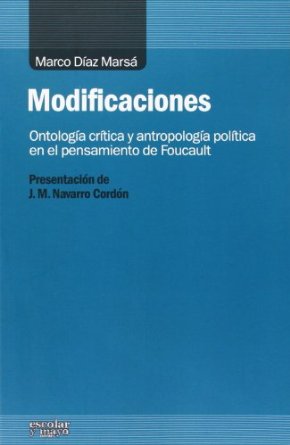
marsa Marco Díaz Marsá, Modificaciones. Ontología crítica y antropología política en el pensamiento de Foucault, Escolar y Mayo Editores, 2014
ISBN 10: 8416020108 / ISBN 13: 9788416020102

Contraportada:
En los últimos tiempos se ha venido afianzado una lectura de la obra de Foucault que desestima las primeras aproximaciones epistemológicas o meramente sociologizantes, muy afines al propio contexto genético en el que surge, para resaltar y hasta ensalzar su dimensión estrictamente ontológica, por la cual se vuelve trabajo de filósofo, en el más justo sentido del término. A tal tendencia se suman ahora estas Modificaciones de Marco Díaz Marsá, esforzado intento de pensar la sistematicidad del pensamiento foucaultiano, allende los habituales cánones lógico-deductivos, incluso por los derroteros más esquivos y, por lo tanto, aquellos que más coraje filosófico requieren: aquellos que tal vez permitan trazar un sistema de la libertad.

Dottorato in Filosofia (XXIX ciclo)
Michel Foucault: Il presente come eredità

Ciclo di seminari
Dipartimento di Filosofia
Sapienza – Università di Roma
Villa Mirafiori, via Carlo Fea 2

A trent’anni dalla scomparsa di Michel Foucault, i diversi aspetti della sua opera, a partire dalla distanza temporale che ce ne separa, emergono come snodi problematici per pensare il presente. In particolare la tramatura dei rapporti tra saperi, poteri e soggetti, di cui sono intessute le forme di vita, emerge in primo piano nell’articolare l’esistenza quotidiana.

Le diverse letture che in questi anni hanno impegnato il suo pensiero, nella torsione verso un immediato impiego “politico” o verso una critica spesso infondata, ne hanno paradossalmente reso opaco l’insegnamento.

I seminari intendono riflettere su alcuni tra i molteplici aspetti della straordinaria opera foucaultiana per tentare una cartografia dei regimi di verità a partire da cui sono possibili una filosofia politica, una teoria della conoscenza e un’analitica del soggetto.

Calendario degli incontri

28 Aprile, Aula XI, ore 17,30

Paolo B. Vernaglione: La natura umana come dispositivo. Foucault e la modernità.

Daniele Lorenzini: Etica e politica di noi stessi. Riflessioni su un uso possibile dell’ultimo Foucault

5 maggio, Aula II, ore 17,30

Stefano Catucci: Potere e sensibilità nell’opera di Michel Foucault

Orazio Irrera: Michel Foucault e la critica dell’ideologia

12 maggio, Aula XI, ore 17,30

Martina Tazzioli:Interruzioni di confine e soggettivazioni agiuridiche. Lavorare con Foucault  negli spazi del presente.

Laura Cremonesi: Il concetto di critica in Michel Foucault

Stefano Catucci insegna estetica presso la Facoltà di Architettura di Ascoli Piceno. I suoi studi si sono concentrati sulla ricognizione dello spazio architettonico in rapporto ai grandi problemi sollevati dalla filosofia contemporanea. Ha anche sviluppato, con una metodologia ibrida tra filosofia, critica e storia della musica, originali lavori sull’estetica musicale barocca. E’ autore, tra l’altro di La filosofia critica di Husserl, Bach e la musica barocca, Introduzione a Foucault, Per una filosofia povera, Imparare dalla luna.

Laura Cremonesi ha conseguito il dottorato in Discipline Filosofiche presso l’Università di Pisa e di Paris XII-Val de Marne (UPEC). Si occupa di Filosofia francese contemporanea, e in particolari modo del pensiero di Michel Foucault e di quello di Pierre Hadot. Su questi temi, ha pubblicato vari interventi, tra cui il libro “Michel Foucault e il mondo antico. Spunti per una critica dell’attualità”, ETS, Pisa

Orazio Irrera  collabora con il Centre de philosophie contemporaine de la Sorbonne dell’Université Paris 1 Panthéon-Sorbonne. È co-direttore della rivista “materiali foucaultiani”. Dirige inoltre il seminario “Race et colonialisme. Sur les épistémologies de la décolonisation” presso il Collège International de Philosophie. Ha pubblicato numerosi articoli in Italia e all’estero sugli studi postcoloniali e sul pensiero di Michel Foucault, di cui ha curato l’edizione italiana e francese di Sull’origine dell’ermeneutica del sé, Cronopio, Napoli 2012 e Vrin, Paris 2013.

 Daniele Lorenzini sta ultimando un dottorato di ricerca in filosofia all’Université Paris-Est Créteil e alla Sapienza di Roma, con una tesi sul rapporto tra etica e politica nel pensiero di Michel Foucault, Pierre Hadot e Stanley Cavell. Co-fondatore e co-direttore della rivista “Materiali Foucaultiani”, è anche responsabile dell’edizione critica, in francese, di una serie di conferenze e di testi inediti di Foucault per la casa editrice Vrin. Ha curato di recente i volumi Un demi-siècle d’Historie de la folie e Michel Foucault : éthique et vérité (1980-1984).

 Martina Tazzioli e’ postdoctoral researcher alla University of Oulu (Relate project, dipartimento di geografia). Dopo la laura in filosofia all’Universita’ di Pisa con una tesi su Foucault e la critica al liberalismo, ha conseguito un dottorato in Politics al Goldsmiths College di Londra con una tesi su governo delle migrazioni nel Mediterraneo e pratiche migranti di sommovimento degli spazi all’indomani della rivoluzione tunisina, attraverso una lettura foucaultiana.

Paolo B. Vernaglione, insegnante, ricercatore, è co-fondatore di “SofiaRoney. org” laboratorio filosofico on line, e autore tra l’altro di Il sovrano, l’altro, la storia. Dopo l’umanesimo. Filosofia del comune. Collabora alla rivista “Alfabeta2”.

Organizzazione: Paolo B. Vernaglione, paolo.vernaglione @uniroma1.it. cell: 3335914349

Elisabetta Basso. Master’s seminar on “Michel Foucault and Epistemology” at the “Center for Knowledge Research” (“Innovationszentrum Wissensforschung” – IZW) at the Technische Universität in Berlin.

PDF of program

Summary
How should a thinker like Foucault, who―in his most famous work, Les mots et les choses―claimed to have “learned more”, as a philosopher, from biologists, linguists, economists “than from Kant or Hegel” be read? Although they are difficult to classify within traditional philosophical questioning (Foucault’s inquiries have indeed gone from the birth of psychiatry to the development of human sciences, from the study of criminal law and penal institutions to the problematization of the “hermeneutic” of the Western subject), the analytical tools outlined by the French philosopher are at the core of the present-day philosophical debate.
The proposed seminar intends to dwell in particular upon the contribution given by Foucault to the contemporary epistemological debate. Beginning with the “archaeological” distinction between “savoir” and “connaissance”, the seminar aims to analyze Foucault’s philosophical approach in the light of the French epistemological tradition and the manifold questions that the latter tackles regarding the role of philosophical thought as it relates to the empirical sciences with which it deals.

Key Words: Epistemology, Knowledge, Experience, Science, Rationality, Relativism, Subjectivity, Language, Historical A Priori.

Silva, L.
Foucault in the Landscape: Questioning Governmentality in the Azores
(2014) Landscape Research, Published online March 2014

Abstract
This article focuses on the use of governmentality as a technique of government and its effects, with reference to a protected landscape. Drawing on ethnographic materials from the Azores, it demonstrates that governmentality is not always practised by governments in the way it is meant to be. Although the state’s conservation efforts in Sete Cidades meet the accepted criteria of a governmental programme, they do not transform local subjectivities as intended. The protected landscape of Sete Cidades is a government initiative, but also a tool used strategically by certain social groups living and working within this landscape to object to the appropriation of the space upon which their livelihood relies, and to understand, communicate and legitimise their place in the world.

Author Keywords
Azores; environmentality; Governmentality; land uses; protected landscapes

DOI: 10.1080/01426397.2013.878322

Kutay, A.
Managerial formations and coupling among the state, the market, and civil society: an emerging effect of governance
(2014) Critical Policy Studies, Published online March 2014

Abstract
By taking up the fact that some non-governmental organizations adapt to managerialism under governance mechanisms, this article addresses an emerging governance effect that paves the way for a particular relationship among the state, the market, and civil society. Such relationship, defined here as coupling, is formed and perpetuated through managerial organizational knowledge, professionalized communication techniques, and the reflexive surveillance mechanisms inherent in governance settings. This argument suggests that economic and market rationalities now penetrate into wider fields of social life, notwithstanding actual and possible contestations, resistances, and failures. I draw inspiration primarily from Michel Foucault’s notion of governmentality in examining how coupling develops. I also engage with some other key social theorists, including Max Weber, Jurgen Habermas, and Jodi Dean, to advance a critique of the contemporary influence of managerial formations on the field of governance.

Author Keywords
civil society; governance; governmentality; managerialism; panoptic surveillance; professional communication

DOI: 10.1080/19460171.2013.869180

Inge Claringbould, Annelies Knoppers, and Frank Jacobs
Young athletes and their coaches: disciplinary processes and habitus development
(2014) Leisure Studies, Published online March 2014

https://doi.org/10.1080/02614367.2014.895027

Abstract
Sport scholars have paid relatively little attention to meanings that participants in recreational youth sport may give meanings to their participation and how those meanings are informed by coaching practices. In this study, we draw on Bourdieu’s notions about the development of the habitus, symbolic capital and the positions youth take in the field of sport, and on Foucault’s understanding of disciplinary power to explore meanings 29 children, aged 7-18 years, participating in tennis, soccer, swimming or hockey in Dutch sport clubs assigned to their experiences with their coaches. The data from the semi-structured interviews show how the dispositions these youth developed during their sport participation shifted as they gradually became involved in a disciplinary process directed towards improvement, success and winning. When these youths joined a sport club their goal was to learn how to play the game and have fun. As they participated in organised practices over time, they learned that in order to have fun they had to conform to informal rules about behaviour during the practices. Specifically, we show how the logic of discipline, as described by Foucault, shaped this learning process, and contributed to the development of the habitus of these young athletes.

Author Keywords
coach; disciplinary power; hierarchy; youth sport

Performing Sexual Liberation: The Body and the Medical Authority of Pornography

INVITED PAPERS

October 24, University of Leicester

PDF of call for papers

The 21st century has witnessed a growth in academic interest in what has come to be understood as the pornographication of culture. The purpose of this conference is to gather a group of scholars together whose approach provides a critical counter point to the current academic trend to analyse pornography as sexually liberating for women (and men).

The conference addresses whether pornography as an emblem of sexual freedom in a democratic society needs rethinking. It aims to do so through analysing the complex inter-relation of pornography with branches of medicine (for example, sexology and psycho-therapy, and the pharmaceutical industry that helps support these latter) which afford pornography considerable legitimacy and even authority with regard to sexuality. The conference provides the opportunity to explore the relationship between pornography and medicine within the context of larger social structures and neo-liberal government.

The organising committee specifically invites you to offer a paper which critically examines the increasing medical authority of pornography in the light firstly of feminist ideas and, secondly, of the rapidly changing conditions of neo-liberalism, global capitalism and digital-technologies. We are particularly interested in submissions on the following themes although these are not exhaustive:

  • The body and bio-politics
  • The history of sexuality and medicine in the construction of the female and male body
  • Pornography and the discursive production of a ‘natural’ sexuality
  • The sexual imaginary, the pornography industry and capitalism
  • Patriarchy and the social construction of gender
  • Post-humanist analyses of the body
  • The use of internet pornography in sexology and sex therapy.
  • Racialized pornographic identities
  • Heteronormativity and ‘alt’ porn
  • Foucauldian ethics and the care of the self
  • Governmentality, neo-liberalism and medicine
  • The pharmaceutical industry and the pornification of the body

Proposals on other themes related to the subject of the conference are also very welcome.

TO ACCEPT THIS INVITATION

Please send confirmation of your acceptance and a brief synopsis of the paper you wish to present via email to Dr Heather Brunskell-Evans hbe1@leicester.ac.uk, and Monica O’Brien mob5@student.le.ac.uk by 19th May.

Travel expenses will be paid for invited speakers.

Reyes-Zaga, H.A.
Biopolitics and disposable bodies: A critical reading of Almazán’s Entre perros
(2014) Latin American Perspectives, 41 (2), pp. 189-201.

Abstract
Until now, little has been said about Mexican literature’s relationship with drug trafficking. While the literature influenced by drug trafficking may be seen as opportunistic and as promoting the dissolution of society and advocating crime, it not only contributes to the reproduction of the current violent Mexican imaginary but also appears to question the political and economic decentralization of neoliberalism and its role in making human beings disposable. Examining an example of this genre, Alejandro Almazán’s Entre perros (2009), in terms of the concept of biopolitics developed by Michel Foucault and others reveals it to be a denunciation of the effects of drug trafficking on Mexican society. The narconarrative raises the possibility of thinking about a state in which ethics and human rights are attainable.

Author Keywords
Biopolitics; Disposable humanity; Drug trafficking; Narconarrative; Violence

DOI: 10.1177/0094582X13509799