Foucault News

News and resources on French thinker Michel Foucault (1926-1984)

Affiche A3PDF of poster

PDF of flyer

foucault-nowJames Faubion (Editor), Foucault Now, Polity, February 2014

ISBN: 978-0-7456-6378-4
232 pages

Publisher’s page

Description

Michel Foucault is recognized as one of the twentieth century’s most influential thinkers, however the authors in this volume contend that more use can be made of Foucault than has yet been done and that some of the uses to which Foucault has so far been put run the risk of and occasionally simply amount to misuse.This interdisciplinary volume brings together a group of esteemed scholars, recognized for their command of and insights into Foucault’s oeuvre. They demonstrate the many respects in which Foucault’s project of an ontology of the present remains vital and continues to yield compelling insights and show that an ontology of the present is restricted to no particular terrain, but instead ranges widely and on paths that frequently intersect.The essays in this much-needed new collection address the key components of Foucault’s thought, ranging from his approach to power, biopolitics and parrhesia to analysis of key texts such as Folie et Déraison and Histoire de la sexualité.

This collection will spark debate amongst students and scholars alike and demonstrates that that every further encounter with Foucault’s corpus is more likely than not to demand a revisiting of interpretations already formulated, conclusions already drawn, uses already devised.

  • Interdisciplinary volume that addresses key themes of Foucault’s thought, including biopolitics and parrhesia
  • Provides analysis of key texts such as ‘Folie et Deraison’ and ‘Histoire de la sexualite’
  • Features innovative contributions from leading Foucault scholars such as Didier Eribon, Ian Hacking and Cary Wolfe
  • Contributors argue that Foucault’s thought demands a revisiting of previously-drawn interpretations

Contributors include Didier Eribon, Eric Fassin, John Forrester, Ian Hacking, Lynne Huffer, Colin Koopman, James Laidlaw, Laurence McFalls, Mariella Pandolfi, Paul Rabinow and Cary Wolfe.

Editor Information
James Faubion is professor of anthropology at Rice University. His previous publications include “Foucault’s Genealogy of Ethics,” in A Companion to Moral Anthropology, edited by Didier Fassin (Wiley, 2012) and An Anthropology of Ethics (Cambridge, 2011) with George Marcus, ed.
Reviews

“No thinker of the last generation helped shape understandings of the world more powerfully than Foucault. This splendid and up-to-date anthology shows that his work, through its various phases, retains its analytic power today.”
Simon During, University of Queensland

“Now is an appropriate time to reassess Foucault’s work, to reflect upon its significance, relevance, and impact. These wide-ranging and challenging essays by leading figures in the field demonstrate the extraordinary breadth and depth of Foucault’s contribution to the social sciences and humanities.”
Barry Smart, University of Portsmouth

Foucault Now shows that ‘Foucault then’ is as relevant today as ever he was. The essays collected here traverse the full range of Foucault’s work. In situating his concerns and methods within the politics of his times, they also connect them to the politics of the present with a compelling urgency. Foucault’s originality still astonishes, and he remains simply indispensable.”
Tony Bennett, University of Western Sydney

Henning, A.D.
(Self-)Surveillance, anti-doping, and health in non-elite road running
(2014) Surveillance and Society, 11 (4), pp. 494-507.

Further info

Abstract

This article explores disciplining effects of current anti-doping surveillance systems on the health consequences of non-elites’ daily behaviors and habits. As they are left out of direct anti-doping testing and enforcement, it is tempting to argue non-elites are unaffected by the anti-doping efforts focused on the elite level of their sport. However, it is because they are not subject to antidoping surveillance systems nor forced to comply with anti-doping regulations that non-elites are implicated within the wider arena of disciplinary power that envelops both elite and non-elite athletes and anti-doping agencies (Foucault 1979). Drawing on data from 28 interviews with non-elite runners, I argue these runners do conform to the rules and norms of their sport as far as they understand them, but their knowledge of banned substances is inadequate and many non-elite runners have only a superficial and sometimes incorrect understanding of doping. Many view doping and its associated health risks as a problem only of elite running, as well as a problem limited to only a handful of widely publicized performance enhancing drugs or doping methods. As a result of these misunderstandings non-elite runners are vulnerable to negative health effects of over the counter (OTC) medications and nutritional supplements, which they view as “safe” and part of normal training as a result of the current elite surveillance model of anti-doping. The recent death of a non-elite marathon runner linked to use of the unregulated energy supplement DMAA demonstrates that questionable products are used by runners who may not be fully aware of the risks of use,

Parker, I.
Madness and justice
(2014) Journal of Theoretical and Philosophical Psychology, 34 (1), pp. 28-40.


Abstract

This article makes the case for “social justice” in relation to the conceptions of “madness” that currently operate in mental health practice. The argument proceeds in eight steps which challenge dominant views of “madness” in the discipline of psychology. Each of these eight steps is linked to the question of social justice. The first step concerns the irresolvable differences between “models” of madness, with a focus here on four mainstream models: the psychiatric medical model, psychoanalytic conceptions of “psychosis,” systemic interventions into family systems, and cognitive-behavioral therapy approaches. The second step concerns the differences internal to each of these models. In the third step I identify a fifth “model” which is usually occluded in psychological debate, the model madness elaborates of itself. The article then turns to the social conditions that structure different models of madness. Step four of the argument is to emphasize the way that models of madness are embedded in structures of power and point five steps back to the historical separation of reason from unreason as condition of possibility for “madness” as such to be configured as object of psychology. Step six is concerned with the “madness” of contemporary social reality, and step seven with the way that this socially structured madness informs clinical practice. The eighth step is to draw attention to already-existing alternative social practices; social justice in action organized by and for the mental health system user and survivor movements.

Author Keywords
Foucault; Madness; Marxism; Psychosis; Social justice

DOI: 10.1037/a0032841

lexiconThe Cambridge Foucault Lexicon, Cambridge University Press, 2014.

Editors: Leonard Lawlor and John Nale

Contributors
Dianna Taylor, Erinn Gilson, Gary Gutting, Richard A. Lynch, H. A. Nethery IV, Eduardo Mendieta, John Protevi, Stephanie Jenkins, James Bernauer, Paul Patton, Corey McCall, Leonard Lawlor, Jeffrey T. Nealon, Christopher Penfield, Arun Iyer, Margaret McLaren, Devonya N. Havis, Gilles Deleuze, Ann V. Murphy, Kevin Thompson, Jana Sawicki, Joshua Kurdys, Charles E. Scott, Todd May, Pol Vandevelde, Judith Revel, Nicolae Morar, Samuel Talcott, Robert Vallier, Phillipe Artière, Mary Beth Mader, Fred Evans, Andrew Dilts, Jared Hibbard-Swanson, Hugh J. Silverman, Paolo Savoia, Alan D. Schrift, Bill Martin, Luca Paltrinieri, Ladelle McWhorter, David-Olivier Gougelet, Gary Shapiro, Miguel de Beistegui, Amy Allen, Brad Stone, Colin Koopman, Chloë Taylor, Adrian Switzer, Robert Bernasconi, Carlos Prado, Johanna Oksala, Mark G. E. Kelly, Lynne Huffer, Olivia Custer, Banu Bargu, Stuart Elden, Ed McGushin, John Nale, Patrick Singy, Allan Stoekl, Don T. Deere, Warren Montag, Frédéric Gros, Shannon Winnubst, Kas Saghafi, Samir Haddad, David Webb, Marc Djaballah, Federico Leoni, Jean-François Bert, Timothy O’Leary, Thomas R. Flynn, Andrew Cutrofello

Description
The Cambridge Foucault Lexicon is a reference tool that provides clear and incisive definitions and descriptions of all of Foucault’s major terms and influences, including history, knowledge, language, philosophy, and power. It also includes entries on philosophers about whom Foucault wrote and who influenced Foucault’s thinking, such as Deleuze, Heidegger, Nietzsche, and Canguilhem. The entries are written by scholars of Foucault from a variety of disciplines such as philosophy, gender studies, political science, and history. Together, they shed light on concepts key to Foucault and to ongoing discussions of his work today.

  • The only book like it in print, in any language, offering concise and accessibly-written entries on Foucault’s key concepts
  • Provides the most comprehensive collection of dictionary-style entries written about Foucault
  • Includes entries written by the world’s most prominent Foucault scholars

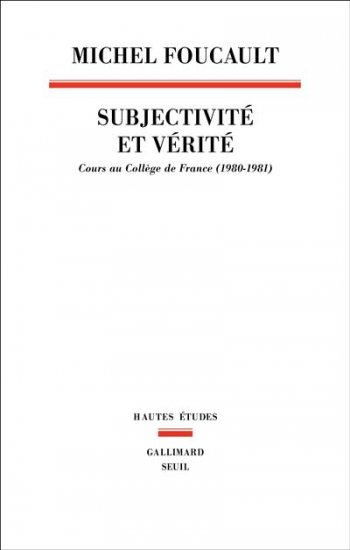
subjectiviteMichel Foucault, Subjectivité et vérité. Cours au Collège de France (1980-1981), Gallimard Seuil, Collection Hautes Etudes

Date de parution 02/05/2014
352 pages – 26.00 € TTC

Publisher’s page

« L’hypothèse de travail est celle-ci : il est vrai que la sexualité comme expérience n’est évidemment pas indépendante des codes et du système des interdits, mais il faut rappeler aussitôt que ces codes sont étonnamment stables, continus, lents à se mouvoir. Il faut rappeler aussi que la façon dont ils sont observés ou transgressés semble elle aussi très stable et très répétitive. En revanche le point de mobilité historique, ce qui sans doute change le plus souvent, ce qui a été le plus fragile, ce sont les modalités de l’expérience. »

Michel Foucault

Foucault prononce en 1981 un cours qui marque une inflexion décisive dans son chemin de pensée et le projet ébauché dès 1976 d’une Histoire de la sexualité. C’est le moment où les arts de vivre deviennent le foyer de sens à partir duquel pourra se déployer une pensée neuve de la subjectivité. C’est le moment aussi où Foucault problématise une conception de l’éthique comprise comme l’élaboration patiente d’un rapport de soi à soi. L’étude de l’expérience sexuelle des Anciens permet ces nouveaux déploiements conceptuels. Dans ce cadre, Foucault analyse des écrits médicaux, des traités sur le mariage, la philosophie de l’amour ou la valeur pronostique des rêves érotiques, afin d’y retrouver le témoignage d’une structuration du sujet dans son rapport aux plaisirs (aphrodisia) antérieure à la construction moderne d’une science de la sexualité, antérieure à la hantise chrétienne de la chair. L’enjeu est en effet d’établir que l’imposition d’une herméneutique patiente et interminable du désir constitue l’invention du christianisme. Mais pour cela, il importait de ressaisir la spécificité irréductible des techniques de soi antiques.

Dans cette série de leçons, qui annoncent clairement L’Usage des plaisirs et Le Souci de soi, Foucault interroge particulièrement le primat grec de l’opposition actif / passif sur les distinctions de genre, ainsi que l’élaboration par le stoïcisme impérial d’un modèle de lien conjugal prônant une fidélité sans faille, un partage des sentiments, et conduisant à la disqualification de l’homosexualité.

With thanks to Stuart Elden at Progressive Geographies for this news

Governing Academic Life

A conference at the LSE and the British Library,

June 25-26, 2014

Register online*

June 25, 2014 is the thirtieth anniversary of the death of Michel Foucault. Governing Academic Life marks this anniversary by providing an occasion for academics to reflect on our present situation through our reflections on Foucault’s legacy – which could include critical reflections on that legacy. The focus of the conference, therefore, will be on the form of governmentality that now constitutes our identities and regulates our practices as researchers and teachers. However the event will also create a space for encounters between governmentality scholars and critics of the neoliberal academy whose critiques have different intellectual roots – especially Frankfurt school critical theory, critical political economy; feminism; Bourdieuian analyses of habitus, capital and field; and autonomist Marxism.

Please see below for the provisional conference programme. For more information, contact info@governing-academic-life.org.

*There will be a limited number of fee waivers/reduced rates available for doctoral students, postdoctoral fellows, other early career academics (particularly if based in academic institutions outside of London), and scholars without an institutional affiliation. To apply for a fee waiver/reduced rate, please send an email to info@governing-academic-life.org by midnight on May 30, 2014 explaining why your participation in the conference would be beneficial to you and/or other attendees, and attaching a short CV (no more than 2 pages).

Wednesday, 25th June

09.30-10.45            Refreshments

10.45-11.00             Welcome and opening remarks

11.00-12.30             Opening Plenary

Gurminder Bhambra (Warwick), ‘The Neoliberal Assault on the Public University’
Wendy Brown (Berkeley) ‘Between Shareholders and Stakeholders: University Purposes Adrift’
Mike Power (LSE) ‘Accounting for the Impact of Research’

12.30-13.30              Lunch

13.30-15.00              Parallel Sessions

A. (Anti-)Social Science, the neoliberal art of government, and higher education

John Holmwood (Nottingham) , ‘Neo-liberalism as a theory of knowledge and its implications for the social sciences and critical thought’
Nick Gane (Warwick), ‘Neoliberalism: How Should the Social Sciences Respond?’
Andrew McGettigan (Critical Education blog), ‘Human Capital in English Higher Education’

B. What is an author, now? Futures of scholarly communication and academic publishing

Roundtable discussion with Steffen Boehm (Essex), Christian Fuchs (Westminster), Gary Hall (Coventry), Paul Kirby (Sussex)

15.00-15.15                 Refreshments

15.15-17.00                 Parallel Sessions

A. Feminism and the knowledge factory
(Convenor: Valerie Hey, Centre for Higher Education and Equity Research (CHEER), University of Sussex)

Barbara Crossouard (CHEER), ‘Materializing Foucault?’
Valerie Hey (CHEER), ‘Neo-Liberal Materialities and their Dissident Daughters’
Louise Morley (CHEER), ‘Researching the Future: Closures and Culture Wars in the Knowledge Economy’

B. Co-operative higher education
(Convenor: Joss Winn, Lincoln)

Richard Hall, ‘Academic Labour and Co-operative Struggles for Subjectivity’
Mike Neary (Lincoln), ‘Challenging the Capitalist University’
Joss Winn (Lincoln), ‘The University as a Worker Co-operative’
Andreas Wittel (Nottingham Trent) ‘Education as a Gift’

18.15-20.00              Pay bar at Terrace Room, British Library

18.30-20.00              Remember Foucault? (Terrace Room, British Library)

Mitchell Dean (Copenhagen Business School), ‘Michel Foucault’s “apology” for neoliberalism’
Lois McNay (Oxford) ‘Foucault, Social Weightlessness and the Politics of Critique’


Thursday, 26th June

09.30- 11.00             Parallel Sessions

A. Governing academic freedom

Stephen J Ball (Institute of Education: University of London) ‘Universities and “the economy of truth”’
Penny Burke (Roehampton) and Gill Crozier (Roehampton), ‘Regulating Difference in Higher Education Pedagogies’
Rosalind Gill (City University), ‘The Psychic Life of Neoliberalism in the Academy’

B. Teaching the ungovernable: rethinking the student as public

(Convenor: Carl Cederström, Stockholm Business School, Stockholm University)

Sam Dallyn (Manchester Business School, Manchester University), ‘Management Education: Critical Management Myopia and Searching for an Alternative Public’
Carl Cederström, ‘The Student as Public’
Matthew Charles (Institute for Modern and Contemporary Culture, Westminster)
‘The Ungovernable in Education: On Unintended Learning Outcomes’
Mike Marinetto (Cardiff Business School, Cardiff University), ‘The Ungovernable Syllabus: Social Science Fiction and the Creation of a Public Pedagogy’

11.00-11.30               Refreshments

11.30-13.00               Parallel Sessions

A. Measurement, management and the market university

Elizabeth Popp Berman (SUNY Albany), ‘Quantifying the Economic Value of Science: The Production and Circulation of U.S. Science & Technology Statistics’
Isabelle Bruno (University of Lille 2), ‘Quality management in education and research: an essay in genealogy’
Christopher Newfield (UC Santa Barbara), ‘The Price of Privatization’

B. Para-academic Practices: becoming ungovernable?
(Convenor Paul Boshears)

Paul Boshears (European Graduate School; continent), ‘Rudderless Piloting, Unwavering Pivoting, Governing without Coercion’
Fintan Neylan, (Dublin Unit for Speculative Thought), ‘The Logic of Para-Organisation’
Robert Jackson (Lancaster) ‘Para-academia and the Education of Grownups’
Eileen Joy (Punctum Books) ‘Amour Fou and the Clockless Nowever: Radical Publics’ (by weblink)

13.00-14.30              Lunch

14.30-16.45               Final Plenary: Beyond the Neoliberal Academy

Participants tbc

16.45-17.00              Closing remarks

pynchonMartin Paul Eve, Pynchon and Philosophy. Wittgenstein, Foucault and Adorno. London: Palgrave Macmillan, 2014.

PDF flyer for book with details of discount
(Discount valid until 31st May 2014)

Publisher’s site
Author’s site

Thomas Pynchon, perhaps the most important living American author, is famed for his lengthy, complex and erudite fictions. Given these characteristics, an examination of the philosophical dimensions of Pynchon’s works is long overdue. In Pynchon and Philosophy, Martin Paul Eve comprehensively and clearly redresses this balance, mapping Pynchon’s interactions with the philosophy, ethics and politics of Ludwig Wittgenstein, Michel Foucault and Theodor W. Adorno, resulting in a fresh approach to these seminal novels.

Pynchon and Philosophy is based on the notion that Pynchon’s brand of postmodern literature mocks theoretical frameworks. On these grounds, Pynchon has been accused of being an anti-rationalist, a postmodern nihilist figure who revels in the collapse of logic. In this book Eve shows that a fruitful showdown between these philosophical figures and Pynchon is now urgently needed to unearth the latent ethics within Pynchon’s novels and to counter these wild claims.

fs-17

Foucault Studies is pleased to announce the publication of issue 17

A Special Issue on Foucault and Deleuze
guest edited by Nicolae Morar, Thomas Nail, Daniel W. Smith

Issue 17 also includes:

3 original articles on the topics of:
Foucault’s discursive practices
Orientalist discourses in Foucault’s work
Foucault’s late studies of and with classical Greek and Roman texts

9 book reviews

Foucault Studies is an electronic, open access, peer reviewed, international journal that provides a forum for scholarship engaging the intellectual legacy of Michel Foucault, interpreted in the broadest possible terms. We welcome submissions ranging from theoretical explications of Foucault’s work and texts to interdisciplinary engagements across various fields, to empirical studies of contemporary phenomena using Foucaultian.

All articles are freely available as open access on our website:


Number 17:

April 2014: Foucault and Deleuze

Table of Contents
Editorial
Sverre Raffnsøe, Alain Beaulieu, Sam Binkley, Patricia Clough, Sven Opitz, Jyoti Puri, Jens Erik Kristensen, Alan Rosenberg, Marius Gudmand-Høyer, Johanna Oksala, Knut Ove Eliassen, Mathias Adam Munch
____________________________________________


Special Issue on Foucault and Deleuze

Foucault and Deleuze – Guest Editors’ Introduction
       Nicolae Morar, Thomas Nail, Daniel W. Smith

Three Concepts for Crossing the Nature-Artifice Divide: Technology, Milieu, and Machine
       Marco Altamirano

Becoming-Other: Foucault, Deleuze, and the Political Nature of Thought
       Vernon W. Cisney

Freedom, Teleodynamism, Creativity
       William E. Connolly

Ethics and the ontology of freedom: problematization and responsiveness in Foucault and Deleuze
       Erinn Cunniff Gilson

Foucault and Deleuze: Making a Difference with Nietzsche
       Wendy Grace

Uncertain Ontologies
Dianna Taylor

Toward a Theory of Transversal Politics: Deleuze and Foucault’s Block of Becoming
Christopher Penfield
____________________________________________

Articles

Reclaiming discursive practices as an analytic focus: Political implications
       Carol Bacchi, Jennifer Bonham

Orientalism as a form of Confession
       Andrea Teti

For The Love Of Boys
       John M. Carvalho

___________________________________________


Reviews

Johanna Oksala, Foucault, Politics, and Violence (Evanston, Il: Northwestern University Press, 2012)
       Christopher Mayes

Luca Paltrinieri, L’expérience du concept (Paris: Publications de la Sorbonne, 2012)
       Matteo Vagelli

Simon O’Sullivan, On the Production of Subjectivity: Five Diagrams of the Finite-Infinite Relation (New York: Palgrave Macmillan, 2012)
       Tara Marie Dankel

Rosi Braidotti, Nomadic Subjects: Embodiment and Sexual Difference in Contemporary Feminist Theory (New York: Colombia University Press, 2011)
       Mujde Kliem

Daniel W. Smith and Henry Somers-Hall (eds.), The Cambridge Companion to Deleuze (New York: Cambridge University Press, 2012)
       Kenneth Noe

Paul Elliot, Guattari Reframed (London; New York: I.B. Tauris, 2012)
       Jonathan Fardy

Mark Bonta and John Protevi, Deleuze and Geophilosophy: A Guide and Glossary (Edinburgh: Edinburgh University Press, 2004)
       Cheryl Gilge, Keith Harris

Colin Koopman, Genealogy as Critique: Foucault and the Problems of Modernity (Bloomington: Indiana University Press, 2013)
       George W. Shea, IV

Michel Foucault, Le beau danger: Entretien avec Claude Bonnefoy, édition établie et présentée par Philippe Artières (Paris: Editions EHESS, 2011)
Adina Arvatu

1° Encuentro Internacional de Estudios Foucaultianos
Joao Pessoa (Brazil),
Universidade Federal da Paraiba
May 13-16 2014

Conference Website

Objetivos

Além de somar esforços às inúmeras iniciativas que presumivelmente ocorrerão por ocasião do 30º aniversário da morte de Michel Foucault (1984-2014) e dos 50 anos do Golpe Civil-Militar brasileiro (1964-2014), a proposta de realização do 1º Encontro de Estudos Foucaultianos: Governamentalidade & Segurança tem por objetivo reunir professores e pesquisadores provenientes de universidades do país e do exterior com o propósito de articular um campo de pesquisas que, embora consolidado no exterior, encontra-se pouco desenvolvido no Brasil. O 1º Encontro de Estudos Foucaultianos pretende ser um esforço para o estabelecimento de relações com outras reflexões realizadas em diferentes domínios do conhecimento (História, Educação, Filosofia, Antropologia, Política, Sociologia), cuja preocupação esteja voltada para a temática do evento. Permitindo, com isso, a configuração de um espaço de confluência para diferentes experimentações no campo dos estudos foucaultianos no Brasil.