Foucault News

News and resources on French thinker Michel Foucault (1926-1984)

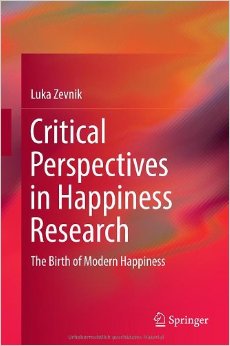
zevnikZevnik, Luka, Critical Perspectives in Happiness Research: The Birth of Modern Happiness, Springer, 2014

Publisher’s page

  • Explores the concept of modernization as the collective pursuit of happiness
  • Places the concept of happiness into a historical and cultural context
  • Analyses the relationship of modern consumer culture with happiness in contemporary western societies
This book presents an interdisciplinary exploration of the origins of happiness in the modern Western culture and makes the argument that happiness is not universal but is instead a culturally and historically specific experience, characteristic only to the Western world. It begins with an overview of the main research approaches to happiness and then studies the important but elusive theme in the context of culture and relations of power. The second part of the book analyses the social, religious, ethical and political processes that lead to the emergence of the experience of happiness, including consumer culture in contemporary societies. It presents an analysis of the medieval Christian experience which concludes that the modern experience of happiness only emerged in the 17th and 18th century, when the ideal of human existence increasingly started to be pursued in the present life. In its conclusion, this book explores the concept of modernization as the collective pursuit of happiness.

Keywords »Anthropology of Well-Being – Art of Living – Basic Parameters of Happiness – Critical History of Happiness – Cultural Construction of Happiness – Cultural Neuroscience – Culture and Relations – Empirical Happiness Research – Ethnocentrism and Happiness – Eudaimonic Well-Being – Foucault and Happiness – Happiness Studies and Life Satisfaction – Happiness and Consumer Culture – Happiness and Culture – Happiness and Medieval Theology – Happiness and Pastoral Power – Interdisciplinary Approach to the Study of Happiness – Middle Ages and Happiness – Neoroscience of Happiness – Origins of Happiness in the Western Culture – Positive Timeless Universal Experience – Public and Communal Happiness – Pursuit of Happiness – Sin and Salvation – The Birth of Modern Happiness – Understanding of Happiness

Dr. Luka Zevnik is assistant professor at University of Ljubljana. He is interdisciplinary oriented and has presented conference papers and published on happiness and emotions, popular culture, consumer culture, experience, cultural studies and neuroscience.

Prospects for an Ethics of Self-Cultivation

Conference 1: ‘Hellenistic Ethics in Nietzsche and Foucault’

Date: 25-27 September, 2014

Location: The University of Warwick, UK

PDF of call for papers

1st Call for Abstracts:

Philosophical interest in the ethical ideal of self-cultivation has increased in the nineteenth and twentieth centuries as philosophers have sought alternatives to deontological and utilitarian theories. This interest has been most evident in the widespread revival of virtue ethics, although contemporary virtue ethicists tend to focus on Aristotle’s account of character formation. Philosophers in the modern European tradition, however, have been influenced by other views on self-cultivation from the Hellenistic period. Nietzsche’s account of self-cultivation, for instance, is closer to Epicurus’s than Aristotle’s, while Foucault draws extensively on Stoicism and Cynicism for his account. The insights of these thinkers suggest that we may deepen and expand our understanding of self-cultivation by reassessing the merits of the Hellenistic tradition.

Confirmed Speakers

Prof. Keith Ansell-Pearson (Warwick)
Prof. Daniel Conway (Texas A&M)
Dr Edward Harcourt (Oxford)
Prof. Beatrice Han-Pile (Essex)
Dr John Sellars (Birkbeck)
Dr David Webb (Staffordshire)

We welcome papers suitable for 30 minute presentation on self-cultivation in Hellenistic ethics and modern European philosophy. Abstracts of around 500 words suitable for blind review should be sent to selfcultivation@warwick.ac.uk by June 30th 2014. Submissions from graduate students and early-career researchers are especially welcome.

This event will be followed by a second conference hosted by Monash University in 2015 with a separate registration and CFA. To find out more about the research project please visit our webpage: www2.warwick.ac.uk/selfcultivation, and to keep up with future news join our Facebook page at www.facebook.com/selfcultivation2014.

Marcella Milana and John Holford (Eds), Adult Education Policy and the European Union: Theoretical and Methodological Perspectives. Rotterdam, Sense Publishers, 2014

PDF flyer
website

The European Union is now a key player in making lifelong learning and adult education policy: this is the first book to explore a range of theoretical and methodological perspectives researchers can use to investigate its role. Chapters by leading experts and younger scholars from across Europe and beyond cover the evolution of EU policies, the role of policy ‘actors’ in what is often seen as the ‘black box’ of EU policy-making, and the contribution state theory can make to understanding the EU and its relations with Europe’s nations. They consider what theories of governability – drawing on the work of Foucault – can contribute. And they demonstrate how particular methodological approaches, such as ‘policy trails’, and the contribution the sociology of law, can make. Contributors include both specialists in adult education and scholars exploring how work from other disciplines can contribute to this field.
This is the first book in a new series from the European Society for Research in the Education of Adults, and draws on work within its Network on Policy Studies in Adult Education.
Original language English
Publication year 2014
Place of publication Rotterdam
Publisher Sense Publishers
Number of pages 180
ISBN (print) 978-94-6209-546-5, 978-94-6209-547-2
ISBN (electronic) 978-94-6209-548-9
State In press
Name Research on the Education and Learning of Adults
Volume I

Keywords

  • adult education, Lifelong learning, policy, research methodologies, European Union

f71-5-14

Dates à venir

Vendredi 23 mai à 23h, dans le cadre de La Nuit des idées,
Notre corps utopique,
Théâtre national Bordeaux Aquitaine (33)

Pour en savoir plus, visitez cette page ou cette page

Jeudi 19 juin à 19h, Le corps utopique, variation pour 2 comédiennes,
dans le cadre du Colloque International Foucault 1984 – 2014, Université  Paris – Est Créteil (94)

Pour en savoir plus, téléchargez le programme

Jeudi 5 juin à 18h, restitution du travail avec les lycéens du lycée Jean Vilar, Plaisir (78), au Collectif 12

Pour en savoir plus, visitez cette page

Le petit corps utopique

Après Notre corps utopique,et librement inspiré du même texte de Foucault,
le collectif F71 prépare un spectacle pour tous à partir de 6 ans, Le petit corps utopique
Création prévue le 23 mars 2015 au Collectif 12, dans le cadre du festival Les Francos

Du 5 mai au 2 juin 2014, résidence de création à l’école Ferdinand Buisson de Mantes-la-Jolie (78) avec le Collectif 12

Lundi 2 juin à 18h, restitution du travail avec les classes de CP et de CM2 au Collectif 12

Pour en savoir plus, visitez cette page et cette page

Contact

Mélanie Autier, 06 22 13 06 82, production.collectiff71@gmail.com
Christelle Kongolo, 06 15 87 39 64, diffusion.collectiff71@gmail.com
Rejoignez-nous sur notre page facebook, ici

www.collectiff71.com

Michel Foucault (1926 – 1984): les arts & les lettres/arts & humanities in the 21st Century

Peter Wall Institute for Advanced Studies & Collège de France Symposium
L’Institut d’études avancées de Paris
17 quai d’Anjou, Paris 75004
June 12 – 13, 2014

Conference website
PDF flyer

Art and architectural history, visual culture, literary studies, media and film studies and aesthetics have all “partaken” of Foucauldian theories, but a comparative exploration of Foucault’s significance has been lacking. If the reception of Foucault has focused on single disciplines and discrete areas of thought, it has also differed across specific linguistic and/or geo-political lines. This colloquium seeks to map the philosophy of Foucault as it impacts the future of the arts and humanities across cultures, institutions and practices.

Participants

Catherine M. Soussloff,
Art History, Visual Art & Theory, University of British Columbia, Canada

Dana Arnold
Architectural History & Theory, Middlesex University, UK

Sophie Berrebi
Art History, University of Amsterdam

Edward Dimendberg
Film and Media Studies, University of California, Irvine, U.S.A.

Françoise Gaillard
Literary Criticism, Art and Intellectual History, Université de Paris VII

Sima Godfrey
French Literature, University of British Columbia, Canada

Fréderic Gros
Philosophie politique, Université de Paris XII

Anton Lee
Art History, University of British Columbia, Canada

Ilka Kressner
Hispanic and Italian Studies, University at Albany, SUNY

Frédéric Pouillaude
Philosophie de l’art, Université de Paris-Sorbonne

Marisa C. Sánchez
Art History, University of British Columbia, Canada

Ariana Sforzini
Philosophie politique, Université de Paris XII

Michael Sheringham
French Literature, Oxford University, UK

T’ai Smith
Art History, Visual Art & Theory, University of British Columbia, Canada

Elisabetta Villari
DIRAAS, Università degli Studi di Genova

Séminaire “Politiques de Foucault”,
6e séance : Luca Paltrinieri, 17 mai 2014, Paris Ouest

webpage

La prochaine séance du séminaire “Politiques de Foucault” accueillera Luca Paltrinieri. Il interviendra sur le thème “’Ou la population ou les classes’ : l’archéologie foucaldienne du débat Marx-Malthus”.

Présentation de la séance  :

“Malthus a mis clairement au centre de la réflexion de l’économie politique moderne la question bio-économique de la population. La sienne est une réponse à l’optimisme des Lumières quant aux régulations possibles du rapport entre population et ressources : à la perfectibilité de la nature humaine de Godwin et Condorcet, Malthus oppose l’obstacle de la loi naturelle de population prescrivant le conflit entre croissance géométrique de la population et croissance arithmétique des subsistances. Par le concept de « surpopulation relative », Marx et Engels ont montré en revanche qu’il n’y a pas de loi naturelle qui règle les rapports entre démographie et économie : la loi de population n’est pas une constante qui fait entrer en contradiction deux progressions naturelles, elle est le produit variable de conditions historiques et notamment, dans le capitalisme, de la surexploitation de la force de travail. Ainsi, derrière la « loi naturelle de la population » se cachent des rapports de classe et, selon les mots de Marx « la population est une abstraction si je néglige les classes dont elle se compose ».

Nous partirons de cette critique marxienne de Malthus pour montrer que la perspective de la gouvernementalité foucaldienne en représente quelque part l’archéologie. Se concentrant sur les théories prémalthusiennes, Foucault tente en effet de gagner un autre point de vue sur la question : ni simple « nature », ni artefact idéologique, la population des Lumières est un ensemble de comportements intotalisables, étrange sujet/objet dont la nature politique la situe pourtant en radicale discontinuité par rapport aux théories de la souveraineté. Son émergence manifeste l’avènement d’un régime gouvernemental où la question du pouvoir ne peut plus être posée dans les termes classique de l’obéissance/désobéissance individuelle, mais impose de repenser les conditions même de (re)production d’une collectivité humaine.

Membre du Collège International de Philosophie, Luca Paltrinieri est directeur du programme De la gestion à l’autogestion. Une généalogie politique de l’entreprise.

Date :
Samedi 17 mai 2014, 10h-12h

Lieu :
Université Paris Ouest Nanterre La Défense
bâtiment D, salle 04 (rez-de-chaussée)
Comment venir ? par le train et le RER
Plan du campus de Paris Ouest Nanterre La Défense

Comité d’organisation :
Philippe Combessie
Stéphane Dufoix
Stéphane Haber
Christian Laval
Christian Lazzeri
Emmanuel Renault

Ann Lazarsfeld-Jensen,
A Foucauldian journey into the islands of the deaf and blind
(2014) Social Identities, Published online March 2014

https://doi.org/10.1080/13504630.2014.893816

Abstract
This autoethnographic study integrates Foucault’s genealogical approach to explore disability, notably deafness and blindness, from historical, social, and personal perspectives. Disability as a modern institution is defined through nuances of language and silence so that power constructs are hidden and continue to evolve through social collusion. Multiple modern circumlocutions intensify the sense of dislocation, emphasising the difference it attempts to conceal, which makes disability a ripe field for ethnographic work. The two men studied, Blind Brewster and Deaf Brewster, led creative working lives that found a small place in history. Both were sustained by a deep piety. The language used to hide disability in the contemporary world is more destructive than protective, in comparison with the blunt labelling of the deaf and blind two hundred years ago when it was a point of distinction, not discrimination.

Author Keywords
autoethnography; blind; deaf; Foucault; genealogy

Chueh, H.-C., Chen, Y.-T.
Social Involvement: Deconstructing practices relating to the formation of students who work with autistic children in a university service-learning course
(2014) Educational Philosophy and Theory, Published online March 2014

Abstract
Participation in service-learning courses has always been considered a part of the informal education in tertiary education worldwide. Originating from the assumption that service-learning courses increase students’ civic engagement and bridge the gap between knowledge and practice, service-learning courses have gradually acquired the status of compulsory courses at universities. This being as it may be, it would seem that the nature of such courses would benefit from further analysis and discussion regarding their function in knowledge reproduction, and their role in teaching and education. The aim of this article is to examine and analyze a university service-learning course-the National Taiwan University (NTU) Star-Rain course with a commitment to serving children with autism-from a Foucaultian perspective, and reflect on how the process of putting knowledge during a service-learning course into practice comes to constitute the subjectivity of students who work with children who are autistic. We argue that the course under investigation has, in effect, become wholly entangled in the medical system’s treatment of autism in Taiwan. The service-learning process involves knowledge acquisition as well as long-term, detailed, concrete hands-on experience, and shapes, in a very complete way, students’ construction of their subject knowledge of autism.

Author Keywords
civic engagement; Foucault; service-learning course; students who work with autism; subjectivity

DOI: 10.1080/00131857.2013.828581

The State of Things

This videoed lecture by Leo Bersani held on 2 June 2011 at the Istituto Veneto di Scienze, Lettere ed Arti in Venice is the second public lecture of the programme ‘The State of Things’, commissioned by the Office for Contemporary Art Norway and organised by its director, Marta Kuzma and OCA’s associate curator, Pablo Lafuente, together with Peter Osborne, director of the Centre for Research in Modern European Philosophy at Kingston University in London.

With this lecture, titled Illegitimacy, Leo Bersani — referring to Bourdieu, Jean Genet and Todd Haynes’s film Safe — attempts to examine strategies of negativity as pre-conditions for inventing what Michel Foucault called ‘new relational modes’.

Call for Papers

A day-long workshop on the topic (with a view to an edited volume)

“Crisis and Reconfigurations: 100 years of European Thought Since 1914”

November 7 2014, Deakin Melbourne City Campus, Australia

An event hosted by the European Philosophy and History of Ideas Research Centre http://www.deakin.edu.au/arts-ed/centre-for-citizenship-and-globalisation/research/thematic-research-groups/ephi and the School of Humanities and Social Sciences

Keynote speaker:

William Altman, author of The German Stranger: Leo Strauss and National Socialism, Martin Heidegger and the First World War: Being and Time as Funeral Oration, Nietzsche: Philosopher of the Second Reich, and Plato the Teacher, the Crisis of the Republic

Overview

August 2014 marks 100 years since the outbreak of the first global war, and the beginning of what some historians have called a second ‘30 years’ war.’  The 1914 war itself, then the Russian revolutions of 1917, a contested peace after 1918, accelerating economic crises, the rise of fascism in Spain, Italy, then Germany, the systematic atrocities committed under these regimes, and the division of the world into the two blocs of the cold war following 1945 profoundly shocked European consciousness and culture.  Many philosophers and thinkers, like Hannah Arendt, argued that there had been an irreversible breach in the continuing traditions of the West.  Many others took these crises as proof positive of the redundancy, or culpability, of the ideals of the 18th and 19th centuries, centring around notions of progress, the beneficence of scientific advance, and the overcoming or taming of natural necessity.  In academic philosophy, this period saw the opening up of the gulf between angloamerican, analytic and ‘continental’ modes of philosophising, a distinction which still has real currency today.  Within European thought, while German post-war thinking largely saw a profound shift away from the figures of Nietzsche, Schmitt and Heidegger, held to have been implicated in their national disaster; in French thought, following 1960, Nietzschean and Heideggerian thought had a huge say in shaping the post-structuralist generation of thinkers whose wider influence around the world, and across disciplinary boundaries, is still felt today.  Differently, the need to avoid any perceived proximities to the oppressive statism of the National Socialist and Stalinist regimes has had a huge role to play, via Hayek, Friedman and others in the economic thought that has widely reshaped the international economic and political landscape since 1979.  This CFP calls for contributions to this workshop (with a view to an edited volume) on and around the hypothesis that European thought since 1914 has been decisively shaped, in both its strengths and weaknesses, by the political, cultural, economic and human crises inaugurated 100 years ago this year.  Possible areas of special interest may be:

– the political and historical context of the analytic-continental divide in philosophy

– the possible shaping force of the European catastrophe in philosophical thinking, rhetoric, modes of argumentation and self-perception

– the role of debates concerning Soviet and Maoist forms of Marxism in wider philosophical and political thought

– the role of reactionary thought in European ideas since 1914, and the centrality of the “crisis” motif

– the motif of a ‘return to the Greeks/Romans/theologians’ in post-1914 European thought

– the influence of theological, and contrastingly, classical motifs inpost-1914 European thinkers’ works

– the oeuvres of particular leading European thinkers, as inflected by the political and cultural crises of the first half of the 20th century.

– what are the future directions for philosophical thought, beyond the attempts to mourn and comprehend the crises set in chain by 1914?


People interested in contributing a paper to this event should send a 300-800 word abstract to msharpe@deakin.edu.au or jack.reynolds@deakin.edu.au.   Deadline: 30 May 2014.