Foucault News

News and resources on French thinker Michel Foucault (1926-1984)

Foucault’s legacy: an interview with Frédéric Gros 14 July 2014, Verso Blog. Translation.

Frédéric Gros is the editor of Michel Foucault’s lectures at the Collège de France and the author of Michel Foucault (1996) and Foucault et la folie (1997). Having taught in prison for many years, he devoted a book to the philosophical fundaments of the right to punish (Et ce sera justice, 2001), as well as other texts such as States of Violence: An essay on the end of war (2010) and Le Principe sécurité (2012). Nicolas Truong from Le Monde recently interviewed Gros about the legacy of Michel Foucault.
read more

Read the original French interview here.

Steve Matthewman, Michel Foucault, Technology, and Actor-Network Theory,Techné: Research in Philosophy and Technology, Volume 17, Issue 2, Spring 2013, Pages 274-292

DOI: 10.5840/techne201317210
Pre-publication copy

Author’s blog

Abstract
While Michel Foucault’s significance as a social theorist is undisputed, his importance as a technological theorist is frequently overlooked. This article considers the richness and the range of Foucault’s technological thinking by surveying his works and interviews, and by tracking his influence within Actor-Network Theory (ANT). The argument is made that we will not fully understand Foucault without understanding the central place of technology in his work, and that we will not understand ANT without understanding Foucault.

If you really must…

This is what it says on the Redbubble site: “High quality Foucault related T-Shirts & Hoodies by independent artists and designers from around the world – also available as Stickers and Kids Clothes. All orders are custom made and most ship worldwide within 24 hours.”

Robin James, Neoliberal Noise: Attali, Foucault, & the Biopolitics of Uncool, Culture, Theory, and Critique 52 (2):138-158 (2014)

Further info

Abstract
Is it even possible to resist or oppose neoliberalism? I consider two responses that translate musical practices into counter-hegemonic political strategies: Jacques Attali’s theory of “composition” and the biopolitics of “uncool.” Reading Jacques Attali’s Noise through Foucault’s late work, I argue that Attali’s concept of “repetition” is best understood as a theory of neoliberal biopolitics, and his theory composition is actually a model of deregulated subjectivity. Composition is thus not an alternative to neoliberalism but its quintessence. An aesthetics and ethos of “uncool” might be a more viable alternative. If and when they function as bad, unprofitable investments, uncool practices like smoothness (predictable regularity) can undercut neoliberal imperatives to self-capitalization. I consider both the impact of neoliberalism on music, and how the study of music can advance theories of neoliberalism.

Annmaria Shimabuku, Schmitt and Foucault on the Question of Sovereignty under Military Occupation, Política común, Volume 5, 2014
https://doi.org/10.3998/pc.12322227.0005.007

Extract
1. A Violation or Production of Sovereignty?
This essay examines the geopolitical underpinnings of Carl Schmitt’s well-known definition of the sovereign as “he who decides the exception” (Political Theology 5) mainly through The Nomos of the Earth (1950). It is in this later work, written after Schmitt had borne witness to the liberation movements of Europe’s colonial territories alongside Germany’s defeat in both world wars, that he contextualized the historical formation of sovereignty in terms of the colonization of the New World and occupatio bellica within Europe from the 16th century onward. In reading The Nomos of the Earth, one cannot help but sense nostalgia for days past—a romanticization of the jus publicum Europaeum that grounds his critique of a new global (dis)order characterized by the transnational flow of capital and concomitant espousal of universal human rights moderated respectively by the American dollar and U.S. military as “world police.” His vitriolic critique of “American imperialism” that violates the sovereignty of postwar European and postcolonial states certainly carries political clout for critics of American Empire (“Modern Imperialism in International Law” 31). However, what exactly is this violated sovereignty? Is this a violation of the traditional form of territorial sovereignty, or a violation of a new form of sovereignty that has given way to an order of globalization? If so, what are its contours?
[…]

read more

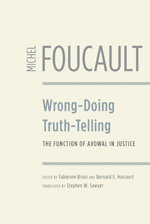
wrong-doingMichel Foucault, Wrong-Doing, Truth-Telling: The Function of Avowal in Justice,
Edited by Fabienne Brion and Bernard E. Harcourt
Translated by Stephen W. Sawyer

360 pages | 6 x 9 | © 2014

Further info

Three years before his death, Michel Foucault delivered a series of lectures at the Catholic University of Louvain that until recently remained almost unknown. These lectures—which focus on the role of avowal, or confession, in the determination of truth and justice—provide the missing link between Foucault’s early work on madness, delinquency, and sexuality and his later explorations of subjectivity in Greek and Roman antiquity.

Ranging broadly from Homer to the twentieth century, Foucault traces the early use of truth-telling in ancient Greece and follows it through to practices of self-examination in monastic times. By the nineteenth century, the avowal of wrongdoing was no longer sufficient to satisfy the call for justice; there remained the question of who the “criminal” was and what formative factors contributed to his wrong-doing. The call for psychiatric expertise marked the birth of the discipline of psychiatry in the nineteenth and twentieth centuries as well as its widespread recognition as the foundation of criminology and modern criminal justice.

Published here for the first time, the 1981 lectures have been superbly translated by Stephen W. Sawyer and expertly edited and extensively annotated by Fabienne Brion and Bernard E. Harcourt. They are accompanied by two contemporaneous interviews with Foucault in which he elaborates on a number of the key themes. An essential companion to Discipline and Punish, Wrong-Doing, Truth-Telling will take its place as one of the most significant works of Foucault to appear in decades, and will be necessary reading for all those interested in his thought.

Anthony Alessandrini, Foucault, Fanon, Intellectuals, Revolutions, Jadaliyya, April 01 2014

[This article is the final in a three-part Jadaliyya series that looks at Foucault’s work in relationship to the legacy of French colonialism in North Africa. Read the first and second installments here: “The Dangers of Liberalism: Foucault and Postcoloniality in France” by Diren Valayden and “Justifications of Power”: Neoliberalism and the Role of Empire by Muriam Haleh Davis.

My theoretical ethic is…“antistrategic”: to be respectful when a singularity revolts, intransigent as soon as power violates the universal. A simple choice, a difficult job: for one must at the same time look closely, a bit beneath history, at what cleaves it and stirs it, and keep watch, a bit behind politics, over what must unconditionally limit it. – Michel Foucault, “Useless to Revolt?”[1]

In their invaluable contributions to this series, Diren Valayden and Muriam Haleh Davis note, rightly, that Michel Foucault had relatively little to say about colonialism, in any direct way, throughout most of his body of work. I have nothing to add to this more general point regarding the Eurocentrism of Foucault’s work, except perhaps a proposal to place it within two larger contexts. The first is the general (and continuing) lack of engagement with postcolonial studies within French scholarship more generally; Achille Mbembe, among others, has described this as a form of provincialism within French thought from which we might, at last, begin to break away today. The second context is the complex history, still being told, of the interconnections between poststructuralist thought and French colonialism in North Africa, so well analyzed by Muriam Haleh Davis in a previous article.

read more

Muriam Haleh Davis, ‘Justifications of Power’: Neoliberalism and the Role of Empire, Jadaliyya, March 25, 2014

This article is the second in a three-part Jadaliyya series that looks at Foucault’s work in relationship to the legacy of French colonialism in North Africa. Read the first installment here: “The Dangers of Liberalism: Foucault and Postcoloniality in France by Diren Valayden

“I am like the crawfish and advance sideways.”[1] So Foucault warns us in the Birth of Biopolitics. And indeed, one would need to be an extremely nimble, if not heroic, crawfish to claim that Foucault espoused a serious reflection on French colonialism in North Africa. Point taken. What is irrefutable, however, is that his writings have had an enormous impact on historians working on colonialism in the Maghreb (and elsewhere). Foucault’s relative silence on colonialism (despite a few references to Algeria in interviews) is even more curious given the fact that the Algerian war was considered a decisive event for a generation of French intellectuals.

One might be tempted to explain this silence by his general distrust of the conventional objects of historical inquiry. Foucault insisted that the genealogy of the “Other” was more expansive than its narrowly colonial guise. Indeed, in explaining the inability of history to come to terms with a “general theory of discontinuity” he postulates it was “[a]s if we were afraid to conceive of the Other in the time of our own thought.”[2] The long-standing units of analysis held little interest for Foucault who maintained, “As soon as one questions that unity, it loses its self-evidence.”[3] Moreover, the definition of colonialism has been the subject of a long debate in Algeria, both in current-day politics as well as in its historical study.[4] It is thus easier to see how colonial practices intersect with the history of madness, disciplinary power, governmentality, and neoliberalism than to identify what Foucault “had to say” about colonialism itself.

read more

Diren Valayden, The Dangers of Liberalism: Foucault and Postcoloniality in Francem Jadaliyya, Mar 17 2014

[This article is the first in a three-part Jadaliyya series that looks at Foucault’s work in relationship to the legacy of French colonialism in North Africa.]

“For with Napoleon’s occupation of Egypt processes were set in motion between East and West that still dominate our contemporary cultural and political perspectives.” So writes Edward Said in Orientalism regarding the Napoleonic invasion of Egypt in 1798, which he describes as “the very model of a truly scientific appropriation of one culture by another, apparently stronger one.”[1] If we take this as a model of what studies of post/colonialism aspire to, then it is fair to say that colonialism and imperialism barely appear in Foucault’s writings. Despite coming face to face with the postcolonial condition while living in Tunisia (he was arrested and beaten because of his support for student protesters), given his apparent support for Israel and lack of solidarity for the Palestinian struggle, and having participated in demonstrations against the Vietnam war, Foucault had very little to say about colonialism. As such, no defense of his position is required. But, that does not mean he was uninterested or ignorant of colonization. This relative silence can in fact be understood in “strategic”[2] terms, as part of an investigation of the very categories of liberalism that shape a concept such as colonialism.

read more

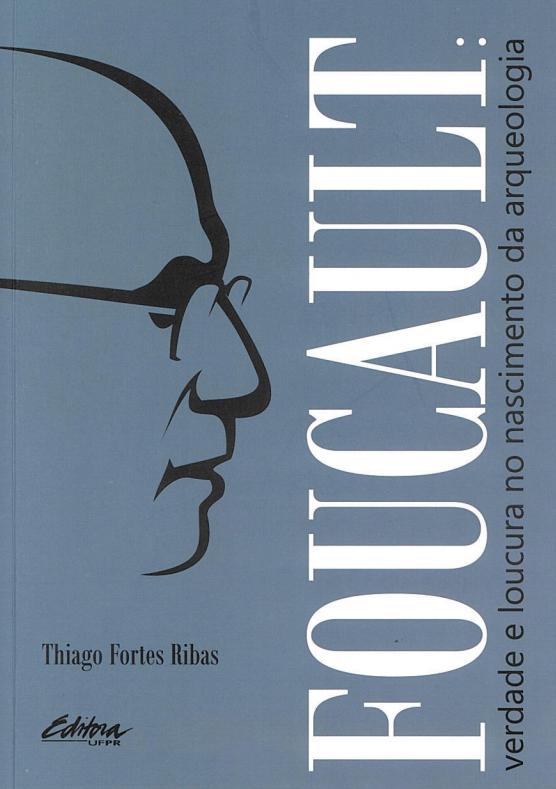
Foucault-verdade-e-loucura2Thiago Fortes Ribas, Foucault: verdade e loucura no nascimento da arqueologia, Editora Universidade Federal do Paraná (2014)

Further info

Com a clareza e a profundidade conceitual necessárias ao estudo de um dos filósofos mais importantes do século XX, este livro traz à tona o tema, atual e relevante, da relação entre verdade e loucura. Como nossa cultura chegou à verdade da loucura? Como a loucura enuncia a verdade do homem? Trata-se do início da produção teórica de Michel Foucault, ou seja, do nascimento de sua arqueologia. Voltado a textos pouco estudados, como o primeiro livro publicado por Foucault, “Doença mental e personalidade”, ainda não traduzido para o português, sua leitura oferece uma contribuição para o estudo desse filósofo e para a compreensão do sentido de seu afastamento em relação ao humanismo.