Foucault News

News and resources on French thinker Michel Foucault (1926-1984)

Peter C. O’Brien, Performance Government: Activating and regulating the self-governing capacities of teachers and school leaders, Educational Philosophy and Theory, Published online: 04 Jul 2014

DOI: 10.1080/00131857.2014.930682

Abstract
This article analyses ‘performance government’ as an emergent form of rule in advanced liberal democracies. It discloses how teachers and school leaders in Australia are being governed by the practices of performance government which centre on the recently established Australian Institute for Teaching and School Leadership (AITSL) and are given direction by two major strategies implicit within the exercise of this form of power: activation and regulation. Through an ‘analytics of government’ of these practices, the article unravels the new configurations of corporatized expert and academic knowledge—and their attendant methods of application—by which the self-governing capacities of teachers and school leaders are being activated and regulated in ways that seek to optimize the performance of these professionals. The article concludes by outlining some of the dangers of performance government for the professional freedom of educators and school leaders.

Keywords

governmentality,
performance government,
liberalism,
professional standards,
professional learning

horneEmily Horne and Tim Maly, The Inspection House: An Impertinent Field Guide to Modern Surveillance, Coach House Books, September 2014.

Further info

Note also: Sept 21 | Emily Horne & The Inspection House at Word on the Street – Toronto

In 1787, British philosopher and social reformer Jeremy Bentham conceived of the panopticon, a ring of cells observed by a central watchtower, as a labor-saving device for those in authority. While Bentham’s design was ostensibly for a prison, he believed that any number of places that require supervision—factories, poorhouses, hospitals, and schools—would benefit from such a design. The French philosopher Michel Foucault took Bentham at his word. In his groundbreaking 1975 study, Discipline and Punish, the panopticon became a metaphor to describe the creeping effects of personalized surveillance as a means for ever-finer mechanisms of control.

Forty years later, the available tools of scrutiny, supervision, and discipline are far more capable and insidious than Foucault dreamed, and yet less effective than Bentham hoped. Shopping malls, container ports, terrorist holding cells, and social networks all bristle with cameras, sensors, and trackers. But, crucially, they are also rife with resistance and prime opportunities for revolution. The Inspection House is a tour through several of these sites—from Guantánamo Bay to the Occupy Oakland camp and the authors’ own mobile devices—providing a stark, vivid portrait of our contemporary surveillance state and its opponents.

stuartelden's avatarProgressive Geographies

Collaborative projects

Some of Foucault’s collaborative projects are well-known – the I, Pierre Rivière collection; the Herculine Barbin memoir; Le désordre des familles with Arlette Farge; and the posthumous Technologies of the Self volume from the seminar at the University of Vermont.

On a dedicated page on this site I have listed the bibliographic details of other collaborative projects Foucault was involved with – either as contributor, research team leader or enabler. Comments, corrections or additions welcome.

View original post

Silcock, M., Hocking, C., Payne, D.
Childhood constructions of contemporary technology: Using discourse analysis to understand the creation of occupational possibilities
(2014) Journal of Occupational Science, 21 (3), pp. 357-370.

Abstract
Ten children aged 10-12 years were audio recorded discussing and demonstrating the types of technology they regularly used at home. A critical discourse analysis of the transcriptions was completed to identify dominant discourses the children deployed. Philosopher Michel Foucault’s theories on the history of existence, power relations, the subject, and ethics of the self informed the analysis. Three discourses were identified: virtual reality as a new dimension, panoptic play, and technological play as risky. The children appeared to assume subject positions within their play that have been created by and through their technology use. These subject positions were created by the unique historical context of the present era and have allowed new relations of power to develop for children. The discourses and associated discursive constructions appear to have an effect on the occupational possibilities available to children at this life course stage, indicating the emergence of norms of behaviour and relations of power unique to technological play.

Author Keywords
Children; Discourse analysis; Foucault; Occupational possibilities; Technological play

DOI: 10.1080/14427591.2013.832647

stuartelden's avatarProgressive Geographies

Update 12 After what has felt like a long break from working on this book, I’ve begun writing again. Some of this was during a recent trip to Ghana.

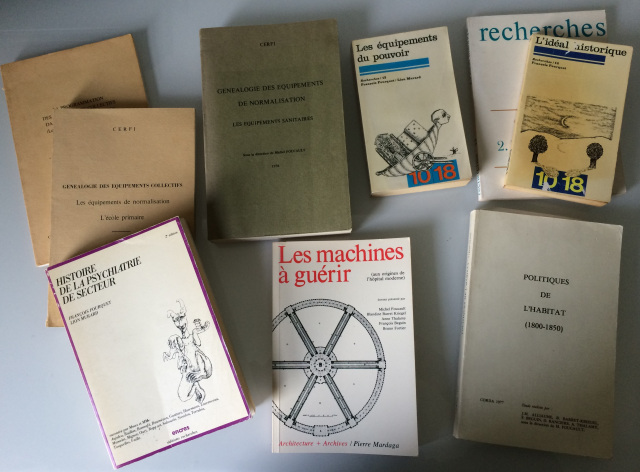
The first part of Chapter Six looks at the collaborative projects Foucault was involved with through his Collège de France seminars and his involvement with CERFI in the 1970s. I discuss four projects. The first was work conducted at CERFI, also involving Deleuze and Guattari, on into urban infrastructure and related themes, which led to the book Les équipements du pouvoir by Lion Murard and François Fourquet. The second is the collective work Les machines à guérir (aux origines de l’hôpital moderne) published in 1976 and then reissued in 1979. The third is a study Foucault edited entitled Politiques de l’habitat (1800-1850) from 1977. The fourth is a study of the ‘green spaces’ of Paris. These projects are important, I think, for moving…

View original post 423 more words

The Groningen Lectures on Modes of Reasoning – The Courage of Truth -Part I
Opening Lecture by Prof. Michael Dillon, 25 Sept. 2013

The Groningen Lectures on Modes of Reasoning are a space for world leading intellectuals to reflect on historical and contemporary modes of reasoning order and power. Speakers are invited to address the topic from their own area of expertise and to engage with questions from a selected audience. Lectures are held annually. A programme can be found here

With thanks to Eugene Wolter’s post on Critical Theory for his post on this.

Edward Said, My Encounter with Sartre, London Review of Books, Vol. 22 No. 11 · 1 June 2000

It was early in January 1979, and I was at home in New York preparing for one of my classes. The doorbell announced the delivery of a telegram and as I tore it open I noticed with interest that it was from Paris. ‘You are invited by Les Temps modernes to attend a seminar on peace in the Middle East in Paris on 13 and 14 March this year. Please respond. Simone de Beauvoir and Jean Paul Sartre.’ […]

When I arrived, I found a short, mysterious letter from Sartre and Beauvoir waiting for me at the hotel I had booked in the Latin Quarter. ‘For security reasons,’ the message ran, ‘the meetings will be held at the home of Michel Foucault.’ […]

Foucault very quickly made it clear to me that he had nothing to contribute to the seminar and would be leaving directly for his daily bout of research at the Bibliothèque Nationale. I was pleased to see my book Beginnings on his bookshelves, which were brimming with a neatly arranged mass of materials, including papers and journals. Although we chatted together amiably it wasn’t until much later (in fact almost a decade after his death in 1984) that I got some idea why he had been so unwilling to say anything to me about Middle Eastern politics.[…]

read more

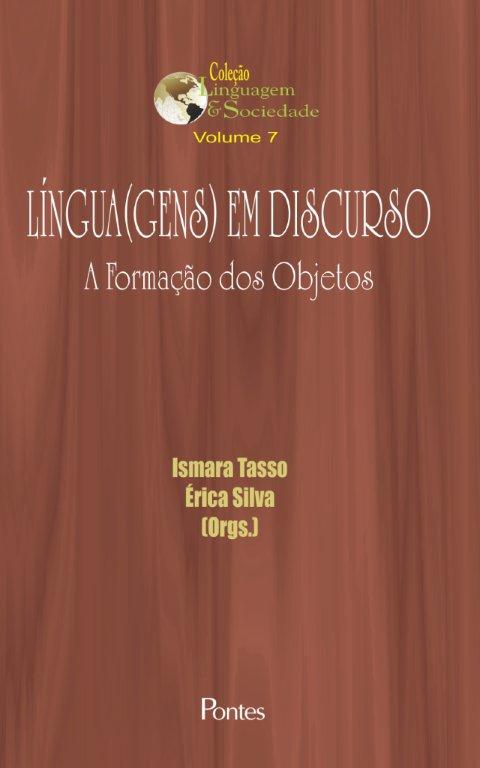
silvaLíngua(gens) em Discurso – A Formação dos Objetos
Organizadoras: Ismara Tasso e Érica Danielle Silva
Editora: Pontes
Coleção Linguagem&Sociedade (v. 7)
Ano de publicação: 2014.

Com o objetivo de subsidiar teórica e metodologicamente pesquisadores e estudiosos do campo epistemológico do discurso, esta coletânea reúne, com singular empenho dos autores, inéditas e substanciais discussões e reflexões acerca da formação dos objetos. Sob tal conjuntura, cada capítulo prima, por sua natureza teórica e analítica, demonstrar a emergência e formação de enunciados para além da articulação das palavras, compreendendo que os objetos não se formam nas realidades materiais anteriores aos discursos, mas são por eles produzidos no conjunto de práticas que arquitetam seu aparecimento, sua manutenção e sua coexistência. O tratamento desse funcionamento discursivo, cujas vertentes teóricas tem seus expoentes em Foucault, Pêcheux, Courtine, Bakhtin, Orlandi, Charaudeau e Maingueneau, possibilitou a organização da obra em duas partes. Na primeira, estão reunidos os textos que abordam as categorias de Acontecimento, espaços de memória, política(s) e mídia. E, na segunda parte, os capítulos estão amparados na investigação sobre a produção de discursos sobre o corpo, inscrita em práticas de subjetivação, no domínio da biopolítica. Organizam-se, portanto, a partir de três eixos − Práticas de subjetivação, biopolítica e corpo.

Barry Stocker's avatarStockerblog

Lecture of 21st February, 1973

Part One (of my summary and  comments, the lecture was delivered as a unified entity)

In the early nineteenth century, the penal system became a penitentiary system for the first time, was more unified, and was much more under  the control of the state than before. At the end of the eighteenth century there was a growth in the capitalist mode of product, which provoked political crises. The plebeians were proletarianised requiring a new repressive apparatus. There was a series of movements of popular sedition in response to the growth of capitalism. Bourgeois power replied to the seditions with a new judicial and penitential system. There is more behind the new system than control of plebeian sedition, it was a control of popular illegality. Until the end of the eighteenth century some popular illegality was compatible with the development of the economic bourgeoise and even…

View original post 625 more words

Date: May 30, 2014

Location: Stanford University Humanities Center

Talk Title: Paul Rabinow “Contemporary Inquiry: Ecologies of Assemblages”

Abstract: How should one conduct inquiry—today—into problems of broad scope and historical depth? How should one give form to participant-observation into problem spaces in which the specific site must be understood to be connected with multiple other sites and formations? In sum, how should one conduct contemporary inquiry?

In this keynote address, Paul Rabinow will argue that traditional modes of comparison have assumed that the parameters of comparison are known and/or stable. It follows that given that inquiry is focused on specific cases or examples. However, whilst terms such as culture or society or politics or history have functioned as the stable comparison units in the past (and continue to do so in much of the social sciences today), their status has come under sustained scrutiny in recent decades.

The challenge, then, is to conceptualize, narrate and give form to a mode of inquiry that would bring together diverse cases by Rabinow and his students and collaborators, such as: post-genomic forays into designing living organisms and systems; emergent forms of curatorial practices in the trans-national art market; the rise of right wing Hindu nationalist movements in India and the politics and representation of the border disputes in South Sudan. New modes of contemporary inquiry require conceptual innovation as well as a remediated practice of participant-observation that confronts and values the singularity of dimensions of such cases whilst refusing to abandon more general claims.

See more information at the contemporary.stanford.edu

Sponsored by: The Stanford Europe Center, Stanford Division of Literatures, Cultures, and Languages, and the Stanford Humanities Center.