Foucault News

News and resources on French thinker Michel Foucault (1926-1984)

fs-18-14
The cover image was produced by Astra Howard, an Action Researcher/Performer currently living in Sydney Australia. Spanning more than a decade, her work has sought to elicit and document marginalised, or overlooked, experiences and discourses of the city. The specific image I have chosen is part of a series entitled ‘Kings Cross the Whisper.’ This series displays selections from a poem about the Kings Cross area that was written by a local socially marginalised man. The images alludes to forgotten histories and marginalization in an increasingly homogenised and gentrified part of Sydney.

Foucault Studies
Number 18: October 2014
Special Issue on Ethnographies of Neoliberal Governmentalities

Table of Contents

Editorial PDF
Sverre Raffnsøe, Alain Beaulieu, Sam Binkley, Barbara Cruikshank, Knut Ove Eliassen, Marius Gudmand-Høyer, Johanna Oksala, Sven Opitz, Jyoti Puri, Jens Erik Kristensen, Alan Rosenberg, Mathias Adam Munch 1-4

Special Issue on Ethnographies of Neoliberal Governmentalities

Introduction PDF
Michelle Brady 5-10
Ethnographies of Neoliberal Governmentalities: from the neoliberal apparatus to neoliberalism and governmental assemblages PDF
Michelle Brady 11-33
Fixing Non-market Subjects: Governing Land and Population in the Global South PDF
Tania Murray Li 34-48
Neo‐Liberalism, Police, and the Governance of Little Urban Things PDF
Randy K. Lippert 49-65
The Grassroots and the Gift: Moral Authority, American Philanthropy, and Activism in Education PDF
Katharyne Mitchell, Chris Lizotte 66-89
Resisting the lure of the paycheck: Freedom and dependence in financial self-help PDF
Daniel Fridman 90-112

Translations

The politics of health in the eighteenth century PDF
Michel Foucault 113-127
Bio‐history and bio‐politics PDF
Michel Foucault 128-130

Articles

Disciplining the Ethical Couponer: A Foucauldian Analysis of Online Interactions PDF
Stephanie Gonzalez Guittar, Shannon K. Carter 131-153
Michel Foucault and Michael Oakeshott: The Virtuosity of Individuality PDF
Jacob Segal 154-172
Law, Objectives of Government, and Regimes of Truth PDF
Leila Brännström 173-194

Section in collaboration with Foucault Circle

Introduction to section from the 12th Annual Foucault Circle Conference PDF
Devonya N. Havis, Richard A. Lynch 195-196
Spotting the Primacy of Resistance in the Virtual Encounter of Foucault and Deleuze PDF
Marco Checchi 197-212
Platonism, Christianity, Stoicism: The Subject, The Truth, And The Political Import Of Their Relationship In Three Traditions PDF
Robin Weiss 213-237

Review Essay section

The Normative and the Transcendental: Comments on Colin Koopman’s Genealogy as Critique PDF
Amy Allen 238-244
On Left Kantianism: From Transcendental Critique to the Critical Ontology of the Present PDF
Eduardo Mendieta 245-252
Genealogy, Cryptonormativity, Interpretation PDF
Kevin Olson 253-260
Genealogy, Methodology, & Normativity beyond Transcendentality: Replies to Amy Allen, Eduardo Mendieta, & Kevin Olson PDF
Colin Koopman 261-273

Review Essay

Outside In, Inside Out, Again and Yet Again: Foucault’s Game in Wrong-Doing, Truth-Telling PDF
Daniel T. O’Hara 274-278

Reviews

Double review: Artières & Bert, Un succès philosophique: L’Histoire de la folie à l’âge classique de Michel Foucault ; Histoire de la folie à l’âge classique de Michel Foucault. Regards critiques 1961-2011, Textes choisis et présentés par Artières et al. PDF
Elisabetta Basso 279-286
Tom Roach, Friendship as a Way of Life: Foucault, AIDS, and the Politics of Shared Estrangement (New York: SUNY Press, 2012) PDF
Matthew Halse 287-290
David Galston, Archives and the Event of God: The Impact of Michel Foucault on Philo-sophical Theology (Montreal McGill-Queens’ University Press, 2011) PDF
Ebru Thwaites 291-292
Lauri Siisiainen, Foucault and the Politics of Hearing (New York: Routledge, 2012) PDF
Perry Zurn 293-296
Lee Braver, Groundless Grounds: A Study of Wittgenstein and Heidegger (Cambridge: MIT Press, 2012) PDF
Apple Zefelius Igrek 297-300
Thomas Nail, Returning to Revolution: Deleuze, Guattari and Zapatismo (Edinburgh University Press, 2012) PDF
Nathan Widder 301-304
Double review: Maudemarie Clark and David Dudrick, The Soul of Nietzsche’s Beyond Good and Evil ; Christa Davis Acampora and Keith Ansell Pearson, Nietzsche’s Beyond Good and Evil: A Reader’s Guide PDF
Robert Guay


David Webb – From Mathematics to Ethics in the Work of Michel Foucault

Recording available on the Backdoor Broadcasting Company site

Event Date: 2 October 2014
Room JG5002,
John Galsworthy Building,
Penrhyn Road Campus, Penrhyn Road,
Kingston upon Thames,
Surrey KT1 2EE

The Centre for Research in Modern European Philosophy (CRMEP), Kingston University  presents:

Professor David Webb (Staffordshire University) – From Mathematics to Ethics in the Work of Michel Foucault

Introduction by Professor Peter Osborne (Kingston):

There are a couple of Foucault examples here in this post comparing photos of celebrities and philosophers on the Daily Nous  – a kind of separated at birth idea.

Patrick Stewart is missing however. (See David Gauntlett’s site theory.org)

Armstrong, P.
The discourse of Michel Foucault: A sociological encounter
(2014) Critical Perspectives on Accounting. Article in Press.

Abstract
Michel Foucault is a major source for the idea in critical accounting and organizational studies that identities (selves, subjectivities) are discursively constituted. This return to the text is intended as a clarification of what Foucault actually says on this matter and an assessment of how far it can be regarded as authoritative. The major conclusions are as follows. The subject matter of Foucault’s ‘discursive’ phase is not discourse in its generality but islands of organization (‘discursive formations’) within it. To all intents and purposes these are bodies of knowledge and Foucault’s focus is on those which he calls ‘human sciences’. His concern is to show that these can be understood as a rule-governed systems of discursive events. The alternative of an action-theoretic account is ruled out by Foucault’s declared intention of avoiding recourse to a concept of human agency. Thus Foucault does not theorize discourse as an expression of human subjectivity. Rather he theorizes the subject as an image of the human being which is produced by, and presumed in, self-organizing systems of knowledge.

In Foucault’s work up to and including The Archaeology of Knowledge, therefore, the discursively constructed subject is not a flesh-and-blood human being at all. It is a thought-object constructed by, and within, the human sciences. Because there are a number of human sciences there are a corresponding number of constituted subjects, each of which, in the first instance, has currency only within its parent knowledge. In Foucault’s earlier Order of Things, however, a unitary ‘contemporary subject’ is theorized as a composite of these constructs. Since the constituting discourses are depicted as evolving autonomously, Foucault is thus able to produce a history of ‘the different modes by which … human beings are made subjects’.

All this means that any support from Foucault for the idea that subjectivities are discursively constituted in actuality must rest on Foucault’s genealogical phase. In Discipline and Punish, the human sciences are depicted, not as self-organizing fields of knowledge, but as the theoretical arms of various regimes of behavioural correction. Foucault is convincing in his claim that this ‘power-knowledge’ has diffused outwards from the total institutions in which it was prototyped, thence to become the characteristically modern modality of power. He is much less convincing on the question of its effects. Despite Foucault’s talk of ‘shaping the soul’, in fact, it is not clear that he has anything at all to say about this. The problem is that all of his descriptions of the various disciplinary orders are ‘top down’ accounts, relying either on the programmes of legal theorists and institutional reformers or on observation of institutional routines by official inspectors. The voice of the inmate is absent entirely, as is any evidence that disciplinary regimes achieve anything more than a calculative conformity to their behavioural dictates. This is not to deny that disciplinary power may impact on subjectivities.

The point here is that such an effect needs to be evidenced rather than simply assumed on the basis of (what has been taken to be) Foucault’s say-so. In critical accounting, unfortunately, the tendency has been to treat accounting as a discursive system or regime of power-knowledge and then cite Foucault as if this were sufficient to establish that it works through the production of subjectivities. The paper concludes with a discussion of two recent examples, one of which appeals to a concept of discursive constitution and one to the concept of power-knowledge.

Author Keywords
Archaeology; Discourse; Discursive constitution; Foucault; Power-knowledge; Subject; Subjectification

DOI: 10.1016/j.cpa.2013.10.009

Barros, S.R.
Deciphering Babel: Dis/locations of the professional self and the second language curriculum
(2013) Qualitative Report, 18 (52).

Full PDF

Abstract
In the following (auto) ethnographic study, I draw from Burdick’s (2012) analogy of qualitative research as “auto-archeology” and from parrhesia (Foucault, 1988) as a rhetorical device of self-definition and preservation to explore the interplay of power and identity within the context of second language education discourses. Specifically, I focus on the ways in which, through the creation of particular performative strategies, two educators working within the context of Liberal Arts institutions negotiate, construct and resist the everyday pressures and implied prejudices often associated with the curriculum and instruction of second languages in the United States. I conclude this study by arguing that the examination of how institutional power is reflected in teachers’ narratives is essential to the achievement of a better understanding of the lack of solidarity among the professoriate as well as the disconnect between authority, theory and praxis in the exercise of the second language profession.


Author Keywords

Autoethnography; Identity; Language education and democracy; Parrhesia

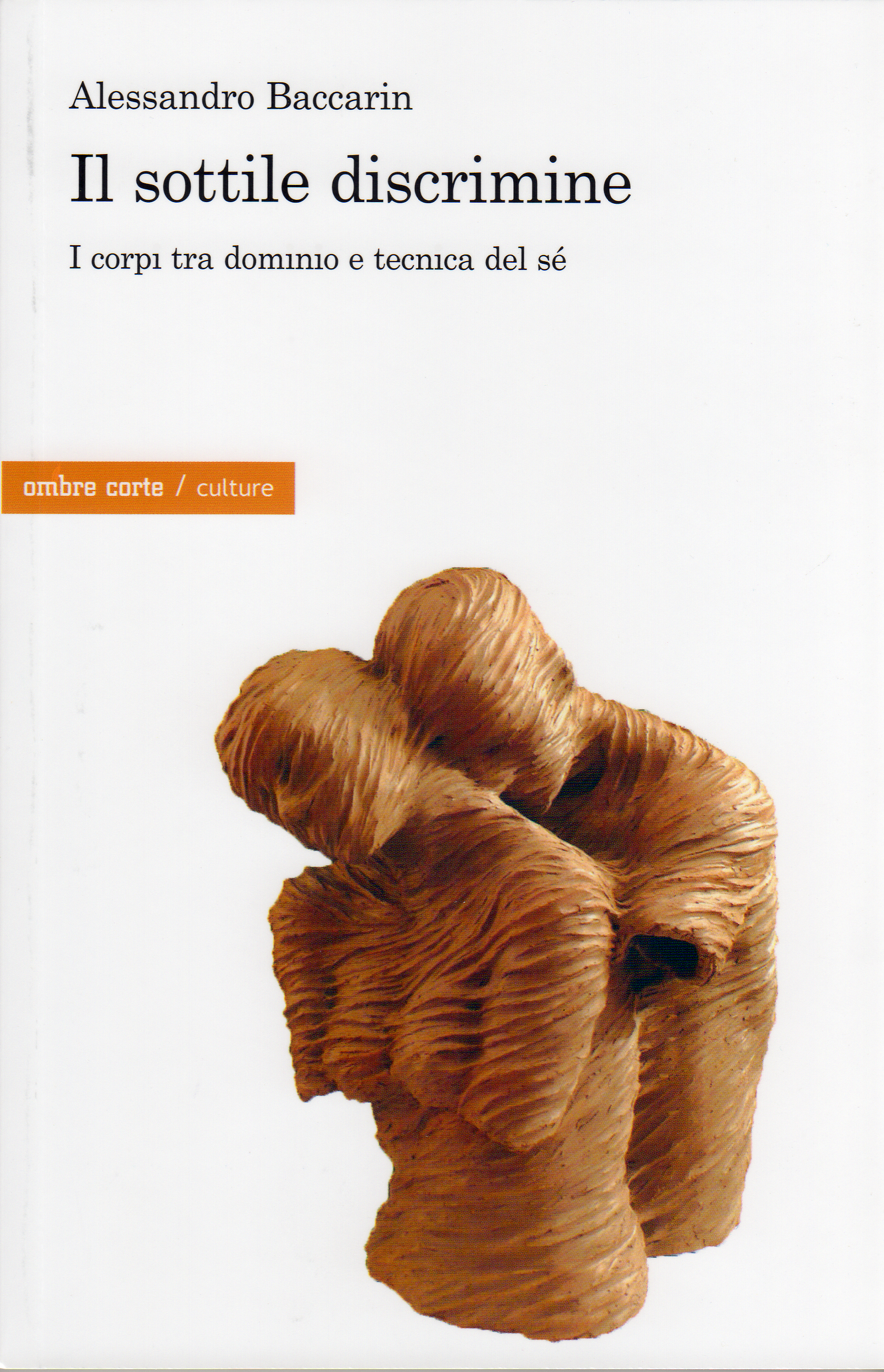
baccarin Alessandro Baccarin, Il sottile discrimine. I corpi tra dominio e tecniche del sé. Ombre Corte, 2014

Il libro
Il corpo è stato per secoli immune al segno. Dall’antichità fino al recente passato l’Occidente ha relegato la segnatura del corpo al confinamento, alla segregazione ed alla reificazione dei soggetti devianti, criminali o inquinanti. Tuttavia nella contemporaneità assistiamo all’emergere di una improvvisa ed apparente libertà per gli individui nel segnare i propri corpi, con il tatuaggio o con le metamorfosi rese ora possibili grazie alla chirurgia estetica o al fitness. E’ intento di questo libro indagare questo passaggio epocale come segno di una trasformazione: da superficie d’iscrizione del potere disciplinare, il corpo si trasforma in piano di appoggio per le pratiche di dominio del biopotere e per le tecniche del sé adottate dai soggetti nel loro agire resistenziale. Attraverso l’agile, efficace e sempre originale strumentazione analitica offerta dal pensiero di Michel Foucault, questa trasformazione è analizzata con un focus puntato sui corpi limite, corpi che segnano con la loro stessa esistenza il limite fra norma e resistenza, fra pratiche di dominio e di libertà. La transessualità, il tatuaggio e la pornografia si costituiscono come dimensioni preferenziali per l’esistenza di queste nuove corporeità. E allora, trasformare il proprio corpo, modellarlo, iscriverlo, sovvertirne il genere o il sesso, costituisce una pratica di libertà o un gesto di obbedienza ai comandi del potere? Tentare di identificare il sottile e tagliente discrimine che separa libertà ed obbedienza è lo scopo principale della presente ricerca.

l’autore
Alessandro Baccarin si è laureato in Lettere antiche presso l’Università La Sapienza di Roma e conseguito il dottorato di ricerca in Storia antica presso l’Università di Pisa. Tra i suoi lavori: Il Mare Ospitale. L’Arcaica concezione greca del Ponto Eusino nella stratificazione delle tradizioni antiche (in “Dìalogues d’histoire ancienne”, 1997); Olivicoltura in Attica fra vii e v secolo a.C. Trasformazione e crisi (in “Dialoghi di archeologia”, 1990). Ha curato la traduzione in italiano di alcuni storici antichi (Senofonte, Diodoro Sicuro).


Description in English

For centuries the body has been immune to markers inscribed upon it. From antiquity to our present the West has identified these bodily markers with confinement, segregation and reification of deviant subjects, criminals or pollutants. However in the contemporary times we are witnessing the emergence of a sudden and ostensible freedom to mark our body. Tatoos or metamorphosis, now possible by aesthetic surgery or by fitness, are the means for this purpose. The aim of this book is to describe and to deal with this momentous shift as an image of a transformation. The body has slowly transformed in expression of autonomy and resistance for subjects or in expression of control and normalization for biopower.

The aim of my research is to deal with this shift using the original and effective analytic tools of Michel Foucault’s thought by focusing on the concept of border-body. By its very existence this border-body delineats the border between norms and resistance, between practices of power and freedom. Transexuality, tatoos and pornography are prime examples of these new border-bodies. Thus, are we trasforming, molding, inscribing on our bodies, changing the sex or gender, by practicing freedom? Are these practices an act of obedience to power? The aim of my reseach is to try to identify and discern the fine line between freedom and obedience.

Columbia Center for Contemporary Critical Thought Launches

New Center Will Be Directed By Critical Thought Professor Bernard E. Harcourt, Who Has Challenged Conventional Wisdom on Practices including Mass Incarceration, Free Market Economics, Broken Windows Policing, and Racial Profiling

Media Contact: Public Affairs, 212-854-2650 or publicaffairs@law.columbia.edu

New York, October 7, 2014—The roots of critical thought go back at least to French Renaissance writer Michel de Montaigne, but a new Columbia Law School and Faculty of Arts and Sciences initiative will apply the age-old interdisciplinary approach to a host of modern issues, including the use of surveillance as a mode of government power in the age of Big Data.

The initiative, launched this fall by Columbia Law School Professor Bernard E. Harcourt, is called the Columbia Center for Contemporary Critical Thought and will bring together scholars and students who are engaged in developing novel ways of understanding how legal and scientific knowledge is produced and organized.

Embraced by philosophers ranging from Nietzsche, Freud, and Marx to Michel Foucault, critical thought takes place at the intersection of law, social sciences, and the humanities.

Harcourt, Isidor and Seville Sulzbacher Professor of Law joined the Columbia Law School faculty in July. He describes critical thought as a “logic of suspicion” that attempts to dismantle commonly held beliefs by demonstrating how they have been constructed over time. In his own work, Harcourt has used critical thought and empirical data to argue against racial profiling, broken windows policing, and mass incarceration, to question free market economics, to reexamine asylums and institutionalization in this country and abroad, and to explore the idea of political disobedience. His latest work, including a book forthcoming in 2015, critically examines government and corporate surveillance in the context of social networking sites such as Facebook and Twitter—or what he calls “digital security” and its effects on governing, exchanging, and policing.

“The mission of the Columbia Center for Contemporary Critical Thought is to nourish, explore, encourage, and support critical reexamination of the received wisdom of our time,” Harcourt said. “The task of contemporary critical thought is to question and challenge the authority of established truths and falsehoods, to challenge their empirical foundations, and to engage in forms of practice that test the limits of knowledge.”

Under Harcourt’s direction, the center will provide opportunities for students to analyze how critical thought can be applied to real-world scenarios. Next semester, Harcourt and University of Chicago Professor W.J.T. Mitchell will co-teach Spectacle and Surveillance, a seminar that will examine surveillance in a time of near-total information storage and retrieval. The course is partially funded by a grant from the Mellon Centre for Disciplinary Innovation.

The center also will host short-term seminars with renowned contemporary theorists, sponsor lectures and workshops, organize book events and colloquia, and create a reading group for faculty members and graduate students across Columbia University. The first one-week seminar will take place in November with François Robert Ewald, the recently retired chair of insurance studies at the Conservatoire National des Arts et Métiers (Paris) and Foucault’s primary assistant from 1976 to 1984. A spring seminar will feature Renata Salecl, a philosopher whose recent work has focused on the anxiety produced by choice.

Another dimension of the center will allow students to participate actively in litigation and policy initiatives addressing such criminal justice practices as capital punishment and prison terms of life imprisonment without parole, with the goal of tying practice to critical thought.

“Critical thought bridges philosophy, political theory, sociology and social theory, anthropology, classics, law, art criticism, and cultural studies,” Harcourt said. “It represents an epistemological approach that is reflected in a wide range of disciplines and approaches.”

Harcourt is the author of several books, including Occupy: Three Inquiries in Disobedience with Michael Taussig and W.J.T. Mitchell (University of Chicago Press 2013) and The Illusion of Free Markets: Punishment and the Myth of Natural Order (Harvard University Press 2011). He is also the editor of Foucault’s 1973 Collège de France lectures, La Société punitive (Gallimard 2013) and co-editor of Foucault’s 1981 Louvain lectures, Wrong-Doing, Truth-Telling (University of Chicago Press 2014). His scholarship has examined the sociology of punishment and penal law and procedure, including through pioneering empirical research on asylums and prisons. In addition to his work as a scholar, Harcourt represents death row inmates pro bono and has served on human rights missions in South Africa and Guatemala.

Before joining Columbia Law School, Harcourt served as the Julius Kreeger Professor of Law and Political Science at The University of Chicago, where he was the chairman of the political science department. He also holds a chair at the École des Hautes Études en Sciences Sociales in Paris.

# # #

Columbia Law School, founded in 1858, stands at the forefront of legal education and of the law in a global society. Columbia Law School combines traditional strengths in corporate law and financial regulation, international and comparative law, property, contracts, constitutional law, and administrative law with pioneering work in intellectual property, digital technology, tax law and policy, national security, human rights, sexuality and gender, and environmental law.

Join us on Facebook
Follow us on Twitter: www.twitter.com/columbialaw

Performing Sexual Liberation: The Body and the Medical Authority of Pornography

A critical counter point to the current academic trend for analysing pornography as sexually liberating for women

Further info

Date 24 October 2014
Duration One day
Venue College Court
Fee £7
Contact Dr Heather Brunskell-Evans        hbe1@le.ac.uk
Book now only 50 places available

Keynote Speakers

Dr Gail Dines, Wheelock College, Boston, USA:
Neo-liberalism, Pornography and the De-fanging of Feminism

Dr Stephen Maddison,
the University of East London, UK:
Make Love Not Porn? Pornography and the Entrepreneurial Voyeur

Dr Meagan Tyler, Victoria University, Melbourne, Australia:
Spectacular Sex: The Collision of Sexology and Pornography
Outline

Description
The 21st century has witnessed a growth in academic interest in what has come to be understood as the pornographication of culture.

The purpose of this conference is to gather a group of scholars together whose approach provides a critical counter point to the current academic trend to analyse pornography as sexually liberating for women (and men).

The conference addresses whether pornography, as an emblem of sexual freedom in a democratic society, needs rethinking. It aims to do so through analysing the complex inter-relation of pornography with branches of medicine (for example, sexology and psycho-therapy, and the pharmaceutical industry that helps support these latter) which afford pornography considerable legitimacy and even authority with regard to sexuality. The conference provides the opportunity to explore the relationship between pornography and medicine within the context of larger social structures and neo-liberal government.

The papers presented critically examine the increasing medical authority of pornography in the light firstly of feminist ideas, and secondly, of the rapidly changing conditions of neo-liberalism, global capitalism and digital-technologies.

Selected presentations include:

  • ’Squirting’ and the pathologisation of female sexuality as uncontrollable.
  • The disciplinary production of the pornographic body.
  • Dark desires versus natural sex: medicine, pornography and the history of women’s sexuality.
  • The confessional health practices of male porn performers.
  • Pornographic assistance in bio-political times.

Schedule

09:30-10:00 Registration

10:00-10:15 Welcome and Opening Remarks
Dr Heather Brunskell-Evans, Centre for Medical Humanities, University of Leicester

10:15-10:50 Key Note: Neo-liberalism, Pornography and the De-fanging of Feminism
Dr Gail Dines, Wheelock College, Boston, USA

10:50-11:10 Coffee

11:15-11:50 Key Note: Make Love Not Porn? Pornography and the Entrepreneurial Voyeur
Dr Stephen Maddison, University of East London, UK

11:50-12:25 Key Note: Prescribing Porn: Sexology, sex therapy and the construction of ideal sex
Dr Meagan Tyler, Victoria University, Melbourne, Australia

12:30-13-30 Lunch

13:30-15:00 Theme 1: The Disciplined Body

13:30-13:45 The Violable Body: cosmetic practices and the pornographic (de)construction of women’s bodies
Dr Julia Long, Anglia Ruskin University, UK

13:45-14:00 Dark Desires versus “Natural” Sex: medicine, pornography and the history of women’s sexuality
Dr Tracy Penny Light and Dr Diana Parry, University of Waterloo, Canada

14-00-14:15 The Performance and Consumption of the Erotic Body
James Kay, University of Warwick, UK

14:15-14:30 Pornography and the Enfreakment of Disability
Dr Helen Pringle, University of New South Wales, Sydney, Australia

14:30-15:00 Questions and discussion to the Panel

15:00-15:30 Tea

15:30-17:00 Theme 2: The Performing Body

15:30-15:45 Squirting: one in the eye for feminism!
Rebecca Inez Saunders, King’s College, UK

15:45-16:00 Focusing Foucault’s ‘Lens’ on Adult Film Performer’s Sexual Health Within the Sexual Health Setting
Gregory King, University of Greenwich, UK

16:00-16:15 Pornography, sexualising sexism, and sexual consent: exploring how young people talk about gender in pornography and about sexual consent
Dr Maddy Coy, London Metropolitan University, UK

16:15-16:45 Questions and discussion to the Panel

16:45-17:00 Comfort break

17:00-17:45 Plenary

17:45-18:00 Final Remarks – ways forward: Heather Brunskell-Evans

18:00-19:00 Wine reception

Andrew Zimmerman,
Foucault in Berkeley and Magnitogorsk: Totalitarianism and the limits of liberal critique
(2014) Contemporary European History, 23 (2), pp. 225-236.

https://doi.org/10.1017/S0960777314000101

Abstract
Returning to Stephen Kotkin’s Magnetic Mountain: Stalinism as a Civilization almost two decades after its publication allows us to take stock, from a slight temporal distance, of the reception in our discipline of the work of Michel Foucault. Magnetic Mountain is the one of the books that came out of a project that Kotkin and a number of other students began under Foucault’s direction at the University of California, Berkeley in 1983 (p. xviii). Foucault’s work in California occurred during a particular turn in his political thinking, a moment when he experimented with liberal alternatives to the left theories of the first decades of his career. Kotkin’s book is not simply an application of a general Foucauldianism, but rather of a specific California Foucault.

Colin Gordon, Plato in Weimar. Weber revisited via Foucault: two lectures on legitimation and vocation, Economy and Society, Volume 43, Issue 3, 2014

DOI: 10.1080/03085147.2014.956464

The text that follows brings together two papers about resonances between late lectures: Weber’s lectures of 1918 on science and politics as vocations, and Foucault’s final courses (1980–84) on subjectivity, truth and the political. The title alludes to Foucault’s 1983 discussion of Plato’s political experiences in Sicily, as narrated in his Seventh Letter, juxtaposed to Weber’s public interventions in Germany at the time of the foundation of the Weimar Republic. Linked to this is an exploration of the centrality in the work of both Weber and Foucault of an historical ethnography and ethology of the political, and of the forms of connectivity in our cultures between ethics, truth and government.