Foucault News

News and resources on French thinker Michel Foucault (1926-1984)

pscyhiatricPower and the Psychiatric Apparatus: Repression, Transformation and Assistance, Edited by Dave Holmes, University of Ottawa, Canada, Jean Daniel Jacob, University of Ottawa, Canada and Amélie Perron University of Ottawa, Canada
Ashgate, 2014

Further info

Drawing on a broad range of approaches in the fields of sociology, anthropology, political science, history, philosophy, medicine and nursing, Power and the Psychiatric Apparatus exposes psychiatric practices that are mobilized along the continuum of repression, transformation and assistance. It critically examines taken for granted psychiatric practices both past and current, shedding light on the often political nature of psychiatry and reconceptualizing its central and sensitive issues through the radical theory of figures such as Foucault, Deleuze and Guattari, Goffman, and Szasz. As such, this ground-breaking collection embraces a broad understanding of psychiatric practices and engages the reader in a critical understanding of their effects, challenging the discipline’s altruistic rhetoric of therapy and problematizing the ways in which this is operationalized in practice.

A comprehensive exploration of contested psychiatric practices in healthcare settings, this interdisciplinary volume brings together recent scholarship from the US, Canada, the UK, Europe and Australia, to provide a rich array of theoretical tools with which to engage with questions related to psychiatric power, discipline and control, while theorizing their workings in creative and imaginative ways.

Meenal Tula & Rekha Pande
Re-inscribing the Indian courtesan: A genealogical approach
(2014) Journal of International Women’s Studies, 15 (1), pp. 67-82.

https://vc.bridgew.edu/jiws/vol15/iss1/5/

Full PDF

Abstract
Women historiography has been one of the major concerns of the feminist movement particularly since 1960s. Looking at the figure of the courtesan in India-its histories, representations, repression and re-emergence, the paper seeks to problematize discourses of both Universalist and minority history writing that have been built around these women. In the context of Post-Colonial theory, and in the light of the dynamic nature of the categories of Truth, Power, Knowledge, and Discourse, the paper seeks to salvage Foucault’s methodology of writing a genealogical history as opening new avenues within the history of the courtesan in India in particular and women’s history writing in general.

Author Keywords
Courtesans; History writing; Indian women; Women on the margins; Women’s history

katherinelbryant's avatarevoneuro

Some background: A few weeks ago on Twitter I floated around the idea of writing a semi-regular blog post on my experiences reading Foucault for the first time as a neuroscience grad student/MRI researcher.  There was some interest, so here’s my first write-up on my experiences and reactions to reading Michel Foucault’s History of Madness, as part of Professor Lynne Huffer’s course (WGS 475) here at Emory.

In this first chapter, Foucault is retracing/uncovering/attempting to uncover the basis of Western ideas related to insanity and institutionalization. We learn about the role of the leper, leprosy, and the leper colony in the European middle ages, where infected individuals were isolated and contained outside city walls, providing a sort of delineation between society and these outcasts. How is this related to insanity or madness? Well, Foucault is building a case for the replacement of the leper, as the infection began to…

View original post 555 more words

Paul Hanna
Foucauldian Discourse Analysis in Psychology: Reflecting on a Hybrid Reading of Foucault When Researching “Ethical Subjects”
(2014) Qualitative Research in Psychology, 11 (2), pp. 142-159.

https://doi.org/10.1080/14780887.2013.853853

Abstract
This article attempts to address a novel dilemma the author recently faced when undertaking qualitative psychological research into sustainable tourism. The article embraces notions of reflexivity to highlight how the research process was far removed from the sanitised version often presented in research methods textbooks. The article provides a reflexive account of the struggles of analysing Internet and interview data in relation to sustainable tourism via the dominant version of Foucauldian Discourse Analysis familiar to many qualitative/critical psychologists. Turning to an account of Foucault’s later work on ethics, this article presents an alternative approach to Foucauldian Discourse Analysis that adopts a hybrid reading of Foucault’s work on power, knowledge, and ethics. Drawing on Foucault’s four precepts helps us explore the ways individuals “cultivate the self as an ethical subject,” and interview data are presented to highlight the ways such an approach can enrich analysis. It is concluded that while presenting issues surrounding understandings of structure and agency, such an approach did offer a pragmatic solution to an ethical question and may indeed be useful in a range of other areas.

Author Keywords
ethics; Foucauldian Discourse Analysis; knowledge; power; reflexivity

stuartelden's avatarProgressive Geographies

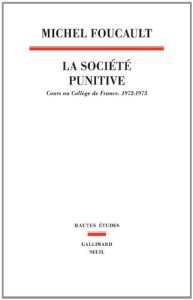
318prs0sjdlMy substantial (c. 8,000 words) essay on Foucault’s La société punitive is forthcoming in Historical Materialism.

Thanks to Sebastian Budgen for his invitation to write this, and Alberto Toscano for taking it through two rounds of review.

My shorter review of this important lecture course appeared in Berfrois earlier this year. You can also hear me lecturing on the course in Melbourne here.

View original post

Ian Hunter, History of Theory workshop

When: October 8th, 12pm-5.30pm

Where: C2.05, Burwood campus, Deakin University, Melbourne, Australia

12pm. Prof. Ian Hunter (UQ): History of Theory: a précis

1pm. Dr Matthew Sharpe (Deakin): Idols of the Den in the Personae of the Theorist

2pm. A/Prof. Adrian Jones (LTU): “Theory” as coming out of Being or as an Ascesis: Implications of New Notions of Mind

3pm. Dr Richard Sebold (LTU): Truth, History, and the Persona of the Theorist

4pm. Prof. Jack Reynolds (Deakin): University metaphysics today: the analytic-continental divide and the fate of transcendental phenomenology in the light of Hunter

5pm. Prof. Ian Hunter (UQ): rejoinders, discussion

5.30 conclude

The workshop is hosted by the European Philosophy and the History of Ideas Research Group (EPHI), Deakin University.

For further information, please contact Jack Reynolds

CALL FOR PAPERS

The fifteenth annual meeting of the Foucault Circle

University of Richmond
Richmond, Virginia

March 20-22, 2015

We seek submissions for papers on any aspect of Foucault’s work, as well as studies, critiques, and applications of Foucauldian thinking.

Paper submissions require an abstract of no more than 750 words. All submissions should be formatted as “.doc” attachments and sent via email to program committee chair Zachary Fouchard (zfouchard@gmail.com) on or before Monday, January 5th, 2015. Indicate “Foucault Circle submission” in the subject heading. Program decisions will be announced during the week of January 19th.

All abstracts should be prepared for anonymous review.

The meeting will begin Friday evening with an informal welcome session. Morning and afternoon paper sessions will be held on Saturday, followed by a business meeting and dinner. The conference will conclude with paper sessions on Sunday morning. Presenters of individual papers will have approximately 35 minutes for paper presentation and discussion combined; papers should be a maximum of 3000 words (15-20 minutes, preferably 15).

Logistical information about lodging, transportation, and other arrangements will be available after the program has been announced.

For more information about the Foucault Circle, please see our website:

or contact our Coordinator, Dianna Taylor: dtaylor@jcu.edu

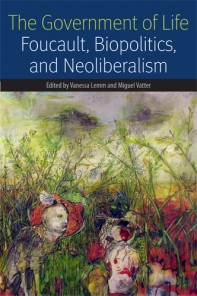
lemm-vatterVanessa Lemm, and Miguel Vatter (eds.) The Government of Life: Foucault, Biopolitics, and Neoliberalism, Fordham University Press, July 2014

ISBN: 9780823255979

Further info

See below description for details of book launch at University of NSW

Description

Foucault’s late work on biopolitics and governmentality has established him as the fundamental thinker of contemporary continental political thought and as a privileged source for our current understanding of neoliberalism and its technologies of power. In this volume, an international and interdisciplinary group of Foucault scholars examines his ideas of biopower and biopolitics and their relation to his project of a history of governmentality and to a theory of the subject found in his last courses at the College de France.

Many of the chapters engage critically with the Italian theoretical reception of Foucault. At the same time, the originality of this collection consists in the variety of perspectives and traditions of reception brought to bear upon the problematic connections between biopolitics and governmentality established by Foucault’s last works.

Book Launch
Friday 3 October 2014, 3-5pm, Morven Brown Building, 310, University of NSW
PDF of invitation

Editorial Assistant wanted, Parrhesia 

The Editorial Board of Parrhesia: A Journal of Critical Philosophy is looking for an Editorial Assistant. This is a voluntary unpaid position. Since 2005, Parrhesia has provided an open-access venue for cutting-edge work in critical philosophy, and the appointment of an Editorial Assistant will allow us to make its publication a more efficient and streamlined process.

The position involves the management of article and review essay proposals, coordination of the peer review process, overseeing of production, and issue proofreading. It will likely involve 3 to 5 hours of work per week, though this will vary depending on the moment in the publishing cycle. The appointment will begin as soon as possible, and will initially be for one year (with the possibility of renewal).

The ideal person is likely an early post-graduate student in philosophy or a cognate discipline, with a particular interest in open-access publishing. Web design skills would be a plus, but are not necessary. This is an unpaid position. Any interested applicants should apply to Dr Jon Roffe jonathan.roffe@unimelb.edu.au, briefly explain who they are and why they are interested in the role, and attach a brief CV.

Coll, S.
Power, knowledge, and the subjects of privacy: understanding privacy as the ally of surveillance
(2014) Information Communication and Society. Article in Press.

Abstract
The aim of this article is to argue that privacy, rather than serving only as a countermeasure against surveillance, can also be seen as its ‘partner-in-crime’. Normative statements made by governments and companies on privacy can be regarded as a tool of governance in service of informational capitalism. Initially defined as a fundamental freedom, privacy has become a precondition for a blossoming economy in the context of the information society. The notion of privacy, as a critique of information society, has been assimilated and reshaped by and in favour of informational capitalism, notably by being over-individualized through the self-determination principle. To develop this idea, this article builds on the results of a study on the loyalty programmes run by the four biggest retailers of Switzerland and on the Foucauldian concept of biopower. Indeed, sexual liberation and the development of scientific knowledge on sexuality, the democratization of privacy, and the emergence of scientific discourses about privacy are processes that show intriguing similarities. Like sexuality, privacy has become a ‘power-knowledge’ related to moral standards defining what privacy should be. It produces ‘subjects of privacy’ who are supposed to take care of it according to the official conception of privacy advocates and of the legislature. Finally, we suggest understanding the conception of privacy as a terrain of power struggle between the promoters of an informational capitalism based on surveillance of citizens and consumers, and those who would prefer to promote privacy as a common good leading society to more democracy and freedom.

Author Keywords
Big Data; biopower; Foucault; loyalty programmes; sociology; surveillance/privacy

DOI: 10.1080/1369118X.2014.918636