Foucault News

News and resources on French thinker Michel Foucault (1926-1984)

Gristy, C.
Engaging with and moving on from participatory research: A personal reflection
(2014) International Journal of Research and Method in Education. Article in Press.

Abstract
In this paper, I respond to the call to articulate experiences of the messy realities of participatory research. I reflect on my engagement and struggle with the realities and ethics of a piece of case study research, which set out with a participatory approach. The project involved a group of young people from an isolated rural community who appeared to be disconnecting from their secondary school. The research set out to develop understanding of the ways in which young people make connections (or not) in and with school, in order to further understanding of how schools might become more inclusive. A series of reflections on moments during the early stages of the research led to a significant shift in the methodological approach. The approach of this project eventually moved away from participatory research to an approach informed by Foucault’s ‘ethical project’. Here, the focus is on the subjection and practices of the researcher. I argue that, on reflection, the ‘ethical project’ framework was more appropriate for this kind of research, where the complexities of participatory research were reducing the transparency of complex power structures.

Author Keywords
exclusion; participatory research; representation; rural; schools; young people

DOI: 10.1080/1743727X.2014.940306

Lewis, S., Hardy, I.
Funding, reputation and targets: the discursive logics of high-stakes testing
(2014) Cambridge Journal of Education. Article in Press.

Abstract
This paper provides insights into teacher and school-based administrators’ responses to policy demands for improved outcomes on high-stakes, standardised literacy and numeracy tests in Australia. Specifically, the research reveals the effects of the National Assessment Program – Literacy and Numeracy (NAPLAN), and associated policies, in the state of Queensland. Drawing suggestively across Michel Foucault’s notions of disciplinary power and subjectivity, and Pierre Bourdieu’s concept of social fields, the research utilises interviews with teachers and school-based administrators to reveal how high-stakes, standardised testing practices served to discursively constitute performative teacher subjectivities around issues of funding, teacher and school reputation and target-setting within what is described as the ‘field of schooling practices’. The paper argues that the contestation evident within this field is also reflective and constitutive of more educative schooling discourses and practices, even as performative logics dominate.

Author Keywords
Bourdieu; disciplinarity; fields; Foucault; high-stakes testing; subjectivity

DOI: 10.1080/0305764X.2014.936826

Taylor, W.G., Piper, H., Garratt, D.
Sports coaches as ‘dangerous individuals’-practice as governmentality
(2014) Sport, Education and Society. Article in Press.

Abstract
Recent concern surrounding sports coaches’ interaction with young people has reflected a fundamental change in the way coaches and others regard the role of sports. In this paper, we consider the identification and definition of the contemporary sports coach (whether acting in a professional or volunteer capacity) as, in Foucault’s term, a ‘dangerous individual’. We suggest that the mainstream discourse of child protection and safeguarding, variously interpreted and applied, has contributed to a culture of fear in sports coaching practice. Drawing on data from a recently completed Economic and Social Research Council-funded research project, we argue that contradictions in policy and practice, which serve to privilege a particular discourse, have cast the coach as both predator and protector of young sports performers. This has undermined the role of the coach, led to intergenerational fear, created doubt about coaches’ intentions and promoted their adoption of defensive and protective practices. Utilising the concept of governmentality, we argue that, as a consequence, fundamental trust-based relationships, necessary in healthy athlete – coach engagement, have been displaced by a discourse embodied in sterile delivery and procedure governed by regulation and suspicion.

Author Keywords
Defensive coaching practices; Deprofessionalisation; Fear of the coach; Foucault; Governmentality

DOI: 10.1080/13573322.2014.899492

Hutchinson, M., Jackson, D.
The construction and legitimation of workplace bullying in the public sector: Insight into power dynamics and organisational failures in health and social care
(2014) Nursing Inquiry. Article in Press.

Abstract
Health-care and public sector institutions are high-risk settings for workplace bullying. Despite growing acknowledgement of the scale and consequence of this pervasive problem, there has been little critical examination of the institutional power dynamics that enable bullying. In the aftermath of large-scale failures in care standards in public sector healthcare institutions, which were characterised by managerial bullying, attention to the nexus between bullying, power and institutional failures is warranted. In this study, employing Foucault’s framework of power, we illuminate bullying as a feature of structures of power and knowledge in public sector institutions. Our analysis draws upon the experiences of a large sample (n = 3345) of workers in Australian public sector agencies – the type with which most nurses in the public setting will be familiar. In foregrounding these power dynamics, we provide further insight into how cultures that are antithetical to institutional missions can arise and seek to broaden the debate on the dynamics of care failures within public sector institutions. Understanding the practices of power in public sector institutions, particularly in the context of ongoing reform, has important implications for nursing.

Author Keywords
Care failures; Horizontal violence; Nursing workforce; Power; Public sector; Uncaring; Workplace bullying

DOI: 10.1111/nin.12077

smithEric C. Smith, Foucault’s Heterotopia in Christian Catacombs: Constructing Spaces and Symbols in Ancient Rome. Palgrave Macmillan, October 2014

Further info

Ringing the city like pearls on a necklace and plunging beneath the earth into darkness, the Christian catacombs of Rome have inspired and captivated people for centuries. This book takes a new approach to the study of the catacombs, using spatial theory to understand the way the catacombs were constructed, decorated, and used. Relying on the theoretical work of Michel Foucault and Henri Lefebvre, this book moves beyond traditional forms of analysis to turn a new lens to the work of understanding these monuments of early Christianity. The location and form of the Callistus Catacomb, the art found inside, the texts referenced in that art, and the community practices performed and referenced deep underground form the heart of this innovative take on the grand burial sites of the early church.

Chaput, C., Hanan, J.S.
Economic Rhetoric as Taxis: Neoliberal governmentality and the dispositif of freakonomics
(2014) Journal of Cultural Economy. Article in Press.

Abstract
This essay expands the rhetoric of economics conversation started by economist Deirdre McCloskey. Through a close engagement with Michel Foucault’s lectures at the Collège de France from 1975 to 1979, concerning the dual problematics of liberalism and biopolitics, we argue for theorizing economic rhetoric as a governmental problem of order, or taxis, which arranges value among divergent subjects beyond the dichotomies of material/cultural and global/local. This approach toward rhetoric, we further contend, takes as its strategic form what Foucault and Agamben have called a dispositif. We demonstrate this premise through a case study of Stephen Dubner and Steven Levitt’s notion of freakonomics, suggesting that it can be understood as a rhetorical dispositif working within the broader political rationality of neoliberal governmentality. We end by gesturing toward a rhetoric of the common as an alternative to the dispositif of freakonomics.

Author Keywords
agency; biopolitics; freakonomics; neoliberalism; rhetoric of economics

DOI: 10.1080/17530350.2014.942349

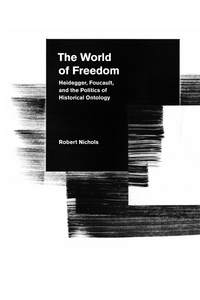
nicholsRobert Nichols, The World of Freedom. Heidegger, Foucault, and the Politics of Historical Ontology, Stanford University Press, September 2014

Martin Heidegger and Michel Foucault are two of the most important and influential thinkers of the twentieth century. Each has spawned volumes of secondary literature and sparked fierce, polarizing debates, particularly about the relationship between philosophy and politics. And yet, to date there exists almost no work that presents a systematic and comprehensive engagement of the two in relation to one another. The World of Freedom addresses this lacuna.

Neither apology nor polemic, the book demonstrates that it is not merely interesting but necessary to read Heidegger and Foucault alongside one another if we are to properly understand the shape of twentieth-century Continental thought. Through close, scholarly engagement with primary texts, Robert Nichols develops original and demanding insights into the relationship between fundamental and historical ontology, modes of objectification and subjectification, and an ethopoetic conception of freedom. In the process, his book also reveals the role that Heidegger’s reception in France played in Foucault’s intellectual development—the first major work to do so while taking full advantage of the recent publication of Foucault’s last Collège de France lectures of the 1980s, which mark a return to classical Greek and Roman philosophy, and thus to familiar Heideggerian loci of concern.

jordanMark D. Jordan, Convulsing Bodies. Religion and Resistance in Foucault, Stanford University Press, October 2014

Further info

By using religion to get at the core concepts of Michel Foucault’s thinking, this book offers a strong alternative to the way that the philosopher’s work is read across the humanities. Foucault was famously interested in Christianity as both the rival to ancient ethics and the parent of modern discipline and was always alert to the hypocrisy and the violence in churches. Yet many readers have ignored how central religion is to his thought, particularly with regard to human bodies and how they are shaped. The point is not to turn Foucault into some sort of believer or to extract from him a fixed thesis about religion as such. Rather, it is to see how Foucault engages religious rhetoric page after page—even when religion is not his main topic. When readers follow his allusions, they can see why he finds in religion not only an object of critique, but a perennial provocation to think about how speech works on bodies—and how bodies resist.

Arguing that Foucault conducts experiments in writing to frustrate academic expectations about history and theory, Mark Jordan gives equal weight to the performative and theatrical aspects of Foucault’s writing or lecturing. How does Foucault stage possibilities of self-transformation? How are his books or lectures akin to the rituals and liturgies that he dissects in them? Convulsing Bodies follows its own game of hide-and-seek with the agents of totalizing systems (not least in the academy) and gives us a Foucault who plays with his audiences as he plays for them—or teaches them.

Colin Koopman's avatarrequiem for certainty

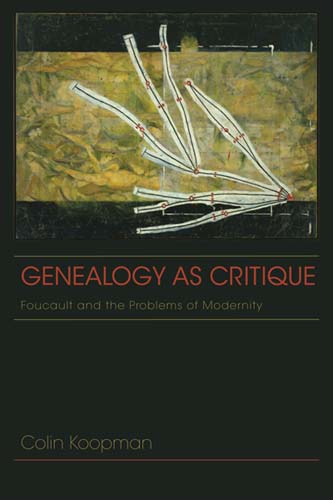
Out in the latest issue of Foucault Studies (in the review essay section)–a symposium on my ‘Genealogy as Critique.’  Honored am I that Amy Allen, Eduardo Mendieta, & Kevin Olson have taken the time to develop responses both careful and critical in orientation.  A hope is that this exchange will help further ongoing conversations about the role and status of critical theory vis-a-vis the contemporary (in Rabinow’s sense of that term).  Some of the topics covered in the symposium (which consists of responses by Allen, Mendieta, and Olson plus my reply): normativity (+ cryptonormativity + normativeness), the status of universality and contingency, the place (or not) of the transcendental in genealogy, the relation between methodology and deployment in philosophy, and how to thinking about the challenge of choosing a problem (object, space, field) for inquiry.

View original post

fs-18-14
The cover image was produced by Astra Howard, an Action Researcher/Performer currently living in Sydney Australia. Spanning more than a decade, her work has sought to elicit and document marginalised, or overlooked, experiences and discourses of the city. The specific image I have chosen is part of a series entitled ‘Kings Cross the Whisper.’ This series displays selections from a poem about the Kings Cross area that was written by a local socially marginalised man. The images alludes to forgotten histories and marginalization in an increasingly homogenised and gentrified part of Sydney.

Foucault Studies
Number 18: October 2014
Special Issue on Ethnographies of Neoliberal Governmentalities

Table of Contents

Editorial PDF
Sverre Raffnsøe, Alain Beaulieu, Sam Binkley, Barbara Cruikshank, Knut Ove Eliassen, Marius Gudmand-Høyer, Johanna Oksala, Sven Opitz, Jyoti Puri, Jens Erik Kristensen, Alan Rosenberg, Mathias Adam Munch 1-4

Special Issue on Ethnographies of Neoliberal Governmentalities

Introduction PDF
Michelle Brady 5-10
Ethnographies of Neoliberal Governmentalities: from the neoliberal apparatus to neoliberalism and governmental assemblages PDF
Michelle Brady 11-33
Fixing Non-market Subjects: Governing Land and Population in the Global South PDF
Tania Murray Li 34-48
Neo‐Liberalism, Police, and the Governance of Little Urban Things PDF
Randy K. Lippert 49-65
The Grassroots and the Gift: Moral Authority, American Philanthropy, and Activism in Education PDF
Katharyne Mitchell, Chris Lizotte 66-89
Resisting the lure of the paycheck: Freedom and dependence in financial self-help PDF
Daniel Fridman 90-112

Translations

The politics of health in the eighteenth century PDF
Michel Foucault 113-127
Bio‐history and bio‐politics PDF
Michel Foucault 128-130

Articles

Disciplining the Ethical Couponer: A Foucauldian Analysis of Online Interactions PDF
Stephanie Gonzalez Guittar, Shannon K. Carter 131-153
Michel Foucault and Michael Oakeshott: The Virtuosity of Individuality PDF
Jacob Segal 154-172
Law, Objectives of Government, and Regimes of Truth PDF
Leila Brännström 173-194

Section in collaboration with Foucault Circle

Introduction to section from the 12th Annual Foucault Circle Conference PDF
Devonya N. Havis, Richard A. Lynch 195-196
Spotting the Primacy of Resistance in the Virtual Encounter of Foucault and Deleuze PDF
Marco Checchi 197-212
Platonism, Christianity, Stoicism: The Subject, The Truth, And The Political Import Of Their Relationship In Three Traditions PDF
Robin Weiss 213-237

Review Essay section

The Normative and the Transcendental: Comments on Colin Koopman’s Genealogy as Critique PDF
Amy Allen 238-244
On Left Kantianism: From Transcendental Critique to the Critical Ontology of the Present PDF
Eduardo Mendieta 245-252
Genealogy, Cryptonormativity, Interpretation PDF
Kevin Olson 253-260
Genealogy, Methodology, & Normativity beyond Transcendentality: Replies to Amy Allen, Eduardo Mendieta, & Kevin Olson PDF
Colin Koopman 261-273

Review Essay

Outside In, Inside Out, Again and Yet Again: Foucault’s Game in Wrong-Doing, Truth-Telling PDF
Daniel T. O’Hara 274-278

Reviews

Double review: Artières & Bert, Un succès philosophique: L’Histoire de la folie à l’âge classique de Michel Foucault ; Histoire de la folie à l’âge classique de Michel Foucault. Regards critiques 1961-2011, Textes choisis et présentés par Artières et al. PDF
Elisabetta Basso 279-286
Tom Roach, Friendship as a Way of Life: Foucault, AIDS, and the Politics of Shared Estrangement (New York: SUNY Press, 2012) PDF
Matthew Halse 287-290
David Galston, Archives and the Event of God: The Impact of Michel Foucault on Philo-sophical Theology (Montreal McGill-Queens’ University Press, 2011) PDF
Ebru Thwaites 291-292
Lauri Siisiainen, Foucault and the Politics of Hearing (New York: Routledge, 2012) PDF
Perry Zurn 293-296
Lee Braver, Groundless Grounds: A Study of Wittgenstein and Heidegger (Cambridge: MIT Press, 2012) PDF
Apple Zefelius Igrek 297-300
Thomas Nail, Returning to Revolution: Deleuze, Guattari and Zapatismo (Edinburgh University Press, 2012) PDF
Nathan Widder 301-304
Double review: Maudemarie Clark and David Dudrick, The Soul of Nietzsche’s Beyond Good and Evil ; Christa Davis Acampora and Keith Ansell Pearson, Nietzsche’s Beyond Good and Evil: A Reader’s Guide PDF
Robert Guay