Foucault News

News and resources on French thinker Michel Foucault (1926-1984)

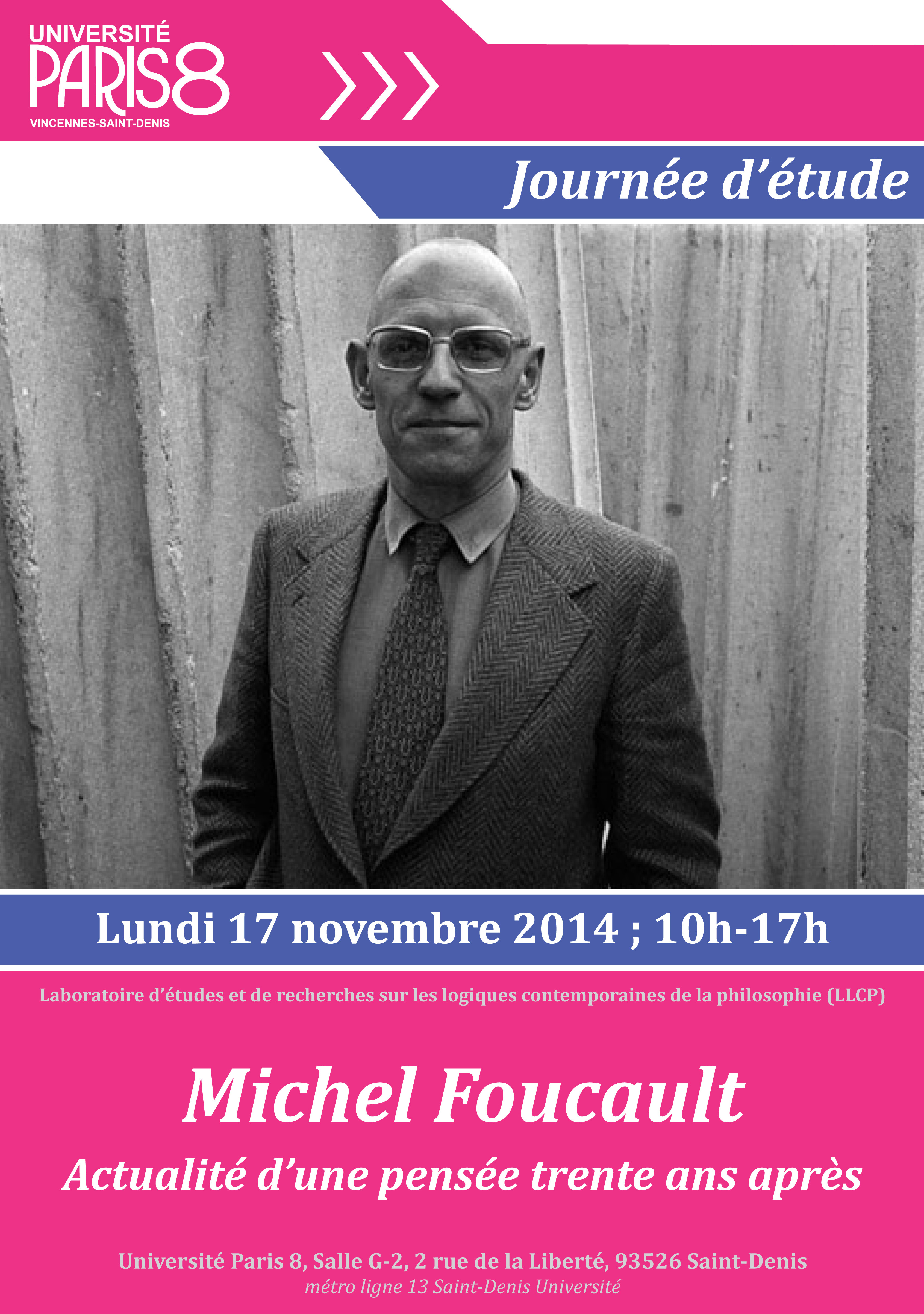
Journée Foucault Paris 8 (1)

Journée Foucault Paris 8:  PDF of Program

Marco DÍAZ MARSÁ / Jorge DÁVILA ROJAS, De la historia del pensamiento y de sus principios. Aproximación a Michel Foucault, REVISTA LOGOS. ANALES DEL SEMINARIO DE METAFÍSICA, Vol. 47 2014, pp. 81-109.

(Universidad Complutense de Madrid, España / Universidad de los Andes, Mérida, Venezuela)

On the History of Thought and its Principles. Approach to Michel Foucault


De la historia del pensamiento y de sus principios. Aproximación a M. Foucault“.

Resumen: 

Este estudio se define y articula a partir de la pregunta por el significado, sentido y estructura de la noción de “historia del pensamiento”, tal como ésta emerge y actúa desde los últimos pronunciamientos e intervenciones de Foucault, de un modo singularmente claro y revelador a partir de la primera versión del Prefacio a la “Historia de la sexualidad” (1984), texto del que nos ocupamos con atención prioritaria a lo largo de este trabajo.

Palabras clave: Problematización, actualidad, historia, crítica, ontología, filosofía,política, principio.

Abstract

This study is defined and articulated on grounds of the question about the meaning,sense and structure of the notion of “history of thought” as it rises and functions from Foucault’s last declarations and interventions, in a particularly clear and illuminating way after the first version of the Préface à l’“Histoire de la sexualité” (1984), which we will mindfully approach along this work.

Keywords: Problématisation, actuality, history, critique, ontology, philosophy, politics, principle.

Steven Hutchinson, Intelligence, reason of state and the art of governing risk and opportunity in early modern Europe, Economy and Society, Volume 43, Issue 3, 2014

DOI: 10.1080/03085147.2014.883796

Abstract

Drawing upon primary and secondary historical material, this paper explores the role of intelligence in early modern government. It focuses upon developments in seventeenth- and early-eighteenth-century England, a site-specific genealogical moment in the broader history of state power/knowledges. Addressing a tendency in Foucauldian work to neglect pre-eighteenth-century governance, the analysis reveals a set of interrelated processes which gave rise to an innovative technique for anticipating hazard and opportunity for the state. At the intersection of raison d’État, the evolving art of government, widespread routines of secrecy and a post-Westphalia field of European competition and exchange, intelligence was imagined as a fundamental solution to the concurrent problems of ensuring peace and stability while improving state forces. In the administrative offices of the English Secretary of State, an assemblage of complex and interrelated procedures sought to produce and manipulate information in ways which exposed both possible risks to the state and potential opportunities for expansion and gain. As this suggests, the art of intelligence played an important if largely unacknowledged role in the formation and growth of the early modern state. Ensuring strategic advantage over rivals, intelligence also limited the ability of England’s neighbours to dominate trade, control the seas and master the colonies, functioning as a constitutive feature of European balance and equilibrium. As the analysis concludes, understanding intelligence as a form of governmental technique – a way of doing something – reveals an entirely novel way of thinking about and investigating its myriad (historical and contemporary) formations.

Call for Papers: Soft Power Third Issue: June 30, 2015

Soft Power: Euro-American Journal of Historical and Theoretical Studies of Politics

Soft Power is an inter-disciplinary academic journal published in 2014 by the Grupo Planeta, one of the leading publishers in the Spanish-speaking world. It is supported by the University of Salerno and the Universidad Católica de Colombia.

The aim of the journal is to be a forum of discussion for researches and scholars interested in the changes of contemporary political and legal
 orders. Through an approach that integrates philosophy, legal and political theory and history, it tries to investigate the diffused and fragmentary power dispositifs emerging forms social practices that bring to light new aspects of political and legal rationality. In particular, research interests focus on transformations of law and politics in contemporary neoliberalism.

The main topics of third issue is: Governmentality and Soft Power. Its editor is Salvo Vaccaro (University of Palermo)

On one side, the concept of governmentality in Foucault introduces the notion of “conduire les conduits”, that’s to say a practice of power which is not hierarchical, vertical, repressive; on the other side, this same concept is useful in order to investigate the new forms of post-democratic regimes which are typical in the era of neoliberalism.

Soft Power invites submissions of articles of 6,500 to 7,500 words, including footnotes, on any aspect related to notions and practice of Governmentality and Soft Power.

Proposals with Name, tentative Title, little Abstract (max 20 lines) and Keywords should be submitted by December 20, 2014. Acceptance of the proposals shall be communicated by January 10, 2015, but this does not commit any real publication. Articles for issue number 3 should be submitted by April 10, 2015.

Philosophical, theoretical, historical and interdisciplinary articles are welcome. All articles are peer-reviewed using a double-blind peer-review process. Articles must be written in English or in Spanish. Abstracts and keywords must be in English as well as in Spanish in order to facilitate the inclusion in international databases and indexing services.

For more information, for the author’s style guide, and for submission of 
articles, please write to: softpower.journal@gmail.com

Detti, Scritti & Corsi : la Filosofia di Michel Foucault (1984-2014)
[Org: Rossano Pecoraro], Quadranti, Volume II, nº 1, 2014

Sommario

p. 3 / Nota del Direttore
p. 4 / Diogo Sardinha – Balibar e Foucault: introdução a um prefácio
p. 11 / Étienne Balibar – Como se uma filosofia houvesse nascido
p. 23 / Daniele Lorenzini – La tentazione ontologica di Michel Foucault
p. 39 / Manuel Mauer – L’archéologie foucaldienne de la vie
p. 62 / Laura Bazzicalupo – Foucault e la naturalizzazione dell’umano
p. 80 / Miguel de Beistegui – The Subject of Truth: On Foucault’s Lectures on the “Will to Know”
p. 100 / Luca Paltrinieri – Archeologia della volontà. Una preistoria delle “Lezioni sulla volontà di sapere”
p. 136 / Mario Autieri – Democrazia e “liberalismo” in M. Foucault
p. 152 / Óscar Martiarena – Observaciones sobre la noción de gobierno en los últimos cursos de Michel Foucault en el “Collège de France”
p. 183 / Carlos A. Manrique – – La dramatización de la verdad, y la discursividad de los cuerpos (líneas de resonancia entre los estudios de Foucault sobre la gubernamentalidad neoliberal y la parrhesía cínica)
p. 206 / Luiz Celso Pinho – O imperativo do discurso corajoso: a “parresia” no último curso de Foucault
p. 216 / Rodrigo Castro Orellana – Foucault y el debate postcolonial. Historia de una recepción problemática
p. 250 / Vera Malaguti Batista – Foucault na periferia da barbárie
p. 264 / Mariana Canavese – Señas particulares: la fortuna argentina y latinoamericana de Foucault
p. 283 / María Emilia Tijoux & Gonzalo Díaz Letelier – Inmigrantes, los “nuevos bárbaros” en la gramática biopolítica de los estados contemporáneos
p. 310 / Angela Donini – Biopolítica e tecnossexualidade
p. 321 / Juan Pablo Arancibia Carrizo – Lenguaje, Tragedia y Melancolía en la Filosofía Política de Foucault
p. 360 / Stefano Righetti – Foucault, l’invisibile e la fotografia

© La revisione del testo e le opinioni ivi espresse sono di esclusiva responsabilità degli Autori

Gristy, C.
Engaging with and moving on from participatory research: A personal reflection
(2014) International Journal of Research and Method in Education. Article in Press.

Abstract
In this paper, I respond to the call to articulate experiences of the messy realities of participatory research. I reflect on my engagement and struggle with the realities and ethics of a piece of case study research, which set out with a participatory approach. The project involved a group of young people from an isolated rural community who appeared to be disconnecting from their secondary school. The research set out to develop understanding of the ways in which young people make connections (or not) in and with school, in order to further understanding of how schools might become more inclusive. A series of reflections on moments during the early stages of the research led to a significant shift in the methodological approach. The approach of this project eventually moved away from participatory research to an approach informed by Foucault’s ‘ethical project’. Here, the focus is on the subjection and practices of the researcher. I argue that, on reflection, the ‘ethical project’ framework was more appropriate for this kind of research, where the complexities of participatory research were reducing the transparency of complex power structures.

Author Keywords
exclusion; participatory research; representation; rural; schools; young people

DOI: 10.1080/1743727X.2014.940306

Lewis, S., Hardy, I.
Funding, reputation and targets: the discursive logics of high-stakes testing
(2014) Cambridge Journal of Education. Article in Press.

Abstract
This paper provides insights into teacher and school-based administrators’ responses to policy demands for improved outcomes on high-stakes, standardised literacy and numeracy tests in Australia. Specifically, the research reveals the effects of the National Assessment Program – Literacy and Numeracy (NAPLAN), and associated policies, in the state of Queensland. Drawing suggestively across Michel Foucault’s notions of disciplinary power and subjectivity, and Pierre Bourdieu’s concept of social fields, the research utilises interviews with teachers and school-based administrators to reveal how high-stakes, standardised testing practices served to discursively constitute performative teacher subjectivities around issues of funding, teacher and school reputation and target-setting within what is described as the ‘field of schooling practices’. The paper argues that the contestation evident within this field is also reflective and constitutive of more educative schooling discourses and practices, even as performative logics dominate.

Author Keywords
Bourdieu; disciplinarity; fields; Foucault; high-stakes testing; subjectivity

DOI: 10.1080/0305764X.2014.936826

Taylor, W.G., Piper, H., Garratt, D.
Sports coaches as ‘dangerous individuals’-practice as governmentality
(2014) Sport, Education and Society. Article in Press.

Abstract
Recent concern surrounding sports coaches’ interaction with young people has reflected a fundamental change in the way coaches and others regard the role of sports. In this paper, we consider the identification and definition of the contemporary sports coach (whether acting in a professional or volunteer capacity) as, in Foucault’s term, a ‘dangerous individual’. We suggest that the mainstream discourse of child protection and safeguarding, variously interpreted and applied, has contributed to a culture of fear in sports coaching practice. Drawing on data from a recently completed Economic and Social Research Council-funded research project, we argue that contradictions in policy and practice, which serve to privilege a particular discourse, have cast the coach as both predator and protector of young sports performers. This has undermined the role of the coach, led to intergenerational fear, created doubt about coaches’ intentions and promoted their adoption of defensive and protective practices. Utilising the concept of governmentality, we argue that, as a consequence, fundamental trust-based relationships, necessary in healthy athlete – coach engagement, have been displaced by a discourse embodied in sterile delivery and procedure governed by regulation and suspicion.

Author Keywords
Defensive coaching practices; Deprofessionalisation; Fear of the coach; Foucault; Governmentality

DOI: 10.1080/13573322.2014.899492

Hutchinson, M., Jackson, D.
The construction and legitimation of workplace bullying in the public sector: Insight into power dynamics and organisational failures in health and social care
(2014) Nursing Inquiry. Article in Press.

Abstract
Health-care and public sector institutions are high-risk settings for workplace bullying. Despite growing acknowledgement of the scale and consequence of this pervasive problem, there has been little critical examination of the institutional power dynamics that enable bullying. In the aftermath of large-scale failures in care standards in public sector healthcare institutions, which were characterised by managerial bullying, attention to the nexus between bullying, power and institutional failures is warranted. In this study, employing Foucault’s framework of power, we illuminate bullying as a feature of structures of power and knowledge in public sector institutions. Our analysis draws upon the experiences of a large sample (n = 3345) of workers in Australian public sector agencies – the type with which most nurses in the public setting will be familiar. In foregrounding these power dynamics, we provide further insight into how cultures that are antithetical to institutional missions can arise and seek to broaden the debate on the dynamics of care failures within public sector institutions. Understanding the practices of power in public sector institutions, particularly in the context of ongoing reform, has important implications for nursing.

Author Keywords
Care failures; Horizontal violence; Nursing workforce; Power; Public sector; Uncaring; Workplace bullying

DOI: 10.1111/nin.12077

smithEric C. Smith, Foucault’s Heterotopia in Christian Catacombs: Constructing Spaces and Symbols in Ancient Rome. Palgrave Macmillan, October 2014

Further info

Ringing the city like pearls on a necklace and plunging beneath the earth into darkness, the Christian catacombs of Rome have inspired and captivated people for centuries. This book takes a new approach to the study of the catacombs, using spatial theory to understand the way the catacombs were constructed, decorated, and used. Relying on the theoretical work of Michel Foucault and Henri Lefebvre, this book moves beyond traditional forms of analysis to turn a new lens to the work of understanding these monuments of early Christianity. The location and form of the Callistus Catacomb, the art found inside, the texts referenced in that art, and the community practices performed and referenced deep underground form the heart of this innovative take on the grand burial sites of the early church.