Foucault News

News and resources on French thinker Michel Foucault (1926-1984)

Call for papers

CRMEP 2015 Graduate Conference: Philosophy, Power, Potentialities

Centre for Research in Modern European Philosophy,

Kingston University London, Penrhyn Road campus, KT1 2EE

Thursday 21st – Friday 22nd May 2015

Confirmed keynote speaker: Alenka Zupančič (Slovenian Academy of Sciences and Arts/EGS)

Deadline for abstracts: 28th February 2015

* * *

In a contemporary discourse suffused with the theme of ‘crisis’ – political, economic, educational, social, ecological, technical – what are the resources of philosophy at this moment for thinking power relations and potentialities?

‘Power’ has long been a central concept for philosophy and critical thought. The theme gained particular influence in the wake of Michel Foucault’s studies of the 1970s and ’80s, spurring productive dialogue with different accounts of power and domination provided by the feminist, post-colonial and Marxist traditions, and in race/ethnicity, gender and queer studies. More recent European thought – drawing on influences as broad as Spinoza, Marx, Aristotle, Heidegger, Benjamin, mathematics and religious texts – has provided challenging new resources for thinking power, potency, potentiality, subjectivities and politics.

For all this, to what extent can philosophy in 2014 help comprehend contemporary social and political forces? Can it think the powers and potentialities at work within our modern context? Have the concepts of power, potency and potentiality been adequately theorised? How might these concepts help us to think the relation of theory and practice? How do powers and other force relations manifest themselves in the very location of philosophical and critical thought itself?

We invite papers from a broad spectrum of disciplines engaging with modern European philosophy, on topics that could include (but are not limited to):

  • contemporary conceptualisations of power (Marxist, post-Marxist, post-colonial, feminist and other)
  • historical potentialities
  • theorising the reversibility of social power relations in gender, sexuality and race/ethnicity studies
  • actualisations of philosophy, contemporary impacts
  • theories of resistance
  • the potential of philosophical history: dynamis, energeia, potestas, potentia
  • regimes, discourses, institutions of power
  • power and limits of critique
  • contemporary political power, crisis, and philosophical/critical responses

Please send 300-word abstracts to: crmepagc@gmail.com by 28th February 2015.


Barry Stocker's avatarStockerblog

My latest post at the New APPS group blog

Continuing from my last post on ‘Style of Living versus Juridification in Foucault’, there seems to be me to be something to be gained by thinking about Kierkegaard’s ethics here, even if Kierkegaard’s Christianity and Foucault’s aesthetic self seem rather distinct. The emphasis in Foucault on style or aesthetics of life or existence seems to be be already the object of criticism, in Kierkegaard’s account of the aesthetic (as a mode of life rather than with regard to the appreciation of art and beauty). However, Foucault does refer on occasion to the self as acting on itself in Kierkegaard. So Kierkegaard has a particular importance in suggesting that the self is not just an observing consciousness.

Kierkegaard’s attitude to the self , and modes of living, is in some degree structured by an understanding of the relation between individuality and…

View original post 79 more words

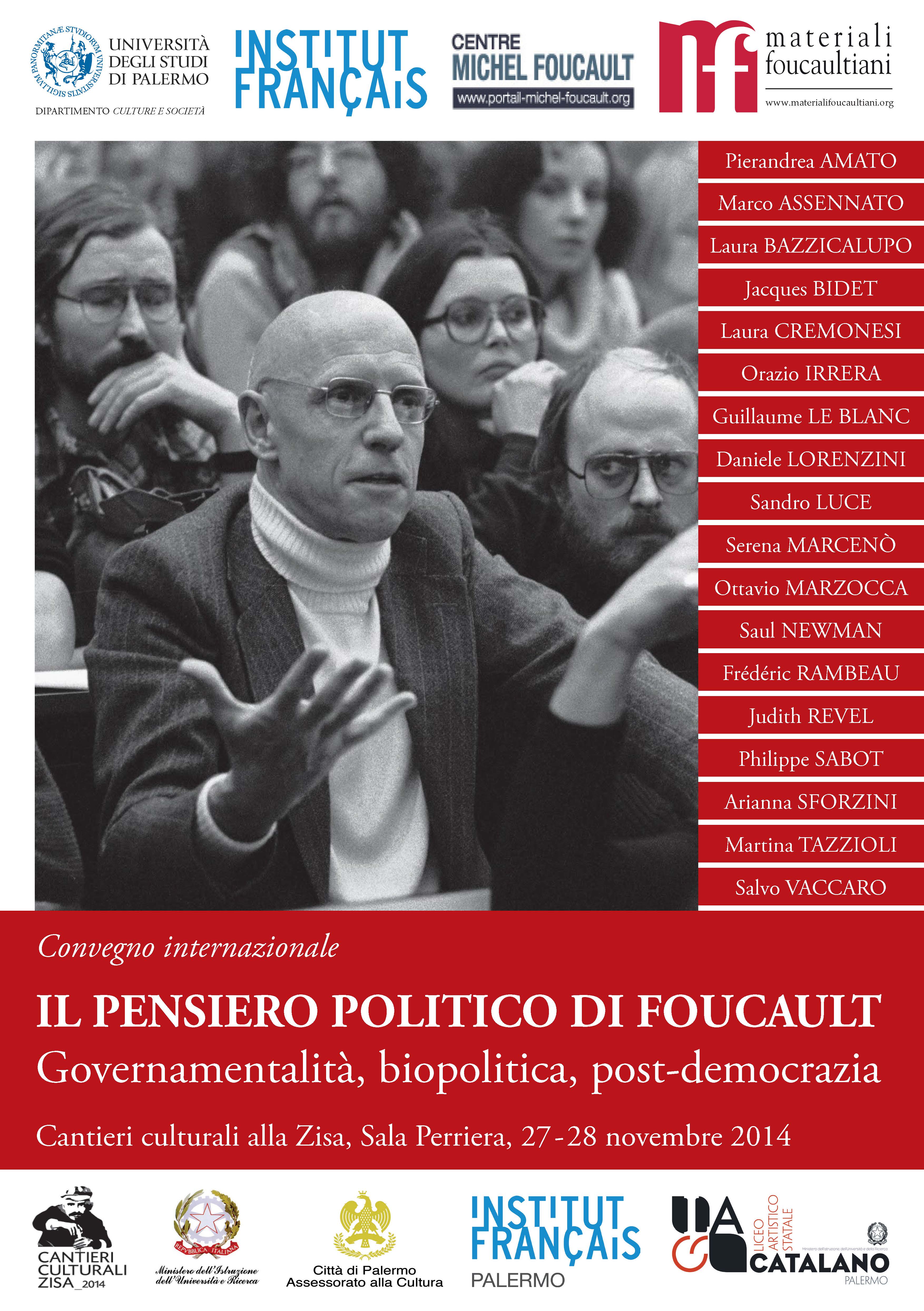
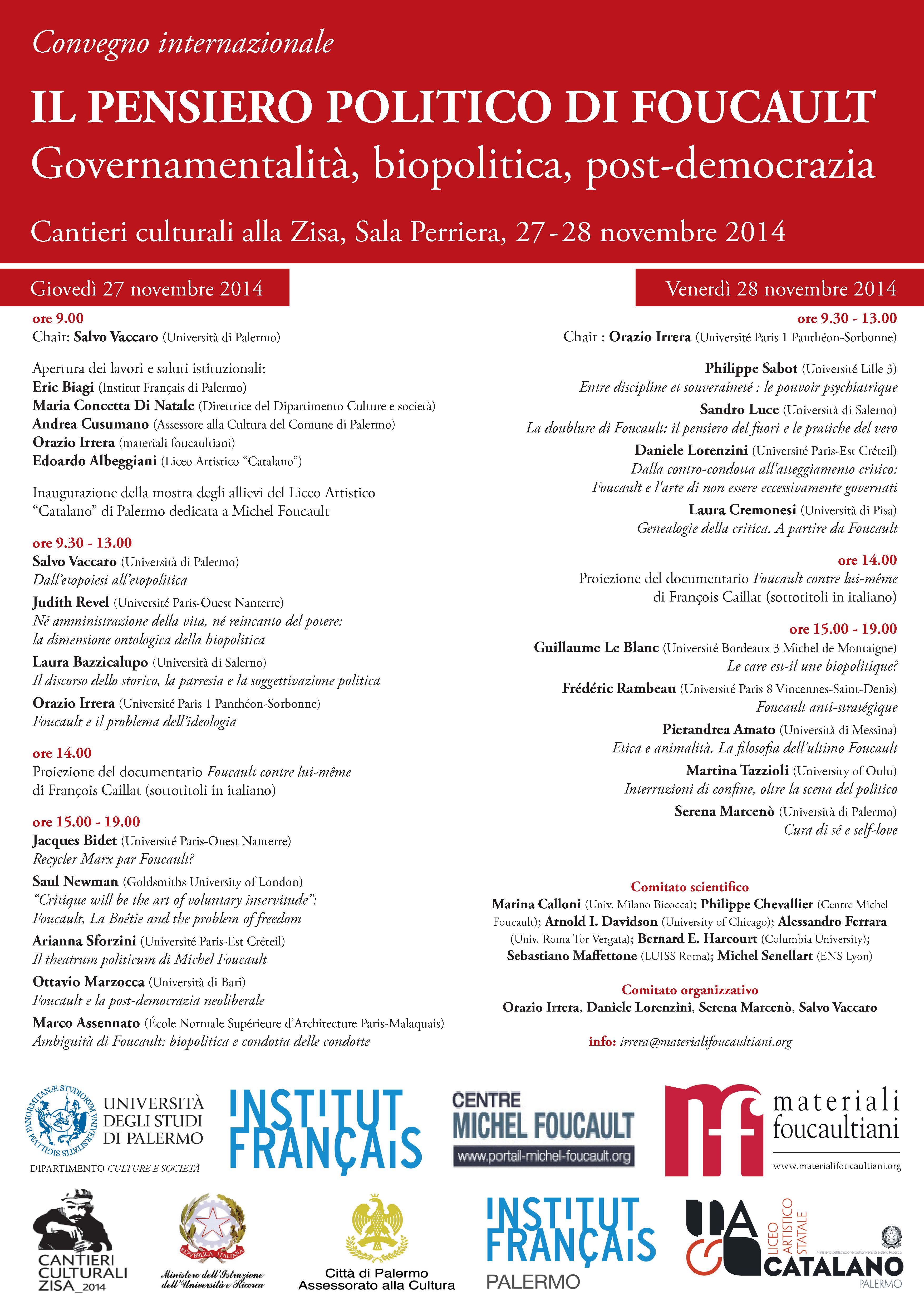
PDF for download

Conference website

Palermo2014_Page_1

Palermo2014_Page_2


CFP: Time Served: Discipline and Punish 40 Years On

Nottingham Trent University is now accepting submissions for their 2015 conference on Michel Foucault‘s “Discipline and Punish.” The deadline for submissions is March 1, 2015.

11-12 September 2015, The Galleries of Justice, Nottingham, UK

40 years after it was first published in French, the impact of Michel Foucault’s seminal text Discipline and Punish on theories of incarceration, discipline and power remains largely unchallenged. The aim of this conference is to revisit the text in light of the past four decades of penal developments, public debate and social consciousness on incarceration as it continues to constitute society’s mode of punishment par excellence.

In addition to thinking through the legacy of Discipline and Punish and its continued relevance today, specific focus will be given to the text itself, its position within Foucault’s wider critical project and its important relationship with his activism most notably the work of the GIP [Groupe d’Information sur les prisons] during the early 1970s. For example, the publication in 2013 of his 1973 lectures at the Collège de France on La Société Punitive, calls for a return to this period and a new engagement with Foucault’s work on prisons, not least in its pursuit of a more openly Marxist critique of the relationship between incarceration and bourgeois capital accumulation.

Here, attention should also be paid to Foucault’s methodology in researching and writing the text. Discipline and Punish marks his movement from an archeological to a genealogical approach towards what he terms the ‘history of the present.’ What is at stake in this shift and how effective is his genealogical method for thinking through the material and discursive structures of incarceration operating within our own society and moment? How does the juxtaposition set up between the torture and killing of Damiens and the prison timetable of the book’s opening raise important questions not simply about punishment but the role of representation – images and narratives of incarceration – in framing public consciousness about the space of the prison?

It is hoped that the conference will bring together a range of participants: scholars working in the fields of philosophy, sociology, criminology, urban geography, architecture, history, literature, media studies as well as artists, writers and activists involved in projects based in and about prisons and their conditions.

If you would like to offer a paper or other form of intervention, please send us a 250 word abstract along with your name, e-mail and (if relevant) institutional affiliation. If you would like to organize a panel of 3 or 4 presenters, please also send a panel title along with the abstracts and contact details.

Deadline for abstracts: 1 March 2015.

E-mail: sophie.fuggle@ntu.ac.uk

The conference is organized by Nottingham Trent University and will be held at the Galleries of Justice in Nottingham.

Call for Papers: Critical Spaces – Disorienting the Topological

Critical Spaces Call for Papers

Facebook page

***The deadline for applications has now been extended to Friday 14th November 2014***

A graduate conference in the critical humanities to be hosted by The London Graduate School at Kingston University, London.

Monday 5th January 2015

Keynote speakers will include:

Claire Colebrook

Eyal Weizman

Eleni Ikoniadou

Fred Botting

Call for Papers:

“The present epoch will perhaps be above all the epoch of space.” — Michel Foucault ‘Of Other Spaces’

“Oh God! I could be bounded in a nutshell and count myself a king of infinite space.” —Hamlet

Foucault’s assertion that the present epoch will be one of space immediately evokes the temporal. Whether we consider our epoch as modern, postmodern, or as nonmodern, the philosophical treatment of space has been subordinated to time. Elizabeth Grosz has suggested that philosophy could draw on architecture to consider itself as a form of building or dwelling rather than as reflection of thought, evoking the spatial already implied by Heidegger. Occupy Wall Street and other recent anti-establishment protests in Brazil and Istanbul have been defined by journalist Bernardo Gutierrez as forming ‘a new architecture of protest’, convened by networks of consensus rather than dominant groups and ideology. Current theories and practices surrounding geopolitics, metamodelling, neuroscience, cartography and choreography support this growing emphasis on spatiality – whether focusing on produced space, social space and spaces of resistance, imaginary and poetic space, psychoanalytical and embodied space, sovereign space, performative space, digital space and/or virtual space.

This conference invites interdisciplinary approaches to the spatial. In particular we are interested in how thinking spatially or spatial practices reveal and open up disruptive, subversive or minoritarian fields within already existing discourses, be they philosophical, political, cultural or aesthetic. As Foucault has done in defining heterotopias, and as Edward Soja shows us through the idea of ‘thirding as othering’, it aims to rupture not only the particularities of those discourses, but the very possibility of thought itself through challenging existing borders, boundaries, horizons, surfaces and planes.

We welcome proposals from all approaches including but not limited to: New Materialisms, Non-philosophy, Philosophy and Praxis, Cultural Studies, Political Theory, Geography, Architecture, Postcolonial Theory, Feminist and Queer Theory, Literature, Visual Cultures, and Art Theory and Practice, which consider space in the broadest terms. We also welcome proposals for practice based approaches and interventions.

Please send abstracts of no more than 300 words to lgscriticalspaces@gmail.com by Friday 31 October 2014.

stuartelden's avatarProgressive Geographies

I’ve made some additions and amendments to the Foucault Resources page on this blog.

Among other things, the two contributions from Graham Burchell are linked; I’ve updated the table of Foucault’s various plans for The History of Sexuality, with a list of his lecture courses and related material; and it also has links to various other bits and pieces, including some short translations of material unavailable elsewhere.

View original post

Foucault-Genealogie_1 Brindisi, Cremonesi, Gros, Harcourt, Irrera, Lorenzini, Senellart, Tazzioli, Foucault e le genealogie del dir-vero Cronopio (collana “Tessere”), Napoli 2014, pp. 219 ,

In occasione del trentesimo anniversario della morte di Foucault, questo volume raccoglie i contributi alla giornata di studi organizzata da “materiali foucaultiani” all’école des Hautes études en Sciences Sociales il 27 marzo 2013 sulla genealogia foucaultiana del dir-vero e sull’emergere della soggettività nelle forme giuridiche e penali nelle società occidentali. I contributi presentati in questo volume si addensano intorno a una delle fasi ancora meno studiate dell’opera di Foucault, quella tra il 1980 e il 1981, e si concentrano sul ruolo strategico giocato dall’ingiunzione a “dire il vero” nei meccanismi governamentali contemporanei. Foucault mostra, infatti, la rilevanza politica delle pratiche di veridizione all’interno delle procedure (giuridiche, economiche, medico-psichiatriche, ecc.) del governo degli uomini, ma apre anche uno spazio fondamentale di riflessione sulle forme etico-politiche di resistenza che, oggi, è possibile opporre loro.

 Indice

Laura CREMONESI, Orazio IRRERA, Daniele LORENZINI, Martina TAZZIOLI

Introduzione

Frédéric GROS

Soggetto morale e sé etico in Foucault

Orazio IRRERA

La verità come forza. Dir-vero, potere e soggettività nell’ultimo Foucault

Michel SENELLART

Il corso Del governo dei viventi nella prospettiva della Storia della sessualità

Laura CREMONESI

Veridizione antica e veridizione cristiana in Michel Foucault

Gianvito BRINDISI

L’Edipo re tra governo, giurisdizione e veridizione

Daniele LORENZINI

Genealogia della verità e politica di noi stessi

Martina TAZZIOLI

Condotte di non-verità. Biografie irregolari e confessione senza verità nel governo dei rifugiati

Bernard E. HARCOURT

Le forme di verità e le forme giuridiche. Una lettura incrociata di Mal fare, dir vero e di La verità e le forme giuridiche per un’ermeneutica del presente


Mobilities and Foucault. Special Issue, Mobilities Volume 9, Issue 4, 2014

Further info

Introduction to Special Issue on ‘Mobilities and Foucault’
Katharina Manderscheid, Tim Schwanen & David Tyfield

‘One Must Eliminate the Effects of … Diffuse Circulation [and] their Unstable and Dangerous Coagulation’: Foucault and Beyond the Stopping of Mobilities
Chris Philo

Securing Circulation Through Mobility: Milieu and Emergency Response in the British Fire and Rescue Service
Nathaniel O’Grady

Prison and (Im)mobility. What about Foucault?
Christophe Mincke & Anne Lemonne

Veins of Concrete, Cities of Flow: Reasserting the Centrality of Circulation in Foucault’s Analytics of Government
Mark Usher

Governing Mobilities, Mobilising Carbon
Matthew Paterson

Putting the Power in ‘Socio-Technical Regimes’ – E-Mobility Transition in China as Political Process
David Tyfield

The Movement Problem, the Car and Future Mobility Regimes: Automobility as Dispositif and Mode of Regulation
Katharina Manderscheid

Lanuza, G.M.
Agency and Governmentality: The Regulation and resistance of Muslim students in a public high school
(2013) Asia-Pacific Social Science Review, 13 (2), pp. 63-78.

Further info

Abstract
This paper is an attempt to show how Michel Foucault’s notion of governmentality can be used to illustrate the regulation of Muslim students while engaging in self-making in the context of the disciplinary feld of a public high school. Using ethnographic data, this paper argues that Muslim students are not just passive subjects; rather, they are active agents in constituting their identities while simultaneously subjected to the power relations in the school. Towards the end of the paper, I propose certain policy recommendations that could address the problems generated by current specifc form of rationality of government that normalizes Muslim students in public schools. © 2013 De La Salle University, Philippines.

Author Keywords
Foucault; Governmentality; Identity; Muslim; Reproduction

Miró-Bonet, M., Bover-Bover, A., Moreno-Mulet, C., Miró-Bonet, R., Zaforteza-Lallemand, C.
Genealogy as a critical toolbox: Deconstructing the professional identity of nurses
(2014) Journal of Advanced Nursing, 70 (4), pp. 768-776.

Abstract
Aim: To discuss the Foucauldian concept of genealogy as a framework for understanding and transforming nurses’ professional identity. Background: The professional identity of nurses has primarily been defined by personal and interpersonal attributes and by the intradisciplinary dimensions of nursing, leading to its conceptualization as a universal, monolithic phenomenon. The Foucauldian genealogical perspective offers a critical lens to examine what constitutes this professional identity; Spanish nursing offers a historical case study of an active effort to impose an identity that fits the monolithic ideal. Data sources: Five of the 33 professional conduct manuals for nurses’ training published from 1956-1976 during the Franco dictatorship in Spain and six interviews with nursing instructors or students at the time were analysed using a theoretical framework drawn from Foucault’s writing. Discussion: Foucault’s genealogical framework considers practices of normalization and resistance as a means of understanding knowledge continuities and discontinuities, clarifying practices that constitute nurses’ professional identity in a particular way in specific contexts and analysing the implications of this theoretical frame. Implications for nursing: The genealogy concept offers valuable tools to determine how professional identities are constituted, questions assumptions about the profession and its professionals and envisions alternative approaches. This theoretical approach helps both scholars and practitioners understand, question and transform their practices as needed. Conclusion: The genealogical approach prioritizes analysis of the phenomenon over its description and challenges many unknown, forgotten, excluded and/or unquestioned aspects of identity from a position of diversity and complexity.

Author Keywords
Discourse; Foucault; Genealogy; Identity; Nursing history; Poststructuralism; Power; Profession; Qualitative research

DOI: 10.1111/jan.12236