
Foucault News

News and resources on French thinker Michel Foucault (1926-1984)

Martin Paul Eve, Foucauldian methodologies for considering emerging archives? 2015

Some notes and early (very abstract) draft thoughts on whether Foucauldian genealogies, as redefined by Colin Koopman, can help us to address the problems of the archive in contemporary fiction studies.

In Pynchon and Philosophy, I needed to give a succinct outline of the usual approach towards Foucault’s broad body of history/philosophy. In sketching the trajectory of Foucault’s career, I wrote:

Foucault’s works are most commonly split along a methodological axis that divides his early phase – designated ‘archaeology’ – and his later writings, which are termed, with deliberate Nietzschean overtones, ‘genealogies’. Archaeology consists of an excavation of the surrounding conditions that make an episteme possible; an analysis of the historical conditions that make viable a certain way of thinking that is no longer comprehensible within a contemporary context. Genealogy on the other hand takes Nietzsche’s anti-positivist ‘methodology’ – in so far that it can be thus termed – of removing the mask of universality from a specific truth at a localised level in order to show how these small fluctuations contribute to a shift in thinking. As Árpád Szakolczai puts it, genealogy centres on ‘the conditions of emergence’ while assuming ‘that reality is not a uniform surface but is built of interconnected layers’ and also ‘involves a special relation the investigator has to himself’. However, genealogy is not a retraction – it shares much in common with its preceding archaeology – it is rather one of the three ‘successive layers […] characterizing three necessarily simultaneous dimensions of the same analysis’, the others being archaeology and ‘strategy’; the overarching term that Foucault used for his methods (WC, 397). — Eve, Pynchon and Philosophy (Palgrave, 2004), pp. 77-78

read more

Part of St John’s Nottingham timeline project

Publicity from the site

To be informed and inspired by academic specialists in Philosophy or Theology often means travelling to conferences and seminars at leading universities throughout the World.

What would it be like if someone did all that for you? Travelling to the many university departments and asking the key scholars to give an introduction to the topic, movement or thinker they are specialists in.

In essence this is the vision that lies behind this educational project.

Using contemporary green screen technology and computer editing, the dozens of richly illustrated presentations from leading academics have been compiled, so that you can access them on your tablet or laptop.

Barry Stocker, Style of Living versus Juridification in Foucault, New APPS: Art, Politics, Philosophy, Science Blog, 05 October 2014

I’m making a brief exploration of one of the most significant oppositions in Foucaut’s thought, which has not been discussed that much in my experience, but I may well have overlooked some vast bibliography. In any case, there is a major polarity in Foucault between the style of living in antiquity, related to care of the self, and in which ‘style’ can be replaced by ‘aesthetics’ or ‘techne’, while ‘living’ can be replaced by ‘existence’, in ways I do not think make much difference to the current discussion. There is also a relation with the discussions of the government of the self and the use of pleasure. I am not getting into references and precise context, but outlining the general field.

Read more

stuartelden's avatarProgressive Geographies

I’ve previously posted some requests for help in locating some difficult-to-find short texts by Foucault, and thanks to readers of this site have received copies of some of these. I’ve updated the requests for help page, along with a few more requests.

I’ve also updated the list of links to pieces I’ve been able to locate – these are basically short pieces which are not in Dits et écrits or major collections of his work in English. Additions to that last list very welcome – though this list, as stated there, does not aim to replicate Richard Lynch’s important work on English translations of pieces in Dits et écrits.

View original post

Review by A. Janae Sholtz of Marcelo Hoffman, Foucault and Power: The Influence of Political Engagement on Theories of Power, Notre Dame Philosophical Reviews, 2014.09.25

Extract
[…]
Hoffman makes several signature claims. As his central thesis, he proposes the relationship between Foucault’s political and militant activities and his analysis of power as a dialectic interplay, which provides a more refined and discriminate view of the various permutations of power throughout the development of Foucault’s philosophy. The book consists of a detailed examination of the different models of power identified by Foucault (war and governmental) and an analysis of the interrelations between the different modalities of power (disciplinary, biopolitical and governmental) as they relate to specific instances of activism and desire for militant intervention. Hoffman clearly challenges readings of Foucault that demarcate his thinking according to the break with one theory of power in lieu of another. Hoffman conducts a nuanced and precise study of how subsequent iterations of power bear the residuals of predecessor accounts or are informed by them in significant ways. Thus he proposes a continuum where conceptions of power bleed into one another rather than operate as discontinuous breaks.

read more

Bea Moyes, The Necessity of Disorder in a Soft City: De Certeau vs Foucault, Part 1, The Society Pages, Sociology Lens, (blog), September 7 2014

Part two

Extract

For better or worse, [the city] invites you to remake it, to consolidate it into a shape you can live in.

In his novel Soft City, written in 1974, Jonathan Raban eloquently drew out a vision of London as a fluid city. A city in a continuous process of making and re-making by its inhabitants. A postmodern city whose central locus was not imposed and pre-constructed, as with modernist urban utopias like those of Le Corbusier, but a palimpsest. Malleable and in constant state of construction.

My own research into the fluid fabric of the city has concentrated on the social and cultural shifts in East London when Raban was writing in the 1970s. I am looking, in particular, at the influx of artists whose DIY activities and collectives were instrumental in the transformation of this area of London. Again and again looking at this period I have returned to a central debate between the two French theorists, Michel Foucault and Michel De Certeau, regarding the power relations in the spaces of everyday life. A debate which hinges not only on how we see the city, but how we continue to construct future cities.

read more

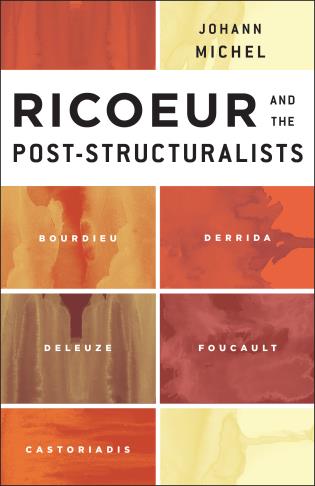
michelJohann Michel, Ricoeur and the Post-Structuralists Bourdieu, Derrida, Deleuze, Foucault, Castoriadis, Translated by Scott Davidson, Rowman & Littlefield, 2014

publisher’s page
French original edition

In this important and original book, Johann Michel paves the way for a greater understanding of Paul Ricoeur’s philosophy by exploring it in relation to some major figures of contemporary French thought—Bourdieu, Derrida, Deleuze, Foucault and Castoriadis.

Although the fertile dialogue between Ricoeur and various structuralist thinkers is well documented, his position in relation to the post-structuralist movement is less-widely understood. Does Ricoeur’s philosophy stand in opposition to post-structuralism in France or, on the contrary, is it in fact a unique variation of that movement? This book defends the latter statement. Michel speaks of post-structuralisms in the plural form and engages them in a dynamic confrontation between Ricoeur and his contemporaries in the French intellectual scene. The result is a better understanding of Ricoeur’s thought and also of the distinctive issues that emerge through confrontation between Ricoeur and each of these post-structuralist thinkers.

Foucault and neoliberalism. A pop-up online reading group.

This is a tumblr blog run by Jason Wilson with invitations to read various texts on Foucault and neoliberalism in live sessions on google hangouts.

Mark Kelly, Michel Foucault: Political Thought, Internet Encyclopedia of Philosophy.

The work of twentieth-century French philosopher Michel Foucault has increasingly influenced the study of politics. This influence has mainly been via concepts he developed in particular historical studies that have been taken up as analytical tools; “governmentality” and ”biopower” are the most prominent of these. More broadly, Foucault developed a radical new conception of social power as forming strategies embodying intentions of their own, above those of individuals engaged in them; individuals for Foucault are as much products of as participants in games of power.

The question of Foucault’s overall political stance remains hotly contested. Scholars disagree both on the level of consistency of his position over his career, and the particular position he could be said to have taken at any particular time. This dispute is common both to scholars critical of Foucault and to those who are sympathetic to his thought.

What can be generally agreed about Foucault is that he had a radically new approach to political questions, and that novel accounts of power and subjectivity were at its heart. Critics dispute not so much the novelty of his views as their coherence. Some critics see Foucault as effectively belonging to the political right because of his rejection of traditional left-liberal conceptions of freedom and justice. Some of his defenders, by contrast, argue for compatibility between Foucault and liberalism. Other defenders see him either as a left-wing revolutionary thinker, or as going beyond traditional political categories.

To summarize Foucault’s thought from an objective point of view, his political works would all seem to have two things in common: (1) an historical perspective, studying social phenomena in historical contexts, focusing on the way they have changed throughout history; (2) a discursive methodology, with the study of texts, particularly academic texts, being the raw material for his inquiries. As such the general political import of Foucault’s thought across its various turns is to understand how the historical formation of discourses have shaped the political thinking and political institutions we have today.

Foucault’s thought was overtly political during one phase of his career, coinciding exactly with the decade of the 1970s, and corresponding to a methodology he designated “genealogy”. It is during this period that, alongside the study of discourses, he analysed power as such in its historical permutations. Most of this article is devoted to this period of Foucault’s work. Prior to this, during the 1960s, the political content of his thought was relatively muted, and the political implications of that thought are contested. So, this article is divided into thematic sections arranged in order of the chronology of their appearance in Foucault’s thought.

Read more

The Centre for the History of European Discourses (CHED) at the University of Queensland (Australia) is looking for well-qualified and innovative postdoctoral researchers (no more than 5 years out of their PhD by June 30, 2015) whom it can support as applicants to the University of Queensland’s Postdoctoral Fellowship scheme, which offers full-time research-only positions for a period of three years beginning in January 2016. We are particularly interested in candidates specialising in the history of sexuality/history of medicine. A team of researchers within the Centre is currently working on topics in the intellectual and cultural history of sexuality, including Professor Peter Cryle and Dr Karin Sellberg.

Interested researchers should send their CV and a brief (200 word) outline for a project to Peter Cryle p.cryle@uq.edu.au and Karin Sellberg k.sellberg@uq.edu.au by February 8 2015

The criteria for selection are:
1.the quality and innovation of the project
2. neatness of fit with the centre’s research strengths
3. a relatively established record of publication in the field.

For further information, please visit CHED’s website or contact Peter Cryle p.cryle@uq.edu.au and Karin Sellberg k.sellberg@uq.edu.au