Foucault News

News and resources on French thinker Michel Foucault (1926-1984)

CFP: Conference: Discipline and Punish – Today

November, 5th to 7th
Bremen, Germany

Update October 2025. Link above is to the archived page on the Internet Archive Wayback Machine.

This conference is about how we can use and develop Foucault’s analysis from Discipline and Punish now, 40 years after its publication. We invite you to submit abstracts no longer than 500 words until April 31st 2015.
You may of course give your talk in English, but a passive understanding of German is needed to follow the discussions and to read the full CFP:

Frieder Vogelmann/Jörg Bernardy/Martin Nonhoff
Überwachen und Strafen heute
Bremen, 5.-7. November 2015

Vor genau 40 Jahren veröffentlichte Michel Foucault Überwachen und Strafen, ein Buch, das Schockwellen in ganz verschiedene Disziplinen schickte und mit seiner genealogischen Analyse der disziplinären Machttechniken ein theoretisches Werkzeug anbot, das seither für vielfältige Zwecke verwendet wird. Daher soll nicht die Rezeption seines Buches, sondern die Fortführung von dessen Analyse im Zentrum der Tagung stehen: Wie überwachen und strafen wir heute? Gibt es entscheidende Brüche, Mutationen und evolutionäre Weiterentwicklungen der Disziplinarmacht? Wie müssen wir Disziplin heute konzeptualisieren, um beispielsweise den reformierten Sozialstaat oder das Finanzregime der Europäischen Union zu analysieren? Oder müssen wir neue Machttypen ausfindig machen?

Überwachen heute
Dass die flächendeckende Überwachung von Bürger_innen fast aller Nationalstaaten heute gang und gäbe ist, scheint ein Faktum geworden zu sein, mit dem wir uns arrangiert haben. Im Namen von Terroristenbekämpfung, allgemeiner Gefahrenabwehr oder Kriminalprävention an Überwachung gewöhnt, konnte nicht einmal die NSA-Abhöraffäre zu einem echten Skandal werden. Doch wie analysieren wir die Machttechniken der Überwachungsdispositive und ihre Effekte auf die Subjekte? Reicht das Diagramm des Panoptikums immer noch, um die heutigen Überwachungsfantasien zu erfassen? Und wie steht unser ungeheures Verlangen nach Transparenz zu diesen alltäglich gewordenen Überwachungstechniken? Vor welche neuen politischen, pädagogischen und gesellschaftlichen Herausforderungen stellt uns der digitale Wandel, durch den die Frage nach Transparenz und Privatsphäre auf einer radikal neuen Ebene gestellt werden muss?

Strafen heute
Unsere Strafprozeduren haben sich in den letzten 40 Jahren gewandelt. Nicht nur sind Todes- und Schamstrafen (besonders in den USA) wieder populär geworden, auch ist die Bereitschaft angewachsen, mehr und härter zu strafen. Angesichts des immer dominanteren Präventionsparadigmas in der Kriminalpolitik scheint zudem der zentrale Bezug auf die »Seelen« der Täter_innen, den Foucault in Überwachen und Strafen herausarbeitet, in den Hintergrund zu treten: Nicht länger das Individuum mit seiner psychischen und sozialen Biografie, sondern die Figur des statistischen Knotenpunkts, des Individuums als Risikofaktorenbündel, bildet den Fokus einer auf Prävention umgestellten Strafkultur. Welche Machttechniken werden also heute in den Präventions- und Strafpraktiken geboren, erprobt und verfeinert – und wohin schwärmen sie aus? Müssen wir beispielsweise die Sozialpolitik mit Loïc Wacquant mittlerweile als Ergänzung der Kriminalpolitik denken, so dass aus welfare der Zweiklang workfare und prisonfare wird?

Disziplinarmacht heute
Damit stellt sich die zeitdiagnostische Frage nach den gegenwärtig dominanten Machttechniken. Denn obwohl die Gouvernementalitätsforschung in den letzten zwei Jahrzehnten gezeigt hat, dass die von der Disziplin beherrschte »Kerkergesellschaft« nicht Foucaults letztes Wort war, ist die Disziplin nicht verschwunden und ihr Verhältnis zu den regulativen Machtbeziehungen nicht abschließend geklärt. Wie hat sich die Disziplinarmacht entwickelt und welchen Status hat sie heute?

Zwei Entgrenzungen von Foucaults Analyse scheinen hier hilfreich: Einerseits rückt der Wandel des Sozialstaats, der lange Zeit als klassisches Beispiel der Disziplinarmacht galt, die Frage in den Vordergrund, welche Machtverhältnisse sozialstaatliche Institutionen heute prägend und welche Rolle der Disziplin dabei (noch) zukommt. Zwar wurde häufig die Zunahme Anreize-setzender, regulierender Machtbeziehungen beschrieben, die eher dem Sicherheitsdispositiv zuzurechnen sind, aber ohne sanktionsbewährtes Fordern scheint dieses Fördern dennoch nicht auszukommen.

Andererseits hilft es, Foucaults Blick vom französischen Staat auf die Europäische Union zu erweitern. Insbesondere in der Finanzkrise hat sich gezeigt, dass Sanktionen und politische Disziplinarmechanismen auf dem internationalen Parkett zum unverzichtbaren Repertoire gehören. Kann man hierbei von einer neuen Disziplinarmacht sprechen? Und ist sie vielleicht sogar wesentlich und entscheidend für die Funktionsweise und Verfassung der postnationalen europäischen Demokratie? Oder ist die Europäische Union der Inkubator einer ganz anderen Machttechnik jenseits von Disziplin und Sicherheit? Wie also steht es um die Entwicklung der Disziplinarmacht mit Blick auf den Sozialstaat und auf transnationale Räume?

Fragen
Die drei Fragekomplexe deuten an, dass ein produktives Anknüpfen an Foucaults Überwachen und Strafen nicht allein in der Fortschreibung seiner Machtanalyse bestehen kann, sondern auch seine für die Analyse genutzten Begriffen kritisch prüfen und an der veränderten Gegenwart erproben muss. Wir suchen daher nach Beiträgen (ungeachtet ihrer disziplinären Herkunft), die sich mit der Möglichkeit einer Aktualisierung sowohl der materialen Diagnose als auch der methodischen Begrifflichkeiten versuchen, um so auch Foucaults Verdienst einer interdisziplinären Transferleistung Rechnung zu tragen.

Format
Die Tagung findet vom 5.–7. November 2015 in Bremen statt. Die anvisierten 15–17 Vorträge werden ungefähr zur Hälfte mit eingeladenen Sprecher_innen und zur anderen Hälfte über diesen Call for Papers (PDF) besetzt. Bisher zugesagt haben Friedrich Balke, Thomas Biebricher, Petra Gehring, Susanne Krasmann, Katrin Meyer, Maria Muhle und Martin Saar.

Für jeden Vortrag ist mit Diskussion eine volle Stunde Zeit vorgesehen; Vorträge sollten also nicht länger als 30 Minuten dauern und können auf Deutsch und Englisch gehalten werden. Wir streben eine Publikation der ausgearbeiteten Vorträge im Rahmen eines Schwerpunkts in der Zeitschrift Foucault Studies an.

Wir laden ein, Abstracts von einer Länge bis zu 500 Worten bis zum 31. April 2015 an ueberwachenundstrafenheute [at] openmailbox [dot] org zu schicken; Benachrichtigungen werden wir spätestens am 1. Juni verschicken. Reise- und Übernachtungskosten werden (unter dem Vorbehalt der Finanzierung) übernommen.
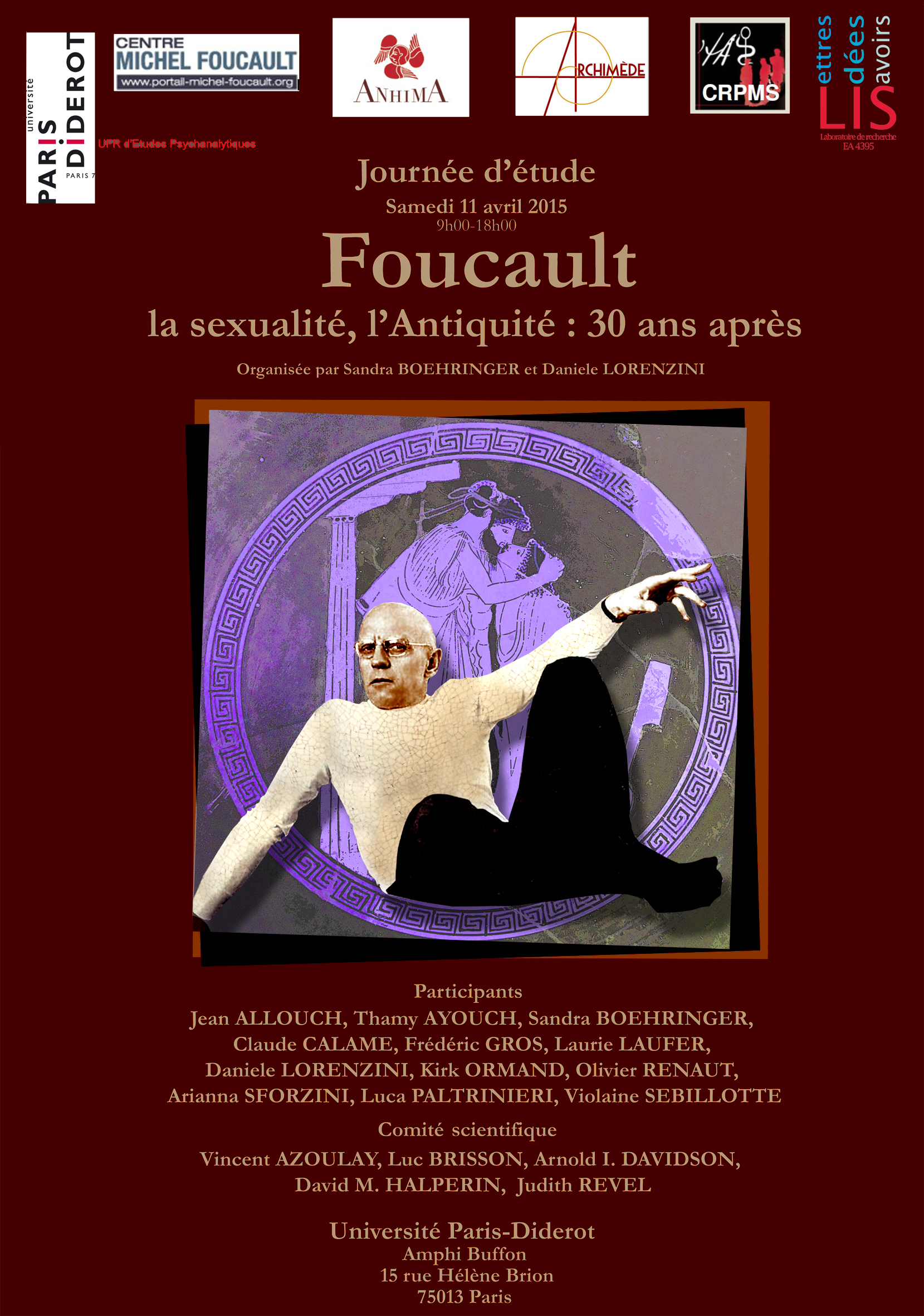

Journée d’étude

« Foucault, la sexualité, l’Antiquité : 30 ans après »
organisée par Sandra Boehringer et Daniele Lorenzini

Amphi Buffon, Université Paris Diderot-Paris 7, Paris
11 avril 2015, 9h-18h
PDF of program

Affiche FAS


The history of sexuality is one of the last major projects launched by Michel Foucault. The History of Sexuality is a momentous undertaking that profoundly affected the fields of humanities and social sciences: in the two volumes dealing with Antiquity, Michel Foucault proposed new epistemai with which specialists could approach the societies of ancient Greece and Rome; in particular, he created a new epistemological framework for analyzing the erotic realm, and the process by which the individual is required to recognize him/herself as the subject of his/her desire and his/her own existence.

Where does this leave us, thirty years later? How should we define the impact that Michel Foucault’s work on sexuality and Antiquity had on the fields of humanities and social sciences, now that the volume Subjectivity and Truth has appeared – Michel Foucault’s first course at the Collège de France entirely devoted to Greco-Roman Antiquity? How do current anthropologists of the Greek and Roman worlds do their work, twenty-five years after the pioneering book Before Sexuality: The Construction of Erotic Experience in the Ancient Greek World? In this conference, we will consider how the work of Michel Foucault reoriented the investigations of researchers and intellectuals, who today use Antiquity as a site of analysis in many fields such as ethics, gender studies, philosophy, history, anthropology, politics and psychoanalysis.

La sexualité est l’un des derniers grands chantiers ouverts par Michel Foucault. L’Histoire de la sexualité est une entreprise immense, qui marqua profondément le champ des sciences humaines : dans les deux volumes portant sur l’Antiquité, Michel Foucault allait proposer de nouveaux epistemai aux spécialistes pour aborder les sociétés grecque et romaine, et un nouveau cadre épistémologique pour penser l’érotisme et le processus par lequel l’individu est amené à se reconnaître comme sujet de son désir et de sa propre existence.

Qu’en est-il, trente ans après ? Comment définir l’impact dans le champ des sciences humaines des travaux de Michel Foucault sur la sexualité et l’Antiquité, au moment où paraît le volume Subjectivité et vérité – le premier cours de Michel Foucault au Collège de France entièrement consacré à l’Antiquité gréco-romaine ? Et quel est l’usage qu’en font actuellement les anthropologues des mondes grec et romain, vingt-cinq ans après l’ouvrage pionnier Before Sexuality : The Construction of Erotic Experience in the Ancient Greek World ? Lors de cette journée, il s’agira de comprendre comment les travaux de Michel Foucault ont infléchi les réflexions des chercheur-e-s et des intellectuel-le-s qui s’appuient aujourd’hui sur l’Antiquité dans les champs nombreux que sont l’éthique, les études de genre, la philosophie, l’histoire, l’anthropologie, la politique et la psychanalyse.


Participants :

Jean Allouch, École lacanienne de psychanalyse
Thamy Ayouch, Université de Lille 3
Sandra Boehringer, Université de Strasbourg
Claude Calame, EHESS
Frédéric Gros, Sciences Po
Laurie Laufer, Université Paris Diderot-Paris 7
Daniele Lorenzini, Université Paris-Est Créteil
Kirk Ormand, Ohio College
Olivier Renaut, Université Paris Ouest Nanterre La Défense
Arianna Sforzini, Université Paris-Est Créteil
Luca Paltrinieri, Collège International de Philosophie
Violaine Sebillotte, Université Paris 1 Panthéon-Sorbonne

Comité scientifique :

Vincent Azoulay, Université Paris-Est Marne-la-Vallée
Luc Brisson, CNRS
Arnold I. Davidson, University of Chicago
David M. Halperin, University of Michigan
Judith Revel, Université Paris Ouest Nanterre La Défense

Eduardo Rivera Vicencio, The firm and corporative governmentality. From the perspective of Foucault, International Journal of Economics and Accounting, 2014 Vol.5, No.4, pp.281 – 305

Abstract:
The fundamental base of this paper is the work of Michel Foucault and specifically during the period 1978-1979 at the Collège de France (The Birth of Biopolitics). The paper describes the relationship of power in institutional firms from the point of view of archaeological and genealogical methods, such as discourse, discipline, ethics and governmentality. Through this description, the characteristics of a new form of government – corporate governmentality – are determined and how they in turn shape the current homo economicus, the subject of law and economics in firms. At the same time, the paper describes how there has been a misappropriation of rents over time, how it is shaping a block of countries to appropriate the rents of others through large firms, and how these large corporations are imposing their objectives on states and international organisations, generating government corporations globally or what is described in this paper, as the characteristics of corporate governmentality.

Keywords: institutional firms; Michel Foucault; corporate governmentality; power relationships; ethics; rent appropriation; discourse; discipline; neo-liberalism; profit maximisation; law; economics; government corporations.

DOI: 10.1504/IJEA.2014.067421

bernardyJörg Bernardy, Warum Macht produktiv ist. Genealogische Blickschule mit Foucault, Nietzsche und Wittgenstein, Wilhelm Fink, 2015

Further info

Informationen zum Buch

Im alltäglichen Denken und in den Medien ist Macht meist negativ besetzt. Dass Macht auch produktiv wirkt, wird dabei oftmals vergessen.

Der historische Wandel von der traditionellen Souveränitätsmacht zu den subtilen Mechanismen moderner Disziplinargesellschaften ist ein Beispiel für die produktive Seite von Macht. Im Zentrum dieses Wandels stehen der Beginn der modernen Leistungsgesellschaft und die wachsende Ungleichheit der Vermögensverteilung. Um die Produktivität von Macht zu verstehen, spürt das vorliegende Buch die stilistischen und ästhetischen Mittel der genealogischen Erzählungen von Foucault und Nietzsche auf. Die Genealogie ist eine Blickschule des Denkens, die von berühmten Denkern wie Rousseau, Schopenhauer, Nietzsche, Freud, Wittgenstein und Foucault in ihren Gesellschaftsdiagnosen auf je unterschiedliche Weisen angewandt wurde. Der hierfür typische Blick auf den Menschen in seiner Gesellschaft und Kultur ist sichtverändernd und erfordert bestimmte Techniken ästhetischer Vorstellungskraft.

English summary
Power often is characterized as destructive and negative. The fact that power is productive seems to be forgotten in such contexts. The historical change from traditional power structures of sovereignty to the subtle mechanisms of modern disciplinary societies gives a very good example for the productivity of power. In the core of this historical transition you find the beginning of modern achieving society which also means a disparity in the allocation of wealth. This book follows the genealogies of Foucault and Nietzsche to show the literary and philosophical implications of how productivity of power can be thought and expressed in a philosophical frame (Nietzsche, Foucault and Wittgenstein). The most important tool is the “genealogical look”, a technique of thought which has been applied by many great thinkers such as Rousseau, Schopenhauer, Nietzsche, Freud, Wittgenstein and Foucault.

Prospects for an Ethics of Self-Cultivation

Conference 2: ‘Modern Appraisals of the Hellenistic Legacy’

29 June–1 July 2015
Monash University Prato Centre, Italy

See facebook page

Call for Abstracts

Philosophical interest in the ethical ideal of self-cultivation has increased in recent years as philosophers have sought alternatives to deontological and utilitarian theories. This interest has been most evident in the widespread revival of virtue ethics, although contemporary virtue ethicists tend to focus on Aristotle’s account of character development. Despite the contemporary emphasis on Aristotle, philosophers in the modern European tradition, including those below, have been influenced by other notions of self-cultivation that were taught during the Hellenistic period.

Spinoza (cultivating joyful affects)
Rousseau (On Education)
Kant (The Doctrine of Virtue)
Schopenhauer (on the Stoics)
Emerson (friendship)
Guyau (La Morale d’Epicure)
Camus (Lyrical and Critical Essays)
Hadot (Hellenistic therapies)

Each of these thinkers drew upon the philosophical resources of Hellenistic philosophy to develop their own accounts of self-cultivation. We suggest that investigating the Hellenistic legacy in these and other thinkers in the modern European tradition will deepen and expand our understanding of ethical self-cultivation and contribute to its revival in contemporary virtue ethics.

We invite papers suitable for 30-minute presentation on Hellenistic self-cultivation and its reception by the modern European tradition. Abstracts of up to 300 words should be sent to arts-selfcultivation@monash.edu by 31st March 2015. We particularly encourage submissions from graduate students and early-career researchers.

Confirmed Participants

Prof Keith Ansell-Pearson (Warwick)
Prof Daniel Conway (Texas A&M)
Prof Susan James (Birkbeck)
Dr Katrina Mitcheson (UWE)
Dr John Sellars (King’s College)
Dr Matthew Sharpe (Deakin)
Dr Michael Ure (Monash)

Prospects for an Ethics of Self-Cultivation is supported by the Monash-Warwick Alliance, the Department of Philosophy at the University of Warwick, and the Philosophy Department at Monash University.

Foucault Circle 2015
University of Richmond Downtown
Richmond, VA
March 20-22

All sessions will be held the University of Richmond Downtown, 626 E. Broad St, Suite 100

Friday, March 20th

6:00pm-8:00pm – Reception (drinks and light fare) at the University of Richmond Downtown
(626 E. Broad St, Suite 100, Richmond, VA 23219)

Saturday, March 21st

8:30am-9:00am – Coffee, tea, light breakfast

9:00am-10:45am – Neoliberalism
Moderator: Steven Ogden

“Advertising and Public Relations as Corporate Governmentality: Retooling Liberalism and the Liberal Subject for Permanent, Continuous, and Intensive Government”
Cory Wimberly, University of Texas-Pan American

“Hermeneutics of the Neoliberal Subject”
Ricky Crano, Ohio State University

“Caring for the Self or Building a Better Enterprise?: Foucault’s Ethics in Contemporary Contexts”
Erinn Gilson, University of North Florida
Bryan Bannon, Merrimack College

11:00am-12:45pm – Intersections/Engagements
Moderator: Dianna Taylor, John Carroll University

“Foucault, Biomedical Ethics, and Bioethics”
Charles Scott, Vanderbilt University

“Arts of Resistance: Locating Black Women’s Philosophies”
Devonya Havis, Canisius College

“Foucault and the Family”
Katherine Logan, University of Oregon

1:00pm-2:15pm – Lunch

2:30pm-4:15 – Language & Life
Moderator: Zachary Fouchard

“Beyond Biophilosophy: Diagnosing the Vitalist Misreading of Foucault’s Thought from the Outside”
Romy Opperman, Pennsylvania State University

“The Untimely Speech of the GIP Counter-Archive”
Lynne Huffer, Emory College of Arts and Sciences

“Modalities of Failure: Le Groupe d’information sur les prisons and Incarceration Today”
Perry Zurn, DePaul University

4:30pm-5:10 – Vision & Visibility
Moderator: Cooper Francis, Kingston University, London

“The Panopticon and the Garden: Diagrams of Visibility and Power in Earth Art”
Gary Shapiro, University of Richmond

“Delusions of Grandeur: The Politics of Vision in Foucault’s Magritte”
Samuel Talcott, University of the Sciences

5:15 – Business Meeting

6:30 – Dinner: Location TBD

Sunday, March 22nd

8:30am-9:00am – Coffee, tea, light breakfast

9:00am-10:45 – Abnormal Monsters
Moderator:

“Monsters of Sex: Foucault and the Problem of Biological Sex”
Sarah Hansen, Drexel University

“Foucault’s Lombroso: Criminal Typologies, Physiognomy, and the Question of Racial Profiling”
Corey McCall, Elmira College

“Monsters, Perverts, and Criminals: Death in Biopolitics”
Ege Selin Islekel, DePaul University

11:00am-12:45 – Freedom in the Later Work
Moderator: Richard A. Lynch, St. Ambrose University

“The Debate about Freedom in Foucault: Can Foucault’s Later Work be Read as a Correction of his Earlier Deficient Understanding of Freedom?”
Karsten Schubert, New School for Social Research

“A Practice of Freedom: The Art of Not Being Governed Thus”
Nicole Ridgway, University of Wisconsin-Milwaukee

“Irony and The Courage of Truth: Socrates, Foucault, and Lear on Irony, Power, and the Care of the Self”
Edward McGushin, Stonehill College

Université Paris 1 Panthéon-Sorbonne

Ecole Doctorale de Philosophie

CALL FOR PAPERS

 Workshop

Historical Epistemology: beginnings and current issues

 22-23 May 2015

PDF of Call for papers

We hereby invite contributions by graduate students and young researchers for the two-day workshop “Historical epistemology: beginnings and current issues”, which will take place at the University of Paris 1 Panthéon-Sorbonne on 22-23 may 2015.

Historical epistemology (HEP) can be placed within the renewed debate about the “marriage between the philosophy and the history of science” (HPS). Located at the crossroad of conceptual analysis and the history of practices, this methodological approach to the sciences combines historical and philosophical perspectives. HEP finds its roots in France with the positive philosophy of Auguste Comte and represents the deployment of the complex path of the so-called “French style in epistemology”, whose principal representatives are G. Bachelard, G. Canguilhem and M. Foucault. Since the 90s, it is possible to talk of a renaissance of HEP within Anglo-American domains, thanks to the works of I. Hacking, A. I. Davidson and L. Daston, among others. The international development of HEP in its contemporary phase is paralleled by a sort of paradoxical void in its birth place. The reconnection of this kind of epistemology to the original philosophical framework from which it emerged represents the occasion to reopen the debate in France.

The aim of the workshop will be to gather the graduate students and young researchers working within the constantly expanding field of HEP. This first meeting will allow the creation of a space of reflection wherein those involved can expose and share their research, methods and difficulties, as well as discuss the formation of a research group on HEP for future activities.

Proposals will be considered in the following areas:

  1. History of historical epistemology: of the French tradition (Bachelard, Canguilhem and Foucault) and its contemporary forms.
  2. Methodological debates over the history and the philosophy of medicine, psychology and psychiatry. These disciplines have represented and still represent particularly fertile domains for HEP, which has transformed their methods and issues.

III. Open section.  HEP has been linked to the most diverse disciplines and themes, and new directions are currently being opened.

Proposals (400 words and a brief presentation of the candidate) are to be forwarded before January 26th (with a reply by February 16th), as word or pdf files, to epistemologiehistorique@gmail.com. French and English are the two languages of the workshop. A limited number of financial aid covering the totality or a part of the travelling expenses of the participants is available and can be solicited.

 Dates importantes / Important dates

Limite de proposition d’interventions / Application deadline :    January 26th 2015

Réponse / Notification of acceptance:                                              February 16th 2015

Journées d’études / Workshop days :                                               May 22-23rd 2015


Comité scientifique / Scientific Committee

Jean-François BRAUNSTEIN, Université Paris 1 Panthéon-Sorbonne

Bernadette BENSAUDE VINCENT, Université Paris 1 Panthéon-Sorbonne

Arnold I. DAVIDSON, University of Chicago

Frédéric FRUTEAU DE LACLOS, Université Paris 1 Panthéon-Sorbonne

Les organisateurs / The organizers,

Iván MOYA DIEZ et Matteo VAGELLI

Université Paris 1 Panthéon-Sorbonne

EA3562 Centre de Philosophie Contemporaine de la Sorbonne (PhiCo)

epistemologiehistorique@gmail.com


Gabe Meier's avatarThe Astral Plane

TheAstralPlane_VectorFINAL01

Release day is always a bit bittersweet, because, despite all the dithering and busy work that goes into releasing music, it means that the process is almost over. That being said, Heterotopia has been a passion project of ours for quite some time now and it’s with great, treacly pleasure that we finally get to unleash it on all of you. Heterotopia is inspired by Michel Foucault’s essay of the same, but not to the extent that the compilation is imprisoned within the French philosopher’s admittedly problematic framework. The tape is positioned to guide the listener into an alternate reality, not in the science fiction sense, but in the liminal, distinctly body-oriented manner of the club-verse. It was our intention to gather a group of transcendent, progressive musicians and the artists who participated in the project took the conceptual framework to heart and drafted 12 polyglot heat rocks that have…

View original post 97 more words

Notes on some papers uploaded on Academia.edu

Colin Gordon, 11 February 2015.

All but one of these uploads are about Michel Foucault’s History of Madness and/or issues relating to madness and psychiatry.

There is some information about individual pieces in the abstracts.

 “History of madness, history of exclusion” was the result of a commission for the Blackwells Companion to Foucault. This version had to be significantly shortened for publication, omitting discussions of complementary work by other historians which bears on the idea of a history of exclusion. The chapter aimed to restore an understanding of the conceptual architecture and political context of a book which has tended to be consistently underrated by commentators.

History of madness really deserves its own ‘companion’ volume, and I have a longish-term aspiration to put one together. Watch this space…

“La ‘Storia della follia’ in Inghilterra” was commissioned by Mauro Bertani and the Italian journal Aut Aut for a special issue in 2011 marking 50 years since the publication of History of Madness

“La ‘Historia de la locura’ en Inglaterra” appeared in El evangelo del diablo. Foucault y la Historia de la locura (ed. V Galvan, tr. Blanca Garcia Seballos. Biblioteca Nueva, Madrid 2013) the augmented Spanish translation of the Aut Aut issue.

 The chapters in Rewriting the History of Madness: Studies in Foucault’s `Histoire de la Folie’, eds. A Still, I. Velody correspond to my articles in the two special issues History of the Human Sciences on which this volume is based. The first piece has one minor amendment, the second was revised and expanded to cover additional or revised responses to the first.

“Extreme Prejudice…” was a French translation of my response to Andrew Scull’s TLS review of History of Madness, included in a collection marking the 50th anniversary of the publication of Foucault’s book.

« La réception de l’Histoire de la folie chez les historiens et les géographes : l’exemple anglo-saxon. » was an invited presentation at an international public conference, Culture psychiatrique-culture juridique : relire Michel Foucault, Folie et justice,   at La Villette, Paris in Sepember 2008 organized by Philippe Cheavllier and Tim Greacen. The event which included an intervention by Robert Badinter, was focussed on new security and carceral policies and proposals of the Sarkozy administration in France.

“Philosophy in the Water Supply” was a guest editorial for the Journal of Mental Health Promotion.

“Translator’s note” to The Philosophical Imaginary: I met Michèle Le Doeuff in Paris in the late 1970s while reporting for Radical Philosophy on the activities of GREPH, an initiative seeking to change the way philosophy was taught in French schools. I helped to arrange for the translation of her article ‘Women in Philosophy’ in Radical Philosophy, and translated two other articles of hers, on Simone de Beauvoir and Pierre Roussel, for Ideology & Consciousness. Her essay collection Recherches sur l’imaginaire philosophique was published in 1980, and my translation was published by Athlone Press in 1989.


With thanks to DMF for this news