Foucault News

News and resources on French thinker Michel Foucault (1926-1984)

Golob, M.I., Giles, A.R.
Multiculturalism, neoliberalism and immigrant minorities’ involvement in the formation and operation of leisure-oriented ventures
(2015) Leisure Studies, 34 (1), pp. 98-113.

DOI: 10.1080/02614367.2014.962589

Abstract
This study draws on Foucault’s concept of the ‘entrepreneur self’ to broaden understandings of the links and intersections between the normative prescriptions of multicultural citizenship in Canada and immigrant minorities’ involvement in the formation and operation of leisure-oriented ventures in the Windsor-Essex region of southwestern Ontario. Using participant observation and semi-structured interviews, our findings indicate that participation in the formation and operation of leisure-oriented organisations is an important medium for immigrant minorities’ effective use of power. A space and a channel to assert and resist ethno-cultural identities and a strategy to break down barriers and create opportunities for themselves and others to participate in a wide range of leisure traditions and practices – in short, a technique employed by study participants to assert their membership in Canadian society and to lay claims to full and equal citizenship rights.

Author Keywords
ethnicity; Foucault; immigrant minorities; multiculturalism; neoliberalism

Index Keywords
citizenship, cultural identity, ethnicity, immigrant, minority group, multiculturalism, neoliberalism, recreational activity; Canada, Ontario [Canada]

Hardy, C., Thomas, R.
Discourse in a Material World
(2015) Journal of Management Studies. Article in Press.

DOI: 10.1111/joms.12113

Abstract
We challenge recent assertions that discourse studies cannot de facto address materiality. We demonstrate how a Foucauldian theorization of discourse provides a way to analyse the co-constitutive nature of discursive and material processes, as well as explore the power relations implicated in these relationships. To illustrate our argument, we identify exemplary studies that have effectively combined a study of discourse and different aspects of materiality – bodies, objects, spaces, and practices. In doing so, we show how discourse scholars are able to study both materiality and power relations.


Author Keywords

Discourse; Foucault; Materiality; Power

epistemologie

Programme
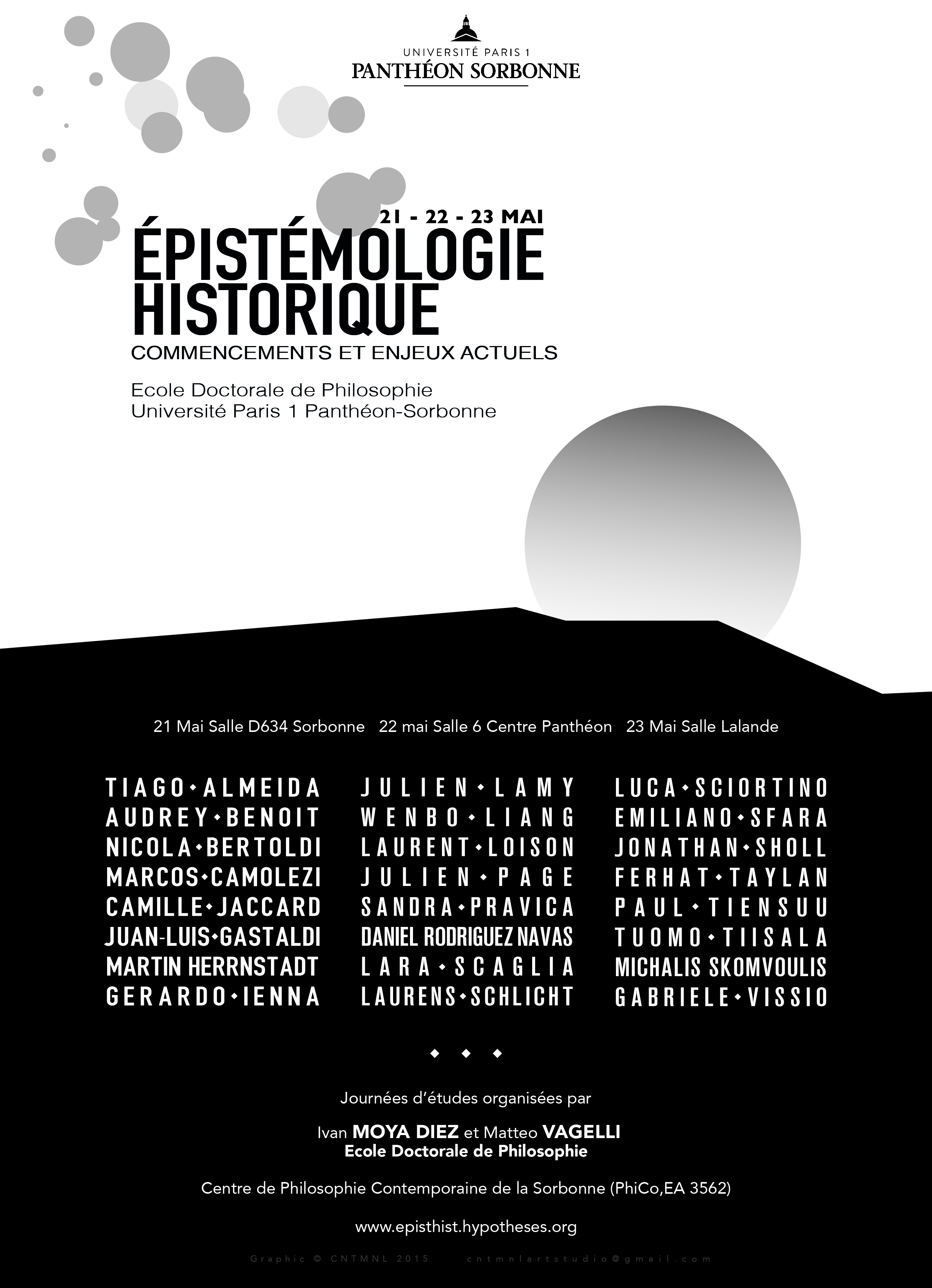
Journées d’études / Workshop

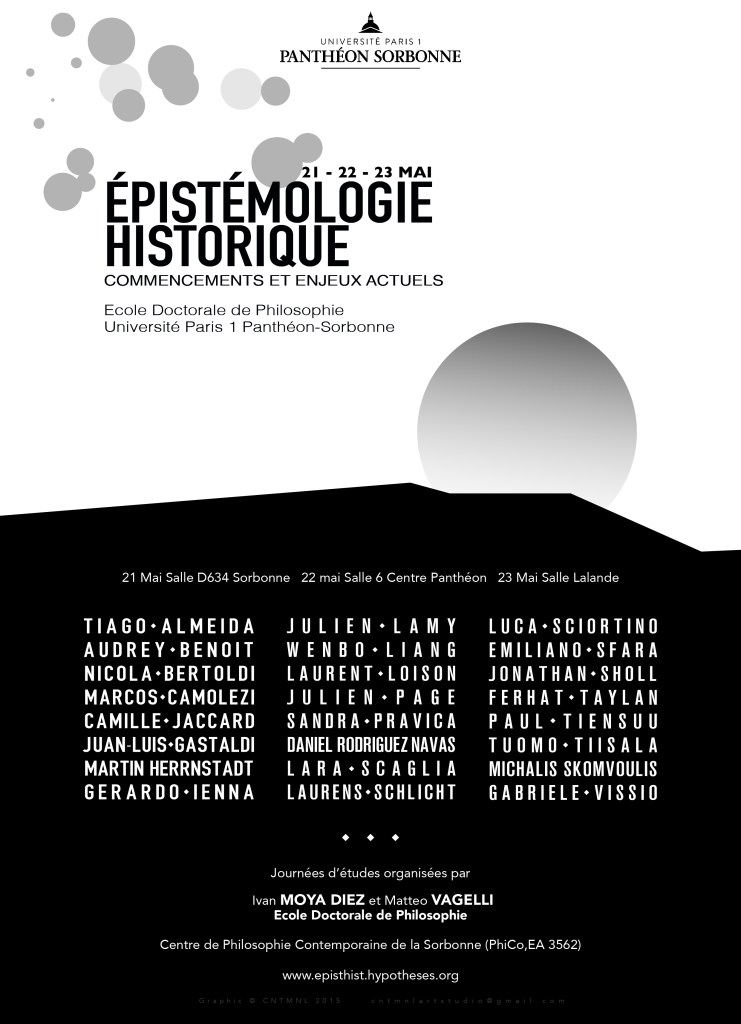
Epistémologie Historique: commencements et enjeux actuels
Historical Epistemology: beginnings and current issues
Paris, 21-22-23 mai 2015

Université Paris 1 Panthéon-Sorbonne
Ecole Doctorale de Philosophie

Further info

Télécharger le programme et les résumés des interventions

Jeudi 21 mai
    Salle D634 (Galerie Dumas, escalier L), Sorbonne (1, Rue Victor Cousin, 75005)

9h30 – 10h10
Organisateurs, Bienvenue
Pr. Jean-François BRAUNSTEIN, Introduction

10h10 – 11h00       Modérateurs : Matteo Vagelli – Ivan Moya Diez
Martin HERRNSTADT – Laurens SCHLICHT, Goethe University Frankfurt : « Epistemologies of the Sciences of Man. An Inquiry into the Epistemological Shift of the French Sciences of Man around 1800 »

11h30 – 13h10       Modérateurs : Matteo Vagelli – Ivan Moya Diez
Tiago ALMEIDA, Universidade de São Paulo – Université Paris 1 Panthéon-Sorbonne : « Georges Canguilhem et l’École germano-américaine d’histoire de la médecine »
Audrey BENOIT, Université Paris 1 Panthéon-Sorbonne : « Héritages comparés de l’épistémologie historique chez Althusser et Foucault : théorie de la connaissance et philosophie de l’histoire »

14h40 – 16h20       Modérateur : Giuseppe Bianco
Marcos CAMOLEZI, Universidade de São Paulo – Université Paris 1 Panthéon-Sorbonne : « Remarques sur Claude Bernard entre Bergson et Canguilhem »
Emiliano SFARA, Université de Montpellier 3 : « La conception du « Statut social de la science moderne » chez Georges Canguilhem »

16h40 – 18h20       Modérateur: Giuseppe Bianco
Paul TIENSUU, University of Helsinki : « Comment s’interroger sur les valeurs du droit d’une façon constructive ? L’épistémologie historique et la problème de l’indétermination du droit »
Ferhat TAYLAN, Collège international de philosophie – Université Paris Ouest Nanterre La Défense : « De l’histoire des concepts à l’histoire des rationalités. L’extension foucaldienne de l’épistémologie historique »

Vendredi 22 mai
    Salle Panthéon 6 (Escalier M, 4e étage), Centre Panthéon (12, place du Panthéon, 75005)

9h30 – 11h10       Modérateur: Ivan Moya Diez
Nicola BERTOLDI, Université Paris 1 Panthéon-Sorbonne : « Pour une épistémologie historique de la génétique des populations »
Camille JACCARD, Université Paris 1 Panthéon-Sorbonne – Université de Lausanne : « La clinique des troubles du langage comme objet de l’épistémologie historique »

11h30 – 13h10      Modérateur: Ivan Moya Diez
Jonathan SHOLL, University of Leuven: « Towards an Historical Epistemology of Medicalization »
Tuomo TIISALA, University of Chicago: « That the Abnormal is Existentially Prior to the Normal: An Interpretation and A Defense of Canguilhem’s Meta-normative Thesis »

14h40 – 16h20      Modérateur: Daniel Rodriguez Navas
Julien LAMY, Université Lyon III Jean Moulin : « L’enquête épistémologique au risque de la science effective et de son histoire : la philosophie des sciences de Gaston Bachelard»
Sandra PRAVICA, Center for Literary and Cultural Research Berlin: « Science in Other Words: Re-evaluating Gaston Bachelard’s Works for the Philosophy of Science Today »

16h40 – 18h20      Modérateur: Jonathan Sholl
Wenbo LIANG, Université Paris 1 Panthéon-Sorbonne : « Rethinking Ian Hacking’s “styles of scientific thinking” from the studies of integrative medicine »
Luca SCIORTINO, The Open University: « Ian Hacking’s Styles of Thinking and Relativism: The Case of the Existence of Theoretical Entities»

Samedi 23 mai
Salle Lalande (Escalier C, 1e étage), Sorbonne (17, rue de la Sorbonne, 75005)

9h30 – 11h10      Modérateur: Matteo Vagelli
Lara SCAGLIA, Universitat Autònoma de Barcelona : « The transcendental doctrine of Schematism and its psychological interpretations. The status of Epistemology between philosophy and natural sciences »
Michalis SKOMVOULIS, Université Aristote de Thessalonique: « L’épistémologie historique de Hegel. Le cas des sciences sociales »

11h30 – 13h10      Modérateur: Matteo Vagelli
Gabriele VISSIO, Università degli Studi di Torino – Université Paris 1 Panthéon-Sorbonne : « La logique de Husserl et l’épistémologie historique »
Daniel RODRIGUEZ NAVAS, University of Chicago: « The Influence of Foucault’s early reading of Nietzsche in his Critique of Psychology and the Human Sciences »

14h40 – 16h20      Modérateur : Tiago Almeida
Julien PAGE, Laboratoire SPHERE : « Histoire conceptuelle de théories de Galois»
Juan Luis GASTALDI, IREPh Paris Ouest – ESBAMA : « L’archéologie à l’épreuve des savoirs formels »

16h40 – 18h20      Modérateur : Camille Jaccard
Gerardo IENNA, La Sapienza – Università di Roma: « La notion de frontière disciplinaire dans le régionalisme épistémologique de Pierre Bourdieu »
Laurent LOISON, Université de Strasbourg: « Quel est le statut du présent pour l’épistémologie historique ? »

Comité scientifique
Jean-François BRAUNSTEIN, Université Paris 1 Panthéon-Sorbonne
Bernadette BENSAUDE-VINCENT, Université Paris 1 Panthéon-Sorbonne
Arnold I. DAVIDSON, University of Chicago
Frédéric FRUTEAU DE LACLOS, Université Paris 1 Panthéon-Sorbonne

Les organisateurs,
Ivan MOYA DIEZ, Matteo VAGELLI
Centre de Philosophie Contemporaine de la Sorbonne (PhiCo, EA3562),
Université Paris 1 Panthéon-Sorbonne

Maddalena, K., Packer, J.
The Digital Body: Telegraphy as Discourse Network
(2015) Theory, Culture and Society, 32 (1), pp. 93-117.

DOI: 10.1177/0263276413520620

Abstract
This article considers the use of flag telegraphy by the US Signal Corps during the Civil War as it functioned as a proto-technical medium that preceded wire telegraphy as a military communications technology. Not only was flag telegraphy a historical step towards contemporary technical media, it was also an early iteration of the digitization of communication. Our treatment ties together three main theoretical threads as a way of seeing ‘the digital’ in material communication practices: (1) Friedrich Kittler’s concept of technical media as a remediation between the 19th and 20th centuries, (2) Foucault’s docile bodies as means of reproducing culture, and (3) James Carey’s argument that the telegraph reconfigured communication. The Signal Corps is a rich historical moment in terms of media history and history of technology because it illustrates the convergence of historical exigencies at work in the war machine: mobility, secrecy, precision, and speed. Each contributes, we argue, to a digital telos that privileges digital ways of knowing and being.

Author Keywords

communications theory; digitalization; discipline; Foucault; Kittler; media; war

Luchies, T.
Towards an Insurrectionary Power/Knowledge: Movement-Relevance, Anti-Oppression, Prefiguration
(2015) Social Movement Studies, 16 p. Article in Press.

DOI: 10.1080/14742837.2014.998643

Abstract
Despite ongoing efforts to articulate radical methods and theoretical frameworks for social movement research, the field remains embedded in exploitative, oppressive, and hierarchical modes of knowledge production. Following Foucault, I argue that this is because societies like ours, founded through racial and patriarchal violence, are invested in a regime of truth supportive of that violence. In light of this, I argue that social movements scholars need to adopt a radically different form of knowledge practice. Building on anarchist, anti-racist feminist, and anti-colonial scholarship, this paper begins by analysing how liberalism constrains social justice organizing and how academic norms foreclose accountable social movements scholarship. I then introduce three unique ethics emerging in resistance to this situation: movement-relevant, anti-oppressive, and prefigurative. The first confronts the extractive imperatives of enlightenment truth-making; the second resists its neutral and disinterested tendencies; and the third models a rejection of its hierarchical and exclusive mode of authority. I argue that together they provide scholars with a strategy for re-/orienting their research towards what Foucault theorizes as an insurrection of knowledges. These three ethical frameworks combine to facilitate an insurrectionary power/knowledge that fosters collective struggle as it progressively dismantles the regime of truth underlying social movements research.

Author Keywords
activism; anti-oppression; movement-relevance; power/knowledge; prefiguration; Research ethics; social movements

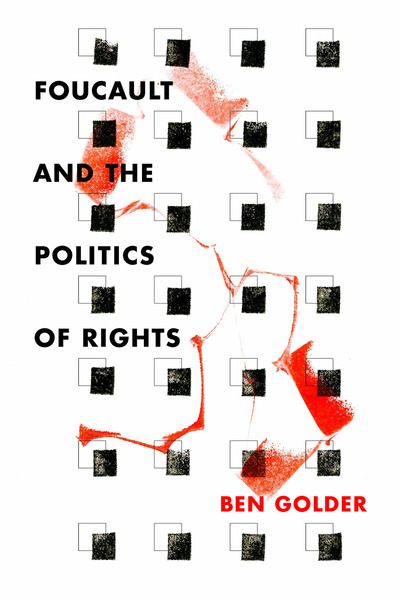
golder1 Ben Golder, Foucault and the Politics of Rights. Stanford University Press, forthcoming in October

This book focuses on Michel Foucault’s late work on rights in order to address broader questions about the politics of rights in the contemporary era. As several commentators have observed, something quite remarkable happens in this late work. In his early career, Foucault had been a great critic of the liberal discourse of rights. Suddenly, from about 1976 onward, he makes increasing appeals to rights in his philosophical writings, political statements, interviews, and journalism. He not only defends their importance; he argues for rights new and as-yet-unrecognized. Does Foucault simply revise his former positions and endorse a liberal politics of rights? Ben Golder proposes an answer to this puzzle, which is that Foucault approaches rights in a spirit of creative and critical appropriation. He uses rights strategically for a range of political purposes that cannot be reduced to a simple endorsement of political liberalism. Golder develops this interpretation of Foucault’s work while analyzing its shortcomings and relating it to the approaches taken by a series of current thinkers also engaged in considering the place of rights in contemporary politics, including Wendy Brown, Judith Butler, and Jacques Rancière.

About the author
Ben Golder is Senior Lecturer at the Faculty of Law at the University of New South Wales, Australia.

The Columbia Center for Contemporary Critical Thought​ and The Hispanic Institute for Latin American & Iberian Cultures are proud to invite you to the release of the last volume of Michel Foucault’s series of seminars at the Collège de France:

Foucault and May 68: Penal Theories and Institutions (Collège de France Lectures, 1971-1972) (Hautes Études, Gallimard and Seuil, 2015)

Participants include François Ewald (CNAM), general editor of the series, Bernard Harcourt (Columbia Law School, Columbia Center for Contemporary Critical Thought) the volume editor, and Jesús R. Velasco (LAIC Chair, Columbia University)

Casa Hispánica
Room 201
Wednesday, May 6, 7PM

Reception to follow

From the back cover:

Théories et Institutions pénales est le titre donné par Michel Foucault au cours qu’il prononce au Collège de France de novembre 1971 à mars 1972. Dans ces leçons, Michel Foucault théorise, pour la première fois, la question du pouvoir qui va l’occuper jusqu’à la rédaction de Surveiller et punir (1975) et au-delà, d’abord à travers la relation minutieuse de la répression par Richelieu de la révolte des Nu-pieds (1639-1640), puis en montrant comment le dispositif de pouvoir élaboré à cette occasion par la monarchie rompt avec l’économie des institutions juridiques et judiciaires du Moyen Âge et ouvre sur un «appareil judiciaire d’État», un «système répressif» dont la fonction va se centrer sur l’enfermement de ceux qui défient son ordre. Michel Foucault systématise l’approche d’une histoire de la vérité à partir de l’étude des «matrices juridico-politiques», étude qu’il avait commencée dans le cours de l’année précédente (Leçons sur la volonté de savoir), et qui est au coeur de la notion de «relation de savoir-pouvoir». Ce cours développe sa théorie de la justice et du droit pénal. La parution de ce volume marque la fin de la publication de la série des Cours de Michel Foucault au Collège de France (dont le premier volume a été publié en 1997).

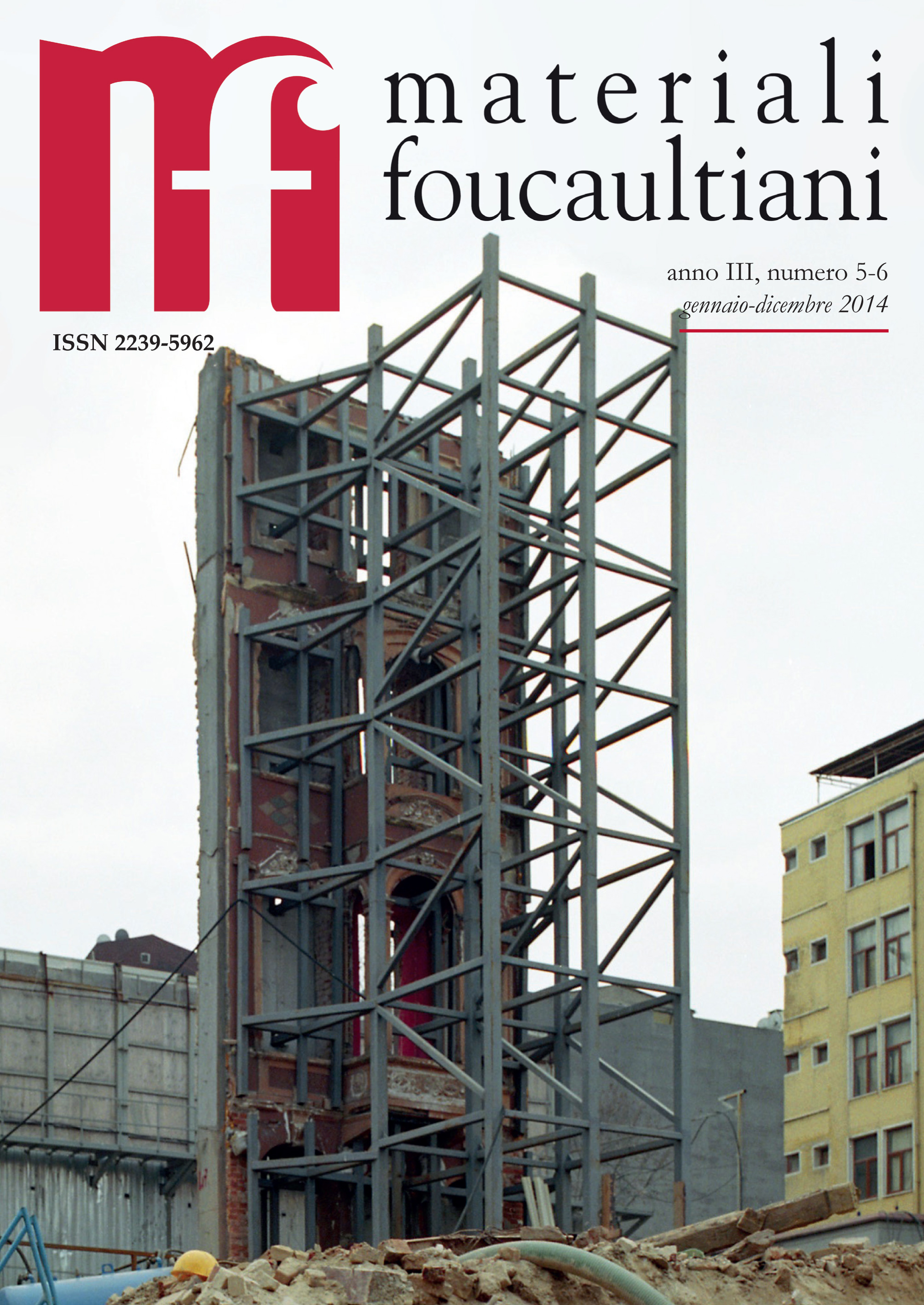
COPERTINA III,5-6

New issue of materiali foucaultiani

volume III, number 5-6 (January-December 2014)

TABLE OF CONTENTS

Il lavoro della sperimentazione  (pp. 4-7)

Laura Cremonesi, Orazio Irrera, Daniele Lorenzini, Martina Tazzioli

La parrhesia e l’attualità politica della critica

Introduzione  (pp. 9-13)

  Laura Cremonesi, Orazio Irrera, Daniele Lorenzini, Martina Tazzioli

Nota di lettura  (pp. 15-20)

  Laura Cremonesi, Orazio Irrera, Daniele Lorenzini, Martina Tazzioli

La parrhesia  (pp. 21-52)

Michel Foucault

Dalla parrhesia alle pratiche politiche nella postcolonia  (pp. 53-70)

Mariangela Milone

Authority, Interpretation and the Space of the Parrhesiastic Encounter  (pp. 71-90)

Nancy Luxon

What is Political Philosophy?  (pp. 91-112)

Johanna Oksala

Enunciazione e politica. Una lettura parallela della democrazia: Foucault e Rancière  (pp. 113-134)

Maurizio Lazzarato

Michel Foucault on Problematization, Parrhesia and Critique  (pp. 135-154)

  Giovanni Maria Mascaretti

Saggi

Foucault mitologo delle scienze. Per una rilettura de Le parole e le cose  (pp. 157-175)

 Ronan de Calan

Le parole, le cose ed altre inquisizioni  (pp. 177-196)

Marta Menghi

The Normative Immanence of Life and Death in Foucauldian Analysis of Biopolitics  (pp. 197-218)

  Marcos Nalli

Dal potere sulla vita al governo dell’ethos. Centralità genealogica della governamentalità  (pp. 219-240)

  Ottavio Marzocca

Sguardi foucaultiani

Il muro del silenzio  (pp. 243-245)

  Philippe Bazin

   Nascita della società punitiva

Nota introduttiva  (pp. 247-252)

  Laura Cremonesi, Orazio Irrera, Daniele Lorenzini, Martina Tazzioli

Foucault e la società punitiva  (pp. 253-262)

  Frédéric Gros

The Missing Link. An Inquiry into Michel Foucault’s Distinction from “Penal Evolution” Literature

between The Punitive Society and Discipline and Punish (1973-1975)  (pp. 263-282)

  Sacha Raoult

Per una sociologia morale delle traiettorie di controllo. Una lettura de La société punitive  (pp. 283-306)

  Corentin Durand

Dall’illegalismo alla gestione differenziale degli illegalismi: ritorno su un concetto  (pp. 307-322)

  Grégory Salle

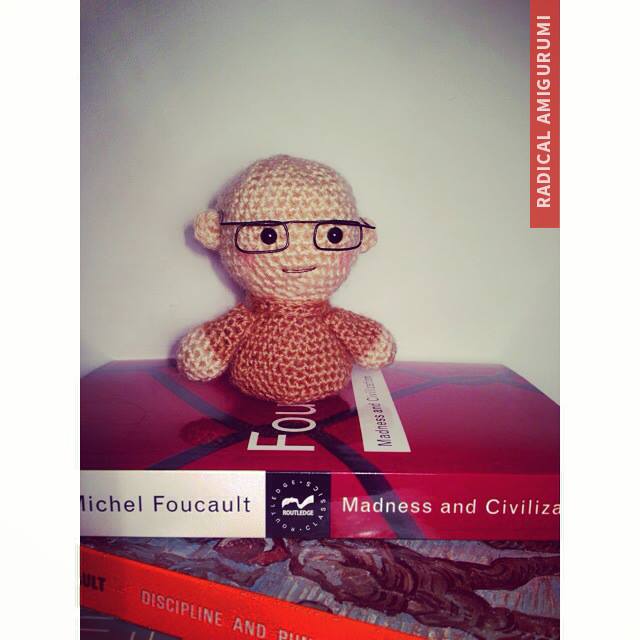
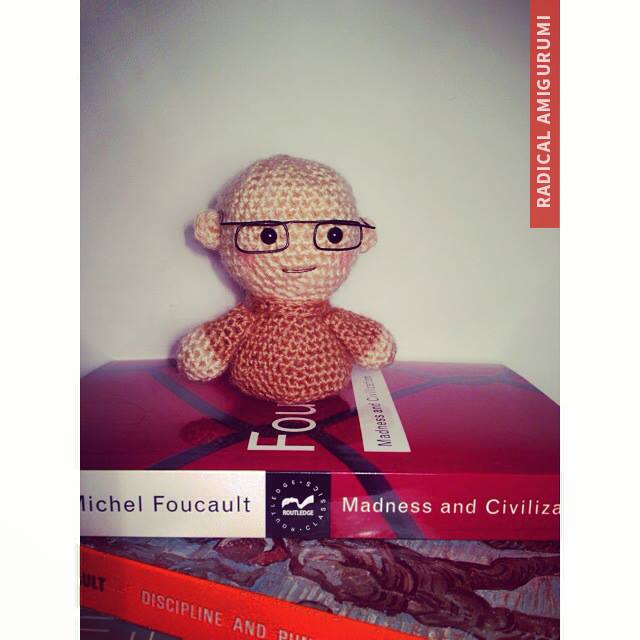
Amigurumi (編みぐるみ?, lit. crocheted or knitted stuffed toy) is the Japanese art of knitting or crocheting small stuffed animals and anthropomorphic creatures. The word is derived from a combination of the Japanese words ami, meaning crocheted or knitted, and nuigurumi, meaning stuffed doll (Wikipedia)

RadicalAmigurumi's avatarRadical Amigurumi

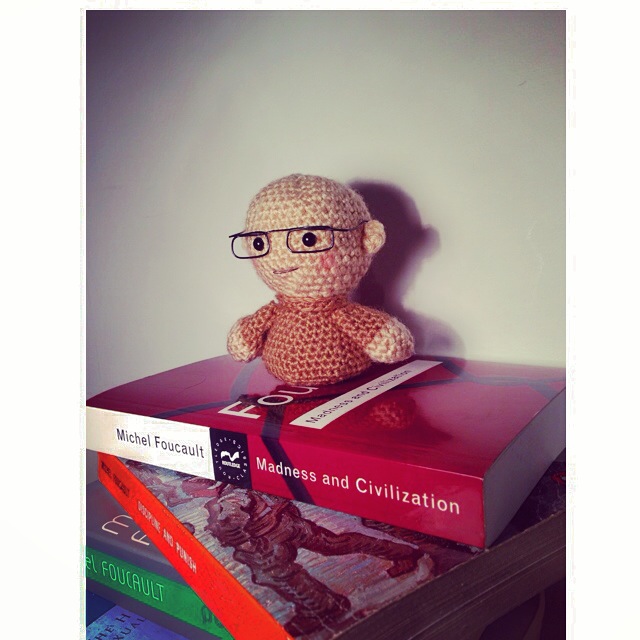
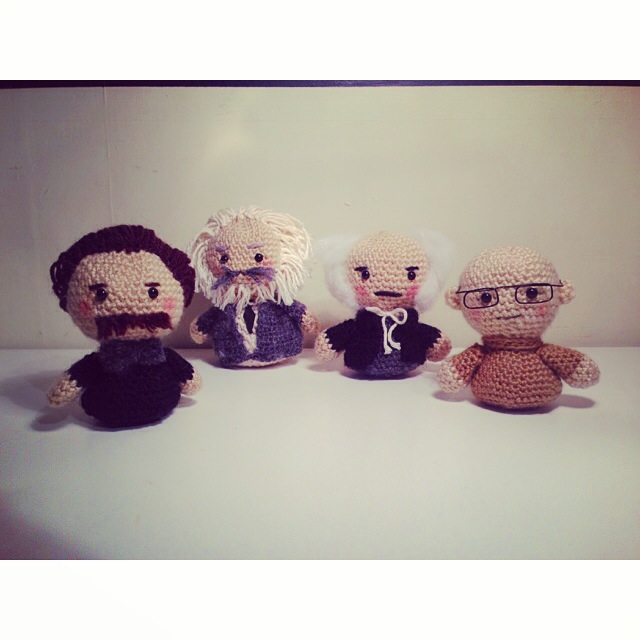
And a new member to the radical boy band, may I introduce Michel Amigurumi Foucault!!

My first ears and my first glasses, and enjoyed the bald look…

Michel Amigurumi Foucault says: “Where there is power, there is resistance.”

Foucault w CR

photo 2 (8)

photo 3 (5)

foucault irlphoto 4 (3)

View original post

Michel Foucault et la peinture

Peter Wall Institute for Advanced Studies Faculty Associate, Catherine Soussloff, will be giving a series of seminars on “Michel Foucault et la peinture” as Visiting Lecturer at the Collège de France in Paris on May 5, 12, 19 and 26 beginning at 2:30 pm.

About the speaker:

Catherine M. Soussloff’s research explores the historiography, theory, and philosophy of art in the European tradition from the Early Modern period (ca. 1400) to the present. She has published books and over forty essays and articles, and she has lectured extensively in Canada, Europe, the U.K., the U.S.A., and South America. Professor Soussloff has advised and supervised M.A. and Ph.D. graduates in Art History, Visual and Cultural Studies, History of Consciousness, Literature, and History. Known for her comparative and historical approaches to the central theoretical concerns of art history and aesthetics, Soussloff’s recent publications have focused on: Performance theory and visual culture, theories of painting from Leonardo da Vinci to contemporary post-structuralism, concepts of the Baroque, Viennese art and culture in the early 20th century, Jewish studies and art history, contemporary theories of the image, and curatorial practice.  She is presently preparing two books for publication: Michel Foucault and Painting and Theory for Art in the Late Twentieth Century.  Soussloff’s views on Foucault are featured in the Slovenian art mockumentary: MY NAME IS JANEZ JANŠA (dir. Janez Jansa). 

Before coming to UBC in 2010 as Head of the department, Professor Soussloff taught for twenty-four years at the University of California, Santa Cruz where she held a prestigious University of California Presidential Chair in Visual and Performance Studies and the first Patricia and Rowland Rebele Chair in the History of Art. For twelve years Soussloff was Director of Visual and Performance Studies, an international and multi-disciplinary faculty-graduate research initiative. In that capacity she programmed major conferences and an annual seminar series, funded by competitively awarded grants. She recently served as Chair of the Editorial Board of the Art Journal (College Art Association of America) and she was a founding editor of Images: Journal of Jewish Art and Visual Culture. For two years she was a member of the board of Live Vancouver, the city’s performance art biennale.

Professor Soussloff has been the recipient of grants and fellowships from the National Endowment for the Humanities, The Getty Research Institute, The Sterling and Francine Clark Art Institute, the University of California Humanities Research Institute, the College Art Association of America, the Herbert D. Katz Center for Advanced Judaic Studies, University of Pennsylvania and the Institute for the Humanities at New York University. In summer 2011 Soussloff was resident at the University of California, Irvine where she held a National Endowment for the Humanities Summer Seminar fellowship for the study of Walter Benjamin’s Later Writings. During the academic year 2013-14 Catherine M. Soussloff is a distinguished scholar in residence at the Peter Wall Institute for Advanced Studies.

Date: Tuesday, May 5, 2015
Time: 2:30 pm
Location: Collège de France, Salle 5 11, place Marcelin-Berthelot, 75005 Paris
Link: Read More