Foucault News

News and resources on French thinker Michel Foucault (1926-1984)

Miguelángel Verde Garrido, Contesting a biopolitics of information and communications: The importance of truth and sousveillance after Snowden, Surveillance and society, Vol 13, No 2 (2015)
https://doi.org/10.24908/ss.v13i2.5331

Abstract
This article aims to provide a novel conceptual understanding of the nature of the global mass surveillance policies and practices revealed by whistleblower Edward Snowden in collaboration with the Guardian and Washington Post newspapers. The critical analysis and conceptual reinterpretation of state and corporate surveillance and its impact on the political agency of civil society is multidisciplinary. An intersection of surveillance studies, political philosophy, and global politics/international relations provides an overview of the policies and practices that states and corporations develop and implement in relation to information and communications technologies (ICT). Clarifying how contemporary society is global and digital, it analyzes the way in which political economies inform contemporary policies and practices of surveillance. A critical analysis the relation of political economy to neoliberal governmentality, biopolitical technologies of power, and contemporary regimes of truth, leads to posit that global mass surveillance is a technology of power deployed by a contemporary biopolitics of information and communication. A conceptual reinterpretation of Foucault’s notion of parrhesia and Mann’s notion of sousveillance leads to posit that parrhesiastic sousveillance is a socio-political and technologically-enabled modality of resistance that can resemantize contemporary politics of truth and lead towards a newborn digital agency for global(ized) civil society.

Keywords
Global politics; biopolitics; parrhesia; biopolitics of information and communications; resistance; information and communications technologies (ICT); sousveillance; regime of truth; political economy; states; corporations; civil society

Michel Foucault and the smart city (2015)
Francisco Klauser – Neuchátel University – from The Programmable City
Video of paper

Drawing upon Michel Foucault’s approach to power and governmentality, the paper explores the regulatory dynamics inherent in contemporary data-driven forms of regulation and management-at-a-distance of urban systems. More specifically, channelled through Michel Foucault’s concept of ‘security’, the paper portrays ‘governing through data’ not only as fundamentally reality-derived, relative and plural in scope and scale, but also as inherently flexible and fluid in aim and functioning. This in turn raises a series of critical questions with regard to the novel possibilities of differentiation and prioritisation, the actual adequateness, and the very implications of contemporary governing through data.

Empirically speaking, the paper focuses on the study of two high-profile pilot projects in Switzerland in the field of smart electricity management: iSMART and Flexlast. Both projects rely on massive efforts of data generation, interconnection and analysis, thus allowing the critical investigation of the rationales and problems inherent in the management of urban systems through data.

Foucault 4/14 Daniele Lorenzini | A Dispatch from Paris: “A Little History of Truth in General”

I have followed with great interest, from Paris, the discussions which arose before, during, and after the first three meetings of the seminar “Foucault 13/13”, and I really look forward to “Foucault 4/14”, which is going to be exciting—Linda Zerilli and Anna Lvovsky’s posts on Psychiatric Power are brilliant and challenging. I would like to contribute to these rich discussions by drawing some attention to an aspect of Foucault’s lectures on Psychiatric Power that I have always considered crucial, both for the “discursive economy” of these lectures and in view of the methodological and conceptual “shifts” Foucault introduced a few years later in On the Government of the Living (1979-1980).

At the beginning of his 23 January 1974 lecture of Psychiatric Power, Foucault opens what he himself calls “a parenthesis”—but readers of Foucault’s lectures at the Collège de France have already learnt that what he presents as a parenthesis is very often something quite decisive. Foucault, speaking about the complex and many-sided “mechanism of discipline” that functioned within the asylum in the nineteenth century, argues that its effects introduced a question of truth: “medical knowledge, which again was only a token of power, found itself required to speak, no longer just in terms of power, but in terms of truth” (PP, p. 235). Indeed, as Anna Lvovsky correctly suggests, in Psychiatric Power Foucault delivers an analysis of madness as a battle over truth-production, and in many senses also the hysterics’ “counter-conduct” that will be taken into account by Linda Zerilli can be described in terms of a challenge on the level of truth. This is why, by retracing “a little history of truth in general” (PP, p. 235), Foucault is actually doing something crucial with respect both to the stakes of these lectures and to future developments of his thought.

read more

Paul Beatriz Preciado – ¿La muerte de la clínica?
Published on 7 Apr 2013

En El nacimiento de la clínica (1963), Michel Foucault sugería que a cada modelo de poder corresponde un cuerpo sano y enfermo, una forma específica de gestión de la sexualidad y de la reproducción, una espacialización de las diferencias en la ciudad y una utopía de inmunidad nacional. ¿Cuál sería este

Mathias Schönher, “Deleuze, a Split with Foucault.” Le foucaldien 1, no. 1 (2015): 1–12. DOI: https://doi.org/10.16995/lefou.8 [Note: In 2022, Le foucaldien relaunched as Genealogy+Critique.]

Abstract
In 1977, Deleuze and Foucault found themselves in opposite camps in the public dispute among French intellectuals, resulting in a parting of the ways between two colleagues who had for many years been friends. Deleuze considered the reason for the split to have been their differing ideas on the connection between the historical situation and philosophical thought; in his view, it was occasioned by the debate over the New Philosophers, in which Foucault supported those intellectuals who, according to Deleuze, opposed the creative thinking of philosophy. After Foucault’s death, Deleuze sought to reconcile the two positions, but his attempts only highlighted the depth of the division between them.

Keywords: dispositif, philosophy, power, resistance, revolution, society, television, Deleuze, Foucault

Überwachen und Strafen heute
Bremen, 5.–7. November 2015
Frieder Vogelmann/Jörg Bernardy/Martin Nonhoff

Programm

Programm als PDF öffnen

Durchgehend zu sehen ist der künstlerische Beitrag von Christoph Faulhaber: Jedes Bild ist ein leeres Bild (2014)

Donnerstag, 5. November 2015

14:00–14:30 Uhr Begrüßung
14:30–15:30 Uhr Susanne Krasmann: Imagining Foucault. Über das digitale Subjekt und »visuelle Bürgerschaft«
15:45–16:45 Uhr Tobias Matzner: Subjektivierung durch Daten – Disziplin oder Performativität?
Pause 16:45–17:15 Uhr
17:15–18:15 Uhr Dietmar Kammerer: Das Panopticon zwischen Analyse und Inflation, Anschein und Wirklichkeit
18:30–19:30 Uhr Philipp Wüschner: Scham und Schuld, Verletzung und Verbrechen

Freitag, 6. November 2015

9:00–10:00 Uhr Friedrich Balke: Schandbilder und Schriftmacht. Zur Rolle der Medien in »Überwachen und Strafen«
10:15–11:15 Uhr René Aguigah: »Die Seele: Gefängnis des Körpers«. Zum Verhältnis von Zeitgenossenschaft und Philosophie in »Überwachen und Strafen«
11:30–12:30 Uhr Marita Rainsborough: Rereading Foucault. Foucaults Machtkonzeption aus Sicht der postkolonialen Theorien von Achille Mbembe und Walter Mignolo
Mittagspause 12:30–14:00 Uhr
14:00–15:00 Uhr Thomas Biebricher: Überwachen und Strafen der politischen Ökonomie: Der Fall Europa
15:15–16:15 Uhr Martin Nonhoff: Die Macht im Geldbeutel, oder: Zur Herstellung fiskalischer Normalität durch Einkommensteuern
Pause 16:15–16:45 Uhr
16:45–17:45 Uhr Jörg Bernardy: »Überwachen und Strafen« als Science-Fiction und Kriminalroman. Über Disziplinen und Drohnen
18:00–19:00 Uhr Petra Gehring: Das invertierte Auge

Samstag, 7. November 2015

9:00–10:00 Uhr Frieder Vogelmann: Zur Geburt der Sozialwissenschaften im Gefängnis
10:15–11:15 Uhr Maria Muhle: Normalisierung, Normierung, Normation
11:30–12:30 Uhr Martin Saar: Die Form der Macht
Mittagspause 12:30–14:00 Uhr
14:00–15:00 Uhr Katrin Meyer: Ausschließen und Eingrenzen. Neue Formen der Überwachung
15:15–16:15 Uhr Sophia Hoffmann: Der Archipel »Flüchtlingslager«. Überwachen und Strafen im jordanischen Lager Azraq

Foucault 4/13: LIVESTREAM

You can also find it at this link

This will also be available as a recording after the event

October 26, 2015, 6:15pm
Linda Zerilli, University of Chicago
Anna Lvovsky, Columbia University
Alondra Nelson, Columbia University

Moderators:
Bernard E. Harcourt, Columbia University
Jesús R. Velasco, Columbia University

Linda Zerilli, Alondra Nelson, and Anna Lvovsky discuss Foucault’s fourth lecture series at the Collège de France, Psychiatric Power (1973-1974). Please watch the video here or here. Please also read the introductory posts presenting the lectures by Linda Zerilli, Alondra Nelson, and Anna Lvovsky. Bibliographical references for the seminar are here.  Welcome to Foucault 4/13!

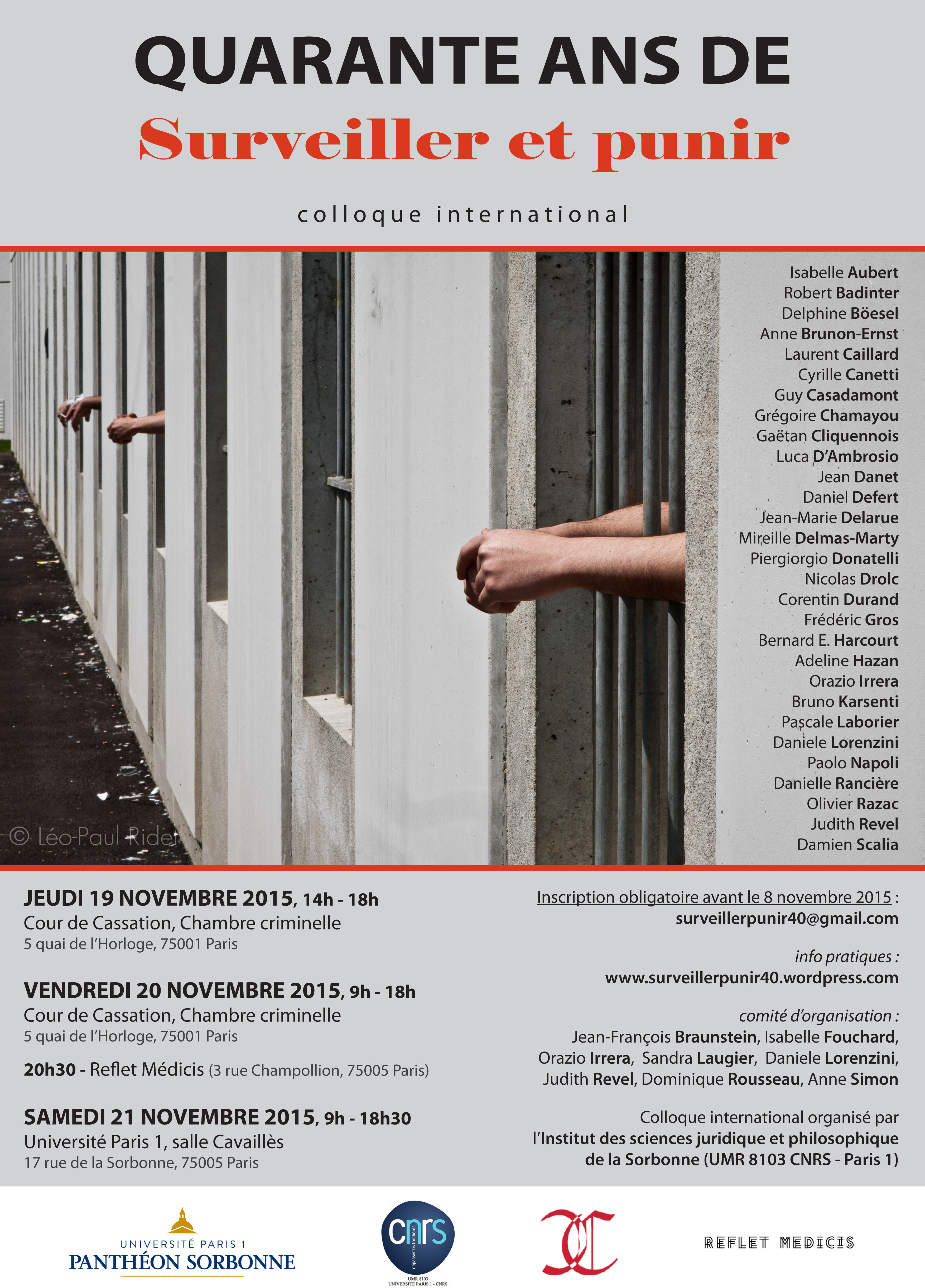
Affiche A3 S&P - HDPDF programme

Université Paris 1 Panthéon-Sorbonne

Colloque international

Quarante ans de Surveiller et punir

Institut des sciences juridique et philosophique de la Sorbonne (UMR 8103 CNRS Paris 1)
Centre de philosophie contemporaine de la Sorbonne (PhiCo)

19-21 novembre 2015

Paru en 1975, l’ouvrage de Michel Foucault Surveiller et punir. Naissance de la prison a fait date : non seulement il a connu un énorme succès lors de sa publication, mais il est aujourd’hui le livre le plus cité dans le domaine des sciences humaines et sociales. Cependant, dans ce colloque, quarante ans après, il ne s’agira pas tant de le célébrer que de s’interroger, avec la lucidité que permet le recul, sur ses enjeux, sa fortune et sur la valeur qu’il peut encore revêtir pour nous aujourd’hui.

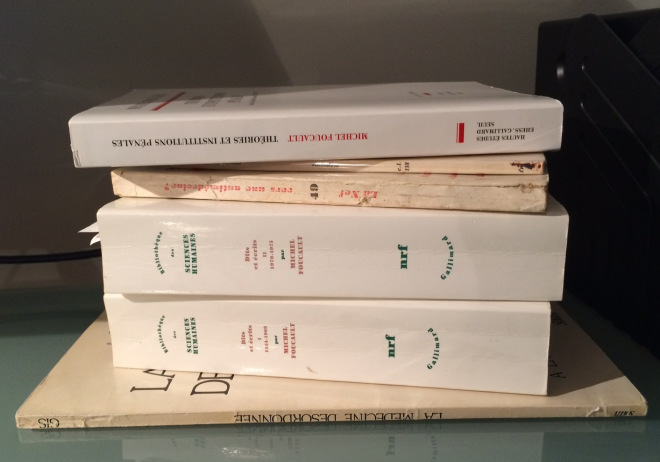
Avant tout, il faudra revenir sur le contexte historique et politique concret dans lequel cet ouvrage a émergé, en faisant scandale et en suscitant beaucoup de débats et de controverses. En même temps, on possède à présent davantage d’instruments pour inscrire de manière très précise la rédaction de cet ouvrage au sein du parcours intellectuel de Foucault. D’une part, il s’agira donc de reconstruire l’aventure du G.I.P. (Groupe d’information sur les prisons), qui a été plus ou moins directement à l’origine de l’intérêt de Foucault pour l’« objet-prison ». D’autre part, la publication récente de deux cours au Collège de France du début des années 1970 (Théories et institutions pénales, paru en mai 2015, et La société punitive, publié en 2013) rend désormais possible de retracer l’arrière-plan plus spécifiquement philosophique de Surveiller et punir et de suivre très précisément l’élaboration de l’étude du « pouvoir disciplinaire ».

Il sera également nécessaire de relire les écrits de Foucault à la lumière d’une actualité juridique dense. En effet, l’adoption de la loi pénitentiaire le 24 novembre 2009 a marqué une prise de conscience politique de la nécessité d’appréhender les questions pénales et pénitentiaires d’une manière globale et concertée. Depuis l’adoption de cette loi, les avancées concrètes semblent néanmoins limitées et deux réformes récentes ont pu sonner comme un aveu d’impuissance politique quant à l’amélioration du sort des personnes incarcérées. La première est l’adoption de la loi du 15 août 2014 qui créé une nouvelle peine : la contrainte pénale. L’exposé des motifs de la loi retient notamment l’exigence de développer les peines exécutées en milieu ouvert, eu égard notamment aux mauvaises conditions d’incarcération dans les établissements pénitentiaires français. Outre le fait que la contrainte pénale ne remplace pas l’emprisonnement mais s’y ajoute, la mesure pourrait donc être perçue comme un contournement de la problématique essentielle que représente l’avenir de la peine carcérale. L’autre évolution juridique, moins visible mais néanmoins significative, est le nouveau report pour 2020 de l’application du principe de l’encellulement individuel, pourtant consacré, une fois de plus, par la loi de 2009. Le droit pénitentiaire semble donc marqué du sceau de l’inertie et ce malgré un dynamisme jurisprudentiel interne et européen d’une rare intensité. L’étude approfondie de ces « vents contraires » apparaît dès lors indispensable.

Enfin, l’un des enjeux principaux de ce colloque sera de réfléchir sur la valeur – à la fois historique, philosophique, juridique et politique – des analyses foucaldiennes de la société punitive, de l’archipel carcéral, de la surveillance généralisée, du panoptisme, des illégalismes, de la délinquance, etc., afin d’en mesurer la portée réelle et de les mettre à l’épreuve de notre présent. Pour ce faire, il sera essentiel de mobiliser une pluralité d’approches différentes et de favoriser le dialogue entre plusieurs disciplines (philosophie, science politique, droit, historie, sociologie, anthropologie, géographie, etc.).

Comité d’organisation :

Jean-François Braunstein (Université Paris 1 Panthéon-Sorbonne)

Isabelle Fouchard (Université Paris 1 Panthéon-Sorbonne)

Orazio Irrera (Université Paris 1 Panthéon-Sorbonne)

Sandra Laugier (Université Paris 1 Panthéon-Sorbonne)

Daniele Lorenzini (Université Paris-Est Créteil)

Judith Revel (Université Paris Ouest Nanterre La Défense)

Dominique Rousseau (Université Paris 1 Panthéon-Sorbonne)

Anne Simon (Université Paris 1 Panthéon-Sorbonne)


Comité scientifique :

Sandro Chignola (Università degli Studi di Padova)

Arnold I. Davidson (University of Chicago)

Didier Fassin (Institute for Advanced Study, Princeton University)

Clare O’Farrell (Queensland University of Technology)

Pierrette Poncela (Université Paris Ouest Nanterre La Défense)

 

Foucault et Baudrillard — Hamdi Nabli (2015).
Livre: Foucault et Baudrillard: La fin du pouvoir (2015)

stuartelden's avatarProgressive Geographies

FBP 5

Most of the most recent work on this book project has been on the section of Chapter Two discussing the Nu-Pieds revolts. An analysis of these, and the repression that follows, takes up the first seven lectures of Théories et institutions pénales. It’s a fascinating story, and nowhere else does Foucault give so much attention to a struggle between people and state power. I will be speaking about this part of the course at the Historical Materialism conference in November, though the brevity of that talk will mean I can only highlight a few major themes. If you don’t read French, Barry Stocker’s analyses of the first few of these lectures are very useful. Chapter Two now exists in a complete, long, draft – a discussion of the Nu-Pieds; then on the shift from Germanic law to the Monarchical State, and the legal system of the high Middle…

View original post 575 more words