Foucault News

News and resources on French thinker Michel Foucault (1926-1984)

Editor: Palgrave Macmillan have kindly offered a 30% discount to readers of Foucault News on books in their Foucault collection

Works included in this collection are The Punitive Society and Michel Foucault: A Research Companion The full price on the latter work has been reduced since I last posted on this. I will repost again shortly with full details.

“Save 30% on all titles in the Palgrave Foucault Collection. Just enter discount code PM15THIRTY at checkout when ordering on palgrave.com. Offer valid until December 31, 2015. Terms and conditions apply.”

This offer is not available to Australasia and Canada.

Michel Foucault vu par son neveu La Novelle République, Communes, Vienne – Vendeuvre-du-Poitou – Vendeuvre-du-poitou, 23/09/2015

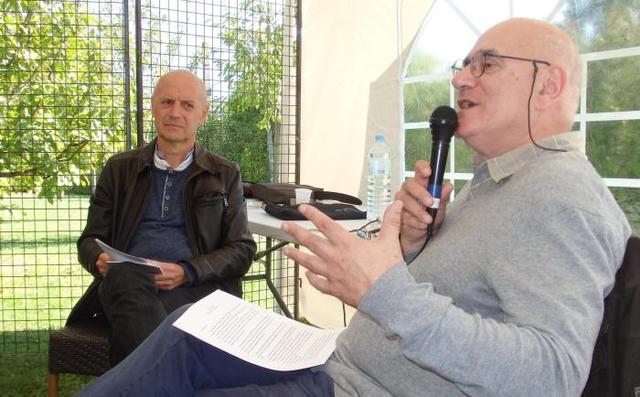
Henri-Paul Fruchaud raconte Foucault au quotidien.

Henri-Paul Fruchaud raconte Foucault au quotidien.

A l’occasion des journées du patrimoine, une exposition promenade était organisée dans les jardins de la maison familiale où Michel Foucault a écrit une grande partie de son œuvre durant les vacances. Pour Jocelyne Berge, présidente de l’association Le Jardin de Michel Foucault, il s’agit de faire découvrir aux Vendeuvrais ce philosophe connu au niveau national mais pas nécessairement localement.

“ C’est toujours lui qui faisait la mayonnaise ! ”

Environ 70 personnes étaient présentes pour assister à la causerie donnée par Henri-Paul Fruchaud, aîné des neveux de Michel Foucault. Il a évoqué le parcours professionnel et l’œuvre de son oncle à travers certaines étapes significatives de la réflexion de Foucault. L’« Histoire de la folie » (1961) marque une première étape, « Les mots et les choses » (1966) pose un deuxième jalon. Le parcours évolue ensuite avec « Surveiller et punir » (1975) qui traite de la naissance de la prison utilisée comme seul moyen de punition.
C’était aussi l’occasion de découvrir le philosophe sous un angle familial. Henri-Paul Fruchaud a raconté de nombreuses anecdotes, à commencer par l’habitude qu’il avait d’observer le travail du philosophe assis dans son bureau. Foucault écrivait au moins 3 versions de ses livres et finalisait la troisième à Vendeuvre. Il écrivait 5 à 6 heures par jour. Il participait aussi à la vie familiale. Ainsi, « c’est toujours lui qui faisait la mayonnaise ! ». Ses promenades inspiraient ses réflexions.

Il trichait au poker

Il s’adressait aux enfants comme à des adultes, jouait et trichait au poker en famille et était doté d’un rire très sonore. Henri-Paul Fruchaud a également évoqué les indignations du philosophe.

En terminant la causerie, il a annoncé que 37.000 feuillets écrits par Foucault sont déposés à la Bibliothèque Nationale. Son œuvre devrait être publiée dans La Bibliothèque de la Pleïade en novembre prochain. Désormais, on s’oriente vers la publication de ses cours, causeries et conférences enregistrés.

With thanks to Stuart Elden and Colin Gordon for this news

Mitchell Dean, Foucault must not be defended, History and Theory, Volume 54, Issue 3, pages 389–403, October 2015

DOI: 10.1111/hith.10767

Available on academia.edu. You need to log in

ABSTRACT

This paper responds to and comments on many of the themes of the book under consideration concerning Foucault and neoliberalism. In doing so, it offers reflections on the relation between the habitus of the intellectual and the political contexts of action and engagement in the case of Foucault, and the strengths and weaknesses of his characterization of his work in terms of an “experimental” ethos. It argues that it is possible to identify his distinctive views on neoliberalism as a programmatic ideal, as a language of critique of the postwar welfare state, and as an element within actual political forces such as the French “Second Left” of the 1970s. It examines the legacy of Foucault in “governmentality studies” and argues for attentiveness to the different intellectual positions, and their potentially divergent political consequences, within this school of thought. It concludes by suggesting that the discussion currently taking place, and in part inaugurated by this book, might signal a change of his status in the humanities and social sciences today from “unsurpassable horizon” of critical thought to acknowledged classical thinker, with strengths and limitations, and a series of problems that might not be our own.

Keywords:

Foucault;neoliberalism;Marxism;governmentality;politics;critique;ethos;habitus

stuartelden's avatarProgressive Geographies

Michel_Focault_13102015There is an interview with Daniel Defert in German here, in which he discusses Foucault’s life and work, Adorno, May 68 and political activism, the AIDES group he founded after his death, the lecture courses and the material sold to the BNF, and confirms that the History of Sexuality, Vol IV, Les aveux de la chair, will eventually be published. I already knew this from Defert, but this might be the first place it’s been publicly announced.

The article can be viewed by clicking on ‘Weiter zum Artikel’ when you load the page. Many thanks to Kai Frederik Lorentzen for the link.

View original post

Editor: See Colin Gordon’s response from the comments section of this blog post below.

Michel Foucault’s Iranian Folly
Jeremy Stangroom on Michel Foucault’s political naiveté, TPM Online (The Philosopher’s magazine)

Extract
Everywhere outside Iran, Islam serves as a cover for a feudal or pseudo revolutionary oppression… The Left should not let itself be seduced by a cure that is perhaps worse than the disease.”

Foucault, unfortunately, was precisely seduced by the popular uprising in Iran, which he claimed might signify a new “political spirituality”, with the potential to transform the political landscape of Europe, as well as the Middle East.

read more

Guest – Colin Gordon, Oxford, UK
[Editor:Foucault’s birthday was 15 October 1926]

Your site’s taste in posthumous birthday offerings is duly noted.

Mr Stangroom is a promising parrot – good at recycling other people’s smears; but short on forensic and reading skills – checking allegations against evidence. Or perhaps one should say he is a talented manipulator of evidence, like the American authors he relies on. The second text he quotes – including the words on the rights of women – is not Foucault’s manifesto for Iranian government, it is a summary of comments by a senior Shi’ite cleric, forming part of Foucault’s newspaper reports on ideas current in Iran at the time of an uprising which mobilized overwhelming popular support – a fact which at the time impressed many international observers besides Foucault. Foucault stated more than once before the fall of the Shah’s regime that there were disquieting aspects to the agenda for Islamic government and that he did not find its assurances about human and minority rights entirely reassuring. He did not endorse a Khomeini regime, either before or after the fact. He did not recommend ‘political spirituality’ as an elixir for the West. He did, on the other hand, refuse to treat all contemporary manifestations of Islam with uncomprehending or a priori contempt – a position which continues to earn comments such as these from some philosophers and other trolls.

By the way, the first text Stangroom has managed happens to open with a mistranslation. Foucault did not write that the Iranian situation could be understood as a great joust – he wrote that it seemed at that point in time to be tied to (‘semble être suspendue à’) the highly visible public confrontation between two personal figures, Shah and Khomeini. Anyone who bothers to read Foucault’s reports will find that they contained a broad and nuanced picture of the sociopolitical, economic and cultural background and components of the uprising, a shrewd analysis of the unfolding conflict, and an accurate assessment of the survival prospects of the regime – at a time when the New Left’s renowned middle eastern expert, the late Fred Halliday, was predicting it could stay in power for decades.

stuartelden's avatarProgressive Geographies

In the German interview with Daniel Defert I linked to earlier this week, it was revealed that the fourth volume of Foucault’s History of Sexuality will eventually be published. This is my attempt at answering some of the common questions – some I’ve received by mail, twitter, etc. and some that have been asked before.

Didn’t Foucault want ‘no posthumous publications’?

– yes, but this wish has been interpreted more and more liberally over the past several years, and has been broken repeatedly recently, so this is not surprising. Dits et écrits in 1994 was a literal following of the wish – a posthumous collection, but only of pieces which were published in some form in his lifetime, or a few which were authorised but appeared later due to publishing delays. It brought a number of pieces into/back into French which had been published in other languages. But it missed a few…

View original post 789 more words

Schreiber, V., Stein, C., Pütz, R.
Governing childhood through crime prevention: the case of the German school system
(2015) Children’s Geographies, 15 p. Article in Press.

DOI: 10.1080/14733285.2015.1048426

Abstract
Over the last decade, numerous crime prevention programmes have been implemented across the German school sector. Although several serious violent attacks have happened in the last 12 years in German schools, the emergence of crime prevention programmes within the education sector cannot simply be conceived as a reaction to a rise in youth crime. Following Michel Foucault’s writings on power and governmentality, and drawing upon extracts of a discourse analysis of crime prevention programmes and political speeches, we argue that crime prevention within German schools signifies a new mode of governing childhood. Although we focus on Germany, our findings may illustrate an international trend within education policy, which first tends to spatialise socio-structural problems and transform them into local solutions, and second seeks to create childhood subjectivities that cause children to feel responsible for their own safety, while simultaneously subjecting children and young people to wide-ranging social control via area-based networks.

Author Keywords

crime prevention; Germany; governmentality; school; self-governance

Bogner, A., Torgersen, H.
Different ways of problematising biotechnology – and what it means for technology governance
(2015) Public Understanding of Science, 24 (5), pp. 516-532.

DOI: 10.1177/0963662514539074

Abstract
To understand controversies over technologies better, we propose the concept of ‘problematisation’. Drawing on Foucault’s idea of problematisation and on the concept of frames in media research, we identify characteristic forms of problematising biotechnology in pertaining controversies, typically emphasising ethical, risk or economic aspects. They provide a common basis for disputes and allow participants to argue effectively. The different forms are important for how controversies are negotiated, which experts get involved, what role public engagement plays and how political decisions are legitimised – in short, for technology governance. We develop a heuristic for analysing the link between forms of problematisation and different options for technology governance. Applied to synthetic biology, we discuss different problematisations of this technology and the implications for governance. © The Author(s) 2014

Author Keywords
bioethics; biotechnology; framing risk; governance of science and technology; public participation; studies of science and technology

The “Biological Turn” in Law – A Critical Appraisal

This symposium is a cooperation between UNSW Law, the Initiative for Bio-Legalities, the School of Social Sciences, and the Biopolitical Studies Research Network, UNSW.

Date: Friday, 23 October, 2015
Venue: Staff Common Room, Level 2, UNSW Law Building
RSVP: http://thebiologicalturninlaw.eventbrite.com.au

This symposium is interested in pursuing some of the implications of the “biological turn” in the human and social sciences as they touch upon jurisprudence and legal theory. Many studies show that with the increasing use of biological markers of identity (genetic, biometric, etc.), the traditional category of the legal (and moral) person is increasingly becoming unable to articulate or track the new interfaces between life and law. This symposium thematizes the empirical and normative transformations in the ideas of legal personhood, legal form, and subjective rights caused or motivated by the biologization of law and politics.

PDF of full program and speaker biographies

Bernard E. Harcourt, Foucault 3/13 The Punitive Society: Didier Fassin, Axel Honneth, Nadia Urbinati, and the Question of the Political and Moral Economies of Punishment

[This article draws on a longer essay titled “The ’73 Graft: Punishment, Political Economy, and the Genealogy of Morals”]

In their fascinating and provocative articles on The Punitive Society, Didier Fassin, Axel Honneth, and Nadia Urbinati raise a set of critical questions about Foucault’s 1973 lectures, concerning:

  • the idea of civil war as a model for relations of power in society, and the related notion of the “criminal as social enemy” as a specific instantiation of the matrix of war;
  • the concept of “illegalisms” as the basis for a political economy of punishment that criminalizes the poor and minorities;
  • the relation of that particular political-economic theory to a Weberian-inspired, genealogical  analysis of the protestant roots of the wage- and prison-form;
  • the contemporary reflections of all this in our present condition of massive and racialized over-incarceration, or what has come to be known as the New Jim Crow; and
  • the role and method for militant specific intellectuals to intervene in our present, drawing on The Punitive Society as a political text.

read more