
Foucault News

News and resources on French thinker Michel Foucault (1926-1984)

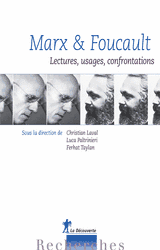
lavalChristian LAVAL, Luca PALTRINIERI, Ferhat TAYLAN, Marx & Foucault: Lectures, usages, confrontations, Éditions La Découverte, 2015

Marx et Foucault : deux œuvres, deux pensées sans lesquelles on ne peut saisir le sens de notre présent. Pas de théorie critique qui puisse se passer de leurs concepts et de leurs analyses. Et pas de luttes qui ne renvoient à tel moment ou à tel aspect de leur héritage. Pourtant, de l’un à l’autre le passage ne va pas de soi. Les époques, les intentions, les philosophies même ne sont pas superposables. Hétérogènes donc, ces pensées font, l’une et l’autre, obstacle à tout « foucaldo-marxisme ».

L’ouvrage vise à montrer des rapports mobiles et complexes, non des identités profondes ou des incompatibilités d’essence. Rapports de Foucault à Marx : il prend appui sur lui pour le déborder, l’envelopper, et parfois l’opposer à lui-même. Rapports de Foucault aux marxismes, sous leurs variantes les plus diverses, humaniste, existentialiste, althussérienne, qui n’ont cessé de composer les actualités changeantes de Foucault. Rapports des marxistes, d’hier et d’aujourd’hui, à Foucault : comment l’ont-ils lu ? Que lui ont-ils reproché, que lui ont-ils emprunté ? Qu’en font-ils aujourd’hui de neuf ?

C’est donc l’actualité d’une lecture croisée de Marx et Foucault qui est au centre des contributions de cet ouvrage et qui ouvre sur un espace fécond pour l’avenir de la pensée critique.
“An Archaeology of Adam Smith’s Epistemic Context”
Iara Vigo de Lima and Danielle Guizzo
Review of Political Economy, Published online: 26 Oct 2015

(DOI:10.1080/09538259.2015.1082819)

Abstract:
Adam Smith played a key role in Foucault’s archaeology of political economy. This archaeology, which Foucault accomplished in The Order of Things, is the focus of this article. Foucault may have disagreed with the writings of the classical political economists but he widens our perspective through new possibilities of understanding. It is very illuminating to understand Smith’s thinking as following a discursive practice that economic thought shared with the knowledge of living beings (natural history) and language (grammar). Foucault’s archaeology highlights some ontological and epistemological conditions that shed light on some of the pillars of Smith’s thinking: the centrality of exchange, the division of labour and the labour theory of value. The proximity between Newton and Smith is also examined in ontological and epistemological terms which can be understood through an investigation of that interdiscursivity practice. Beyond testing Foucault’s considerations, our aim is to demonstrate their potential for the current scholarship of Smith’s works. Foucault’s archaeology of knowledge offers a range of elements that warrants greater analysis by historians of economic thought.

Key Words:
Adam Smith, archaeology, Foucault, interdiscursive practice, Newtonian method, ontological and epistemological conditions.

Deleuze ABECEDAIRE, Fidélité Amitié, seconda parte: Foucault
Deleuze describes his friendship with Michel Foucault

With thanks to Colin Gordon for this link

CALL FOR PAPERS
The sixteenth annual meeting of the Foucault Circle

Sydney, Australia
June 29-July 2, 2016
(hosted by the University of New South Wales)

PDF of Call for papers

We invite individual papers and roundtable proposals (4-5 panelists) on any aspect of Foucault’s work. Studies, critiques, and applications of Foucauldian thinking are all welcome. We will aim for a diversity of topics and perspectives.

Abstracts should be prepared for anonymous review, and are to be submitted to the program committee chair, Richard A. Lynch, by email (lynchricharda@sau.edu) on/before Friday, Nov. 20, 2015. Please indicate “Foucault Circle submission” in the subject heading, and include the abstract as a “.docx” attachment.

Individual paper submissions require an abstract of no more than 750 words; roundtable submissions require a 500-word abstract describing the theme and 150-word summaries of each panelist’s talking points.

Program decisions will be announced in December.

Each speaker will have approximately 35 minutes for paper presentation and discussion combined—papers should be a maximum of 3000 words (15-20 minutes reading time). Roundtables will have approximately 50 minutes total for presentation and discussion combined; individual panelists should plan to speak for no more than 5-7 minutes. In addition to paper and roundtable sessions, the conference will also feature a “reading group” discussion session (texts TBA) open to all participants.

Logistical information about lodging, transportation, and other arrangements will be available after the program has been announced.

For more information about the Foucault Circle, please see our website:

The Foucault Circle at UNSW will be held immediately before the Australasian Association of Philosophy Conference which in 2016 is being hosted by Monash University at the Caulfield campus. AAP

Dates are: Sunday 3rd July – Thursday 7th July 2016. Scholars planning to attend the Foucault Circle may also wish to attend the AAP.

Plateau Simone Signoret, Michel Foucault
06 oct. 1982, Antenne 2, Site l’Institut national de l’audiovisuel

présentateur
Christine Ockrent

Christine OCKRENT interviewe l’actrice Simone SIGNORET et le philosophe Michel FOUCAULT sur la situation en Pologne, où le syndicat Solidarité vient d’être interdit par le gouvernement.

Simone SIGNORET, qui porte un badge du syndicat polonais “Solidarité”, explique pourquoi elle est allée en Pologne, notamment avec Médecins du Monde. Elle raconte qu’elle n’a pas eu le courage de porter ce badge là-bas. Elle estime que tout le pays est en dissidence ; elle parle de la situation économique et du fait que les Polonais sont surveillés en permanence : “on ne parle pas car il y a des micros partout”. Elle a vu des acteurs polonais “boycotter” leur travail, à savoir leur participation à des émissions de télévision qui leur apporte un revenu fixe. Cette décission n’est pas une consigne donnée par un syndicat, mais elle est prise individuellement.

Michel FOUCAULT étudie la notion de normalisation en Pologne, parle du régime totalitaire dans les pays socialistes. Il engage les français à se rendre dans ce pays. Il pose le problème de l’engagement nécessaire de l’Europe, explique ce que ressentent les Polonais a propos des français.

With thanks to Colin Gordon for this news

André Glucksmann par Michel Foucault, Le Nouvel Observateur

Le philosophe des “Maîtres penseurs” est mort à 78 ans. Celui de “Surveiller et punir” l’avait lu, pour “le Nouvel Observateur”, en 1977. Voici son texte, dans son intégralité.

Article de Michel Foucault sur “les Maîtres penseurs”,
paru dans “le Nouvel Observateur” du 9 mai 1977
La grande colère des faits

Pour Michel Foucault, comme pour André Glucksmann, il est urgent que la philosophie apprenne à se battre à mains nues, en riant et en criant, contre tous les tenants de l’Etat-Révolution.

Ce qui s’est passé de moins insignifiant dans nos têtes, depuis une quinzaine d’années? Je dirais dans un premier mouvement: une certaine rage, une sensibilité impatiente, irritée, à ce qui se passe, une intolérance à la justification théorique et à tout ce lent travail d’apaisement qu’assure au jour le jour le discours «vrai».

Sur fond d’un décor grêle que la philosophie, l’économie politique et tant d’autres belles sciences avaient planté, voilà que des fous se sont levés, et des malades, des femmes, des enfants, des emprisonnés, des suppliciés et des morts par millions. Dieu sait pourtant que nous étions tous armés de théorèmes, de principes et de mots pour broyer tout cela.

Quel appétit, soudain, de voir et d’entendre ces étrangers si proches? Quel souci pour ces choses frustes? Nous avons été saisis par la colère des faits. Nous avons cessé de supporter ceux qui nous disaient – ou plutôt le chuchotement qui, en nous, disait: «Peu importe, un fait ne sera jamais rien par lui-même; écoute, lis, attends; ça s’expliquera plus loin, plus tard, plus haut.»
Le réel irrationnel

Est revenu l’âge de Candide où l’on ne peut plus écouter l’universelle petite chanson qui rend raison de tout. Les Candides du XXe siècle, qui ont parcouru le vieux monde et le nouveau à travers les massacres, les batailles, les charniers et les gens terrorisés, existent: nous les avons rencontrés, Ukrainiens ou Chiliens, Tchèques ou Grecs. La morale du savoir, aujourd’hui, c’est peut-être de rendre le réel aigu, âpre, anguleux, inacceptable. Irrationnel donc?

suite

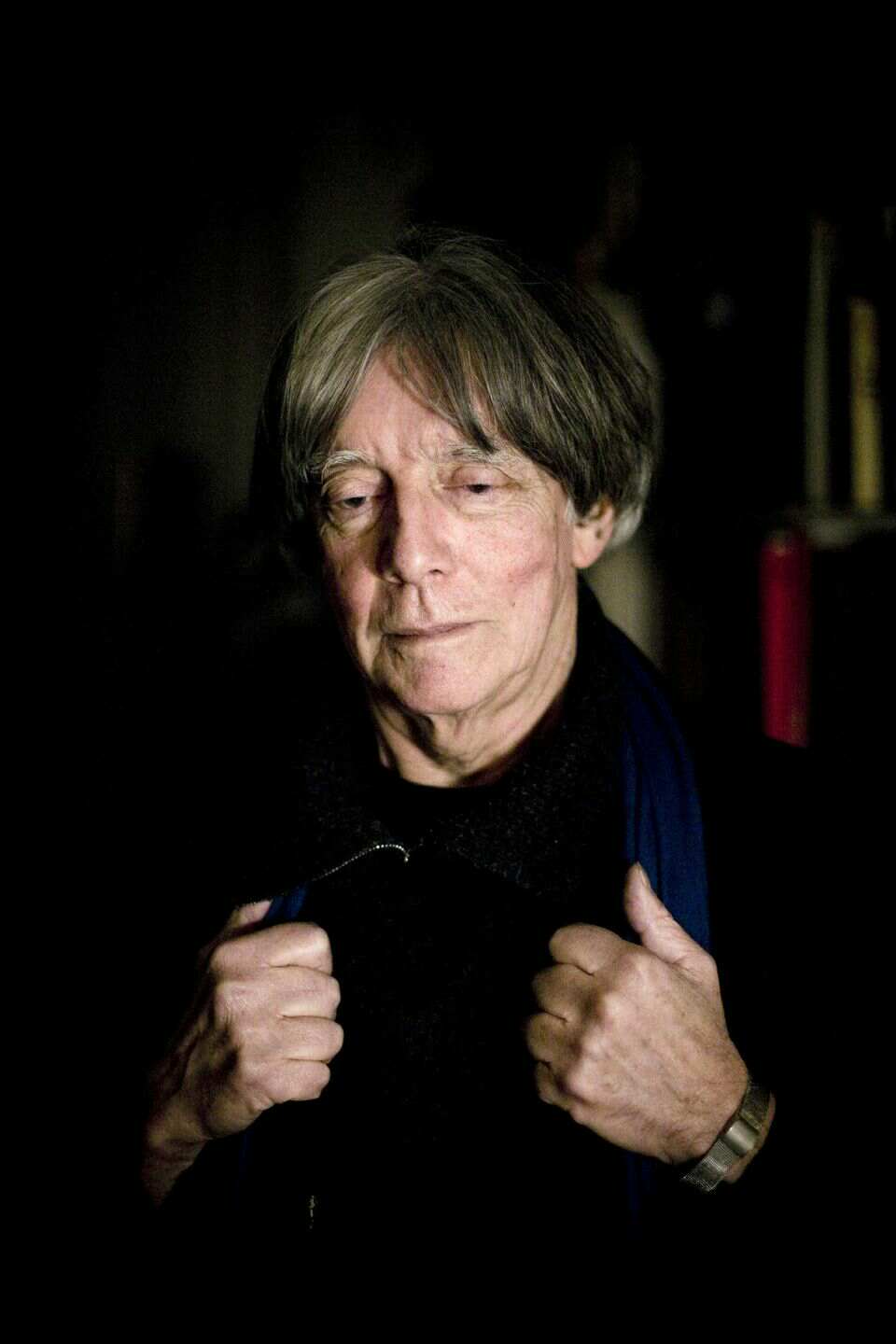
André Glucksmann en 2007 à Paris. Photo Frédéric Stucin pour Libération

André Glucksmann en 2007 à Paris. Photo Frédéric Stucin pour Libération

French philosopher Andre Glucksmann dies at 78, BBC News site

See also The Guardian

En français: Libération

Andre Glucksmann, one of the most prominent figures in French philosophy, has died aged 78.

An associate of Jean-Paul Sartre, he helped provide the intellectual underpinning for the student and worker revolts of May 1968.

He was originally seen as a Maoist but changed his views when he discovered the reality of totalitarianism.

He persuaded Sartre to back his call to help boat people fleeing the communist regime in Vietnam in 1979.

“My first and best friend is no more,” his son Raphael wrote on Tuesday. “I had the incredible luck to know, laugh, debate, travel, play – do all and nothing at all with such a good and brilliant man.”

Andre Glucksmann was born into a Jewish family originally from Poland and his experience of the Nazi occupation of France during World War Two inspired his early involvement with the French Communist party, as well as Maoists who advocated civil war.

In the early 1970s he condemned President Georges Pompidou’s France as “fascist”.

It was when he read The Gulag Archipelago by Soviet writer Alexander Solzhenitsyn in 1974 that his views dramatically changed, Le Figaro reports.

In common with other leading French thinkers such as Bernard-Henri Levy, he soon made a much-publicised break with Marxism. Together they came to be known as the “New Philosophers”.

In 1977, he wrote a stinging attack on communism in Barbarism with a Human Face.

Glucksmann’s thinking focused increasingly on the rights of the individual against the threat of totalitarianism, and he was prominent in promoting human rights in Bosnia, Chechnya and the Middle East, says the BBC’s Hugh Schofield in Paris.

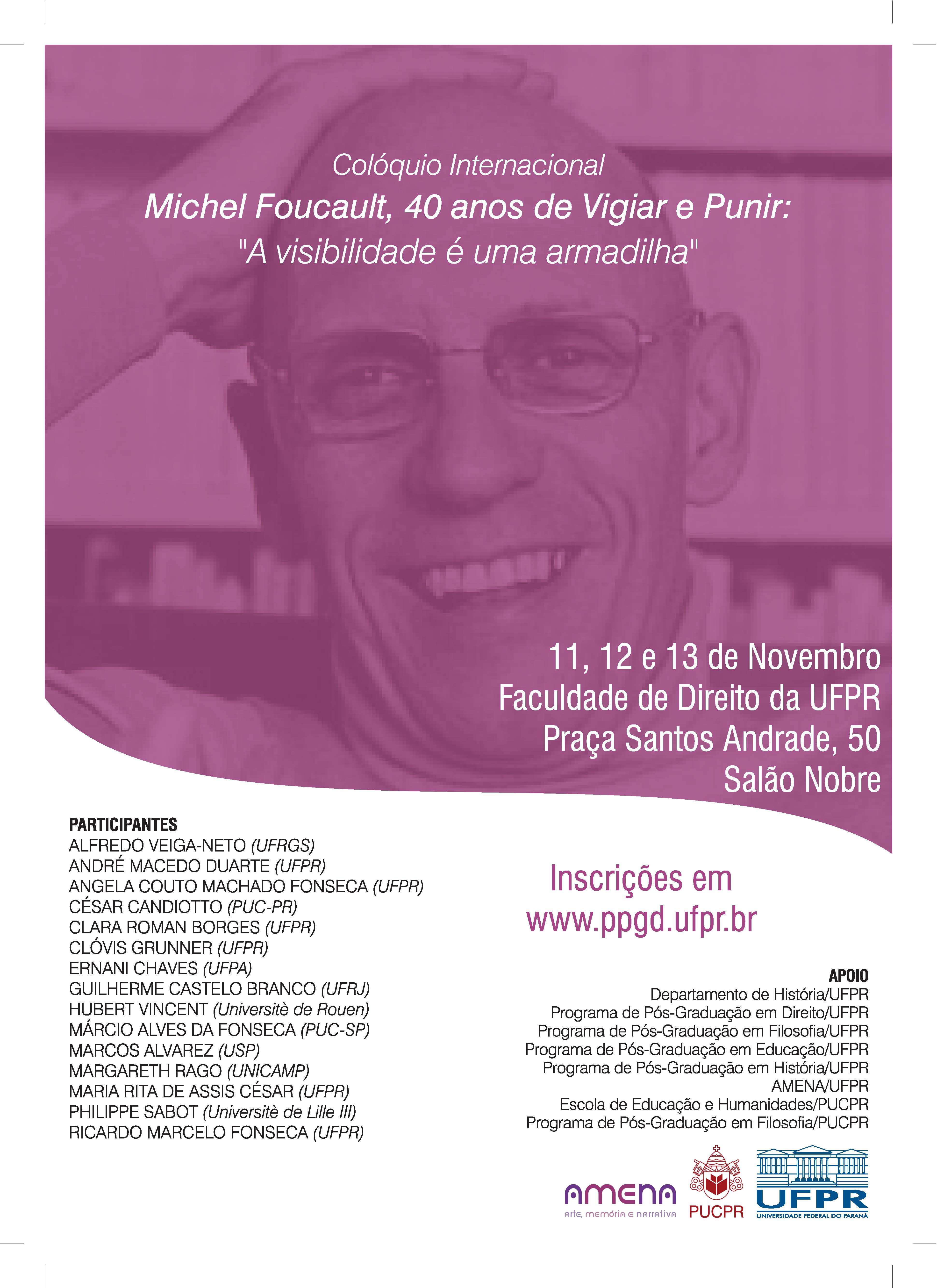
Cartaz Foucault

Colóquio Internacional 40 anos de Vigiar e Punir de Michel Foucault: “A visibilidade é uma armadilha”

Local: Salão Nobre da Faculdade de Direito da Universidade Federal do Paraná – UFPR – Curitiba, PR, Brazil
Data: 11-13/11/2015

Programação

Palestras do dia 11/11 às 14:30:
André Duarte (UFPR)
Ernani Chaves (UFPA)
César Candiotto (PUC-PR)

Palestra da noite de 11/11 às 19:30
Philippe SABOT (Université de Lille III)

Palestras do dia 12/11 às 14:30
Guilherme Castelo Branco (UFRJ)
Marcos Alvarez (USP)
Ricardo Marcelo Fonseca (UFPR)

Palestra da noite de 12/11 às 19:30
Hubert Vincent (Université de Rouen)

Palestras do dia 13/11 às 14:30
Marcio Alves da Fonseca (PUC-SP)
Alfredo Veiga-Neto (UFRGS)
Margareth Rago (UNICAMP)

Deakin University’s European Philosophy and the History of Ideas research group (EPHI) is pleased to be able to host the following workshop:

Problematizing the ‘Problem’ in 20th Century French Thought

PDF flyer

Where: Deakin University, Melbourne City Campus, Level 3, 550 Bourke St., Melbourne.

When: Thursday December 10, 2015, 8.30am-5.30pm

Workshop theme: The workshop will explore how a notion of the ‘problem’ was mobilized in 20th century French philosophy, in various ontologies of problems, in problematization as a philosophical method, and in the deployment of concepts of the problem and the problematic in diverse philosophical programs. Papers will explore the work of Bergson, Marcel, Wahl, Cavaillès, Lautman, Bachelard, Althusser, Hadot, Foucault and Deleuze.

To register: email Sean Bowden s.bowden@deakin.edu.au (please write ‘problems workshop’ in the subject line). All are welcome but registrations are essential.

Registration deadline: December 1, 2015.

Draft program:

8.30-8.35            Welcome
8.35-9.20            Craig Lundy (Wollongong), ‘Bergson’s Problematic Philosophy and the Pursuit of Metaphysical Precision’
9.20-10.05         Sean Bowden (Deakin), ‘Jean Wahl and the Problem of the Concrete’
10.05-10.50        Felicity Joseph (UNE), ‘Beyond philosophical “problems”: Gabriel Marcel’s problem/mystery distinction revisited’
10.50-11.10        Coffee
11.10-11.55        Simon Duffy (Yale-NUS), ‘Lautman on problems as the conditions of the existence of solutions’
11.55-12.40        Knox Peden (ANU), ‘Jean Cavaillès and the Problem of the Object’
12.40-1.30         Lunch
1.30-2.15          Alison Ross (Monash), ‘The errors of history: chance and reason in Bachelard and Foucault’
2.15-3.00          Mark Kelly (WSU), ‘Foucault and Althusser: The Problematic Missing Term’
3.00-3.20          Coffee
3.20-4.05          Matthew Sharpe (Deakin), ‘Between History, Wittgenstein and Phenomenology: The Unique Philosophical Problematic of Pierre Hadot’
4.05-4.50          Jon Roffe (UNSW), ‘Chronostructuralism in The Archeology of Knowledge and Difference and Repetition: some methodological notes on conceiving the reality of problems’
4.50-5.35           Colin Koopman (Oregon), ‘Problematization in Foucault’s Genealogy & Deleuze’s Symptomatology: Or, How to Study Sexuality without Invoking Oppositions’

groulxRichard Groulx, Michel Foucault, la politique comme guerre continuée. De la guerre des races au racisme d’État, Sur le Cours au Collège de France, “Il faut défendre la société”, Paris: Editions l’Harmattan, 2015.

La guerre est-elle un accident des sociétés ou appartient-elle à leur constitution même ? Telle est la question posée par Foucault dans son Cours de 1976 « Il faut défendre la société ». Renversant le célèbre aphorisme de Clausewitz sur « la guerre prolongée par la politique », il démontre comment un « dispositif de guerre » s’est introduit dans le discours politique moderne comme « guerre continuée » ou guerre nécessaire à la fois comme guerre des races, lutte des classes, social racisme et racisme d’État.