Foucault News

News and resources on French thinker Michel Foucault (1926-1984)

Kollosche, D.
Criticising with Foucault: towards a guiding framework for socio-political studies in mathematics education
(2015) Educational Studies in Mathematics, 14 p. Article in Press.

DOI: 10.1007/s10649-015-9648-5

Abstract
Socio-political studies in mathematics education often touch complex fields of interaction between education, mathematics and the political. In this paper I present a Foucault-based framework for socio-political studies in mathematics education which may guide research in that area. In order to show the potential of such a framework, I discuss the potential and limits of Marxian ideology critique, present existing Foucault-based research on socio-political aspects of mathematics education, develop my framework and show its use in an outline of a study on socio-political aspects of calculation in the mathematics classroom.

Author Keywords
Calculation; Critical mathematics education; Critique; Foucault; Marx

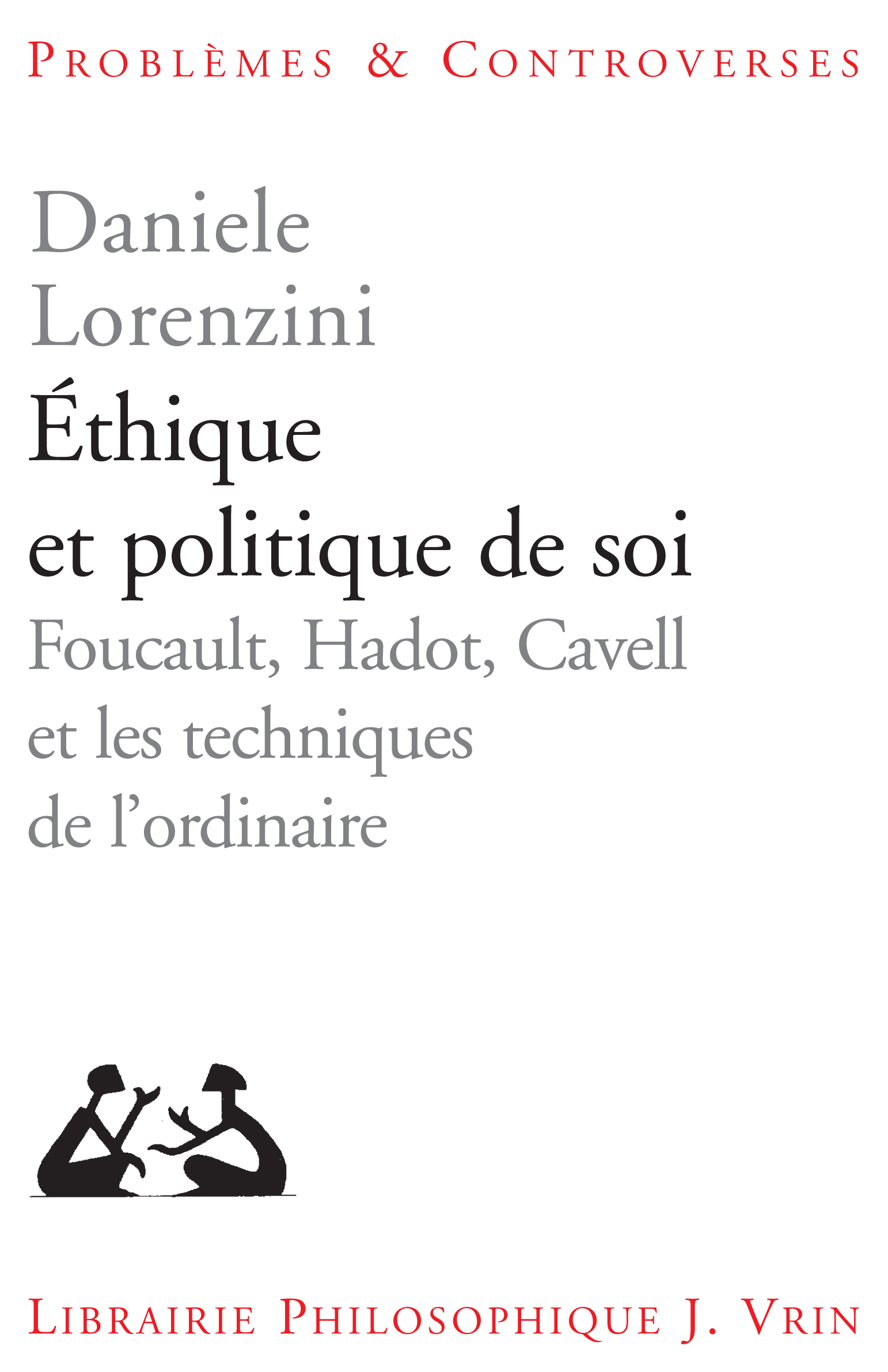
lorenzini-livreDaniele Lorenzini, Éthique et politique de soi. Foucault, Hadot, Cavell et les techniques de l’ordinaire. Paris: Librairie Philosophique J. Vrin, 2015

Introduction et Table des matières

Quel(s) rapport(s) est-il possible de tracer entre l’éthique et la politique? Michel Foucault, Pierre Hadot et Stanley Cavell, à partir de trois positions philosophiques très différentes, ont élaboré des stratégies de réponse à cette question que le présent ouvrage se propose de rendre explicites et d’explorer. Ainsi, l’esthétique de l’existence, les exercices spirituels et le perfectionnisme moral y sont combinés afin de construire un arrière-plan conceptuel et pratique permettant de saisir à la fois les enjeux politiques d’une « éthique de soi » et l’incontournable dimension éthique d’une « politique de nous-mêmes ». Cet ouvrage entend contribuer à l’élaboration d’une « philosophie analytique de la politique » dont le but est de rendre visibles l’existence et le fonctionnement concret du pouvoir dans ses ramifications quotidiennes; une telle entreprise se noue de façon étroite avec une analyse des « techniques de l’ordinaire », c’est-à-dire de ces pratiques que les individus utilisent pour donner une forme à leur vie et pour transformer leur rapport à eux-mêmes, aux autres et au monde.

Daniele Lorenzini, docteur de l’université Paris-Est et de l’université La Sapienza de Rome, enseigne l’éthique et la philosophie des sciences humaines à l’université Paris-Est Créteil.

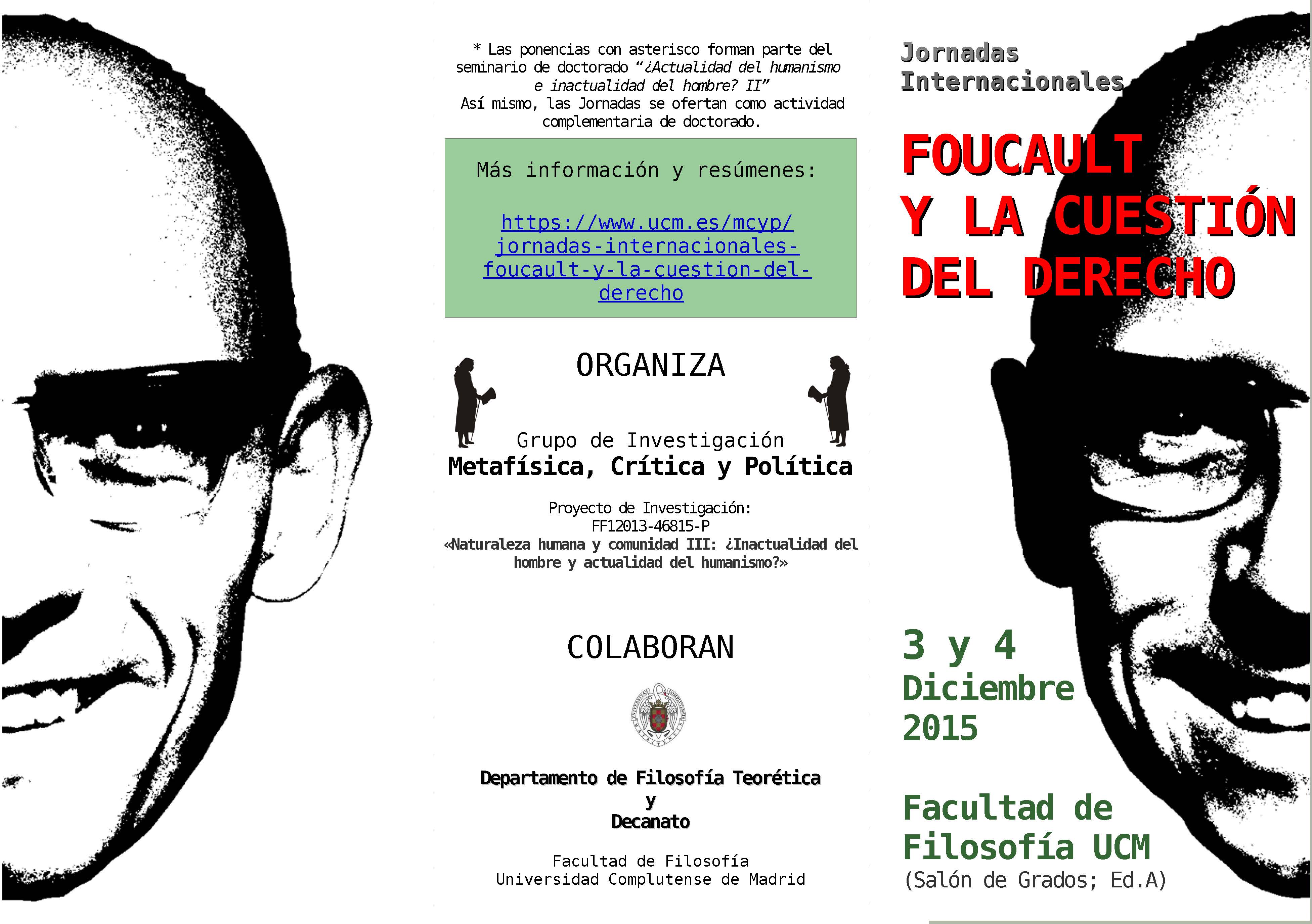
Tríptico_Page_1

PDF flyer and program

Jornadas Internacionales “Foucault y la cuestión del derecho”

Faculty of Philosophy
Complutense University of Madrid
3 and 4 December 2015

JUEVES 3 de Diciembre
(Salón de Grados; Ed.A)

SESIÓN DE MAÑANA

9:30 Inauguración: Rafael Orden (Excmo. Decano de la Facultad de Filosofía), Rogelio Rovira (Dir. Dpto. de Filosofía Teorética) y José Luis Pardo (Dir. Grupo de Investigación “Metafísica, Crítica y Política”)
(Modera Jorge Dávila)

10:00 “Foucault hecho y derecho. La quaestio iuris y la quaestio facti”, José Luis Pardo

10:50 Debate
11:10 Pausa

11:25 “Michel Foucault, la modernidad y las formas jurídicas”, Fernando Álvarez-Uría (UCM)

12:15 Debate

12:35 “La suspensión del derecho y el fantasma de la soberanía en la detención indefinida. Judith Butler sobre Foucault”, Emma Ingala (UCM)

13:10-13:30 Debate
SESIÓN DE TARDE
(Modera Emma Ingala)

16:30 “Breve arqueología del derecho a la última palabra”, Silvia Castro (UCM)

17:05 Debate

17:25 “« Ubu au tribunal » La loi et la norme dans le prisme de l’expertise psychiatrique”, Alain Gigandet (Université Paris XII)

18:15 Debate
18:35 Pausa

18:50 “El eclipse del «homo criticus» en la sociedad neoliberal: el diálogo de Wendy Brown con Michel Foucault”, Nuria Sánchez Madrid (UCM)

19:25-19:45 Debate

VIERNES 4 de Diciembre
(Salón de Grados; Ed.A)

SESIÓN DE MAÑANA
(Modera Nuria Sánchez Madrid)

10:00 “Direito e análise da política em Foucault”, Márcio Alves (Pontifícia Universidade Católica de São Paulo) *

10:50 Debate
11:10 Pausa

11:25 “Foucault y la problematización de la relación Ética – Derecho”, Jorge Dávila (Universidad de los Andes, Mérida, Venezuela) *

12:15 Debate

12:35 “Sobre «Derecho y Ontología» en Foucault (1978-1984)”, Marco Díaz Marsá (UCM)

13:10-13:30 Debate

SESIÓN DE TARDE
(Modera Marco Díaz Marsá)

16:30 “El pueblo como sujeto de lo universal. De la gubernamentalidad a la Aufklärung”, Jesús González Fisac (Universidad de Cádiz) *

17:05 Debate

17:25 “Une minorité qui ne fait pas loi. Le Kant des Lumières relu par Foucault”, Diogo Sardinha (Collège International de Philosophie -Paris) *

18:15 Debate
18:35 Pausa

18:50-19:45 Clausura y presentación del libro Foucault actual: ética y política (bid & co. Editor/Fundecem). Pausides Reyes (editor y presidente de Fundecem, Mérida, Venezuela)

Engels, K.S.
Biopower, Normalization, and HPV: A Foucauldian Analysis of the HPV Vaccine Controversy
(2015) Journal of Medical Humanities, 14 p. Article in Press.

DOI: 10.1007/s10912-015-9361-5

Abstract
This article utilizes the Foucauldian concepts of biopower and normalization to give an analysis of the debate surrounding the controversial administration of the HPV vaccine to adolescents. My intention is not to solve the problem, rather to utilize a Foucauldian framework to bring various facets of the issue to light, specifically the way the vaccine contributes to strategies of power in reference to how young adults develop within relationships of power. To begin, the article provides an overview of the Foucauldian concepts of biopower and normalization, including how these two strategies of power were present in the administration of the smallpox vaccine in the 19th century. Next, information about HPV and the history of the current controversy in the United States is presented. Lastly, the article presents an analysis of the strategies of biopower and normalization present in the debate on HPV, including an emphasis on how the vaccination is similar to, and different from, 19th century smallpox vaccination. It also explores the way that mechanisms of disease control affect and are affected by individual subjects, in this case, adolescents. © 2015 Springer Science+Business Media New York

Author Keywords
Biopower; Foucault; Human papillomavirus; Normalization

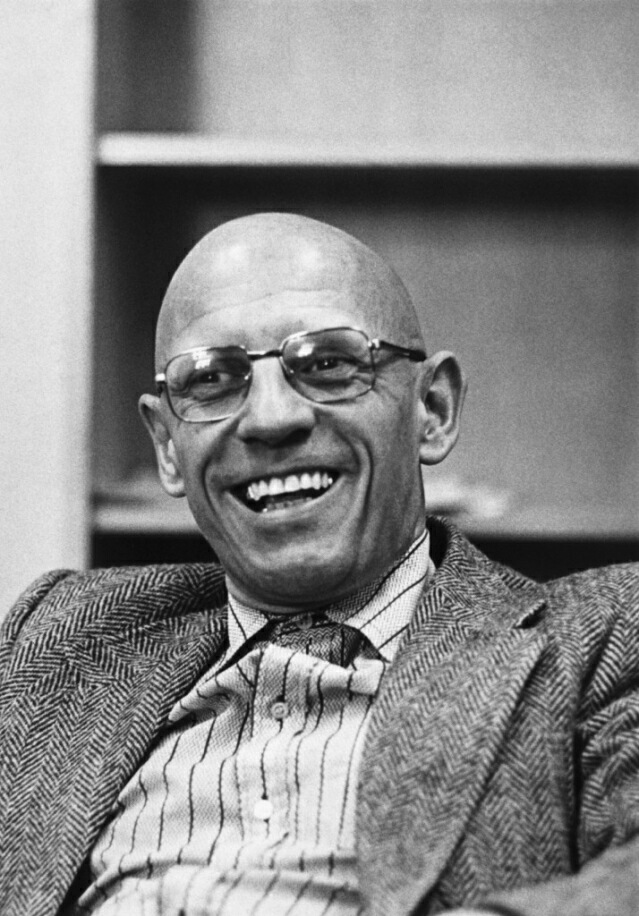
Michel Foucault le 5 novembre 1979© corbis - 2015 / Bettmann/CORBIS

Michel Foucault le 5 novembre 1979© corbis – 2015 / Bettmann/CORBIS

La marche de l’histoire. Michel Foucault, France Inter Radio

Invité Philippe Artières
Historien, chercheur au CNRS

Il avait mesuré que l’intervention des intellectuels passait de plus en plus par l’essai bref et le plateau télé et encore n’a-t-il pas connu l’économie du web 2.0. Puisque la discontinuité est de mise, il disait par provocation qu’advenait le temps du journaliste. En tout cas, la figure de l’intellectuel qui s’autorise d’une vérité transcendante et d’une compétence universelle pour distribuer la bonne parole, ce n’était pas son style !

Et son succès inouï dans les années 70 aussi bien au Collège de France qu’auprès de ses auditoires du monde entier ne changea pas son point de vue. « Je ne suis pas là où vous me guettez », disait-il. Il n’aimait pas les rôles de répertoire. « Je ne suis pas là où vous me guettez mais, ajoutait-il, je suis ici d’où je vous regarde en riant. » Rien ne l’enchantait plus que de passer d’un terrain d’enquête à un autre. Dans les années 1960, l’écart entre les mots et les choses. Plus tard, les pratiques de résistance face aux discours et aux techniques des pouvoirs. Dans les dernières années, avant sa mort prématurée en 1984, la technique, le contrôle de soi…

Nouveaux terrains, nouveaux concepts, nouveaux intervenants…. L’intellectuel non pas généraliste mais « spécifique » qu’il défendait, c’était un technicien qui ouvrait les portes à ceux qui ne se tiennent généralement ni dans les écrans de télé ni dans les rectangles de papier.

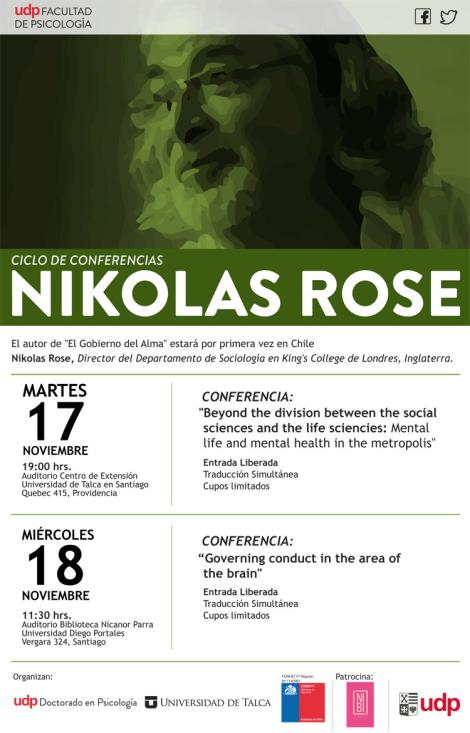
Ciclo de conferencias de Nikolas Rose (2015)
Nuevo horario conferencia de Nikolas Rose . Martes 17/11, 18 horas. Quebec 415, Providencia.

nikolas_rose

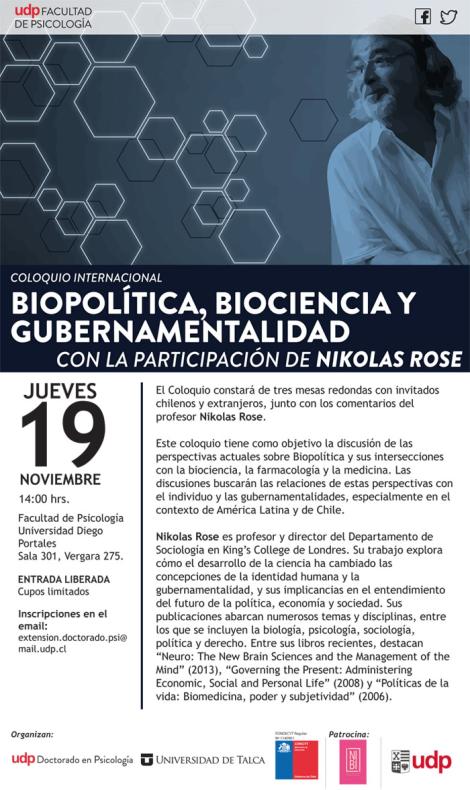
International Workshop Program

Biopolitics, Bioscience and Governmentality

November 19th, 2015
Room “auditorio DEC”,
Faculty of Engineering Diego Portales University (Vergara # 432, Santiago)

See also this link

conversatorio_nikolas_rose

Panel 1 (14:00 a 15:45 hrs):
Claudio Maino and Álvaro Jiménez (Universidad Paris 5 (Descartes)): The challenges to think mental health in democratic societies: What can the biopolitical approaches offer?

Mauricio Sepúlveda, Sebastían de la Fuente and Jorge Lucero (Universidad de Chile): The poppers as technology of the body in the sexual (counter) practices: Pleasure, counter-pratice and somatic fiction

Jimena Carrasco (Universidad Austral de Chile) and Arthur Arruda (Universidade Federale Rio de Janeiro): Brazilian and Chilean psychiatric reforms and management for freedom – a history of the modes of governance in mental health practices.

Coffee Break

Panel 2 (16:00 a 17: 45):

Jorge Castillo (Universidad de Santiago de Chile): Bio-governmentality: regimes of subjectification, embodiment and biosociality in GES: approach to expert repertoires
Sebastián Rojas (King’s College London): A biomedical hybridization of childhood? Modes of agency and flashes of will according to an ethnographic experience in a Chilean school of Santiago

Ricardo Camargo (Universidad de Talca) and Nicolás Ried (Universidad de Chile):
Biopolitics and Truth in the Chilean judicial apparatus: the case of the Marchiafava Bignami disease

Coffee Break

Final: 18:00
Nikolas Rose: “Biopolitics in the Twenty First Century”

Open University December philosophy seminar

Dr Luca Sciortino (Visiting Research Fellow, University of Leeds)
‘Styles of Thinking and Epistemic Relativism’

2pm December 2nd 2015
Meeting Room 5, Walton Hall, Milton Keynes

Abstract
In the 1980s Ian Hacking put forward the ‘styles project’, as he called it, whose central idea is that there exist distinct styles of thinking which have emerged in the course of the history of science. This paper points at a potential tension between Hacking’s entity realism and his styles project. I argue that realism about unobservable entities is a case in which a scientific claim is justified for a community that adopts a certain style and unjustified for a community that adopts another style. I conclude that Hacking’s styles project implies epistemic relativism.

Michel Foucault: The rights and duties of international citizenship (2015)

The front page of the Open Democracy Site, 14 November 2015

Also includes links to the following items:

Michel Foucault “The refugee problem is a presage of the great migrations of the twenty first century”, 1979. Translated by Colin Gordon.

Colin Gordon, The drowned and the saved: Foucault’s texts on migration and solidarity, 13 November 2015

Engin Isin, Michel Foucault as an activist intellectual, 13 November 2015

Jen Bagelman, Foucault and the ‘current’ refugee crisis, 13 November 2015


“Face aux gouvernements, les droits de l’homme”, Liberation no 967, 30 June /1 July 1984, p. 22. Dits et ecrits IV pp. 707-8 (355), Gallimard 1994.

This statement was read by Foucault at a press conference on June 19th 1981, organized in association with the organizations Médecins du monde and Terre des hommes, in the presence of Yves Montand, André Glucksmann and Bernard Kouchner. The press conference, according to the newspaper Libération when it published Foucault’s text for the first time just after his death in 1984, was to have marked the public announcement of the formation of an International Committee against Piracy. Another account states that this Committee was set up in Lausanne on April 30 that year. The Libération editor’s note states that Foucault wrote this statement “minutes” before he read it. The title of the piece as published by Libération, “Confronting governments, human rights” seems to have been provided by them, not by Foucault. Given the public profile of the event and those present, it is unclear why the text appears not to have been published at the time.

“We are here only as private individuals and with no other claim to speak, and to speak together, except a certain difficulty we share in enduring what is taking place.

I know very well, and one must defer to this evident truth: we can do little about the reasons which make men and women prefer to leave their country rather than remain and live in it.  It is not in our power to change these facts.

So who asked us to speak? No one, and that is exactly our entitlement. It seems to me that we need to keep in mind three principles which, I believe, guide this initiative, like several others that have preceded it: Ile-de-Lumière, Cap Anamour, A Plane for El Salvador, but also Terre des Hommes and Amnesty International.[1]

1) There exists an international citizenship which as such has its rights and duties, and which is obliged to stand up against all forms of abuse of power, no matter who commits them, no matter who are their victims. After all, we are all governed, and, by that fact, joined in solidarity.

2) Because of their claim to care for the wellbeing of societies, governments arrogate to themselves the right to treat in terms of profit and loss the human suffering which their decisions cause and their negligence allows. It is a duty of this international citizenship to always confront the eyes and ears of governments with the human suffering for which it cannot truthfully be denied that they bear responsibility. People’s suffering must never be allowed to remain the silent residue of politics. It grounds an absolute right to stand up and to challenge those who hold power.

3) We must refuse the division of labour which is so often proposed to us: individuals are allowed to be indignant and to talk, while it falls to governments to deliberate and to act. It is true that well-intentioned governments appreciate the sacred indignation of the governed, providing that it remains merely lyrical. But I think we must be aware that it is very often those who govern who talk, are only able to talk, or only want to talk. Experience shows that we can and must refuse the histrionic role of pure protest which governments would like to offer us.  Amnesty International, Terre des Hommes, Médecins du Monde are initiatives which have created this new right: the right of private individuals to intervene actively and materially in the order of international politics and strategy. The will of individuals must be present and expressed in the order of reality which governments have sought to monopolise. Step by step and day by day, their purported monopoly must be rolled back.

Translated by Colin Gordon, October 2015


[1] Ile-de-Lumière was a French hospital and rescue ship organized by Bernard Kouchner and others  which conducted a series of  missions in the South China Sea in 1979. Cap Anamour was another rescue ship organised by the German humanitarian activists Christel and Rupert Neudeck and others.

Editor: My thoughts are with those of you reading Foucault News from Paris in the wake of Friday night’s terrible events.