
Foucault News

News and resources on French thinker Michel Foucault (1926-1984)

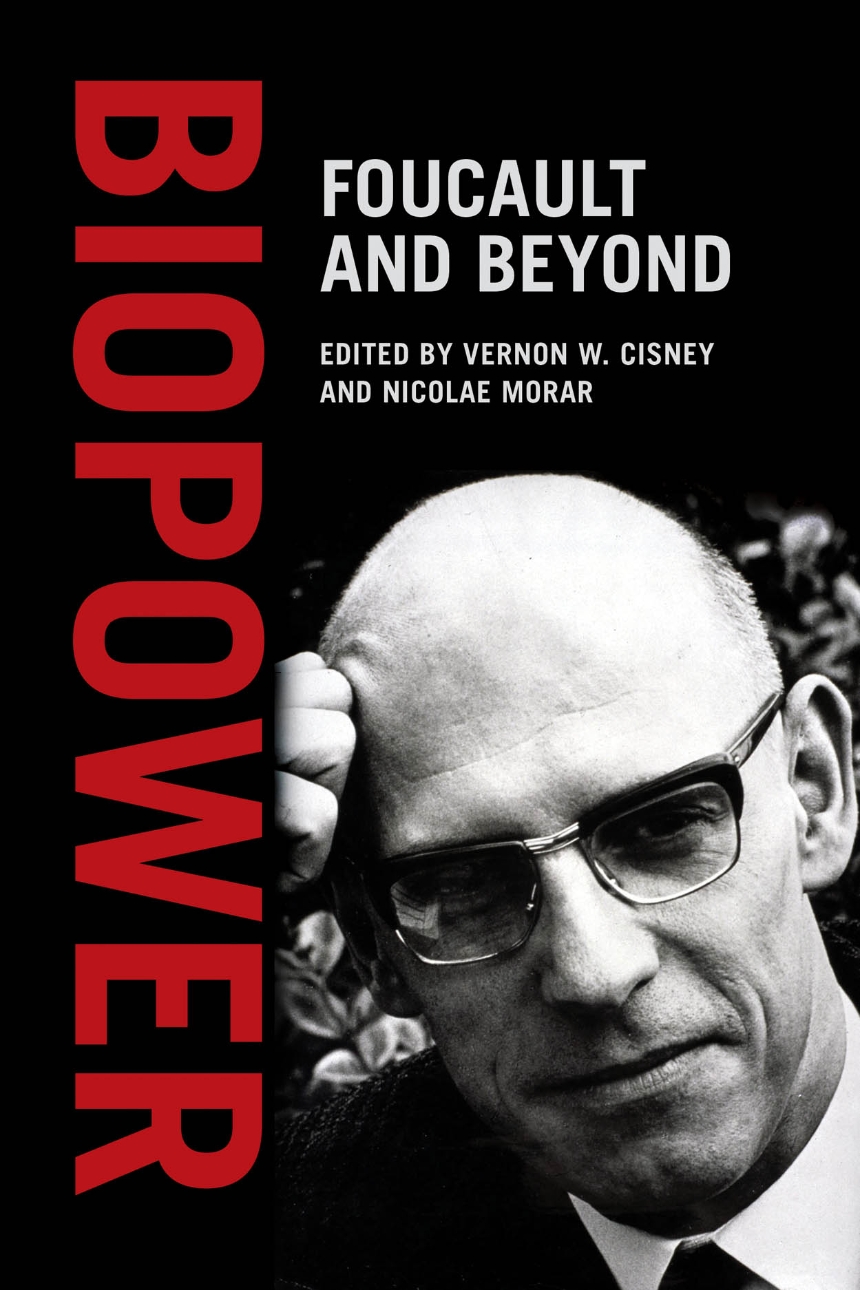
Vernon W. Cisney and Nicolae Morar (Eds), Biopower: Foucault and Beyond, University of Chicago Press, 2015

Michel Foucault’s notion of “biopower” has been a highly fertile concept in recent theory, influencing thinkers worldwide across a variety of disciplines and concerns. In The History of Sexuality: An Introduction, Foucault famously employed the term to describe “a power bent on generating forces, making them grow, and ordering them, rather than one dedicated to impeding them, making them submit, or destroying them.” With this volume, Vernon W. Cisney and Nicolae Morar bring together leading contemporary scholars to explore the many theoretical possibilities that the concept of biopower has enabled while at the same time pinpointing their most important shared resonances.

Situating biopower as a radical alternative to traditional conceptions of power—what Foucault called “sovereign power”—the contributors examine a host of matters centered on life, the body, and the subject as a living citizen. Altogether, they pay testament to the lasting relevance of biopower in some of our most important contemporary debates on issues ranging from health care rights to immigration laws, HIV prevention discourse, genomics medicine, and many other topics.

Endorsement
Biopower is a remarkable book. Although it contains essays written by the most important and well-known commentators on Foucault, it is really more than a study of Foucault’s concept of biopower. The majority of the essays expands, extends, and transforms the concept of biopower. Like all of the essays in the volume, the introduction written by Morar and Cisney is excellent. They are to be congratulated not only for organizing such an impressive volume, but guiding us through it with their analysis. This will be the definitive volume on biopower for decades to come.” (Leonard Lawlor, Penn State University)

Contents

Vernon W. Cisney and Nicolae Morar
Introduction: Why Biopower? Why Now?

Part I : Origins of Biopower

Judith Revel
One / The Literary Birth of Biopolitics (translated by Christopher Penfield)

Antonio Negri
Two / At the Origins of Biopolitics (translated by Diana Garvin)

Ian Hacking
Three / Biopower and the Avalanche of Printed Numbers

Catherine Mills
Four / Biopolitics and the Concept of Life

Paul Patton
Five / Power and Biopower in Foucault

Part II : The Question of Life

Mary Beth Mader
Six / Foucault, Cuvier, and the Science of Life

Jeff T. Nealon
Seven / The Archaeology of Biopower: From Plant to Animal Life in The Order of Things

Eduardo Mendieta
Eight / The Biotechnological Scala Naturae and Interspecies Cosmopolitanism: Patricia Piccinini, Jane Alexander, and Guillermo Gómez-Peña

Part III : Medicine and Sexuality: The Question of the Body

Carlos Novas
Nine / Patient Activism and Biopolitics: Thinking through Rare Diseases and Orphan Drugs

David M. Halperin
Ten / The Biopolitics of HIV Prevention Discourse

Jana Sawicki
Eleven / Precarious Life: Butler and Foucault on Biopolitics

Part IV : Neoliberalism and Governmentality: The Question of the Population

Todd May and Ladelle McWhorter
Twelve / Who’s Being Disciplined Now? Operations of Power in a Neoliberal World

Frédéric Gros
Thirteen / Is There a Biopolitical Subject? Foucault and the Birth of Biopolitics (translated by Samantha Bankston)

Martina Tazzioli
Fourteen / Discordant Practices of Freedom and Power of/over Lives: Three Snapshots on the Bank Effects of the Arab Uprisings

Part V : Biopower Today

Paul Rabinow and Nikolas Rose
Fifteen / Biopower Today

Ann Laura Stoler
Sixteen / A Colonial Reading of Foucault: Bourgeois Bodies and Racial Selves

Roberto Esposito
Seventeen / Totalitarianism and Biopolitics? Concerning a Philosophical Interpretation of the Twentieth Century (translated by Timothy Campbell)

A Foucault News exclusive.

Governmentality studies observed
Interview with Colin Gordon by Aldo Avellaneda and Guillermo Vega
September 2015

Full PDF of article

Interviewers’ introduction
Colin Gordon is considered one of the key references of what, in a rather generic although recognizable way, has come to be called “governmentality studies”. He has been involved since the late 1970s in various projects dealing with Foucault’s work and has drawn attention since then to the particularities and advantages of Michel Foucault’s study of “arts of government”. Among his key works we can mention the editing, in 1980, of Power/Knowledge (one of the first compilations and translations in English of Foucault’s work on power) and the co-editing in 1991 – with Graham Burchell and Peter Miller – of The Foucault Effect (TFE). He has also published over the last thirty years many articles and papers about the reception of Foucault in Britain, Foucault and law, the relation between Foucault and Weber, among other topics. And in so doing, he has become one of the most relevant contributors to the reception of Foucault in the Anglophone world.

During the second half of the last year we undertook, with some colleagues and friends, the reading and translation into Spanish of the well-known introductory chapter by Colin Gordon in TFE, “Governmental Rationality. An introduction” (published in Revista Nuevo Itinerario in September 2015). After we finished it, we decided to make contact with its author in order to discuss the possibilities of a Spanish edition. The interview we present below accompanies that translation and is the result of numerous emails we exchanged since February. Our main intention was to present the author’s thoughts about a wide range of topics related to governmentality studies, although we’ve tried to focus particularly on its present situation and its analytical effectiveness.

We thank Colin Gordon for his friendly and continuing cooperation.

Aldo Avellaneda
Guillermo Vega
Facultad de Humanidades,
Universidad Nacional del Nordeste – Argentina

Read more

Foucault @ 90
International Conference

22nd-23rd June 2016
University of the West of Scotland
Ayr Campus, Scotland, UK

Further information and registration

PDF conference flyer

Call for Papers
This year marks the 90th anniversary of the birth of the French thinker Michel Foucault (1926-84). This interdisciplinary conference aims to reflect on the work of Michel Foucault and in particular on the question of its abiding relevance and value.

Keynote speakers include Stephen Ball, Mark Olssen, and Clare O’Farrell.

Based at our attractive Ayr campus, on the scenic west coast of Scotland, this conference promises to be a stimulating and enjoyable event. Research paper submissions are now sought on the conference themes listed below.

Abstracts should be up to 400 words in length and cover the context of the research, research questions, theoretical framework, methodology, findings, significance. Abstracts should be readied for blinded peer review. The conference will run as a series of 90-minute sessions with 3 or 4 papers allocated to each.

Symposia: the conference welcomes submissions for symposium sessions. These should comprise a set of four or more related paper submissions (as above) with an agreed Chairperson and Discussant.

Posters: posters will be displayed throughout the conference, with a set time agreed for presenters to be available to discuss their work with conference delegates. Posters should be submitted in A1/upright form and be accompanied by a 250 word abstract.

Conference/Abstract themes:
The conference seeks papers which deal with the work of Foucault in relation to any of the following themes:
• Education
• Health
• Justice
• Criminology
• Psychiatry/Psychology
• Methodology
• Sexuality
• Culture/aesthetics
• Philosophy
• Politics

Key dates

Abstract submission opens 15th October 2015
(papers/posters/symposia)
Abstract submission ends 1st March 2016
Notification of peer review/abstract acceptance 22nd March 2016
Early Bird Registration commences 22nd March 2016
Presentation times announced 15th April 2016
Early Bird Registration ends 1st May 2016

Contact
Abstract submissions should be emailed by attachment to: foucaultconference@uws.ac.uk

Thomson, P., Pennacchia, J.
Hugs and behaviour points: Alternative education and the regulation of ‘excluded’ youth
(2015) International Journal of Inclusive Education, 19 p. Article in Press.

DOI: 10.1080/13603116.2015.1102340

Abstract
In England, alternative education (AE) is offered to young people formally excluded from school, close to formal exclusion or who have been informally pushed to the educational edges of their local school. Their behaviour is seen as needing to change. In this paper, we examine the behavioural regimes at work in 11 AE programmes. Contrary to previous studies and the extensive ‘best practice’ literature, we found a return to highly behaviourist routines, with talking therapeutic approaches largely operating within this Skinnerian frame. We also saw young people offered a curriculum largely devoid of languages, humanities and social sciences. What was crucial to AE providers, we argue, was that they could demonstrate ‘progress’ in both learning and behaviour to inspectors and systems. Mobilising insights from Foucault, we note the congruence between the external regimes of reward and punishment used in AE and the kinds of insecure work and carceral futures that might be on offer to this group of young people. © 2015 Taylor & Francis

Author Keywords
alternative education; behaviourism; Foucault; inclusion; therapeutic approach

koopmanColin Koopman, Pragmatism as Transition. Historicity and Hope in James, Dewey, and Rorty, Columbia University Press, 2015

Pragmatism is America’s best-known native philosophy. It espouses a practical set of beliefs and principles that focus on the improvement of our lives. Yet the split between classical and contemporary pragmatists has divided the tradition against itself. Classical pragmatists, such as John Dewey and William James, believed we should heed the lessons of experience. Neopragmatists, including Richard Rorty, Hilary Putnam, and Jürgen Habermas, argue instead from the perspective of a linguistic turn, which makes little use of the idea of experience. Can these two camps be reconciled in a way that revitalizes a critical tradition?

Colin Koopman proposes a recovery of pragmatism by way of “transitionalist” themes of temporality and historicity which flourish in the work of the early pragmatists and continue in contemporary neopragmatist thought. “Life is in the transitions,” James once wrote, and, in following this assertion, Koopman reveals the continuities uniting both phases of pragmatism. Koopman’s framework also draws from other contemporary theorists, including Michel Foucault, Pierre Bourdieu, Bernard Williams, and Stanley Cavell. By reflecting these voices through the prism of transitionalism, a new understanding of knowledge, ethics, politics, and critique takes root. Koopman concludes with a call for integrating Dewey and Foucault into a model of inquiry he calls genealogical pragmatism, a mutually informative critique that further joins the analytic and continental schools.

About the Author
Colin Koopman is associate professor of philosophy at the University of Oregon and author of Genealogy as Critique: Foucault and the Problems of Modernity.

Foucault 7/13: WEBCAST/LIVESTREAM

David Armitage, Adam Tooze, and Jeremy Kessler will discuss Foucault’s seventh lecture series at the Collège de France, Security, Territory, Population (1977-1978) on Monday, December 7, 2015, at 6:15pm EST. Please watch the livestream  here or here. Please also read the introductory posts presenting the lectures by David Armitage, Adam Tooze, and Jeremy Kessler, and the framing essays by Velasco and Harcourt (another one here). Bibliographical references for the seminar are here. Welcome to Foucault 7/13!

Dorrestijn, S.
The Care of Our Hybrid Selves: Ethics in Times of Technical Mediation
(2015) Foundations of Science, 11 p. Article in Press.

DOI: 10.1007/s10699-015-9440-0

Abstract

What can the art of living after Foucault contribute to ethics in relation to the mediation of human existence by technology? To develop the relation between technical mediation and ethics, firstly the theme of technical mediation is elaborated in line with Foucault’s notion of ethical problematization. Every view of what technology does to us at the same time expresses an ethical concern about technology. The contemporary conception of technical mediation tends towards the acknowledgement of ongoing hybridization, not ultimately good or bad but ambivalent, which means for us the challenge of taking care of ourselves as hybrid beings. Secondly, the work of Foucault provides elements for imagining this care for our hybrid selves, notably his notions of freedom as a practice and of the care of the self. A conclusions about technical mediation and ethics is that whereas the approaches of the delegation of morality to technology by Latour and mediated morality by Verbeek see technical mediation of behavior and moral outlook as an answer in ethics, this should rather be considered the problem that ethics is about. © 2015 The Author(s)

Author Keywords
Art of living; Care of the self; Michel Foucault; Philosophy of technology; Technical mediation

Index Keywords
Social sciences; Art of living, Care of the self, Michel Foucault, Philosophy of technology, Technical mediation; Philosophical aspects

Mifsud, D.
The policy discourse of networking and its effect on school autonomy: a Foucauldian interpretation
(2015) Journal of Educational Administration and History, 24 p. Article in Press.

DOI: 10.1080/00220620.2016.1092427

Abstract
Policy discourse officially operates to distinctly influence public perception in an irrevocable and normalising manner. In a Maltese educational scenario of gradual decentralisation and increased accountability, I explore the ‘effects’ of both the global and the local policy discourse of networks and networking on the practising leaders, in addition to their reaction to the policy document mandating these multi-site school collaboratives, with a particular interest on their imposed nature and how this reform impinged on individual school autonomy. This research adopts a case study methodology, with data collected through in-depth, semi-structured interviews; participant observation; and documentary analysis, interpreted via a Foucauldian theoretical framework through narrative analysis. The findings reveal an inherent tension among autonomy, centralisation, and decentralisation both within the policy discourse and the unfolding network leadership dynamics. This paper has particular philosophical implications for educational policy, practice, and theory in an educational scenario of school policy globalisation. © 2015 Taylor & Francis

Author Keywords
(de)centralisation; accountability; autonomy; Foucault; policy discourse; school networks/collaboratives

Carte Semiotiche Annali 4 – Call For Papers in Italian, English, French and Spanish

PDF with full details

LE IMMAGINI DEL CONTROLLO. Visibilità e governo dei corpi
La redazione di Carte Semiotiche vi invita ad inviare proposte di contributo in italiano, inglese, francese o spagnolo (max. 2000 caratteri spazi inclusi o 500 parole) corredate di un breve profilo biografico (max. 10 righe) entro il 31 gennaio 2016 al seguente indirizzo: cartesemiotiche@gmail.com
Per ulteriori informazioni si prega di contattare i curatori del volume, Maria Cristina Addis (krix.addis@gmail.com) e Giacomo Tagliani (giacomo.tagliani@sns.it).

IMAGES OF CONTROL. Visibility and the Government of Bodies
The Editorial Board invites you to send an abstract with a proposal of contribution (2000 characters or 500 words) in English, French, Italian, Spanish (please attach a short biography) by the 31st of January 2016, to the following address: cartesemiotiche@gmail.com For any questions, please contact the editors Maria Cristina Addis (krix.addis@gmail.com) and Giacomo Tagliani (giacomo.tagliani@sns.it)

LES IMAGES DU CONTRÔLE. Visibilité et gouvernement des corps
La rédaction de Carte Semiotiche vous invite à envoyer vos propositions de contribution (max. 2000 caractères espaces inclus ou 500 mots) accompagnées d’une brève bibliographie (max. 10 lignes) avant le 31 janvier 2016 à l’adresse suivant: cartesemiotiche@gmail.com. Si vous avez des quéstiones, n’hesitez pas à contacter les directeurs éditorials du volume Maria Cristina Addis (krix.addis@gmail.com) et Giacomo Tagliani (giacomo.tagliani@sns.it)

IMÁGENES DEL CONTROL. Visibilidad y gobierno de los cuerpos
La redacción de Carte Semiotiche invita a enviar propuestas de contribuciones (máximo 2000 caracteres con espacios incluidos o 500 palabras) acompañadas de un breve perfil biográfico (máximo 10 líneas) del autor antes del 31 de enero de 2016 a la redacción: cartesemiotiche@gmail.com. Si tienes preguntas, contacter por favor los coordinadores del número Maria Cristina Addis (krix.addis@gmail.com) y Giacomo Tagliani (giacomo.tagliani@sns.it)

The Philosophy Research Initiative at Western Sydney University will be running a new MA in Continental Philosophy from 2016 (to replace Honours, which will no longer be available from 2016).

Members of the group have special expertise in Kant and post-Kantian German thought from Hegel to Nietzsche, the traditions of 20th-century French and German philosophy emerging out of phenomenology and existentialism and moving into Critical Theory, deconstruction, post-structuralism, and the more recent philosophical trends arising out of those movements. We are open to diverse issues, but place a special emphasis on questions of ethics, social and political philosophy, aesthetics, environmental philosophy, and the historical sense of those questions.

More information about the MA