Foucault News

News and resources on French thinker Michel Foucault (1926-1984)

Journée d’études à l’EHESS

« Relire le Foucault de la Pléiade »

6 janvier 2016
École des Hautes études en sciences sociales
amphithéâtre François-Furet
105 bd Raspail
75006 Paris

PDF of programme

En novembre 2015, Michel Foucault fait son entrée à la Pléiade. La question que nous allons nous poser, dans cette journée d’étude, est la suivante : Est-il possible de discerner aujourd’hui une nouvelle lecture de Foucault grâce a cette édition Pléiade, les nouvelles notices, ou l’événement même de son entrée ? Est-ce que la publication des cours au Collège de France, l’accès aux nouvelles archives du Fonds Foucault à la BnF, ou d’autres développements récents, nous permettent de repenser les livres, la collection des œuvres publiées dans cette nouvelle édition Pléiade, ou, plus largement, « l’intervention Foucault » ? Pourrait-on discerner un nouveau Foucault ?

Avec Frédéric Gros, Arianna Sforzini, Daniele Lorenzini, François Delaporte, Daniel Defert, Jean-Francois Bert, Philippe Chevallier, Martin Rueff, Bernard E. Harcourt, et Philippe Sabot.

Sous la direction de Bernard E. Harcourt, directeur d’études

Programme

9:00 Bienvenue et problématique
Bernard Harcourt, Columbia University/EHESS

9:10 Frédéric Gros, SciencesPo, Paris
« Foucault est-il devenu classique ? »

10:00 Arianna Sforzini, Université Paris-Est Créteil
« Quand Foucault est devenu une archive. Travailler sur la bibliothèque foucaldienne : le Nietzsche de Foucault avant l’Histoire de la folie »

10:45 Daniele Lorenzini, Université Paris-Est Créteil
« Souci de soi et culture de soi : évolutions et effets de retour (1984-2015) »

11:30 François Delaporte, Université de Picardie Jules-Verne
« Naissance de la clinique »

12:15 Daniel Defert
« L’Ordre du Discours »

14:30 Jean-Francois Bert, Université de Lausanne
« Histoire de la folie à l’âge classique »

15:15 Philippe Chevallier, BnF
« Recontextualiser les articles et conférences : quelques exemples de problèmes d’édition »

16:00 Martin Rueff, Université de Genève
« L’Archéologie du savoir »

16:45 Philippe Sabot, Université de Lille
« Les Mots et les choses : Foucault et ses archives »

17:15 Bernard E. Harcourt, Columbia University/EHESS
« Surveiller et punir : nouvelles ressources »

Nildo Avelino, Confession and Political Normativity: Control of Subjectivity and Production of the Subject, May 4th 2015.

This article is the result of research activities held at the Department of Social Sciences (Federal University of Paraiba/UFPB).

Full text available on Academia.edu.

Abstract
The theme of confession, present in the reflection of Michel Foucault since the early 1960s, pursued the same direction of his researches from the late 1970s concerning the problem of government and the studies of governmentality. Under this perspective, confession is taken as recognition through which the subject authenticates in himself or herself his or her own actions and thoughts. Therefore, it is not only a verbal act by means of which the subject states the truth of his or her being; confession also binds the subject to truth, throwing him or her in a relation of dependency regards the other, and, at the same time, modifying the relationship that he or she establishes with himself or herself. According to Foucault, this is what explains the massive growth of practices of confession in Western societies up until their actual inscription at the heart of procedures of individualization typical of modern political power. This paper explores Foucault’s analysis of confessional practices and its recent developments in the work of Giorgio Agamben (Opus Dei. Archeologia dell’Ufficio, 2012) and Roberto Esposito (Due. La macchina della teologia politica e il posto del pensiero, 2013).

Keywords
Confession, oath, subjectivity.

Nildo Avelino
Full Professor of Political Theory at the Depart-ment of Social Sciences (Federal University of Paraiba/UFPB) and Professor of Political History at the Postgraduate Program in History (UFPB). Associate Researcher at the Centre Max Weber (CNRS-Centre National de la Recherche Scientifique, France) and coordinator of the Group of Anarchists Studies and Research at UFPB. His scientific interests focus on Governmentality Studies; Anarchist Studies; Government practices and power techniques.Contact: nildoavelino@cchla.ufpb.br

Miller, H.E., Thomas, S.L., Smith, K.M., Robinson, P.
Surveillance, responsibility and control: An analysis of government and industry discourses about “problem” and “responsible” gambling
(2015) Addiction Research and Theory, 14 p. Article in Press.

DOI: 10.3109/16066359.2015.1094060

Abstract
Background: Discussions of gambling have traditionally focused on ideas of “problem” and “responsible” gambling. However, few studies have examined how Institutions attempt to exert social control over gamblers in order to promote so-called “responsible” behaviour. In this study, we examine the way “problem” and “responsible” gambling are discussed by Australian governments and the gambling industry, using a theoretical framework based on the work of Foucault.

Method: We conducted a thematic analysis of discourses surrounding problem and responsible gambling in government and gambling industry websites, television campaigns and responsible gambling materials. Results: Documents distinguished between gambling, which was positive for the community, and problem gambling, which was portrayed as harmful and requiring medical intervention. The need for responsible gambling was emphasised in many of the documents, and reinforced by mechanisms including self-monitoring, self-control and surveillance of gamblers. Conclusions: Government and industry expect gamblers to behave “responsibly”, and are heavily influenced by neoliberal ideas of rational, controlled subjects in their conceptualisation of what constitutes “responsible behaviour”. As a consequence, problem gamblers become constructed as a deviant group. This may have significant consequences for problem gamblers, such as the creation of stigma. © 2015 Taylor & Francis

Author Keywords
Deviance; Foucault; gambling; responsibility; stigma

Kelly Quinn and Renee M. Powers
Revisiting the concept of ‘sharing’ for digital spaces: an analysis of reader comments to online news
(2015) Information Communication and Society, 19(4), 442–460.

https://doi.org/10.1080/1369118X.2015.1092565

Abstract
‘Sharing’ as it relates to the online environment is underconceptualized, and yet has been proposed as a means for understanding how individuals negotiate everyday privacy. To explore this possibility, we gather reader comments to online news accounts, as these offer an opportunity for observing everyday discourse. Using semantic network analysis, we map related concepts, and use these as a basis for revisiting the concept of ‘sharing’ as it pertains to the digital sphere. We argue that while ‘sharing’ continues to encompass traditional notions of communality and distribution, as practiced in digital spaces, it also takes on an added dimension of subjectivity. Consonant with Foucault’s (1988) ‘technologies of the self’, sharing online becomes a reflexive mechanism to know and care for oneself. By considering ‘sharing’ in this light, we aim to further the conversation of counter-posing sharing to privacy, especially when envisioned as a boundary management process. © 2015 Taylor & Francis

Author Keywords
self-surveillance; semantic network analysis; Sharing; technologies of the self

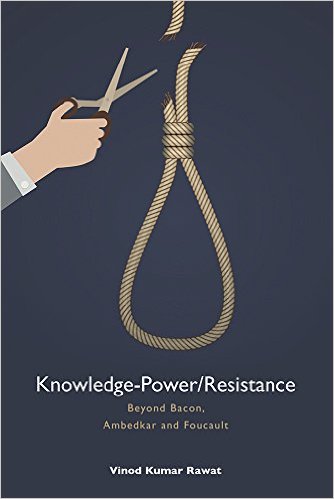
rawatVinod Kumar Rawat, Knowledge-Power/Resistance: Beyond Bacon, Ambedkar and Foucault, Partridge India Publication, 2014

Schools, Colleges, Universities, and Educational institutes, that is, “knowledge factories,” apart from producing self-governing citizens, and skilled docile workers, function as minute social observatories that indirectly monitor their families. Michel Foucault delineates power in terms of Pastoral (church and salvation), Sovereign (visible and verifiable), Disciplinary (invisible and unverifiable), Bio-power (reproduction and individualization), Psychiatric (normal and abnormal), and Governmentality (sovereignty, discipline, and government). By applying Foucault’s theory, the research investigated the relevance of the Francis Bacon’s popular dictum, “Knowledge is Power,” and Dr. B. R. Ambedkar’s final words, “Educate, Agitate, Organize.” The insights of the research may benefit the seekers and disseminators of knowledge in understanding the subtle operative modes of the government-capitalist nexus and in advocating appropriate resistance against the pathologies of power.

Summary by author
Academic institutes appear to be apolitical, independent, and gender-neutral in their innocuous transaction of knowledge between the teachers and the taught. The inherited belief is that teachers and academic administrators facilitate transmission of liberal education to the student community. However, Michel Foucault (1926-84) points out that even the libertarian institutes like universities and hospitals are structured on oppressive and disciplinary institutions like factories, prisons, and barracks that reinforce the government in exercising power over the citizens. These “knowledge factories,” apart from producing self-governing citizens, skilled and docile workers, function as minute social observatories that indirectly govern the families of the students.

Foucault applied tools like genealogy and archaeology to study a range of institutions like family, church, parliament, factory, barrack, dormitory, hospital, prison, and mental asylum with an objective to expose the “modes of objectifications” through which human beings are transformed into “subjects.” The first mode is “inquiry” through disciplines like linguistics, economics, and biology. The second mode, “dividing practices,” either divides the individual from within (insane) or from others (criminals and good students). And in the final mode, self-objectification, one learns to recognise oneself as the subject of some knowledge like sexuality. In this way, Foucault delineates power in terms of Pastoral (church and salvation), Sovereign (visible and verifiable), Disciplinary (invisible and unverifiable), Bio-power (reproduction and individualization), Psychiatric (normal and abnormal), and Governmentality (sovereignty, discipline, and government). The research attempts to investigate the relevance of Francis Bacon’s popular dictum, “Knowledge is Power,” and B. R. Ambedkar’s final words, “Educate, Agitate, and Organize,” seeks to explore the invisible link between knowledge, education, and power. Simultaneously, the thesis examines the education-knowledge-power nexus wherever teacher-taught relationship is in practice.

A campus comprises the microcosmic image of the nation, formed by the people from different parts of the country in the form of faculty, administrators, students, and office staff. In this regard, India is considered a macrocosmic social metaphor for the Indian campuses, and its apparatus and officiates are seen vis-à-vis with those of the campuses such as the Constitution of India/institute, the official language of India/the first language of the institute, the parliament/the senate, the prime minister/the vice-chancellor or the director, the ministers/the administrators, the citizens/the residents, the bureaucrats/the faculty, the lawyers/the student-representatives, the courts/the disciplinary committees, and the prisoners/the students.

The thesis contains five chapters. The first chapter titled, “Education, Knowledge, and Power,” uses the views of various thinkers to illustrate that the covert function of the educational institutes is to maintain class inequality instead of imparting knowledge. Foucault proclaims that power can be converted into knowledge and vice-versa, and that it produces resistance.Foucault subverts the popular theories of “power” by Karl Marx and Sigmund Freud who propagated that power is negative and repressive. After establishing and exposing the relationship between the politics-knowledge nexus, the thesis investigates the semantic boundaries of campus fiction. It also contains a brief review of the Western works and shows how this genre originated and developed.

The second chapter titled, “Sovereign Power: Caste System and University Administration,” discusses Foucault’s view of the Sovereign power and examines why understanding the history of a country is a prerequisite for understanding the contemporary culture and society. In this regard, it evaluates the Indus valley civilisation, Hindu caste-system, Muslim invasion, the British rule and the partition of India. It maps the knowledge-power nexus in the Western context and explains that in India, apart from the race and class, the ancient caste system has given rise to new complexities. This analysis leads to the discovery of various misconceptions, mis/representations of people and false propaganda within the Indian society as a part of power-politics nexus. The chapter ends with the discussion on the assassination of Mahatma Gandhi who played a pivotal role in laying the foundation of modern and independent India.

The third chapter titled, “Disciplinary Power: Class and Panoptic Professors,” seeks to understand how Foucault by leading the life of an exemplary disciplined student substantially developed his concept of disciplinary power. It introduces the important concept of “Panopticism,” with a focus on “invisible gaze,” and elaborates that the teachers merely act as “agents of power.” It evaluates the socio-political conditions that took place between the partition of India in 1947 and the enforcement of the Indian Constitution in 1950. Finally, the chapter reveals how the “class system,” through the establishment of the democracy, permeated the post-independent Indian society and premier educational institutes like the IITs, the IIMs, the IIITs, and the NITs.

The fourth chapter titled, “Bio-Power: Gender, Caste, and Resistance,” deals with Foucault’s theory of bio-power and traces the subordination of women in the global perspective. In the Indian context, it exposes the subjugation of the females through scriptures. This chapter also deals with Foucault’s views on resistance and employs his archeology methodology to expose the statements made by Rajendra Pandey regarding the continuation of the traditional castes in maintaining their status quo as the intellectual castes even after the Indian independence. Finally, it attempts to consolidate Foucault’s views to sketch the exact relationship between power, knowledge and resistance. Accordingly, these triads are inseparably linked together as Knowledge-Power/Resistance, they are to be seen as action words, and their functioning is to be grasped in their invisibility.

The fifth chapter titled, “Indian Campus Fiction: Textual Elucidations,” opens with defining India and Indian culture. It further highlights the genesis of fiction as imported genre in India. It traces the origin of the Indian Campus Fiction through a survey of literature on the major works done in this field. In order to illustrate the results derived through Foucauldian study, representative Indian Campus Fiction have been studied. The insights of the research may benefit the seekers and disseminators of knowledge in understanding the subtle operative modes of the government-capitalist nexus and in advocating appropriate resistance against the pathologies of power. The faculty might adopt humanitarian and egalitarian methods of teaching, while the students might gain productive and positive knowledge.

Christopher R. Mayes, Revisiting Foucault’s ‘Normative Confusions’: Surveying the Debate Since the Collège de France Lectures, Philosophy Compass, Volume 10, Issue 12, pages 841–855, December 2015
https://doi.org/10.1111/phc3.12274

Abstract
At once historical and philosophical, Michel Foucault used his genealogical method to expose the contingent conditions constituting the institutions, sciences and practices of the present. His analyses of the asylum, clinic, prison and sexuality revealed the historical, political and epistemological forces that make up certain types of subjects, sciences and sites of control. Although noting the originality of his work, a number of early critics questioned the normative framework of Foucault’s method. Nancy Fraser argued that Foucault’s genealogical method was ‘normatively confused’ as it implied political critique yet claimed to be value-neutral. Jürgen Habermas and Charles Taylor also questioned the normative basis of Foucault’s appeals to critique, arguing it was self-refuting as Foucault left no room for the subject to escape power. Although a debate among these scholars was planned for the mid-1980s, Foucault’s death in 1984 meant this could not occur. A number of edited volumes sought to fabricate a debate, with defenders of Foucault excavating his published monographs to construct responses to his critics. While the monographs remain the central texts of Foucault’s oeuvre, over the past decade his Collège de France lectures have been published and translated into English. This article offers a schematic survey of the influence of the Collège de France lectures in recasting different points in the debates over normativity, critique and resistance.

Alessandro Baccarin, L’esploratore e l’intruso. Le scienze dell’antichità di fronte a Michel Foucault, Rationes Rerum. Rivista di Filologia e Storia, n.° 5, Gennaio-Giugno 2015, pp. 217-242

A trent’anni dalla sua scomparsa, Michel Foucault costituisce ancora una figura chiave per gli antichisti che indagano le problemantiche inerenti la sessualità e il genere nelle società antiche. Oggi, grazie alla completa e recente edizione dei corsi tenuti al Collège de France, il lavoro del filosofo francese chiama le scienze dell’antichità ad un confronto profondo con gli statuti epistemologici delle sue discipline. Scopo di questa ricerca è descrivere ed analizzare l’acceso dibattito (sexuality wars) che ha coinvolto gli antichisti all’indomani della pubblicazione degli ultimi due volumi della Histoire de la sexualitè e allo stesso tempo delineare i nuovi spunti di ricerca che proprio la pubblicazione dei corsi lascia intravedere. Dalla lettura sinottica di entrambe la serie di testi (Histoire e corsi) emerge una significativa trasformazione dell’approccio foucaultiano al mondo antico: da una iniziale “généalogie” ad una ben più radicale “anarchéologie”. Un passaggio cruciale che da una parte consente di individuare punti di forza e debolezze del progetto stesso di una “storia della sessualità”, e dall’altra costringe oggi gli storici dell’antichità ad osservare con sguardo differente l’esplorazione foucaultiana del mondo antico, da molti e per molto tempo ritenuta una inopportuna intrusione. Scopo ultimo del presente lavoro è sottolineare l’importanza di questa svolta metodologica e la sua possibile utilità per le scienze dell’antichità.

Arpad Szakolczai, Max Weber and Michel Foucault: Parallel Life-Works, Routledge, 1998

About the Book
Max Weber and Michael Foucault are among the most controversial and fascinating thinkers of our century. This book is the first to jointly analyse them in detail, and to make effective links between their lives and work; it coincides with a substantial resurgence of interest in their writings. The author’s exciting interpretative approach reveals a new dimension in reading the work of Foucault and Weber; it will be invaluable to students and those researching in sociology and philosophy.

Contents
Introduction Part I: Studying Life-Works
1. On Reflexive Historical Sociology
2. On the Conditions of Possibility of Understanding
3. Nietzsche, Weber and Foucault: The Keys
4. Nietzsche, Weber and Foucault: Their Problem. Introduction to Parts II and III Part II: Weber’s Life-Work
5. Background and Early Years Up to 1897
6. Years of Crisis and Quest 1897-1910
7. New Focus and Recovery 1911-1920 Part III: Foucault’s Life-Work
8. Background and Early Years Up to 1966
9. Years of Quest and Crisis 1966-1979.
10. New Focus and Recovery 1980-1984.
Conclusion.


Author

Arpad Szakolczai studied in Budapest, Hungary and has a PhD from the University of Texas at Austin. From 1990 to 1998 he taught social and political theory at the European University Institute in Florence. He is now Professor of Sociology and Head of Department at University College, Cork.

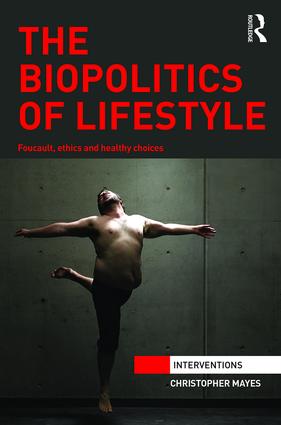
mayesChristopher Mayes, The Biopolitics of Lifestyle: Foucault, Ethics and Healthy Choices, Routledge, 2016. Forthcoming

About the Book
A growing sense of urgency over obesity at the national and international level has led to a proliferation of medical and non-medical interventions into the daily lives of individuals and populations. This work focuses on the biopolitical use of lifestyle to govern individual choice and secure population health from the threat of obesity. The characterization of obesity as a threat to society caused by the cumulative effect of individual lifestyles has led to the politicization of daily choices, habits and practices as potential threats. This book critically examines these unquestioned assumptions about obesity and lifestyle, and their relation to wider debates surrounding neoliberal governmentality, biopolitical regulation of populations, discipline of bodies, and the possibility of community resistance.

The rationale for this book follows Michel Foucault’s approach of problematization, addressing the way lifestyle is problematized as a biopolitical domain in neoliberal societies. Mayes argues that in response to the threat of obesity, lifestyle has emerged as a network of disparate knowledges, relations and practices through which individuals are governed toward the security of the population’s health. Although a central focus is government health campaigns, this volume demonstrates that the network of lifestyle emanates from a variety of overlapping domains and disciplines, including public health, clinical medicine, media, entertainment, school programs, advertising, sociology and ethics.

This book offers a timely critique of the continued interventions into the lives of individuals and communities by government agencies, private industries, medical and non-medical experts in the name of health and population security and will be of interests to students and scholars of critical international relations theory, health and bioethics and governmentality studies.

Christopher Mayes is a Postdoctoral Research Fellow at the Centre for Values, Ethics and the Law in Medicine (VELiM).

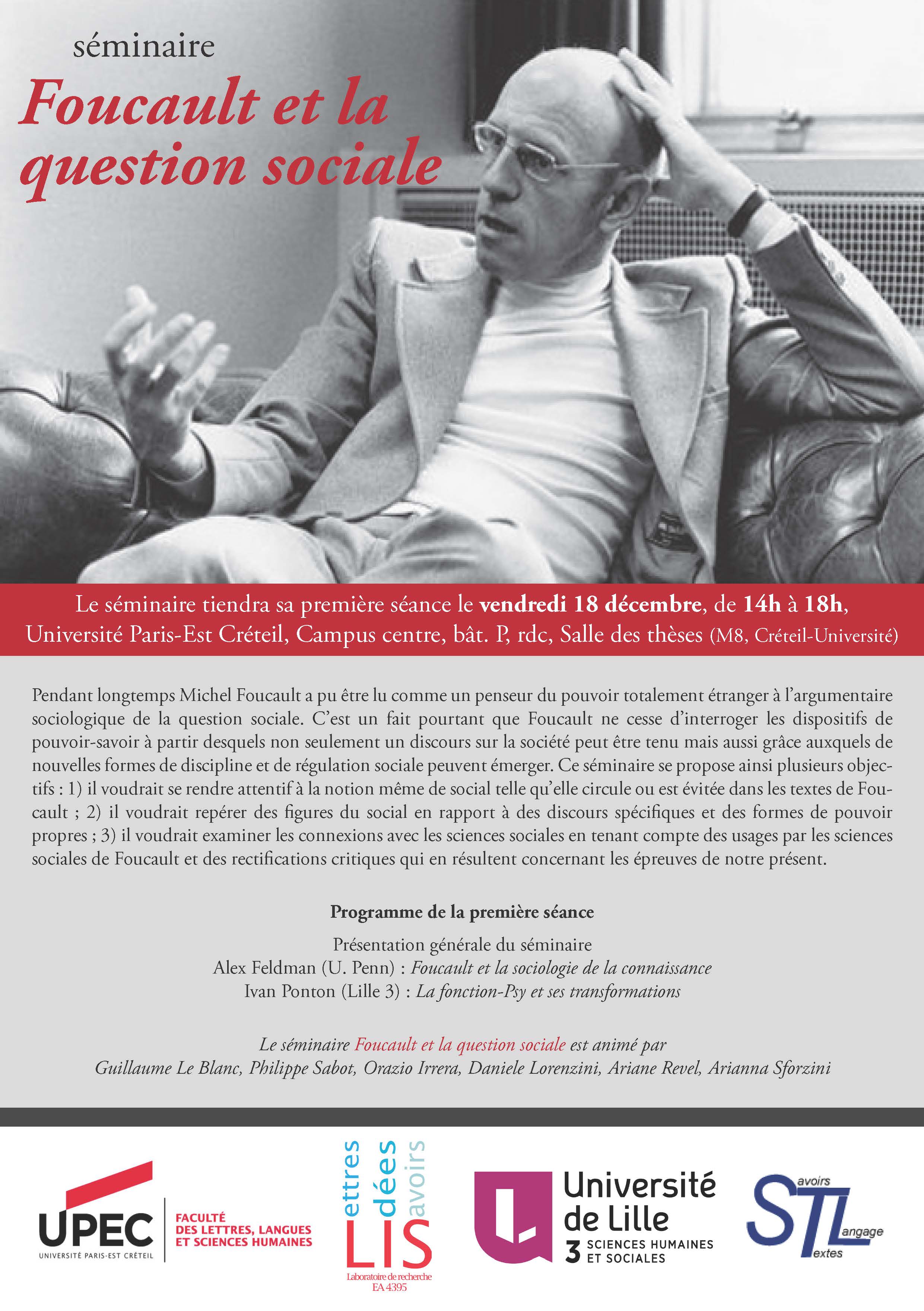
Séminaire Michel Foucault : « Foucault et la question sociale » Année 2015-2016

Affiche-Foucault

Flyer – PDF

Université Paris-Est Créteil/Université Lille 3

Séance n°1 (UPEC) – 18/12/15
Campus centre, Salle des thèses (bâtiment P, rdc),
14h-18h Présentation générale du séminaire

Alex Feldman (U. Penn) : ” Foucault et la sociologie de la connaissance ”
Ivan Ponton (Lille 3) : ” La fonction-Psy et ses transformations ”

Argumentaire

Pendant longtemps Michel Foucault a pu être lu comme un penseur du pouvoir totalement étranger à l’argumentaire sociologique de la question sociale. Il est vrai que les références à la sociologie dans son œuvre s’avèrent peu nombreuses et sont le plus souvent négatives ; elles accréditent la conviction que le social en tant que tel est une fiction produite par un ordre des discours propre aux sciences humaines dont il faut se déprendre si l’on veut penser réellement les formes contemporaines de l’illégitimité politique.

C’est un fait pourtant que Foucault ne cesse d’interroger les dispositifs de pouvoir-savoir à partir desquels non seulement un discours sur la société peut être tenu mais aussi grâce auxquels de nouvelles formes de discipline et de régulation sociale peuvent émerger. L’interrogation sur la guerre sociale, sur l’ennemi intérieur, présente dans les premiers cours (de Théories et institutions pénales à « Il faut défendre la société ») prend le relais d’une histoire de la pauvreté largement esquissée dans l’Histoire de la folie à l’âge classique. Elle fait émerger autant  de figures du social qui croisent la problématisation des sciences sociales. Dans une autre perspective, l’intérêt pris tardivement à la catégorie de gouvernement permet à Foucault de repenser la question sociale (en particulier avec l’analyse de la sécurité sociale ou du plan Beveridge) de l’intérieur de certaines formes hégémoniques de la gouvernementalité libérale ou néolibérale. L’attention portée au discours économique comme discours sur le social s’avère alors prépondérante. Enfin, la référence au hors-la-loi, au hors-norme, à l’anormal, à l’individu dangereux, produite par les dispositifs disciplinaires, et également par l’expertise psychiatrique, révèle dans nombre de textes de Foucault une généalogie de l’asocial.

Mais rapporter la pensée de Michel Foucault à la « question sociale », c’est également faire travailler cette pensée (ses concepts, ses enjeux) dans un rapport critique aux mécanismes de régulation et de sécurisation du champ social qui investissent tous les domaines de la vie humaine : le travail, la santé, l’éducation, les loisirs, etc. Cela revient notamment à produire une réflexion d’ordre historico-critique concernant l’émergence de la question sociale aussi bien que les métamorphoses de cette question jusqu’au point où elle apparaît en butte aux techniques de pouvoir qui organisent ou favorisent l’« insécurité sociale ». Il faut alors se demander ce que la pensée de Foucault peut nous dire des nouvelles formes de vulnérabilités, de souffrances ou de précarités qui sont devenues aujourd’hui autant de formes de subjectivation et qui définissent autant de rapports aux normes sociales. Il est possible, à cette fin, d’ouvrir le débat entre Foucault et les penseurs issus de la tradition de la
« philosophie sociale » ou de la sociologie, pour développer une réflexion croisée sur les enjeux actuels de la question sociale.

Le séminaire se propose ainsi plusieurs objectifs.

1/ Il voudrait se rendre attentif à la notion même de social telle qu’elle circule ou est évitée dans les textes de Foucault.

2/ Il voudrait repérer des figures du social en rapport à des discours spécifiques et des formes de pouvoir propres.

3/ Il voudrait examiner les connexions avec les sciences sociales en tenant compte des usages par les sciences sociales de Foucault et des rectifications critiques qui en résultent concernant les épreuves de notre présent.

Pour réaliser ces objectifs, le séminaire « Foucault et la question sociale » entend mettre en relation doctorants et chercheurs désireux de mettre à l’usage et en partage des hypothèses de travail concernant leurs lectures de Foucault.

***

Pour l’année 2015-2016, le séminaire s’organisera principalement autour de trois séances de travail (1/2 journées d’études). En fonction de l’intérêt manifesté par ces séances, une journée d’études est envisageable à la rentrée 2016.

*** Programme indicatif des deux demi-journées suivantes :

Séance n°2 (Lille 3) – 12/02/16

Clara Mogno (Università di Padova/ Université Paris-Ouest La Défense) : ” Subjectivités laborieuses et subjectivités dangereuses ”

Frédéric Porcher (Université de Strasbourg) : ” Foucault et la critique sociale ”

Théophile Lavault (Paris 1) : “La guerre d’Algérie en métropole. Le transfert d’une hétérotopie militaire et coloniale”

Séance n°3 (UPEC) – 01/04/2016

Guilel Treiber (KULeuven) : ” L’État sans souverain, une stratégie sans stratège. Sur les notions d’Etat et de stratégie chez Foucault et Bourdieu”

Stéphane Zygart (Lille 3) : ” L’histoire dans la sociologie : la maladie comme question sociale chez Foucault ”

Organisation : Guillaume Le Blanc, Philippe Sabot, Daniele Lorenzini, Orazio Irrera, Ariane Revel, Arianna Sforzini