Foucault News

News and resources on French thinker Michel Foucault (1926-1984)

Christopher R. Mayes, Revisiting Foucault’s ‘Normative Confusions’: Surveying the Debate Since the Collège de France Lectures, Philosophy Compass, Volume 10, Issue 12, pages 841–855, December 2015
https://doi.org/10.1111/phc3.12274

Abstract
At once historical and philosophical, Michel Foucault used his genealogical method to expose the contingent conditions constituting the institutions, sciences and practices of the present. His analyses of the asylum, clinic, prison and sexuality revealed the historical, political and epistemological forces that make up certain types of subjects, sciences and sites of control. Although noting the originality of his work, a number of early critics questioned the normative framework of Foucault’s method. Nancy Fraser argued that Foucault’s genealogical method was ‘normatively confused’ as it implied political critique yet claimed to be value-neutral. Jürgen Habermas and Charles Taylor also questioned the normative basis of Foucault’s appeals to critique, arguing it was self-refuting as Foucault left no room for the subject to escape power. Although a debate among these scholars was planned for the mid-1980s, Foucault’s death in 1984 meant this could not occur. A number of edited volumes sought to fabricate a debate, with defenders of Foucault excavating his published monographs to construct responses to his critics. While the monographs remain the central texts of Foucault’s oeuvre, over the past decade his Collège de France lectures have been published and translated into English. This article offers a schematic survey of the influence of the Collège de France lectures in recasting different points in the debates over normativity, critique and resistance.

Alessandro Baccarin, L’esploratore e l’intruso. Le scienze dell’antichità di fronte a Michel Foucault, Rationes Rerum. Rivista di Filologia e Storia, n.° 5, Gennaio-Giugno 2015, pp. 217-242

A trent’anni dalla sua scomparsa, Michel Foucault costituisce ancora una figura chiave per gli antichisti che indagano le problemantiche inerenti la sessualità e il genere nelle società antiche. Oggi, grazie alla completa e recente edizione dei corsi tenuti al Collège de France, il lavoro del filosofo francese chiama le scienze dell’antichità ad un confronto profondo con gli statuti epistemologici delle sue discipline. Scopo di questa ricerca è descrivere ed analizzare l’acceso dibattito (sexuality wars) che ha coinvolto gli antichisti all’indomani della pubblicazione degli ultimi due volumi della Histoire de la sexualitè e allo stesso tempo delineare i nuovi spunti di ricerca che proprio la pubblicazione dei corsi lascia intravedere. Dalla lettura sinottica di entrambe la serie di testi (Histoire e corsi) emerge una significativa trasformazione dell’approccio foucaultiano al mondo antico: da una iniziale “généalogie” ad una ben più radicale “anarchéologie”. Un passaggio cruciale che da una parte consente di individuare punti di forza e debolezze del progetto stesso di una “storia della sessualità”, e dall’altra costringe oggi gli storici dell’antichità ad osservare con sguardo differente l’esplorazione foucaultiana del mondo antico, da molti e per molto tempo ritenuta una inopportuna intrusione. Scopo ultimo del presente lavoro è sottolineare l’importanza di questa svolta metodologica e la sua possibile utilità per le scienze dell’antichità.

Arpad Szakolczai, Max Weber and Michel Foucault: Parallel Life-Works, Routledge, 1998

About the Book
Max Weber and Michael Foucault are among the most controversial and fascinating thinkers of our century. This book is the first to jointly analyse them in detail, and to make effective links between their lives and work; it coincides with a substantial resurgence of interest in their writings. The author’s exciting interpretative approach reveals a new dimension in reading the work of Foucault and Weber; it will be invaluable to students and those researching in sociology and philosophy.

Contents
Introduction Part I: Studying Life-Works
1. On Reflexive Historical Sociology
2. On the Conditions of Possibility of Understanding
3. Nietzsche, Weber and Foucault: The Keys
4. Nietzsche, Weber and Foucault: Their Problem. Introduction to Parts II and III Part II: Weber’s Life-Work
5. Background and Early Years Up to 1897
6. Years of Crisis and Quest 1897-1910
7. New Focus and Recovery 1911-1920 Part III: Foucault’s Life-Work
8. Background and Early Years Up to 1966
9. Years of Quest and Crisis 1966-1979.
10. New Focus and Recovery 1980-1984.
Conclusion.


Author

Arpad Szakolczai studied in Budapest, Hungary and has a PhD from the University of Texas at Austin. From 1990 to 1998 he taught social and political theory at the European University Institute in Florence. He is now Professor of Sociology and Head of Department at University College, Cork.

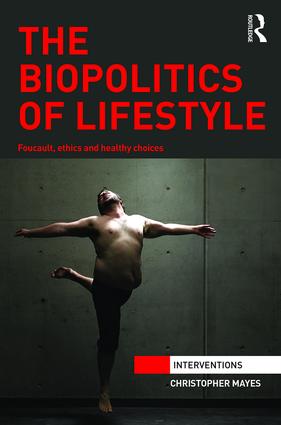
mayesChristopher Mayes, The Biopolitics of Lifestyle: Foucault, Ethics and Healthy Choices, Routledge, 2016. Forthcoming

About the Book
A growing sense of urgency over obesity at the national and international level has led to a proliferation of medical and non-medical interventions into the daily lives of individuals and populations. This work focuses on the biopolitical use of lifestyle to govern individual choice and secure population health from the threat of obesity. The characterization of obesity as a threat to society caused by the cumulative effect of individual lifestyles has led to the politicization of daily choices, habits and practices as potential threats. This book critically examines these unquestioned assumptions about obesity and lifestyle, and their relation to wider debates surrounding neoliberal governmentality, biopolitical regulation of populations, discipline of bodies, and the possibility of community resistance.

The rationale for this book follows Michel Foucault’s approach of problematization, addressing the way lifestyle is problematized as a biopolitical domain in neoliberal societies. Mayes argues that in response to the threat of obesity, lifestyle has emerged as a network of disparate knowledges, relations and practices through which individuals are governed toward the security of the population’s health. Although a central focus is government health campaigns, this volume demonstrates that the network of lifestyle emanates from a variety of overlapping domains and disciplines, including public health, clinical medicine, media, entertainment, school programs, advertising, sociology and ethics.

This book offers a timely critique of the continued interventions into the lives of individuals and communities by government agencies, private industries, medical and non-medical experts in the name of health and population security and will be of interests to students and scholars of critical international relations theory, health and bioethics and governmentality studies.

Christopher Mayes is a Postdoctoral Research Fellow at the Centre for Values, Ethics and the Law in Medicine (VELiM).

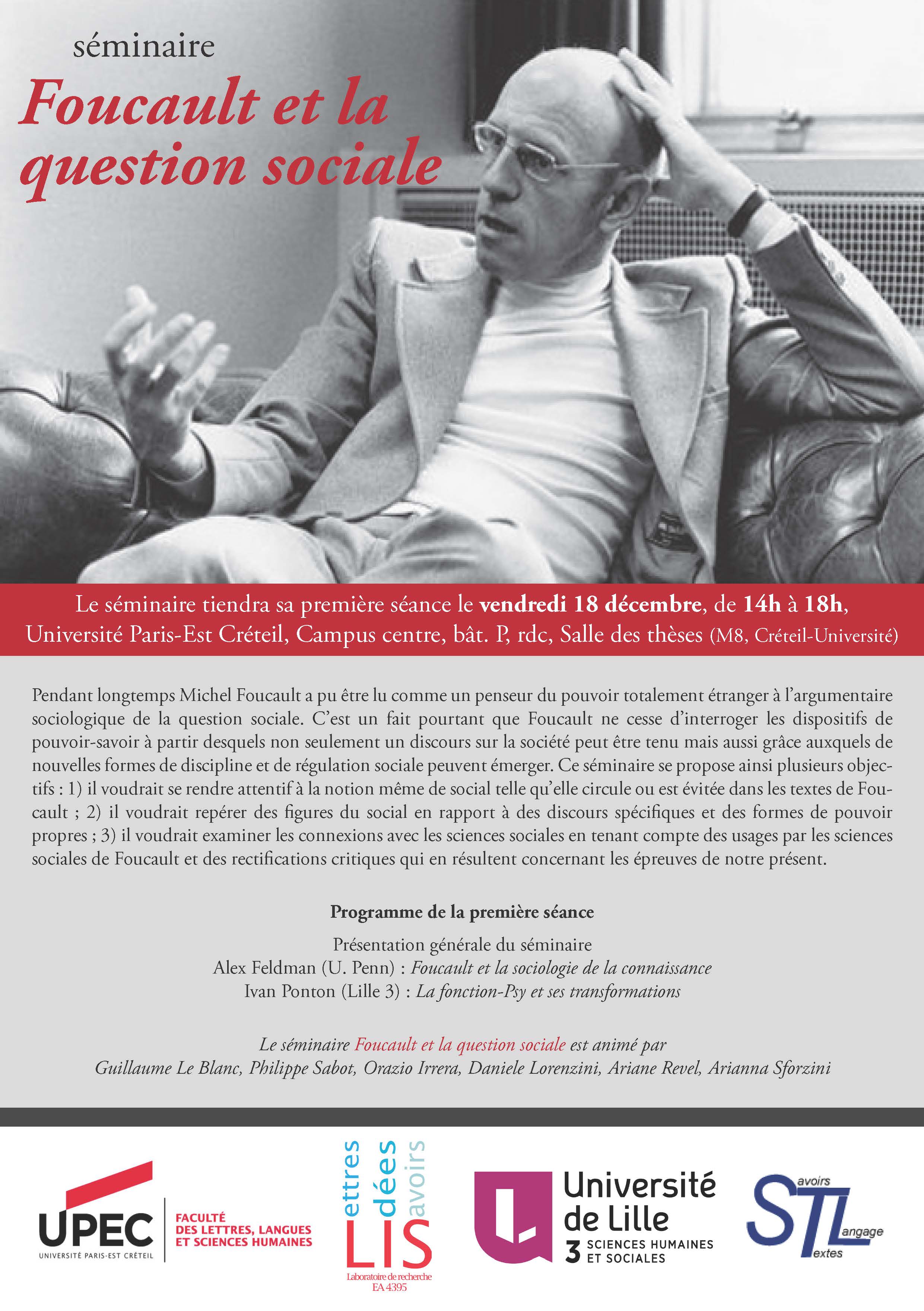
Séminaire Michel Foucault : « Foucault et la question sociale » Année 2015-2016
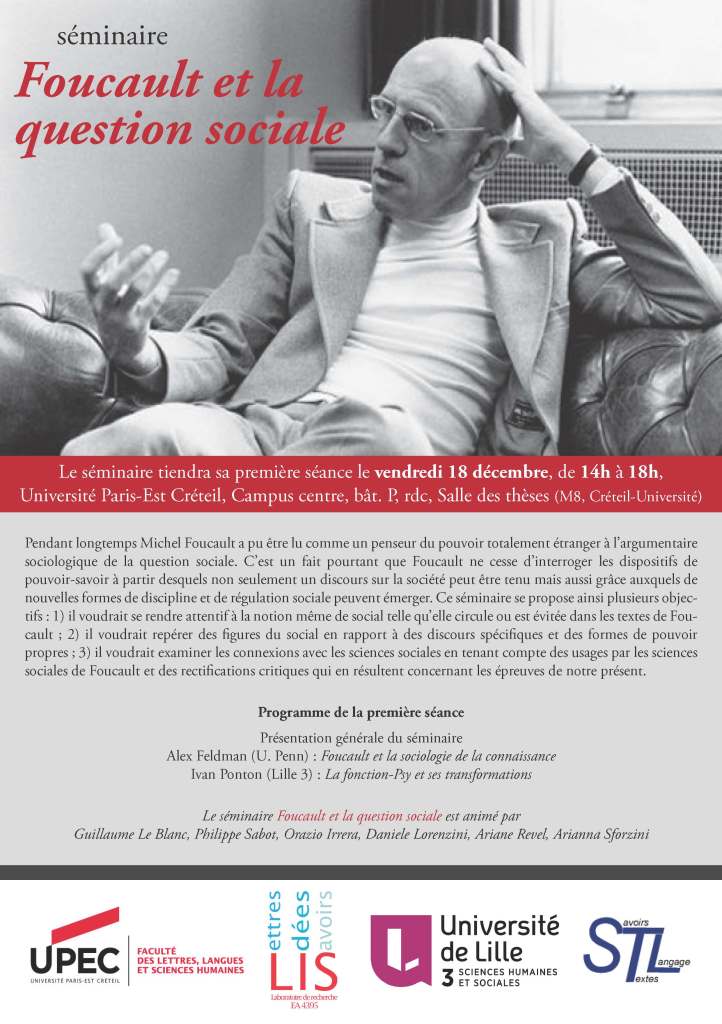
Affiche-Foucault

Flyer – PDF

Université Paris-Est Créteil/Université Lille 3

Séance n°1 (UPEC) – 18/12/15
Campus centre, Salle des thèses (bâtiment P, rdc),
14h-18h Présentation générale du séminaire

Alex Feldman (U. Penn) : ” Foucault et la sociologie de la connaissance ”
Ivan Ponton (Lille 3) : ” La fonction-Psy et ses transformations ”

Argumentaire

Pendant longtemps Michel Foucault a pu être lu comme un penseur du pouvoir totalement étranger à l’argumentaire sociologique de la question sociale. Il est vrai que les références à la sociologie dans son œuvre s’avèrent peu nombreuses et sont le plus souvent négatives ; elles accréditent la conviction que le social en tant que tel est une fiction produite par un ordre des discours propre aux sciences humaines dont il faut se déprendre si l’on veut penser réellement les formes contemporaines de l’illégitimité politique.

C’est un fait pourtant que Foucault ne cesse d’interroger les dispositifs de pouvoir-savoir à partir desquels non seulement un discours sur la société peut être tenu mais aussi grâce auxquels de nouvelles formes de discipline et de régulation sociale peuvent émerger. L’interrogation sur la guerre sociale, sur l’ennemi intérieur, présente dans les premiers cours (de Théories et institutions pénales à « Il faut défendre la société ») prend le relais d’une histoire de la pauvreté largement esquissée dans l’Histoire de la folie à l’âge classique. Elle fait émerger autant  de figures du social qui croisent la problématisation des sciences sociales. Dans une autre perspective, l’intérêt pris tardivement à la catégorie de gouvernement permet à Foucault de repenser la question sociale (en particulier avec l’analyse de la sécurité sociale ou du plan Beveridge) de l’intérieur de certaines formes hégémoniques de la gouvernementalité libérale ou néolibérale. L’attention portée au discours économique comme discours sur le social s’avère alors prépondérante. Enfin, la référence au hors-la-loi, au hors-norme, à l’anormal, à l’individu dangereux, produite par les dispositifs disciplinaires, et également par l’expertise psychiatrique, révèle dans nombre de textes de Foucault une généalogie de l’asocial.

Mais rapporter la pensée de Michel Foucault à la « question sociale », c’est également faire travailler cette pensée (ses concepts, ses enjeux) dans un rapport critique aux mécanismes de régulation et de sécurisation du champ social qui investissent tous les domaines de la vie humaine : le travail, la santé, l’éducation, les loisirs, etc. Cela revient notamment à produire une réflexion d’ordre historico-critique concernant l’émergence de la question sociale aussi bien que les métamorphoses de cette question jusqu’au point où elle apparaît en butte aux techniques de pouvoir qui organisent ou favorisent l’« insécurité sociale ». Il faut alors se demander ce que la pensée de Foucault peut nous dire des nouvelles formes de vulnérabilités, de souffrances ou de précarités qui sont devenues aujourd’hui autant de formes de subjectivation et qui définissent autant de rapports aux normes sociales. Il est possible, à cette fin, d’ouvrir le débat entre Foucault et les penseurs issus de la tradition de la
« philosophie sociale » ou de la sociologie, pour développer une réflexion croisée sur les enjeux actuels de la question sociale.

Le séminaire se propose ainsi plusieurs objectifs.

1/ Il voudrait se rendre attentif à la notion même de social telle qu’elle circule ou est évitée dans les textes de Foucault.

2/ Il voudrait repérer des figures du social en rapport à des discours spécifiques et des formes de pouvoir propres.

3/ Il voudrait examiner les connexions avec les sciences sociales en tenant compte des usages par les sciences sociales de Foucault et des rectifications critiques qui en résultent concernant les épreuves de notre présent.

Pour réaliser ces objectifs, le séminaire « Foucault et la question sociale » entend mettre en relation doctorants et chercheurs désireux de mettre à l’usage et en partage des hypothèses de travail concernant leurs lectures de Foucault.

***

Pour l’année 2015-2016, le séminaire s’organisera principalement autour de trois séances de travail (1/2 journées d’études). En fonction de l’intérêt manifesté par ces séances, une journée d’études est envisageable à la rentrée 2016.

*** Programme indicatif des deux demi-journées suivantes :

Séance n°2 (Lille 3) – 12/02/16

Clara Mogno (Università di Padova/ Université Paris-Ouest La Défense) : ” Subjectivités laborieuses et subjectivités dangereuses ”

Frédéric Porcher (Université de Strasbourg) : ” Foucault et la critique sociale ”

Théophile Lavault (Paris 1) : “La guerre d’Algérie en métropole. Le transfert d’une hétérotopie militaire et coloniale”

Séance n°3 (UPEC) – 01/04/2016

Guilel Treiber (KULeuven) : ” L’État sans souverain, une stratégie sans stratège. Sur les notions d’Etat et de stratégie chez Foucault et Bourdieu”

Stéphane Zygart (Lille 3) : ” L’histoire dans la sociologie : la maladie comme question sociale chez Foucault ”

Organisation : Guillaume Le Blanc, Philippe Sabot, Daniele Lorenzini, Orazio Irrera, Ariane Revel, Arianna Sforzini

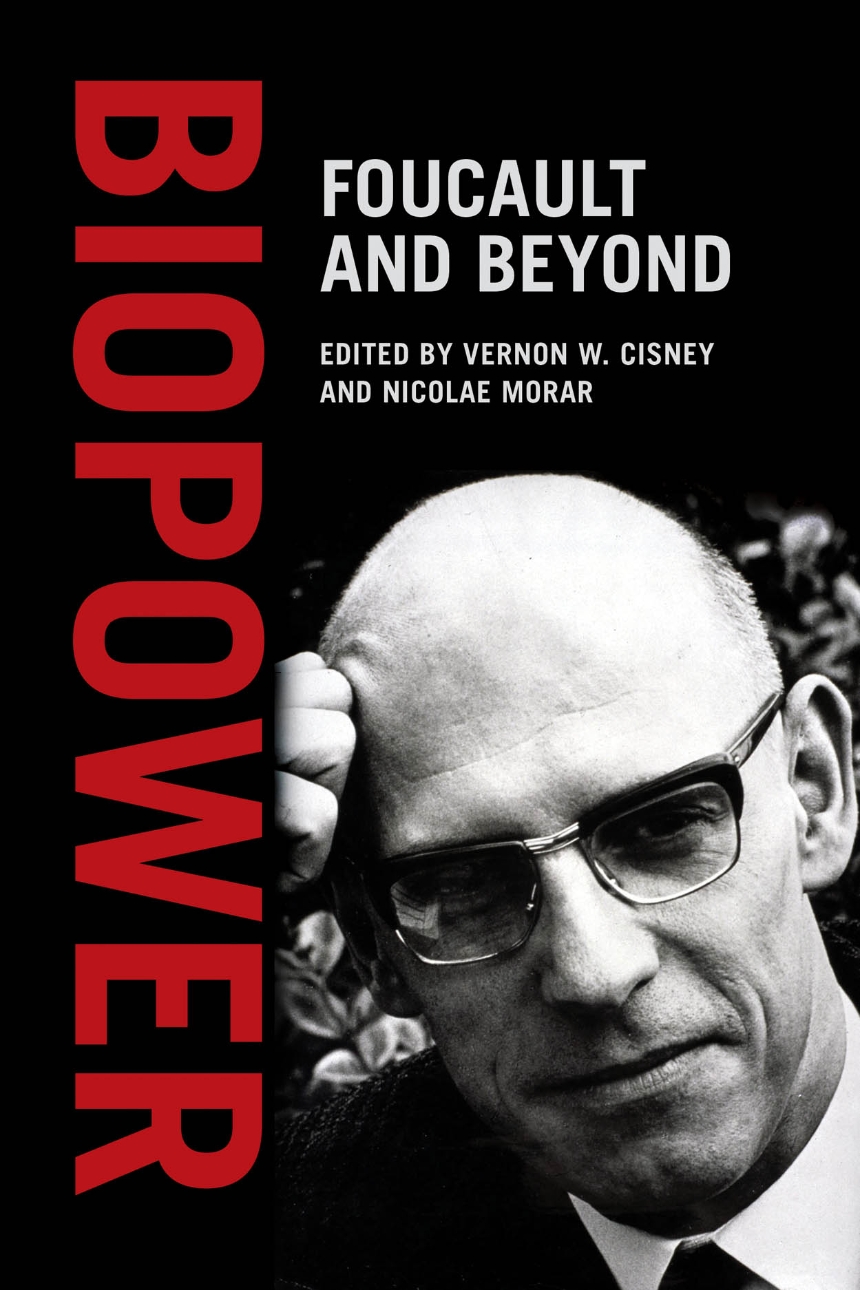
Vernon W. Cisney and Nicolae Morar (Eds), Biopower: Foucault and Beyond, University of Chicago Press, 2015

Michel Foucault’s notion of “biopower” has been a highly fertile concept in recent theory, influencing thinkers worldwide across a variety of disciplines and concerns. In The History of Sexuality: An Introduction, Foucault famously employed the term to describe “a power bent on generating forces, making them grow, and ordering them, rather than one dedicated to impeding them, making them submit, or destroying them.” With this volume, Vernon W. Cisney and Nicolae Morar bring together leading contemporary scholars to explore the many theoretical possibilities that the concept of biopower has enabled while at the same time pinpointing their most important shared resonances.

Situating biopower as a radical alternative to traditional conceptions of power—what Foucault called “sovereign power”—the contributors examine a host of matters centered on life, the body, and the subject as a living citizen. Altogether, they pay testament to the lasting relevance of biopower in some of our most important contemporary debates on issues ranging from health care rights to immigration laws, HIV prevention discourse, genomics medicine, and many other topics.

Endorsement
Biopower is a remarkable book. Although it contains essays written by the most important and well-known commentators on Foucault, it is really more than a study of Foucault’s concept of biopower. The majority of the essays expands, extends, and transforms the concept of biopower. Like all of the essays in the volume, the introduction written by Morar and Cisney is excellent. They are to be congratulated not only for organizing such an impressive volume, but guiding us through it with their analysis. This will be the definitive volume on biopower for decades to come.” (Leonard Lawlor, Penn State University)

Contents

Vernon W. Cisney and Nicolae Morar
Introduction: Why Biopower? Why Now?

Part I : Origins of Biopower

Judith Revel
One / The Literary Birth of Biopolitics (translated by Christopher Penfield)

Antonio Negri
Two / At the Origins of Biopolitics (translated by Diana Garvin)

Ian Hacking
Three / Biopower and the Avalanche of Printed Numbers

Catherine Mills
Four / Biopolitics and the Concept of Life

Paul Patton
Five / Power and Biopower in Foucault

Part II : The Question of Life

Mary Beth Mader
Six / Foucault, Cuvier, and the Science of Life

Jeff T. Nealon
Seven / The Archaeology of Biopower: From Plant to Animal Life in The Order of Things

Eduardo Mendieta
Eight / The Biotechnological Scala Naturae and Interspecies Cosmopolitanism: Patricia Piccinini, Jane Alexander, and Guillermo Gómez-Peña

Part III : Medicine and Sexuality: The Question of the Body

Carlos Novas
Nine / Patient Activism and Biopolitics: Thinking through Rare Diseases and Orphan Drugs

David M. Halperin
Ten / The Biopolitics of HIV Prevention Discourse

Jana Sawicki
Eleven / Precarious Life: Butler and Foucault on Biopolitics

Part IV : Neoliberalism and Governmentality: The Question of the Population

Todd May and Ladelle McWhorter
Twelve / Who’s Being Disciplined Now? Operations of Power in a Neoliberal World

Frédéric Gros
Thirteen / Is There a Biopolitical Subject? Foucault and the Birth of Biopolitics (translated by Samantha Bankston)

Martina Tazzioli
Fourteen / Discordant Practices of Freedom and Power of/over Lives: Three Snapshots on the Bank Effects of the Arab Uprisings

Part V : Biopower Today

Paul Rabinow and Nikolas Rose
Fifteen / Biopower Today

Ann Laura Stoler
Sixteen / A Colonial Reading of Foucault: Bourgeois Bodies and Racial Selves

Roberto Esposito
Seventeen / Totalitarianism and Biopolitics? Concerning a Philosophical Interpretation of the Twentieth Century (translated by Timothy Campbell)

A Foucault News exclusive.

Governmentality studies observed
Interview with Colin Gordon by Aldo Avellaneda and Guillermo Vega
September 2015

Full PDF of article

Interviewers’ introduction
Colin Gordon is considered one of the key references of what, in a rather generic although recognizable way, has come to be called “governmentality studies”. He has been involved since the late 1970s in various projects dealing with Foucault’s work and has drawn attention since then to the particularities and advantages of Michel Foucault’s study of “arts of government”. Among his key works we can mention the editing, in 1980, of Power/Knowledge (one of the first compilations and translations in English of Foucault’s work on power) and the co-editing in 1991 – with Graham Burchell and Peter Miller – of The Foucault Effect (TFE). He has also published over the last thirty years many articles and papers about the reception of Foucault in Britain, Foucault and law, the relation between Foucault and Weber, among other topics. And in so doing, he has become one of the most relevant contributors to the reception of Foucault in the Anglophone world.

During the second half of the last year we undertook, with some colleagues and friends, the reading and translation into Spanish of the well-known introductory chapter by Colin Gordon in TFE, “Governmental Rationality. An introduction” (published in Revista Nuevo Itinerario in September 2015). After we finished it, we decided to make contact with its author in order to discuss the possibilities of a Spanish edition. The interview we present below accompanies that translation and is the result of numerous emails we exchanged since February. Our main intention was to present the author’s thoughts about a wide range of topics related to governmentality studies, although we’ve tried to focus particularly on its present situation and its analytical effectiveness.

We thank Colin Gordon for his friendly and continuing cooperation.

Aldo Avellaneda
Guillermo Vega
Facultad de Humanidades,
Universidad Nacional del Nordeste – Argentina

Read more

Foucault @ 90
International Conference

22nd-23rd June 2016
University of the West of Scotland
Ayr Campus, Scotland, UK

Further information and registration

PDF conference flyer

Call for Papers
This year marks the 90th anniversary of the birth of the French thinker Michel Foucault (1926-84). This interdisciplinary conference aims to reflect on the work of Michel Foucault and in particular on the question of its abiding relevance and value.

Keynote speakers include Stephen Ball, Mark Olssen, and Clare O’Farrell.

Based at our attractive Ayr campus, on the scenic west coast of Scotland, this conference promises to be a stimulating and enjoyable event. Research paper submissions are now sought on the conference themes listed below.

Abstracts should be up to 400 words in length and cover the context of the research, research questions, theoretical framework, methodology, findings, significance. Abstracts should be readied for blinded peer review. The conference will run as a series of 90-minute sessions with 3 or 4 papers allocated to each.

Symposia: the conference welcomes submissions for symposium sessions. These should comprise a set of four or more related paper submissions (as above) with an agreed Chairperson and Discussant.

Posters: posters will be displayed throughout the conference, with a set time agreed for presenters to be available to discuss their work with conference delegates. Posters should be submitted in A1/upright form and be accompanied by a 250 word abstract.

Conference/Abstract themes:
The conference seeks papers which deal with the work of Foucault in relation to any of the following themes:
• Education
• Health
• Justice
• Criminology
• Psychiatry/Psychology
• Methodology
• Sexuality
• Culture/aesthetics
• Philosophy
• Politics

Key dates

Abstract submission opens 15th October 2015
(papers/posters/symposia)
Abstract submission ends 1st March 2016
Notification of peer review/abstract acceptance 22nd March 2016
Early Bird Registration commences 22nd March 2016
Presentation times announced 15th April 2016
Early Bird Registration ends 1st May 2016

Contact
Abstract submissions should be emailed by attachment to: foucaultconference@uws.ac.uk

Thomson, P., Pennacchia, J.
Hugs and behaviour points: Alternative education and the regulation of ‘excluded’ youth
(2015) International Journal of Inclusive Education, 19 p. Article in Press.

DOI: 10.1080/13603116.2015.1102340

Abstract
In England, alternative education (AE) is offered to young people formally excluded from school, close to formal exclusion or who have been informally pushed to the educational edges of their local school. Their behaviour is seen as needing to change. In this paper, we examine the behavioural regimes at work in 11 AE programmes. Contrary to previous studies and the extensive ‘best practice’ literature, we found a return to highly behaviourist routines, with talking therapeutic approaches largely operating within this Skinnerian frame. We also saw young people offered a curriculum largely devoid of languages, humanities and social sciences. What was crucial to AE providers, we argue, was that they could demonstrate ‘progress’ in both learning and behaviour to inspectors and systems. Mobilising insights from Foucault, we note the congruence between the external regimes of reward and punishment used in AE and the kinds of insecure work and carceral futures that might be on offer to this group of young people. © 2015 Taylor & Francis

Author Keywords
alternative education; behaviourism; Foucault; inclusion; therapeutic approach

koopmanColin Koopman, Pragmatism as Transition. Historicity and Hope in James, Dewey, and Rorty, Columbia University Press, 2015

Pragmatism is America’s best-known native philosophy. It espouses a practical set of beliefs and principles that focus on the improvement of our lives. Yet the split between classical and contemporary pragmatists has divided the tradition against itself. Classical pragmatists, such as John Dewey and William James, believed we should heed the lessons of experience. Neopragmatists, including Richard Rorty, Hilary Putnam, and Jürgen Habermas, argue instead from the perspective of a linguistic turn, which makes little use of the idea of experience. Can these two camps be reconciled in a way that revitalizes a critical tradition?

Colin Koopman proposes a recovery of pragmatism by way of “transitionalist” themes of temporality and historicity which flourish in the work of the early pragmatists and continue in contemporary neopragmatist thought. “Life is in the transitions,” James once wrote, and, in following this assertion, Koopman reveals the continuities uniting both phases of pragmatism. Koopman’s framework also draws from other contemporary theorists, including Michel Foucault, Pierre Bourdieu, Bernard Williams, and Stanley Cavell. By reflecting these voices through the prism of transitionalism, a new understanding of knowledge, ethics, politics, and critique takes root. Koopman concludes with a call for integrating Dewey and Foucault into a model of inquiry he calls genealogical pragmatism, a mutually informative critique that further joins the analytic and continental schools.

About the Author
Colin Koopman is associate professor of philosophy at the University of Oregon and author of Genealogy as Critique: Foucault and the Problems of Modernity.