
Foucault News

News and resources on French thinker Michel Foucault (1926-1984)

Death, C.
Counter-Conducts as a Mode of Resistance: Ways of “Not Being Like That” in South Africa
(2016) Global Society, pp. 1-17. Article in Press.

DOI: 10.1080/13600826.2015.1133566

Abstract
This article argues that a “counter-conducts approach”, drawing on the work of Michel Foucault, can be used to disaggregate the concept of resistance and highlight how some resistant practices work to subvert dominant ways of being. One of the features of a “counter-conducts approach” is an attention to the interpenetration of forms of power and resistance, governmentality and alternative modes of subjectification. Such an approach can be used to interpret forms of social protest in new ways, particularly in terms of the ways in which they facilitate or hinder ethical self-reflection and militant lives. Examples are provided from contemporary South Africa, specifically the Occupy Umlazi protest and a township youth movement known as “izikhothane” or pexing. In very different ways these protests are public assertions that “we are not like that”. As such they each challenge mainstream social values, yet they also have quite problematic implications for progressive politics and radical theorists.
Bert Olivier, Foucault and the courage of truth, Thought Leader, Mail and Guardian, 11 March 2016

The last course that Michel Foucault presented at the Collége de France in 1984, when he was already quite weak (he died in June of that year, and taught until March), was on The Courage of Truth – later published with that title (Palgrave Macmillan 2011; Kindle edition). Although I cannot do justice to it here, I would like to draw potential readers’ attention to its relevance for us today, in a difficult time that, in my view, is bound to get even more difficult at different levels of existence, particularly that of the ethical. Why, one might wonder. Simply because the prevailing ideology is uncompromising – either you support and affirm neoliberal tenets (conspicuous consumption, living on credit, ie in debt etc) or the economic system will “punish” you by making it impossible for you to live comfortably).

I believe that Foucault’s final legacy is to show receptive readers that one could learn from ancient Greek philosophy how to fashion oneself ethically (and aesthetically) into a person with an “ethos”, or moral integrity, through the practice of “truth-telling”, or “parrhesia”. Significantly, Foucault distinguishes here between the epistemological sense of truth and its “alethurgic” sense, that is, between the possibility of “true” knowledge and the ethical transformation of the subject through truth-telling techniques that bear on the relation of the subject with her- or himself and with others. Importantly, “alethurgy” cannot be equated with anything epistemological.

Read more

du corpsc’est ici

Le corps utopique, variation pour 2 comédiennes

Petite forme théâtrale à partir de la conférence radiophonique de Michel Foucault, Le corps utopique.

Le samedi 19 mars 2016, de 19h à 21h, dans le cadre d’un café-philo Le corps entre être et avoir”
et en lien avec le projet de la compagnie Nacera Belaza, au Collectif 12 à Mantes-la-Jolie (78).

Pour en savoir plus, visitez cette page ou cette page

Du 18 au 23 avril 2016, dans le cadre du Festival Aux Alentours, festival organisé par Thomas Matalou du Collectif ADM, en partenariat avec l’Etoile du Nord. Aux Alentours met l’accent durant une semaine sur les formes itinérantes créées par les artistes à la suite d’actions artistiques et qui rencontrent des publics nouveaux.
Pour en savoir plus, visitez cette page ou cette page
What are you rebelling against, Johnny?

Cette saison, nous mettons en place un nouveau projet adressé aux étudiants du Conservatoire Municipal
du 5° arrondissement de Paris ainsi qu’à un groupe de détenus du Centre Pénitentiaire de Fresnes.
Sur scène, ils évoqueront ensemble les racines du rock’n’roll et ses héros oubliés sous la forme d’un théâtre épique.
Comment et pourquoi le rock est-il né dans les années 50 en Amérique ? Est-ce une musique noire ou blanche ?
Une révolte adolescente ou une manne commerciale ?

Vendredi 18 mars 2016 à 19h, présentation du travail avec la classe d’art dramatique, CMA Gabriel Fauré, (75).
Dès le 5 avril prochain, Lucie Nicolas et Stéphanie Farison ainsi que Jane Joyet, scénographe,
Siegfried Mandacé, musicien, et Frank Condat, régisseur, dirigeront les ateliers en détention.
En juin 2016, tous les participants seront réunis pour des présentations publiques à l’intérieur et à l’extérieur des murs.

Vendredi 3 juin 2016, présentation au Centre Pénitentiaire de Fresnes (94)
Samedi 4 juin 2016, présentation au CMA Gabriel Fauré (75)
Mercredi 15 juin 2016, dans le cadre de Fin de chantiers, présentation à la Maison des Métallos (75)

Pour en savoir plus, visitez cette page ou cette page
Petite Annonce

Pour vos décors, vous êtes à la recherche d’un stock à partager dans l’Oise? Contactez-nous pour plus d’information.
Contact

Mélanie Autier, 06 22 13 06 82, production.collectiff71@gmail.com

Rejoignez-nous sur notre page facebook, ici

www.collectiff71.com

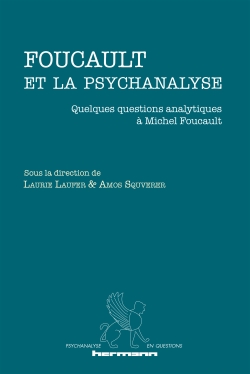
Thamy Ayouch, Foucault pour la psychanalyse : vérité, véridiction, pratiques de soi, in SQUVERER Amos, LAUFER Laurie (dir.), Foucault et la psychanalyse. Quelques questions analytiques à Michel Foucault, Hermann, 2015

Full text on academia.edu

« Foucault pour la psychanalyse » peut augurer autant, a contrario , de la condamnation virulente d’une vulgate psychanalytique instituant un « Foucault contre la psychanalyse », que de celle de foucaldiens déclarant résolument la nécessité d’« échapper à la psychanalyse » C’est aussi le programme d’une série de tentatives proposant d’« être juste avec Foucault », en présentant la généalogie foucaldienne de la psychanalyse comme discours portant sur un autre registre que celui de la psychanalyse, dans une différence tranchée entre le niveau de la véridiction et celui de la vérité.

read more

SQUVERER Amos, LAUFER Laurie (dir.), Foucault et la psychanalyse. Quelques questions analytiques à Michel Foucault, Hermann, 2015

Michel Foucault a entretenu avec la psychanalyse une liaison tumultueuse, faite d’attraction et de rejet. Fasciné par l’œuvre de Freud dans laquelle il reconnaît la rupture essentielle qu’elle représente avec la psychiatrie et la médecine de la fin du XIXe siècle, le philosophe devient, à partir des années soixante-dix, résolument critique. Dispositif disciplinaire contrôlant les corps et les désirs, discours normalisateurs et non réflexifs, voilà ce que représente dès lors la pratique analytique pour Michel Foucault.

En quoi la critique foucaldienne de la psychanalyse peut-elle être, aujourd’hui encore, utile ? Et, inversement, quels déplacements épistémologiques la méthode foucaldienne peut-elle attendre de la psychanalyse ? C’est dans ces deux démarches complémentaires que s’engagent les contributions de Jean Allouch, Paul-Laurent Assoun, Thamy Ayouch, Joël Birman, Roland Gori, Christian Hoffman, Laurie Laufer et Amos Squverer. Cet ouvrage collectif fait émerger la complexité de la rencontre entre Michel Foucault et la psychanalyse, mais également montrent combien les questions et la méthode foucaldienne peuvent être utiles à une psychanalyse open to revision, selon l’expression de Freud.

Kannisto, P.
Extreme mobilities: Challenging the concept of ‘travel’
(2016) Annals of Tourism Research, 57, pp. 220-233.

DOI: 10.1016/j.annals.2016.01.005

Abstract
This article explores extreme mobilities by analysing how ‘global nomads’ create their lifestyles. The focus is on power negotiations regarding freedom of movement and the limits of modern-day mobilities. The study is based on in-depth interviews, instant ethnography and virtual ethnography analysed with Foucauldian discourse analysis. Two discourses are examined-the discourse of home and hearth and the discourse of homelessness-that reveal contradictions in society and in global nomads’ lifestyles. While societies tend to be suspicious about sustained mobilities, mostly promoting homebound travel, global nomads are not able to detach themselves from home either. They are opportunists taking advantage of societies’ dominant discourses and practices. © 2016 Elsevier Ltd.

Author Keywords
Discourse analysis; Extreme mobilities; Foucault; Location-independence; Power

Brisbane Foucault Reading Group

Foucault with students at the Free University of Berlin (DR). In Michel Foucault: Une histoire de la vérité, Paris: Syros, 1985, pp. 118.

Foucault with students at the Free University of Berlin (DR).
In Michel Foucault: Une histoire de la vérité, Paris: Syros, 1985, pp. 118.

If you are interested in attending, please contact Clare O’Farrell.

Brisbane Reading group blog

Please note: This group will be running as a face to face group in Brisbane, Australia. Online attendance is not possible at this point.

Venue: Top floor of the library. Seminar room R 614
Queensland University of Technology
130 Victoria Park Road, Kelvin Grove
Brisbane, Qld, Australia

Map of Kelvin Grove campus.


Time

Fridays 1-3 pm. People are welcome to join the group at any time.

Dates

15 April, 22 April, 6 May, 20 May, 3 June 2016.
Further dates to be determined.

We will be reading one or two chapters a week from the following work:

Michel Foucault, The Punitive Society: Lectures at the Collège de France, 1972-1973, Edited by Arnold I. Davidson, Trans. Graham Burchell, Palgrave Macmillan, September 2015
Table of Contents

Further reading and viewing

Seminar at Columbia University on The Punitive Society
Stuart Elden on The Punitive Society

Aims of the reading group

The work of Foucault is used widely across an enormous range of theoretical and applied disciplines. The aim of this group is to provide an informal setting to read and discuss Foucault’s work and discuss how it might be applied to other domains. The focus will be on recent publications of previously unpublished work by Foucault.

Notes to those wishing to participate

  • Academic staff, higher degree students and anyone with an interest in Foucault’s work are welcome to attend.
  • Participants will be expected to read the set material before coming to each session and also to prepare 2 or 3 discussion points.
  • In addition and optionally, participants are also invited to provide a couple of pages from a secondary reading from an applied field of their choice that relates to the Foucault texts under discussion. This material can be posted in a password protected area for other members of the group to read or skim through before each session.


History of the Reading Group

The Brisbane Foucault Reading group ran most semesters between 2000 and 2012 and is now running again.

Clare O’Farrell, who is organising this group, lectures at the Queensland University of Technology in Brisbane, Australia. Please visit her website for details on some of her publications and online activities.

Michel Foucault and Neoliberalism
PDF with further information

Center for Critical Democracy Studies
American University of Paris
6 rue du Colonel Combes
Paris 75007
Room C-104

March 25-26 2016
Registration at criticaldemocracy@aup.edu

Friday, March 25

9h-9h15: Introductory Remarks Stephen Sawyer

9h15-10h30: Contextualizing Foucault
-Daniel Steinmetz-Jenkins, Foucault and the Neo-liberalism Debate: On the Limitations of a Contextualist Approach
-Claudia Castiglioni, Foucault, Neoliberalism, and the Iranian revolution: an unconventional thinker confronted with an unconventional revolution

10h30-10h45: Short Coffee Break

10h45-12h: Foucault and Politics
-Duncan Kelly, Michel Foucault as Historian of Political Thought
-Aner Barzilay, A rereading of Foucault’s Lectures on the Birth of Biopolitics in light of his early reading of Marx

12h-1h30: Lunch

13h30-15h15: Foucault and the State
-Luca Paltrinieri, Beyond Foucault and neoliberalism: firms, self-employment, self-entrepreneurship today
-Luca Provenzano, Of state-phobia and conceptual inflationism: Foucault and the aporias of anti-Statism

15h15-15h30: Short Coffee Break

15h30-16h45: Was Foucault a Neo-Liberal?
-Michael Behrent, Neoliberalism: The Highest Stage of Anti-Humanism?…
-Serge Audier, Foucault est-il un bon guide pour comprendre, critiquer et combattre le néolibéralisme

17h-18h15: Thinking Foucault and Neoliberalism after the University of Chicago Lectures
-Bernard Harcourt, Foucault’s Critiques of Neoliberalism
-François Ewald, Vérité du néolibéralisme

Saturday, March 26

10h-12h: Governmentality
-Judith Revel, Qu’est-ce que gouverner aujourd’hui? Du gouvernement des vivants au gouvernement des conduites, et retour
-Danilo Scholz, Michel Foucault and François Châtelet: Governmentality and État savant
-Colin Gordon, The political project of Foucault’s governmentality lectures

12h-13h: Closing remarks
Stephen Sawyer and Bernard Harcourt

La Bibliothèque Foucaldienne

A prezi presentation of some of the documents in the archive, uploaded by by Vincent Ventresque on 23 November 2015

Paul Rabinow, Foucault’s Untimely Struggle. Toward a Form of Spirituality, Theory, Culture & Society November 2009 vol. 26 no. 6 25-44

doi: 10.1177/0263276409347699

Abstract
In his series of essays on Kant written during the 1980s, Michel Foucault attempted to discern the difference today made with respect to yesterday. As his essays as well as his lectures (especially at the Collège de France and Berkeley) during the early 1980s demonstrate, he was drawn — and devoted the bulk of his scholarly efforts to a renewed form of genealogical work on themes, venues, practices and modes of governing the subject and others — to experiments in new forms of friendship, sociability and transformations of the self and others that he saw taking shape, or imagined were taking shape around him. This work, which has come to be known unfortunately as the ‘late Foucault’, arose out of deep dissatisfaction with his own life conditions, the broader political climate of the time, and a profound and unexpected rethinking not only of the specific projects he had intended to carry out but of what it meant to think. This article explores some of the elements at play during these deeply (re)formative several years, which as they unfolded were in no way intended to constitute a ‘late Foucault’, quite the opposite, even if fate would have it otherwise. The article begins with a ‘prelude’ that introduces the problem of what mode is appropriate for giving form to thinking. It proceeds to argue that Foucault engaged in a struggle to redefine the object of thinking; that in order to do so he was led to pursue a venue in which such thinking could be practised; and finally to an increasingly articulate and acute quest for a form that would constitute a difference between what Foucault diagnosed as an impoverished modern problem space and a future in which things might be different and better. If we define spirituality as being the form of practices which postulate that, such as he is, the subject is not capable of the truth, but that, such as it is, the truth can transfigure and save the subject, then we can say that the modern age of the relations between the subject and truth begin when it is postulated that, such as he is, the subject is capable of truth, but that, such as it is, the truth cannot save the subject. (Foucault, 2005: 19)

Keywords
Berkeley Foucault society spirituality untimely venue