Foucault News

News and resources on French thinker Michel Foucault (1926-1984)

Luca Provenzano, Foucault 8/13 epilogue: Foucault and neoliberalism conference report

Foucault and Neoliberalism: A Report from American University of Paris

On Friday, March 25 and Saturday, March 26, participants in Foucault 13/13 went to Paris to present at (and report from) the conference “Foucault and Neoliberalism” organized by the Center for Critical Democracy Studies at the American University of Paris. Organized by Daniel Steinmetz-Jenkins and Stephen W. Sawyer, the goal of the conference was to take an inventory of the current scholarship on Foucault and neoliberalism and promote an exchange of views at a time when “The question of neoliberalism and particularly its ostensible triumph remains as vexing as ever” (Sawyer).

In his introduction on Friday, Stephen Sawyer noted that in a sense, conference participants came ‘après la bataille’: much of the most acrimonious debate in the immediate aftermath of Critiquer Foucault volume by Daniel Zamora (2014) and Penser le néolibéralisme by Serge Audier (2015) appears to be behind us, though perhaps the English publication of Critiquer Foucault will interrupt the calm. Nevertheless, Sawyer noted that recent works have raised more questions than answers about how the lectures on neoliberalism fit into Foucault’s oeuvre. In particular, Sawyer asked about how Foucault’s neoliberal moment relates to his later turn to the issue of democracy via his final lectures on the Greeks.

read more

Student reads Foucault to donkey (2012)
Published on May 11, 2012
8 May 2012 was International Donkey Day.

Editor: The student doesn’t appear to be reading from Foucault himself but from J.G. Merquior’s 1985 book Foucault (Fontana Press). The donkey appears to be less than attentive!

Donkey Conference at SOAS (School of Oriental and African Studies) at the University of London as held on 8-9 May 2012.

From youtube site
We organised a charity photoshoot, with Clover the Donkey from Hackney City Farm. This clip contains the photos that we took. If you want a copy of any of these photos, contact: ed.emery[ @] soas.ac.uk

You may also be interested in the World Donkey Day facebook page:

Bourke, T., Carter, J.
“There’s nothing standard about standards”: exploring tensions between two standards documents in higher education
(2016) Journal of Geography in Higher Education, pp. 1-16. Article in Press.

DOI: 10.1080/03098265.2016.1144730

Abstract
Quality in education at the tertiary level is constantly questioned, and increasingly “professional standards” are offered as the solution to the perceived decline in quality. Foucauldian archaeological analysis of teacher graduate and geography graduate standards in Australia is conducted, revealing tensions between the different document sets. Teacher graduate standards reflect two discourses (one of knowledge and understanding, and one of skills) that are anti-intellectual and based on jargon and formulaic prescriptions. In contrast, disciplinary standards give primacy to geography as an intellectual inquiry such that its knowledge and understanding, skills, and concepts lead to progressively higher order thinking in graduates. © 2016 Informa UK Limited, trading as Taylor & Francis Group

Author Keywords
Foucault; geography; standards

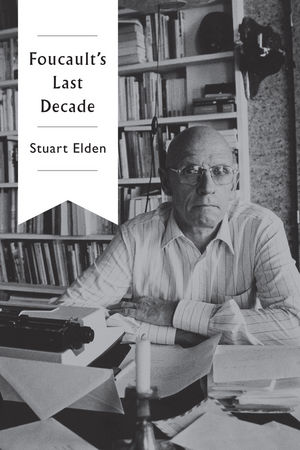
eldenStuart Elden, Foucault’s Last Decade, Polity Press, Official release date 1 April 2016
Publisher’s page

Description
On 26 August 1974, Michel Foucault completed work on Discipline and Punish, and on that very same day began writing the first volume of The History of Sexuality. A little under ten years later, on 25 June 1984, shortly after the second and third volumes were published, he was dead.

This decade is one of the most fascinating of his career. It begins with the initiation of the sexuality project, and ends with its enforced and premature closure. Yet in 1974 he had something very different in mind for The History of Sexuality than the way things were left in 1984. Foucault originally planned a thematically organised series of six volumes, but wrote little of what he promised and published none of them. Instead over the course of the next decade he took his work in very different directions, studying, lecturing and writing about historical periods stretching back to antiquity.

This book offers a detailed intellectual history of both the abandoned thematic project and the more properly historical version left incomplete at his death. It draws on all Foucault s writings in this period, his courses at the Collège de France and lectures elsewhere, as well as material archived in France and California to provide a comprehensive overview and synthetic account of Foucault s last decade.

Table of Contents
Contents
Acknowledgements
Abbreviations
Introduction
1. Pervert, Hysteric, Child
2. The War of Races and Population
3. The Will to Know and the Power of Confession
4. From Infrastructures to Governmentality
5. Return to Confession
6. The Pleasures of Antiquity
7. The Two Historical Plans of the History of Sexuality
8. Speaking Truth to Power
Notes
Top of Page

Author Information
Stuart Elden is Professor of Political Theory and Geography at the University of Warwick

A.B. Evans and J. Allen-Collinson,
From ‘just a swimmer’ to a ‘swimming mother’: women’s embodied experiences of recreational aquatic activity with pre-school children
(2016) Leisure Studies, 35 (2), pp. 141-156.

https://doi.org/10.1080/02614367.2014.962593

Abstract
Increased academic attention on the gendering of leisure pastimes in recent years has highlighted the centrality of the gendered body in influencing how leisure is accessed, experienced and transformed. To date, however, little attention has been paid to how women experience aquatic leisure activity, the second most popular form of leisure activity in the UK, and where female participation predominates. This paper presents results from research investigating the aquatic leisure experiences of 22 women, with children aged under 3, in the North-East of England. A number of key themes emerged from the data, which highlighted the centrality of the gendered, lived body as a key social construct contouring participant perceptions in the swimming pool environment. Women reflected upon their self-perceived physical deficiencies when wearing revealing swimming costumes, particularly under the critical gaze of ‘other’ bodies, whether present or imagined. The co-presence of other bodies was also central in shaping lived experiences, and the presence of ‘dependent’ children’s bodies shifted bodily intentionality away from the self towards perceived maternal responsibilities and the management of perceived risks, including ‘dirt’ and ‘germs’ and the negotiation of the tacit rules of the swimming pool. Results also suggest that the emphasis on maternal responsibility in aquatic leisure activity and timing of parent-toddler sessions could lead to reproduction of gender inequalities and the exclusion of some fathers from participation.

Author Keywords
aquatic activity; embodiment; Foucault; gender; leisure; sociology

Marcelo Hoffman, Foucault and the Political Party
20th March 2015 | 11:00 – 11:45

The talk was given at the conference “Historicizing Foucault: What does this mean?” in Zurich on March 20, 2015.

Update October 2025. Unfortunately the audio recording is no longer available. The text below is from the Genealogy + Critique site

The theme of the political party in Michel Foucault’s analyses has failed to elicit the kind of elaborate attention that has been bestowed on his analyses of other core political concepts. This lack of attention no doubt reflects Foucault’s lack of an elaborate analysis of the party. He never theorized the party at much length, and his discussions of it tended to occupy a place on the margins of his analyses. But the party figured as a recurrent theme in his Collège de France courses from the late 1970s to early 1980s, even as these courses addressed remarkably diverse topics across a vast expanse of time and space. What is more, Foucault announced his intention to conduct research on the party and encouraged his auditors to do likewise. Toward the end of his life, Foucault even began to read the writings of prominent French Socialist Party (PS) leaders for the purpose of producing a whole book on the PS.

This presentation takes Foucault’s disparate reflections on the party seriously. Taken together, these reflections point to new ways of thinking about the party, highlighting dimensions of it not usually accentuated. Foucault did not emphasize the party as a representative body contending for the exercise of political power through an ensemble of formal activities so much as the party as an organization for the production of subjectivity through an interplay between practices of the self and techniques of power. What intrigued him about this organization was its capacity to appeal not only to the broad masses but also to its own internal skeptics and critics. The core problem is that Foucault seems to explain the enigmatic appeal of the party by pointing to the freedom of its rank and file members to have their conducts conducted. This explanation falls short of considering the party as an organization for conducting the conduct of its cadres and leaders. Beyond this problem, Foucault conflates the party with political organization. Frantz Fanon’s account of the “organic party” and Alain Badiou’s affirmation of “politics without party” help us tease out and remedy these limitations.

Marcelo Hoffman holds a PhD from the University of Denver, and has taught at Earlham College and Marian University. His research focuses on contemporary political theory, with a particular emphasis on the contributions of Michel Foucault. He is the author of Foucault and Power: The Influence of Political Engagement on Theories of Power (Bloomsbury Academic, 2014). His writings have been published in New Political Science, Telos, Philosophy & Social Criticism and Michel Foucault: Key Concepts.

Death, C.
Counter-Conducts as a Mode of Resistance: Ways of “Not Being Like That” in South Africa
(2016) Global Society, pp. 1-17. Article in Press.

DOI: 10.1080/13600826.2015.1133566

Abstract
This article argues that a “counter-conducts approach”, drawing on the work of Michel Foucault, can be used to disaggregate the concept of resistance and highlight how some resistant practices work to subvert dominant ways of being. One of the features of a “counter-conducts approach” is an attention to the interpenetration of forms of power and resistance, governmentality and alternative modes of subjectification. Such an approach can be used to interpret forms of social protest in new ways, particularly in terms of the ways in which they facilitate or hinder ethical self-reflection and militant lives. Examples are provided from contemporary South Africa, specifically the Occupy Umlazi protest and a township youth movement known as “izikhothane” or pexing. In very different ways these protests are public assertions that “we are not like that”. As such they each challenge mainstream social values, yet they also have quite problematic implications for progressive politics and radical theorists. © 2016 University of Kent

Ege Selin Islekel
Ubu-esque sovereign, monstrous individual: Death in biopolitics
(2016) Philosophy Today, 60 (1), pp. 175-191.

https://doi.org/10.5840/philtoday2016113103

Abstract
Foucault characterizes the defining feature of modern politics in terms of a new form of power concerned with maximizing life, biopolitics, as opposed to the sovereign right to kill. This characterization becomes problematic, especially when the overwhelming frequency of death and massacres in the twentieth century is considered. The question of how so much death is produced in an economy of power concerned with the maximization of life has stirred considerable debate. This paper argues that there is a death-function internal to biopolitics that should be considered in terms of biopolitical social defense. In making the life of a population its object, biopolitics makes death into an immanent condition of the population. The history of the emer-gence of this death-function internal to biopolitics is traced out in terms of different figurations of the monstrous: The shift from a juridical conception of monstrosity to a criminal and then medico-normative monstrosity shows that the steeping of death in the life of the population is done by normalizing judgment, through which death becomes an immanent condition of society. Thus, I show that the defense of society against its own monstrosity is done on both the disciplinary and the biopolitical levels. © 2016. Philosophy Today.

Author Keywords
Biopolitics; Death; Monstrosity; Normalization; Social defense

stuartelden's avatarProgressive Geographies

IMG_1357This is the 26th and probably final update on the writing and production of Foucault’s Last Decade, as I received an advanced copy of the physical book a couple of days ago. Copies should be available in online stores and elsewhere in the next few weeks. A short post on the book is on the Polity blog. Here’s the backcover description.

On 26 August 1974, Michel Foucault completed work on Discipline and Punish, and on that very same day began writing the first volume of The History of Sexuality. A little under ten years later, on 25 June 1984, shortly after the second and third volumes were published, he was dead.

This decade is one of the most fascinating of his career. It begins with the initiation of the sexuality project, and ends with its enforced and premature closure. Yet in 1974 he had something…

View original post 590 more words

Raffnsøe, S., Gudmand-Høyer, M., Thaning, M.S.
Foucault’s dispositive: The perspicacity of dispositive analytics in organizational research
(2016) Organization, 23 (2), pp. 272-298.

DOI: 10.1177/1350508414549885

Abstract
While Foucault’s work has had a crucial impact on organizational research, the analytical potential of the dispositive has not been sufficiently developed. The purpose of this article is to reconstruct the notion of the dispositive as a key conception in Foucault’s thought, particularly in his lectures at the Collège de France, and to develop dispositional analytics with specific reference to matters of organization. Foucault’s dispositional analysis articulates a history of interrelated social technologies that have been constructed to organize how we relate to each other. The article distinguishes various dispositional prototypes. It shows how dispositional analytics leads the way beyond general periodizations and established dichotomies such as the either-or of the discursive and non-discursive, power and freedom, determinism, and agency; and it demonstrates how dispositional analytics can contribute to a more complex understanding of organizational dynamics, power, strategy, resistance, and critique. Dispositional analytics allows for a new interpretation and use of Foucault in relation to organization studies.

Author Keywords
Analytics; critique; discipline; dispositive; Foucault; law; power; resistance; security