Foucault News

News and resources on French thinker Michel Foucault (1926-1984)

Geoffroy de Lagasnerie, Du droit à l’émancipation. Sur l’État, Foucault et l’anarchisme

Séminaire ETAPE n°19
1 DÉCEMBRE 2015

A voir aussi

PDF

Séance à partir d’un texte de Geoffroy de Lagasnerie, sociologue et philosophe, auteur notamment de : La dernière leçon de Michel Foucault. Sur le néolibéralisme, la théorie et la politique (Fayard, 2012), L’Art de la révolte. Snowden, Assange, Manning (Fayard, 2015) et Juger. L’État pénal face à la sociologie (Fayard, janvier 2016)

Rapporteur « compréhensif » : Manuel Cervera-Marzal, docteur en science politique
Rapporteur « critique » : Rafael Perez, doctorant en histoire de la philosophie et co-fondateur des éditions libertaires Albache
Rapport compréhensif contribution Phillippe Corcuff

Du droit à l’émancipation. Sur l’État, Foucault et l’anarchisme
Geoffroy de Lagasnerie

La réflexion que je voudrais proposer porte sur la question du pouvoir, de la théorie du pouvoir et, plus spécifiquement, du problème de l’Etat. Je voudrais réfléchir sur la place que la théorie critique et la théorie de l’émancipation doivent accorder à l’Etat et sur l’image de l’Etat que, pour nous aider dans cette tâche, nous pouvons tirer des analyses de Michel Foucault. C’est une réflexion que j’ai été amené à conduire dans le cadre de mon dernier livre sur le système pénal et l’appareil répressif, puisque réfléchir sur le Jugement, la forme-Tribunal, la peine, c’est nécessairement rencontrer la problématique de l’Etat, du droit et du pouvoir d’Etat.

Je voudrais essayer de dire pourquoi, alors que j’ai longtemps pensé mon travail comme « anarchiste », je le suis de moins en moins – ou autrement dit comment écrire et réfléchir pour moi a consisté à m’éloigner de l’anarchisme et à renouer avec une certaine croyance dans l’Etat et dans le droit.

[…]
Cependant, contrairement à ce que pourrait laisser penser une lecture rapide, cela ne signifie en aucun cas que l’Etat soit absent de la vision de Foucault. L’idée selon laquelle le pouvoir vient d’en bas ne conduit pas à de désintéresser de l’Etat ou à l’éliminer comme objet de la théorie. Au contraire, la vision foucaldienne est solidaire d’une certaine image de l’Etat, d’une certaine conception de l’Etat dans ses rapports aux pouvoirs.

Pour en savoir plus

soussloffFoucault on the Arts and Letters – Exclusive 30% pre-order discount

Rowman & Littlefield International is proud to announce the forthcoming publication of Foucault on the Arts and Letters: Perspectives for the 21st Century edited by Catherine M. Soussloff. This book is a collection of new essays addressing Foucault’s thought and its impact on thinking about the visual arts, literature and aesthetic discourse in the 21st century.

As one of the most important philosophers of the 20th century, Michel Foucault’s reputation today rests on his political philosophy in relation to the contemporary subject in a neo-liberal and globalized society. This book offers insight into the role of the arts in Foucault’s thought as a means to better understanding his contribution to larger debates concerning contemporary existence. Visual culture, literary, film and performance studies have all engaged with Foucauldian theories, but a full examination of Foucault’s significance for aesthetic discourse has been lacking until now. This book argues that Foucault’s particular approach to philosophy as a way of thinking the self through the work of art provides significant grounds for rethinking his impact today. The volume moves across as many disciplinary boundaries as Foucault himself did, demonstrating the value of Foucault’s approach to aesthetic discourse for our understanding of how the arts and humanities reflect upon contemporary existence in a globalized society.

“This collection demonstrates the continuing productivity of Foucault’s thinking for understanding a surprisingly wide range of the arts: literature, painting, photography, even dance and music. The essayists offer insightful commentaries on concepts such as archaeology, heterotopia, and the aesthetics of existence, while interpreting Foucault’s explorations on figures from Shakespeare to Beckett, from Bosch to Bacon, and many others.” – Gary Shapiro, Tucker-Boatwright Professor in the Humanities-Philosophy, University of Richmond

“As transdisciplinary methods in the arts and sciences are ascending, Foucault emerges as a central thinker, again, because his oeuvre embodies knowledge that defies disciplinary boundaries. Foucault on the Arts and Letters comprises essays engaging a creative display of figures and concepts while enacting the very transdisciplinarity Foucault helped to craft. This volume should engender similar research well beyond Foucault alone.” – Michael Kelly, Professor of Philosophy, UNC Charlotte and President, Transdisciplinary Aesthetics Foundation

Use code OCT1630 to save 30% on the print or eBook when ordering online at www.rowmaninternational.com or call +44 (0)1752 202301.

(This discount cannot be combined with any other special offers and only applies to purchases made directly from R&L or RLI.  Print and eBooks cannot be combined in the same order. eBooks can only be ordered online, and are currently sold individually. Delivery charges will be additional. Quotations for international shipping can be provided on request.)

The History of the Present Collection / Colección Historia del Presente

History of the present is a collection that inquires about the historical and political conditions that shape our present and its evidences. Daily and through various fields -the mass media, political discourse and interventions of “experts”- we are exposed to discourses that address various objects as taken for granted: the problem of poverty, development limits and dependency, household and family crisis, threats to the national language, insecurity, exhaustion of the revolutionary way. This movement, however, closes the historical and political conditions under which these and other objects are identified and problematized. This collection proposes the practice of archival work as a way to denature- deconstruct some of the truths and evidences that are imposed as such, as well as account for the constitutive heterogeneity of what is presented as homogeneous.
buen-vivre
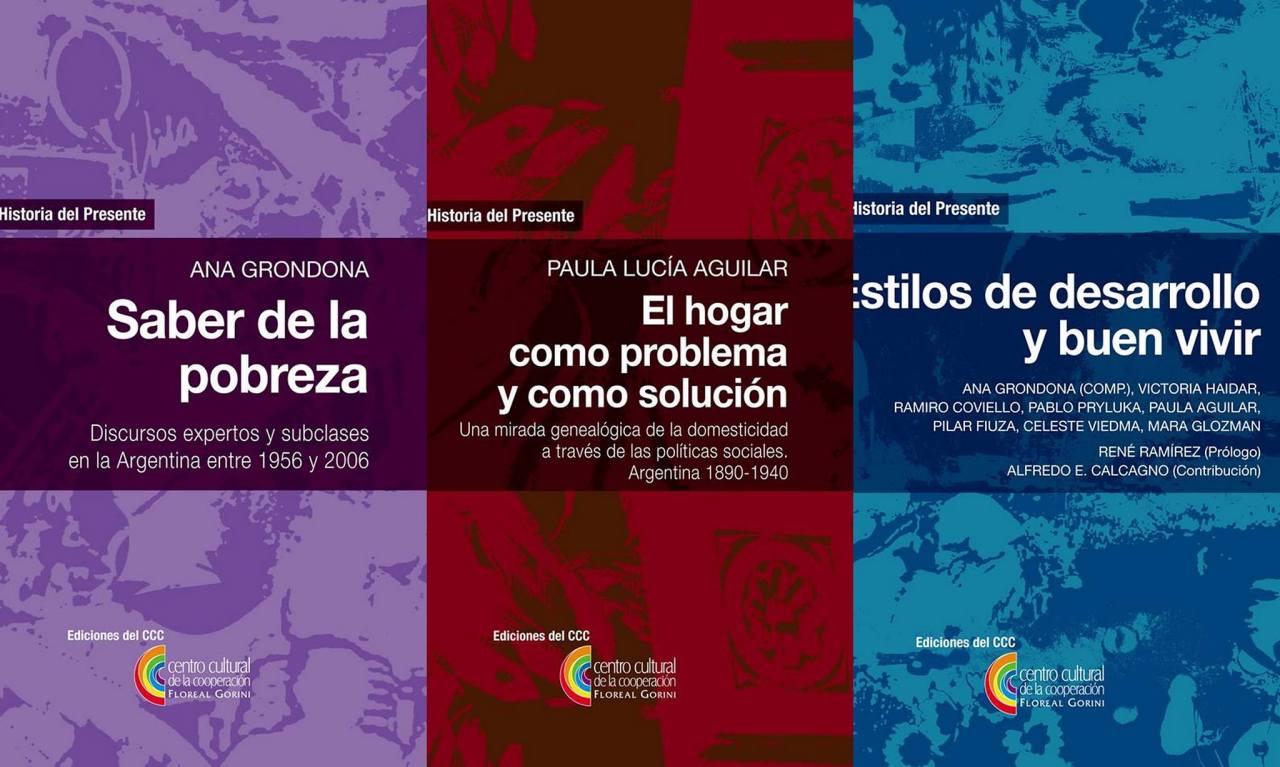
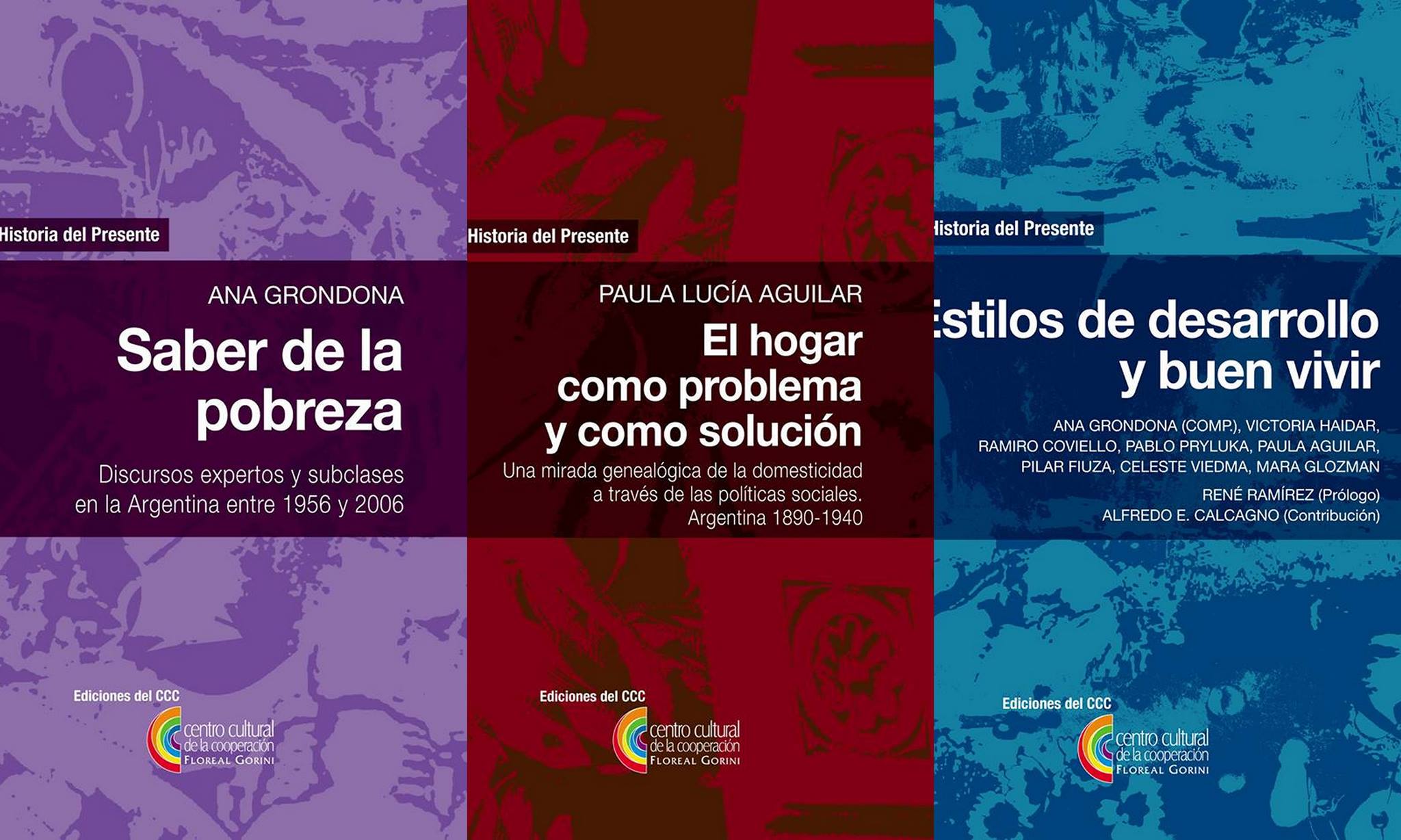
Estilos de Desarrollo y Buen Vivir. 

Development Styles and Good Living 
Ediciones Centro Cultural de la Cooperación Floreal Gorini (2016) 212 p.

The book puts into dialogue discussions of “good living” alternatives to development with a series of proposals that were designed between  mid 1960s and early 1980s in Latin America. In that context , Fundación Bariloche, Oscar Varsavsky and largely ECLAC work hard to formulate alternatives to the pattern of development centered on economic growth , while showed the feasibility of these other styles of development by calculating their main features with  multivariate mathematical complex models . More recently , proposals of good living, inspired by the Sumak Kawsay mainly in andean countries have involved a profound critique of neoliberalism and its civilizational model. The challenge of the book is to destabilize the effect of homogeneity and evidence which usually defines “development” as a one way (North to South) debate and show its conflicts and struggles under different social and historical circumstances.

The book is the result of an investigation conducted at the Cultural Center of Cooperation Floreal Gorini , who also received a subsidy UBACyT under the Faculty of Social Sciences of the UBA . It is an interdisciplinary team, made up of Paula Aguilar ( Sociologist ) , Victoria Haidar ( lawyer ) , Mara Glozman ( linguist ), Paul Pryluka ( historian ) , Ramiro Coviello ( sociologist ), Pilar Fiuza ( Sociologist ) , Celeste Viedma ( sociologist ) and Ana Grondona ( sociologist ).

El Hogar como problema y como solución. Una mirada genealógica de la domesticidad a través de las políticas sociales. Argentina 1890-1940

Home as a problem and as a solution. A genealogical view of domesticity through social policies debate. Argentina, 1890- 1940. 
Ediciones Centro Cultural de la Cooperación Floreal Gorini (2014) 310 p.

Paula Lucía Aguilar (aguilarpl@gmail.com)

The book traces the formation of “modern domesticity” by analyzing the discourses of diagnosis and possible responses to the social question in dispute between 1890- 1940. Through the problematization of the boundaries between the domestic realm and work, the public housing debate, Home Economics knowledge prescribed for household management and statistical records of the lives and work of the working family, domesticity is increasingly defined as an arena for reflection and action in Social Policy debate. In this context the “Home” emerges and condenses both real and utopian concerns about population life and work conditions and the possibility of social reform. From a perspective that seeks to destabilize evidence, this book invites to review the configuration of domesticity, its organization and responsibilities that still resonate today and guide the design and implementation of specific policies.

Paula Lucia Aguilar has a degree in Sociology and a PhD in Social Sciences from the University of Buenos Aires. She is a researcher at CONICET / IIGG and at Centro Cultural de la Cooperación Floreal Gorini. Currently part of the Group Study Group in History and Discourse (GEHD).

Saber de la Pobreza: Discursos expertos y subclases en la Argentina entre 1956 y 2006 

Poverty knowledge: expert discourses and subclasses in Argentina between 1956-2006
Ediciones Centro Cultural de la Cooperación Floreal Gorini (2014) 221 p.

Ana Grondona (antrondona@hotmail.com)

This book discusses the various ways in which expert knowledge defined the problem of “subclasses” in Argentina between 1956-2006. By means of archival work and interviews with key actors of the process, it investigates the diagnoses of marginality, informality, basic needs, poverty and vulnerability. It revisits various discussions –many of them forgotten- and proposed categories from which at present we map the social question. The analysis of multiple memories involved in the production of these categories, allows to account for different regimes of enunciation that, at every historical and political circumstances, organized what could and should be said about the “subclasses”. In particular, it explores the decline of diagnoses focused on macro-causality and consolidation, as from the 80s, of a descriptivist perspective. This mutation is part of a more general transformation that relegated the questioning of capitalism to a marginal position

Grondona Ana has a degree in Sociology and a PhD in Social Sciences from the University of Buenos Aires. She is a researcher of CONICET / IIGG and Centro Cultural de la Cooperación Floreal Gorini. Currently part of the Group Study Group in History and Discourse (GEHD).
Hörberg, U., Dahlberg, K.
Caring potentials in the shadows of power, correction, and discipline-Forensic psychiatric care in the light of the work of Michel Foucault
(2015) International Journal of Qualitative Studies on Health and Well-being, 10, art. no. 28703.

DOI: 10.3402/qhw.v10.28703

Abstract
The aim of this article is to shed light on contemporary forensic psychiatric care through a philosophical examination of the empirical results from two lifeworld phenomenological studies from the perspective of patients and carers, by using the French philosopher Michel Foucault’s historical-philosophical work. Both empirical studies were conducted in a forensic psychiatric setting. The essential results of the two empirical studies were reexamined in a phenomenological meaning analysis to form a new general structure in accordance with the methodological principles of Reflective Lifeworld Research. This general structure shows how the caring on the forensic psychiatric wards appears to be contradictory, in that it is characterized by an unreflective (non-)caring attitude and contributes to an inconsistent and insecure existence. The caring appears to have a corrective approach and thus lacks a clear caring structure, a basic caring approach that patients in forensic psychiatric services have a great need of. To gain a greater understanding of forensic psychiatric caring, the new empirical results were further examined in the light of Foucault’s historical-philosophical work. The philosophical examination is presented in terms of the three meaning constituents: Caring as correction and discipline, The existence of power, and Structures and culture in care. The philosophical examination illustrates new meaning nuances of the corrective and disciplinary nature of forensic psychiatric care, its power, and how this is materialized in caring, and what this does to the patients. The examination reveals embedded difficulties in forensic psychiatric care and highlights a need to revisit the aim of such care. © 2015 U. Hörberg & K. Dahlberg.

Author Keywords
Caring science; Forensic psychiatric care; Foucault; Philosophical examination

Marc Djaballah, Foucault, trente ans après, Revue philosophique de la France et de l’étranger 2016/1 (Tome 141)

Résumé

Français

Revue critique d’un ensemble d’ouvrages éditant des textes de Michel Foucault (1926-1984) ou portant sur son oeuvre, parus en français à l’occasion du trentième anniversaire de sa mort.

English
Michel Foucault after Thirty Years
Critical review of a few books either compiling texts by Michel Foucault (1926-1984) or studying his work, published in French on the occasion of the 30th celebration of his death.

Jodi Sita and Marco Amati, The Panopticons are coming! And they’ll know when we think the grass is greener, The Conversation, August 22, 2016

Eye-tracking technology helps us understand how people interact with their environment. This can improve policy and design, but can also be a tool for surveillance and control.

Extract

[…]we asked park users in the City of Melbourne to view films of walks.

We used eye tracking – a technology that allows us to look deeply into exactly what you are looking at or paying attention to. Eye trackers follow your gaze as you look naturally around a scene. We see where your eye dwells and what things you skip over.

[…]

French philosopher Michel Foucault argued that a panopticon ably maintains social and power imbalances while using that most passive method of control: observation. As governments and private corporations increasingly use eye-tracking data, everyone can act as observers, recorders and the observed – whether they intended to or not.

In this sense we could argue that the increasing development of eye tracking could usher in the age of the mass panopticon. Yet, the relationship between a selfie society, an “all-seeing, all-knowing” culture and the future of eye tracking in open domains remains to be “seen”.

Gildas Salmon Foucault et la généalogie de la sociologie Archives de Philosophie, 2016/1 (Tome 79)

Résumé

Français

Quarante ans après Surveiller et punir, La Société punitive montre qu’avec le concept de discipline, Foucault entendait proposer une généalogie de la sociologie, et en particulier du programme durkheimien. Refusant de faire du droit la mise en forme d’exigences immanentes à la conscience collective, il traite la moralisation de la pénalité comme une stratégie mise en place au XIXe par une bourgeoisie soucieuse de se prémunir contre les nouveaux illégalismes suscités par les transformations de la propriété capitaliste. En prenant pour fil conducteur la confrontation avec l’évolutionnisme sociologique qui sous-tend l’histoire de la pénalité retracée par Foucault, cet article se propose de mettre en évidence les gains obtenus au moyen de la méthode archéologique de dissolution des continuités historiques, mais aussi les apories que rencontre la généalogie pour rendre compte de la formation des sujets politiques modernes non plus à partir des formes de solidarité, mais à partir du principe d’une guerre civile sous-jacente à la société.

Mots clés
Discipline Durkheim Foucault Généalogie Guerre civile Modernité Pénalité Sociologie

English
Forty years after Discipline and Punish, The Punitive Society reveals that with the concept of discipline, Foucault intended to propose a genealogy of sociology – and especially of the durkheimian program. Refusing to regard law as an expression of immanent demands of the collective consciousness, he treats the moralization of the penalty as a strategy put in place in the nineteenth century by a bourgeoisie anxious to guard against new illegalisms raised by the transformations capitalist property. Taking as a core theme the confrontation with the sociological evolutionism underlying the history of penalty traced by Foucault, this article aims to highlight the benefits obtained by the archaeological method of the dissolution of historical continuities. It underscores, however, the paradoxes facing genealogy to account for the formation of modern political subjects on the principle of a civil war underlying society, rather than from the social forms of solidarity.

Mots-clés (en)
Civil War Discipline Durkheim Foucault Genealogy Modernity Penalty Sociology

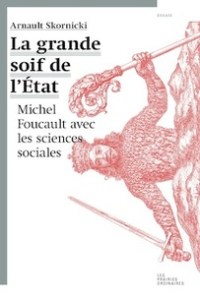
skornickiArnault Skornicki,La grande soif de l’etat. Michel Foucault avec les sciences sociales, Les Prairies Ordinaires, 2016.
288 pages, 20 €
ISBN 978-2-35096-116-3

Michel Foucault n’est pas réputé être un théoricien de l’État, mais un penseur du pouvoir partout où il se trouve (dans l’école, la prison, la caserne, l’usine, l’hôpital). Et pourtant, il apparaît qu’il s’était lancé dans une grande généalogie de l’État moderne. Cet ouvrage se propose de dissiper ce paradoxe en démontrant deux choses.

Oui, il existe bel et bien une théorie foucaldienne de l’État : elle n’est ni systématique ni achevée, mais on peut la reconstituer tant à partir de la fabuleuse richesse des textes de Foucault qu’en le faisant dialoguer avec de grandes entreprises voisines, venues de la philosophie et des sciences sociales : le marxisme, Weber, Elias et Bourdieu, entre autres.

Oui, la généalogie est compatible avec la sociologie. Les concepts de biopolitique, discipline, pastorale, gouvernementalité ne sont pas autre chose que des outils pour saisir l’étatisation des rapports de pouvoir, c’est-à-dire les processus de monopolisation politique qui, du Moyen Âge à nos jours, sont au principe de nos prétendus Léviathans en Europe. L’État ? Non pas le plus froid de tous les monstres froids, ni seulement un grand appareil répressif, mais l’effet et l’opérateur de gouvernementalités multiples, de rationalités hétérogènes, de dispositifs variés.

Ceci n’est pas un nouveau livre sur Foucault. C’est un livre sur l’État et la possibilité toujours vivante d’en faire une théorie, retrempée dans l’eau acide de la généalogie.

Frieder Vogelmann, Reading Practices: How to read Foucault?, Krisis, Journal for Contemporary Philosophy Issue 2, 2016
https://krisis.eu/article/view/38874

Review of: Daniel Zamora and Michael Z. Behrent, Eds. (2016), Foucault and Neoliberalism. Cambridge: Polity Press, 152 pages; and Mitchel Dean and Kaspar Villadsen (2016), State Phobia and Civil Society. The Political Legacy of Michel Foucault. Stanford: Stanford University Press, 196 pages.

Does Foucault have sympathies for neoliberalism? Is his analysis of it therefore rather an “apology” (Becker, Ewald and Harcourt 2012: 4) than a critique? Is his theoretical and political antistatism complicit in the neoliberal dismantling of the welfare state? Such are the questions that have sparked a lively discussion in the last year, mostly on various web blogs[1] but also in journals (Hansen 2015) – and in books, as the two under review here.

Set off by Daniel Zamora’s interview with the strange title “Can We Criticize Foucault?” in the journal Ballast (an English translation appeared in Jacobin),[2] the bold and sweeping accusations that not only had Foucault himself been at least uncritical, if not supportive of neoliberalism, but also that “Foucault scholasticism” (Behrent 2016 [2014]: 54) is therefore implicated in the neoliberal strategy and that this constitutes Foucault’s “political legacy”, (Dean and Villadsen 2016) seem to have touched a sensitive spot within current Foucaultian scholarship. Although Johanna Oksala (2015) is fundamentally right in her assessment that “this debate itself seems misguided,”[3] there is something to learn from this misguided debate because it brings out two questions mostly left unattended by all its participants (but see Erlenbusch 2015): How do weread Foucault? And how does Foucault read (neoliberals like Gary Becker, for example)? By way of reviewing first the English edition of Daniel Zamora’s Critiquer Foucault (2014), and second Mitchell Dean’s and Kaspar Villadsen’s monograph State Phobia and Civil Society (2016), I will argue that the questions of how we read Foucault and how Foucault reads are not sufficiently addressed.

read more

Ron Purser and Edwin Ng, Cutting Through the Corporate Mindfulness Hype, Part One Huffington Post, March 22, 2016

Extract
Michel Foucault made an astute observation: “You know the difference between a real science and a pseudoscience? A real science recognizes and accepts its own history without feeling attacked.” Hopefully, management science scholar-practitioners promoting corporate mindfulness research would contemplate on this statement.

Ron Purser and Edwin Ng, Mindfulness and Self-Care: Why Should I Care? Part Two, Huffington Post, April 6 2016

Extract

Though we are skeptical about celebratory claims, we actually do hope that mindfulness might become a disruptive technology to transform prevailing systems. However, we insist on the importance of collective attentiveness towards the workings of power, which have shaped the dominant individualistic-therapeutic approach to mindfulness and the stresses we face in our private and public lives.

I’d like to clarify the notion of governmentality that guides our work. The blended concept of govern-mentality derives from the work of Michel Foucault. Governmentality does not refer only to the processes of the state. Rather, to think about governmentality is to explore how diverse types of knowledge, expertise, and practices are developed to guide people’s voluntary conduct.

Consider, for instance, the contemporary interest in “wellness“. We learn about the research conducted by medical institutions on exercising or meditation. This knowledge filters through the advice we find in the media. With the help of a trained expert or through our independent efforts, we might cultivate a daily practice of jogging or yoga or mindfulness. Companies and institutions might incorporate a wellness program into their operations.

To put it another way, governmentality plays out formally and informally as the everyday “rules of the game” for responsible conduct. Under the conditions of neoliberal capitalism, the logics of governmentality are imbued with the moral rhetoric of “free choice” and are geared towards self-optimizing, consumerist and entrepreneurial ends.

Ron Purser, Ph.D.. is Professor of Management at San Francisco State University. His article, “Beyond McMindfulness,” in the Huffington Post went viral in 2013.
Edwin Ng, Ph.D., is an author and cultural theorist currently based in Australia. He has written commentaries on the cultural translation of Buddhism and mindfulness for Salon.com and the Buddhist Peace Fellowship.