Foucault News

News and resources on French thinker Michel Foucault (1926-1984)

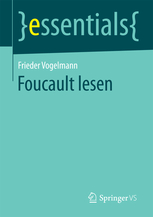
vogelmannFrieder Vogelmann, Foucault lesen, Springer, 2017

Dieses Springer essential stellt einen systematischen und philosophischen Lektürevorschlag zur Diskussion: Systematisch werden Foucaults Schriften von seiner methodologischen Perspektive her als nihilistische, nominalistische und historizistische Analyse von Praktiken und den in ihnen produzierten Wirklichkeiten entlang der drei Achsen des Wissens, der Macht und der Selbstverhältnisse gedeutet. Die Konsequenzen dieser Interpretation werden anhand der Positionen umrissen, die sich in Bezug auf Foucaults Kritikbegriff, seine Attacke auf die Human- und, als Teil davon, die Sozialwissenschaften und sein Verhältnis zum Neoliberalismus ergeben. Philosophisch ist dieser Lektürevorschlag, weil er die Historisierung von Wahrheit als Kern von Foucaults philosophischem Verfahren behauptet.

Affiche SemFouc 16-17

PDF

Université Paris 1 Panthéon-Sorbonne
Institut des sciences juridique et philosophique de la Sorbonne (UMR8103)
Centre de philosophie contemporaine de la Sorbonne (PhiCo)

Séminaire Foucault 2016-2017

AUTOUR DE L’ARCHÉOLOGIE DU SAVOIR

Animé par Jean-François Braunstein et Daniele Lorenzini

Les séances ont lieu de 10h30 à 12h30 à l’Université Paris 1, UFR de Philosophie, 17 rue de la Sorbonne, Paris 5e, escalier C, 1er étage, salle Lalande

15 octobre 2016
David SIMONETTA (Collège de France)
« Histoire des idées et histoire des sciences dans L’archéologie du savoir et les épreuves inédites »

19 novembre 2016
Martin RUEFF (Université de Genève)
Titre à préciser

17 décembre 2016
Philippe SABOT (Université Lille 3)
« Le statut de l’événement dans L’archéologie du savoir »

21 janvier 2017
Judith REVEL (Université Paris Ouest Nanterre)
« Le visible et le caché. Quelques remarques sur la place des problèmes historiographiques dans L’archéologie du savoir »

18 mars 2017
Matteo VAGELLI (Université Paris 1 Panthéon-Sorbonne)
« L’archéologie aux États-Unis. Remarques pour une relecture du “Foucault américain” »

20 mai 2017
Jocelyn BENOIST (Université Paris 1 Panthéon-Sorbonne)
« L’histoire en extériorité »

Pour pouvoir assister au séminaire, l’inscription est obligatoire. Veuillez envoyer un mail, d’ici le vendredi 14 octobre, à l’adresse suivante : seminairefoucault@gmail.com. Une pièce d’identité vous sera demandée à l’entrée du bâtiment de la Sorbonne.
___

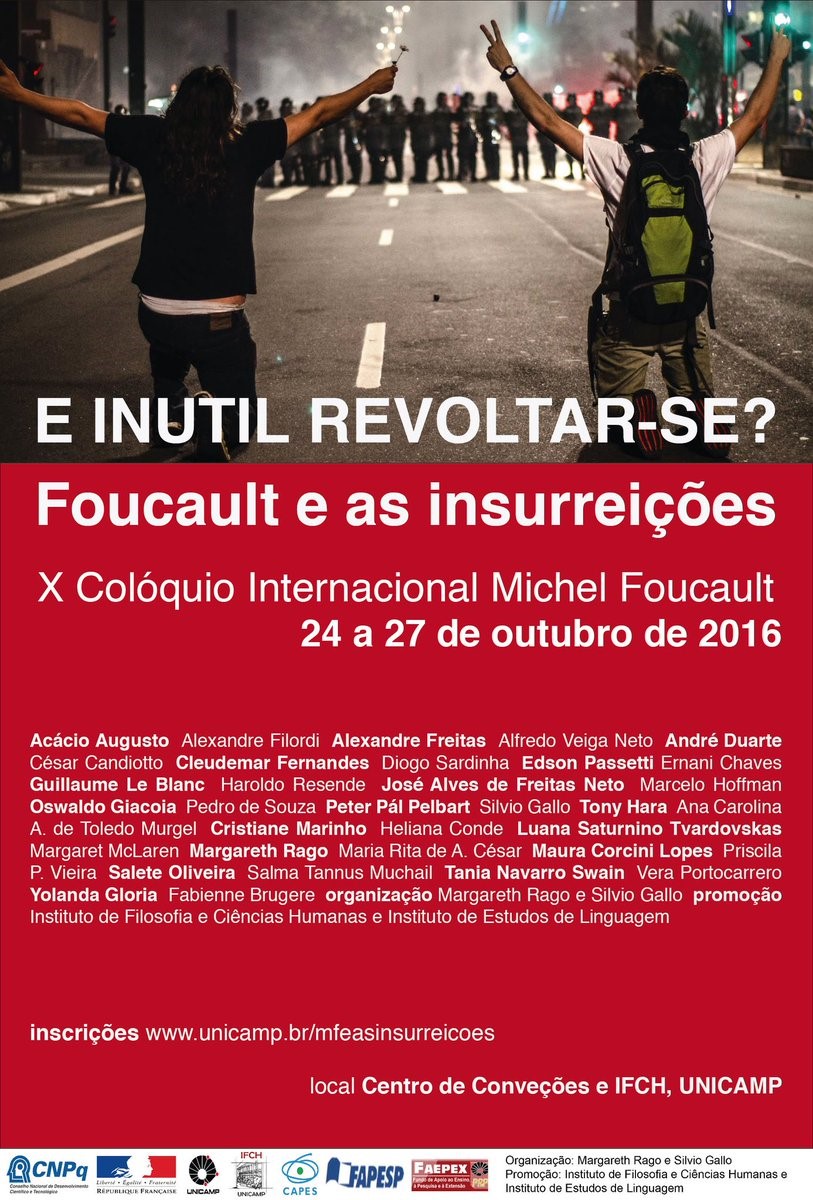
Foucault e as insurreições

revoltar

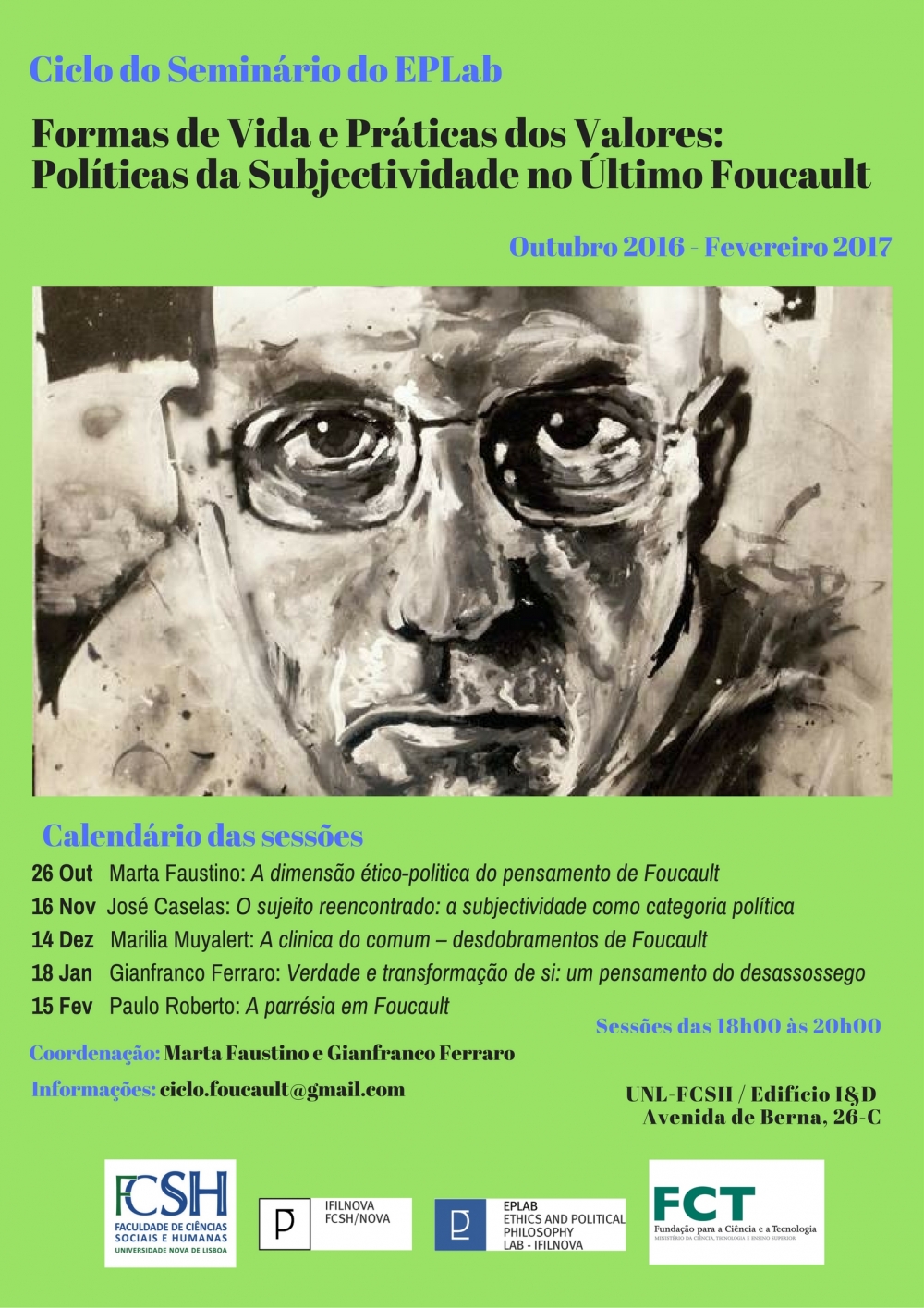
Formas de vida e práticas dos valores: políticas da subjectividade no último Foucault
October 26, 2016 – February 15, 2017
Ciclo de seminários do EPLab

Todas as sessões se realizarão das 18h00 às 20h00, em sala a anunciar.

IFILNOVA – Instituto de Filosofia da Nova
Faculdade de Ciências Sociais e Humanas – Universidade Nova de Lisboa
Av. Berna 26, Lisboa

lisboa

Coordenação: Marta Faustino e Gianfranco Ferraro

26 Out – Marta Faustino: “A dimensão ético-politica do pensamento de Foucault”
16 Nov – José Caselas: “O sujeito reencontrado: a subjectividade como categoria política”
14 Dez – Marilia Muyalert: “A clinica do comum – desdobramentos de Foucault”
18 Jan – Gianfranco Ferraro: “Verdade e transformação de si: um pensamento do desassossego”
15 Fev – Paulo Roberto: “A parrésia em Foucault”

CALL FOR PAPERS

The seventeenth annual meeting of the Foucault Circle

Los Angeles, California
March 23-25, 2017
(hosted by Loyola Marymount University)

We invite individual papers on any aspect of Foucault’s work. Studies, critiques, and applications of Foucauldian thinking are all welcome. We will aim for a diversity of topics and perspectives.

Abstracts should be prepared for anonymous review, and are to be submitted to the program committee chair, Nicole Ridgway, by email (ridgwayn@uwm.edu) on/before Friday, Nov. 18, 2016. Please indicate “Foucault Circle submission” in the subject heading, and include the abstract as a “.docx” attachment.
Individual paper submissions require an abstract of no more than 750 words.
Program decisions will be announced in December.

Each speaker will have approximately 35 minutes for paper presentation and discussion combined—papers should be a maximum of 3000 words (15-20 minutes reading time). In addition to paper sessions, the conference will also feature a screening and discussion of Sur les toits, a documentary film on the 1970s prison revolts in France. This session will be open to all participants.

Logistical information about lodging, transportation, and other arrangements will be available after the program has been announced.

For more information about the Foucault Circle, please see our website:

Jean-François Favreau, Artaud mis en scène par Foucault : une « fiction critique », Les Temps Modernes 2016/1 (n° 687-688)

Premières lignes
Ce que nous nous proposons d’aborder ici, ce sont les usages d’Artaud par Foucault, ce qui nous permet d’un côté de considérer un Foucault critique, metteur en scène de la pensée et de l’écriture d’Artaud, et de l’autre de réévaluer, en regardant du côté de sa réception, ce qu’on pourrait appeler les capacités de comédien d’Artaud. Ces capacités de comédien, appliquées à l’œuvre d’Artaud, font que…

Plan de l’article
La « scène de la folie »
Une histoire secrète de l’occident ou « la matérialité de la pensée »
L’absence d’œuvre, le héros
Artaud penseur
Les années 1970, la via negativa, l’effectivité
« Fiction critique » et figures de la littérature
Artaud irréductible

CALL FOR PAPERS

International Conference

GOVERNMENT OF SELF, GOVERNMENT OF OTHERS

Ethical and political questions in the late Foucault

IFILNOVA / EPLab, Lisbon, 6th-7th March 2017

Organizers

Marta Faustino, Gianfranco Ferraro, Luís de Sousa

The Laboratory of Ethics and Political Philosophy of IFILNOVA invites submissions for its international conference “Government of Self, Government of Others. Ethical and Political Questions in the Late Foucault”, to be held at the New University of Lisbon, on the 6th-7th of March, 2017.

Michel Foucault’s last lecture series at Collège de France constitute a unity that testifies a shift in his thought. This shift deepens and expands the course of his preceding works concerning the genealogy of subjectivity, while, at the same time, adding to it a significant ethical and political dimension. Foucault returns to the practices of the self in antiquity and looks at the birth of the techniques of truth that allow us to understand how the Western subject has developed from the creation of particular relationships with its own body and other subjectivities. At the same time, these courses put in evidence the relationship between truth and power which lies at the core of Western forms of power and even Western democracy, thus inciting us to question our current political environment and face some political challenges of our time. Finally, Foucault’s concern in these last years with the technologies of ethical self-formation through what he calls “care of the self” sheds new light on his philosophical endeavor as a whole and situates his reflections at the center of contemporaneous moral debates.

On the occasion of the 35th anniversary of The Hermeneutics of the Subject (1981-1982) and celebrating the conclusion of the publication of all the lecture courses from the 1980s – from On the Government of the Living (1979-1980) to The Courage of Truth (1984) -, this conference aims to (re)launch the critical debate on the last stage of Foucault’s thought, evaluating in what way and to which extent the perspectives that Foucault offers in this period might help us to unravel modernity and also give us tools to ethically and politically understand and transform our present.

We accept proposals on any of Foucault’s lecture courses from the 1980s or any interrelated aspect of the last period of his thought. The dialogue with other authors from the philosophical, sociological or political tradition is strongly encouraged. Possible topics include, but are not restricted to:

  • Genealogy of subjectivity
  • Hermeneutics and truth
  • Care of the self and aesthetics of existence
  • Governmentality
  • Technologies of power and subjectivation
  • Will to truth and parrhesia
  • Knowledge and identity
  • Ethics and practices of freedom
  • Asceticism and philosophy
  • Foucault’s actuality

We welcome submissions from doctoral students, early career researchers or established academics. Paper proposals of 300 to 500 words, accompanied by a short biography (150 words), should be submitted (in either English, French or Portuguese) to ciclo.foucault@gmail.com by the 30th of November of 2016. Notifications of acceptance will be given by the 15th of December of 2016.

For further information, please contact ciclo.foucault@gmail.com.

Michael Ashworth, Affective Governmentality. Governing Through Disgust in Uganda, Social & Legal Studies, September 23, 2016
doi: 10.1177/0964663916666630

Abstract
This article questions the extent to which calculable numbers are indispensable to the government of conduct. By focusing on the role played by disgust in the government of sexual minorities in Uganda, it provides an account of government by emotion, or affective governmentality. This article draws on the literature on disgust, appropriating elements from the various disciplines and perspectives and bringing them under a Foucauldian umbrella. It explores two techniques through which attempts were made to arouse disgust: the sermon and the tabloid exposé. Although such techniques were performed by agents who operated beyond the state, this article contends that the emergence of the Anti-Homosexuality Act 2014 cannot be accounted for without considering the role played by disgust.

Keywords
Affect Anti-Homosexuality Bill 2009 Anti-Homosexuality Act 2014 disgust Foucault LGBT sexual minorities techniques of government Uganda

Archeologia Filosofica Laboratorio

Sull’archeologia filosofica
Le ragioni di un laboratorio

L’archeologia filosofica è quel sapere delle formazioni discorsive indagate a partire dagli enunciati in cui si determinano i rapporti tra storia e filosofia. L’archeologia retrocede alle condizioni di possibilità del pensiero, a partire dalle relazioni tra saperi, poteri e soggetti. Il metodo archeologico genera genealogie di sopravvivenze, risalendo alla zona di indistinzione di storia e filosofia, natura e cultura, sapere e non sapere.

L’ “invenzione” epistemologica di Foucault, intesa nelle indagini filosofiche di Enzo Melandri e riproposta nella metodologia genealogica di Giorgio Agamben, è il modo della ricerca di una certa posizione in rapporto alla tradizione filosofica, all’etica (politica) e alla storia della verità.

L’archeologia filosofica ci consente la critica del presente, nell’inattualità di questa posizione che prevede l’esposizione dei dispositivi, lasciando emergere l’ apriori storico che ne è all’origine.

Continua a leggere

Chi siamo

Alessandro Baccarin

Autore di articoli sulla filosofia antica e della monografia Il sottile discrimine. I corpi tra dominio e tecnica del sé (Ombre corte, 2014).

Stefano Gambari

si interessa di sistemi scientifici e popolari di classificazione, di metadati e sistemi di descrizione delle risorse; è autore di saggi e monografie di biblioteconomia.

Giacomo Gambaro

studia l’idealismo tedesco, le implicazioni pratiche della filosofia trascendentale di Fichte, la filosofia francese contemporanea di Foucault e Deleuze. Ha pubblicato gli articoli: Antonio Gramsci: dal liberismo ai consigli di fabbrica, in Il fantasma dell’Unità. Riletture del Risorgimento tra Grande Guerra e Fascismo (Mimesis, 2013); Dal teatro allo scacchiere. La concezione del potere in Bernard Mandeville, in Prima e dopo il Leviatano, (Cleup, 2014).

Walter Tossici

studia filosofia a “Sapienza” Università di Roma. E’ interessato alle tematiche del potere e del linguaggio in rapporto alle possibilità degli individui nelle condizioni di vita attuali.

Paolo B. Vernaglione

autore di saggi e testi tra i quali Il sovrano, l’altro, la storia (2006), Dopo l’Umanesimo (2008), Filosofia del comune (2013), Michel Foucault. Genealogie del presente (2014).

Editor: I am delighted to announce that my long out of print 1989 book (originally published with Macmillan) has been republished as an ebook.


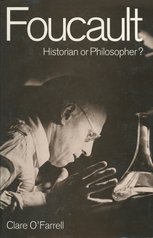
fhpClare O’Farrell, Foucault: Historian or Philosopher? ebook, Palgrave Macmillan, 2016.

PDF flyer

Description
The controversial French thinker, Michel Foucault, was famous not only for the variety of his interests but also for his frequent changes of position. Clare O’Farrell, in a lively and lucid account argues that for all this diversity his work was held together by a coherent theme, namely the idea that philosophy should be practised as an historical inquiry into the limits of ordered experience. At the same time, Foucault’s work is situated in its intellectual and social context in France and striking differences between its French- and English-language reception are discussed and explained.

Short previews of two chapters are available on the Springer site

1. A New Generation of Thinkers
2. The Same, the Other and the Limit
3. Discontinuity and Order
4. In Search of the Limit
5. The Limits Forgotten
6. The Return of the Limits