Foucault News

News and resources on French thinker Michel Foucault (1926-1984)

Noguera-Ramírez, C.E.
The pedagogical effect: On Foucault and Sloterdijk
(2016) Educational Philosophy and Theory, pp. 1-14. Article in Press.

DOI: 10.1080/00131857.2016.1204738

Abstract
Although Foucault did not produce any particular work devoted to teaching or education, following authors like Hoskin this text aims to show the importance that teaching practices and discourses have in Foucault’s analysis, particularly in the analysis of what he called governmentality . If we associate these analyses with the concept of ‘ Antropotécnicas ‘ developed by the German philosopher Peter Sloterdijk, then we have a transparent toolbox for analyzing learning, recognizing that contemporary society is an educating society. © 2016 Philosophy of Education Society of Australasia

Author Keywords
anthropotechniques; educating society; Government; pedagogical practices; practices of the self
Dolly Jørgensen,
Rethinking rewilding
(2015) Geoforum, 65, pp. 482-488.

https://doi.org/10.1016/j.geoforum.2014.11.016

Abstract
The term ‘rewilding’ sounds as if it should have a straightforward meaning ‘to make wild again’. But in truth the term has a complex history and a host of meanings have been ascribed to it. Rewilding as a specific scientific term has its beginnings as a reference to the Wildlands Project, which was founded in 1991 and aimed to create North American core wilderness areas without human activity that would be connected by corridors. Words, however, do not stand still-they change over time and take on new meanings, while sometimes simultaneously retaining the older sense. Employing Foucault’s idea of historical genealogy, this article examines how the term rewilding was historically adopted and modified in ecological scientific discourse over the last two decades. This investigation probes what and, by extension, when and where, rewilding refers to as it has moved into various geographies across the globe. It then examines how the term has moved outside of science and been adopted by environmental activists as a plastic word. Taken as a whole, rewilding discourse seeks to erase human history and involvement with the land and flora and fauna. Such an attempted split between nature and culture may prove unproductive and even harmful. A more inclusive rewilding is a preferable strategy. © 2014 Elsevier Ltd.

Author Keywords
Ecological restoration; Environmental discourse; Historical genealogy; Plastic words; Science communication; Wilderness

Index Keywords
adaptive management, environmental planning, fauna, flora, restoration ecology, strategic approach, wildlife management; North America

Beer, D.
The social power of algorithms
(2016) Information Communication and Society, pp. 1-13. Article in Press.

DOI: 10.1080/1369118X.2016.1216147

Abstract
This article explores the questions associated with what might be thought of as the social power of algorithms. The article, which introduces a special issue on the same topic, begins by reflecting on how we might approach algorithms from a social scientific perspective. The article is then split into two sections. The first deals with the issues that might be associated with an analysis of the power of the algorithms themselves. This section outlines a series of issues associated with the functionality of the algorithms and how these functions are powerfully deployed within social world. The second section then focuses upon the notion of the algorithm. In this section, the article argues that we need to look beyond the algorithms themselves, as a technical and material presence, to explore how the notion or concept of the algorithm is also an important feature of their potential power. In this section, it is suggested that we look at the way that notions of the algorithm are evoked as a part of broader rationalities and ways of seeing the world. Exploring the notion of the algorithm may enable us to see how algorithms also play a part in social ordering processes, both in terms of how the algorithm is used to promote certain visions of calculative objectivity and also in relation to the wider governmentalities that this concept might be used to open up. © 2016 Informa UK Limited, trading as Taylor & Francis Group

Author Keywords
Algorithm; big data; code; Foucault; power; software

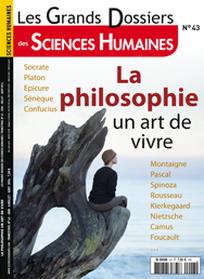
gdsh_043_l204Daniele Lorenzini, Pierre Hadot (1922/2010) et Michel Foucault (1926/1984) – La culture de soiLa philosophie, un art de vivre, Les Grands Dossiers des Sciences Humaines, 2016/6 (N° 43)

Premières lignes
Qu’est-ce que la philosophie ? En posant cette question, dans un article intitulé « La philosophie est-elle un luxe ? », Pierre Hadot remarque que le plus souvent les non-philosophes considèrent la philosophie comme un discours abstrus et abstrait, développé par quelques privilégiés pour répondre à des questions incompréhensibles et sans intérêt. La philosophie serait donc un vain bavardage, infiniment…

Mots-clés
Antiquité Foucault philosophie Hadot histoire de la philosophie Lorenzini

Plan de l’article
La philosophie : discours ou mode de vie ?
Pierre Hadot et les exercices spirituels
Michel Foucault : techniques de soi et esthétique de l’existence
Actualité de la philosophie antique ?

Jiménez, M.A., Valle, A.M.
Pedagogy and the care of the self: A reading from Foucault
(2016) Educational Philosophy and Theory, pp. 1-8. Article in Press.

DOI: 10.1080/00131857.2016.1204736

Abstract
This text reflects about the need to consider an additional institutional alternative that matters, not only to the ones that advocate for pedagogy, but also to all of those involved in different educational processes. It is, so to speak, a Paideia that privileges the care of the self as a substantial value, and, as such, it is not dedicated to a unique moment on people’s lives and it does not correspond to a specific institution, but to the universal and singular spirit of the human affairs. © 2016 Philosophy of Education Society of Australasia

Author Keywords
Care of the self; pedagogy; subject-truth

cultural-historyRevisiting The History of Sexuality: Thinking with Foucault at Forty, Guest edited by Howard Chiang, Cultural History, Volume 5, Issue 2, October, 2016

Articles

Revisiting Foucault: Thinking with The History of Sexuality at Forty
Howard Chiang

‘The Party with God’: Michel Foucault, the Gay Left and the Work of Theory
Steven Maynard

Sex and Truth: Foucault’s History of Sexuality as History of Truth
Marek Tamm

Nous autres, victoriens: Punctuation, Power and Politics in Foucault’s History of Sexuality
Patrick Singy

The History of Sexuality and Historical Methodology
Andrew E. Clark-Huckstep

Acts or Identities? Rethinking Foucault on Homosexuality
Umberto Grassi

Reviews

Elaine Jeffreys with Haiqing Yu, Sex in China
Hongwei Bao

Joseph A. Boone, The Homoerotics of Orientalism
Eng-Beng Lim

Donna J. Drucker, The Classification of Sex: Alfred Kinsey and the Organization of Knowledge
Carrie Pitzulo

Robert Beachy, Gay Berlin: The Birthplace of a Modern Identity
Christopher Ewing

Interview with Stuart Elden by Dave O’Brien (podcast) on the New Books Network

In relation to Foucault’s Last Decade Polity Press 2016

Why did Michel Foucault radically recast the project of The History of Sexuality? How did he work collaboratively? What was the influence of Antiquity on his thought? In Foucault’s Last Decade (Polity Press, 2016) Stuart Elden, Professor of Political Theory and Geography at the University of Warwick explores these, and many more, questions about the final years in a rich intellectual life. The book combines detailed studies of Foucault’s recently collected lecture series with archival material and his publications, to give an in depth engagement with the changes and continuities in his thought during the last decade. Addressing questions associated with key terms, such as governmentality, as well as confession, the self, power, truth telling, and many other core ideas and themes, the book will be essential reading for anyone interested in this most important of Western thinkers.

Jason Read, Cutting Off Heads. A review of Foucault with Marx by Jacques Bidet (Zed Books: London, 2016)

Jacques Bidet’s Foucault with Marx represents yet another contribution to the eventual overcoming of an academic skirmish between advocates of Foucault and Marx, itself a smaller conflict in the larger battle of postmodernism versus Marxism. The perspective which saw Marx and Foucault as mutually opposed theoretical camps has begun to fade thanks to both the publication of Foucault’s courses and lectures, most importantly the short essay on “The Mesh of Power,” and the publication of several texts, such as the monumental collection Marx & Foucault: Lectures, usages, confrontations in France. However, the dissipation of Team Foucault and Team Marx is only a first step; it remains to be seen how Foucault and Marx are related and how their different examinations into history, modernity, and society can be brought together through their points of connection and differences.

read more

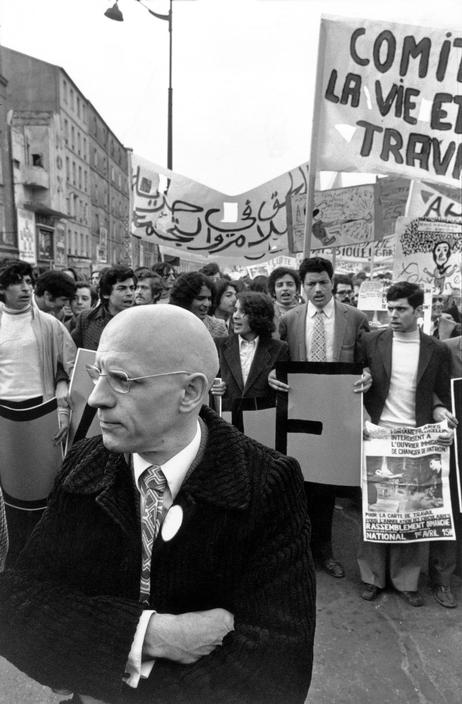
Demonstration in support of immigrant workers. Michel Foucault in the foreground. Paris, 1973. Photo: Gilles Peress.

Demonstration in support of immigrant workers. Michel Foucault in the foreground. Paris, 1973. Photo: Gilles Peress.

bidetJacques Bidet, Foucault with Marx
Translated by Steven Corcoran, Zed Books, 2016

The first synthesis of Foucauldian and Marxist theory, constituting a twenty-first century paradigm shift in political and philosophical thinking.

With this timely commitment, Jacques Bidet unites the theories of arguably the world’s two greatest emancipatory political thinkers. In this far-reaching and decisive text, Bidet examines Marxian and Foucauldian criticisms of capitalist modernity.

For Marx, the intersection between capital and the market is crucial, while for Foucault, the organizational aspects of capital are what really matter. According to Marx, the ruling class is identified with property; with Foucault, it is the managers who hold power and knowledge that rule. Bidet identifies these two sides of capitalist modernity as ‘market’ and ‘organization’, showing that each leads to specific forms of social conflict; against exploitation and austerity, over wages and pensions on the one hand, and against forms of ‘medical’ and work-based discipline, control of bodies and prisons on the other.

Bidet’s impetus and clarity however serve a greater purpose: uniting two souls of critical social theory, in order to overcome what has become an age-long separation between the ‘old left’ and the ‘new social movements’.