Foucault News

News and resources on French thinker Michel Foucault (1926-1984)

Jocelyn Benoist, Des actes de langage à l’inventaire des énoncés, Archives de Philosophie 2016/1 (Tome 79)

Résumé

Français
L’article essaie de comprendre la notion d’« énoncé » telle que Foucault l’emploie dans L’Archéologie du Savoir. Il situe la perspective de Foucault dans le contexte du débat philosophique et linguistique sur le langage après la seconde guerre mondiale. Il la compare avec la philosophie du langage ordinaire, en se concentrant sur la notion d’acte de langage. Dans les deux genres d’analyse on trouve un intérêt similaire pour les performances linguistiques effectives. Cependant, la notion d’acte de langage, en elle-même, demeure trop abstraite à l’aune de l’analyse foucaldienne, et le philosophe français s’ntéresse plus à ce qu’on pourrait appeler les matériaux disponibles pour la performance en un temps donné qu’à la performance prise isolément. L’article essaie de mieux comprendre les ressorts de la ré-historicisation du langage à l’œuvre dans l’analyse de Foucault.

Mots clés
Foucault Austin Langage Acte de langage Énoncé Discours

English
The paper tries to make sense of the notion of a ‘statement’ such as Foucault uses it in his Archeology of Knowledge. It situates Foucault’s perspective within the context of the philosophical and linguistic debate on language after the Second World War. It draws a comparison with ordinary language philosophy, by focusing on the notion of speech act. In both kinds of analysis one finds a similar interest in the actual linguistic performances. However, the notion of a speech act remains as such too abstract by the standard of Foucault’s analysis and, on the other hand, the French philosopher is more interested in what could be called the materials available for a performance at a given time than in the performance taken in isolation. The paper tries to better understand the principles of the re-historicization of language in Foucault’s analysis.

Mots-clés (en)
Foucault Austin Language Speech Act Statement Discourse
Lewis, K.
Social justice leadership and inclusion: a genealogy
(2016) Journal of Educational Administration and History, 48 (4), pp. 324-341.

DOI: 10.1080/00220620.2016.1210589

Abstract
The purpose of this article is to engage in an historical analysis of research about two concepts: social justice leadership and leadership for inclusion. Recent experiences have caused me to wonder about our interpretations of justice, equity, and inclusion. Analysis of the relevant literature revealed a lack of consensus among scholars as to a clear, operational definition of both social justice leadership and inclusion. I use a Foucauldian genealogical method to examine texts and uncover the historical development of social justice leadership and leadership for inclusion in the United States. Uncovering past meanings and contexts should help illuminate current meanings and uses of these concepts. It is recommended that leaders engage in critical reflection to uncover the common sense language of equity-oriented leadership practices and that researchers take a more critical, historical, open stance of social justice leadership, and inclusion. © 2016 Informa UK Limited, trading as Taylor & Francis Group.

Author Keywords

Educational leadership; Foucault; genealogy; inclusion; inclusive leadership; social justice

Nicolas Vallois, « Michel Foucault and the history of economic thought », Œconomia, 5-4 | 2015, 461-490.
https://doi.org/10.4000/oeconomia.2181

Open access

Michel Foucault dedicated a significant part of his works to the study of political economy. In the late 1980s, these analyses attracted the interest of historians of economic thought (Amariglio, 1988, 1900; Birken, 1990). The primary purpose of this article is to provide a review survey of Foucault’s reception among historians of economic thought. Reading and interpreting Foucault is not straightforward. In reflecting on his work, Foucault refused to consider himself an “author” who could be characterized by a single, consistent framework. However, he elaborated a coherent historiographical method which we characterize as politically engaged journalism. The principles of that method allow us to identify two common confusions in interpretations of Foucault’s work. First, advocates of Foucault in the history of economic thought literature consider him a “heterodox economist” who would be opposed to “mainstream economics”. However, Foucault did not intend to criticize economic theories in this particular sense. The second source of confusion involves interpreting Foucault as a sociologist interested in the analysis of power, or a social historian, although he rejected context-based historiographical approaches. We would suggest that Foucault she be considered more a “postmodernist philosopher” than a historian of economic thought per se. In this respect, the association of “Foucauldian theory” with postmodernism is a major distortion in his reception by historians of economic thought.

Ferreira, V.S.
Aesthetics of Youth Scenes: From Arts of Resistance to Arts of Existence
(2016) Young: Nordic Journal of Youth Research, 24 (1), pp. 66-81.

DOI: 10.1177/1103308815595520

Abstract
The aesthetic expressions produced and reproduced within post-war spectacular youth (sub)cultures used to be seen as a display of resistance to and subversion of ‘social order’, perceived as opressive of youth life experiences and chances. Under the traditional subculturalist paradigm, both artefacts or performances were subsumed to the class status of their young practicioners and seen as ideological expression of their dominated and disadvantadged social position. Nowadays, however, the stylistic resources used in youth scenes has taken on new meanings for which the concept of resistance is not enough and/or adequate to explain. Therefore, departing from a post-subcultural approach, this essay intends to highlight the social changes recently occurred in the political culture of spectacular youth scenes and, consequently, to contribute to overcome resistance as nuclear concept on the debate, relocating it towards the concept of existence. Following this idea, and to close this essay, I suggest the concept of arts of existence as analytical point of view on the new expressiveness of the aesthetics of contemporary youth scenes. Inspired in Foucault, that concept allows to go further in the understanding of youth scenes aesthetics as arts of a good living (in the consumption sphere), and arts of making a living (in the production sphere). © 2016, © 2016 SAGE Publications and Young Editorial Group.

Author Keywords
aesthetics; arts of existence; arts of resistance; Subcultures; youth scenes

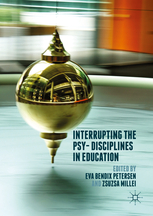
petersenBendix Petersen, Eva, Millei, Zsuzsa (Eds.), Interrupting the Psy-Disciplines in Education, Palgrave Macmillan, 2016

This book offers critical explorations of how the psy-disciplines, Michel Foucault’s collective term for psychiatry, psychology and psycho-analysis, play out in contemporary educational spaces. With a strong focus on Foucault’s theories, it critically investigates how the psy-disciplines continue to influence education, both regulating and shaping behaviour and morality. The book provides insight into different educational contexts and concerns across a child’s educational lifespan; early childhood education, inclusive education, special education, educational leadership, social media, university, and beyond to enable reflection and critique of the implications of psy-based knowledge and practice.

With chapters by a mixture of established and emerging international scholars in the field this is an interdisciplinary and authoritative study into the role of the psy-disciplines in the education system. Providing vivid illustrations from throughout the educational lifespan the book serves as an invaluable tool for reflection and critique of the implications of psy-based practice, and will be of particular interest to academics and scholars in the field of education policy and psychology.

Contents

‘Silences’ in the ‘Inclusive’ Early Childhood Classroom: Sustaining a ‘Taboo’
Watson, Karen
Pages 13-31

Binds of Professionalism: Attachment in Australian and Finnish Early Years Policy
Millei, Zsuzsa (et al.)
Pages 33-57

Becoming a ‘Learner’ in the Australian Primary School: An (Auto)ethnographic Exploration
Petersen, Eva Bendix
Pages 59-74

The Principal Is Present: Producing Psy-ontologies Through Post/Psychology-Informed Leadership Practices II
Staunæs, Dorthe (et al.)
Pages 75-92

Positive Education as Translation and Conquest of Schooling
Saari, Antti (et al.)
Pages 93-110

Labouring Over the Truth: Learning to Be/Come Queer
Bansel, Peter (et al.)
Pages 111-127

Re-thinking ‘Pointiness’: Special Education Interrupted
Laws, Cath
Pages 129-144

Confusions and Conundrums During Final Practicum: A Study of Preservice Teachers’ Knowledge of Challenging Behaviour
McMahon, Samantha (et al.)
Pages 145-166

‘No, I’m Not OK’: Disrupting ‘Psy’ Discourses of University Mental Health Awareness Campaigns
Saltmarsh, Sue
Pages 167-183

The Risk Factors For Psy-Diagnosis? Gender, Racialization and Social Class
Allan, Julie (et al.)
Pages 185-202

‘How Do You Solve a Problem Like Maria?’ Troubling the Psy-gaze in the Qualitative Analysis and Representation of Educational Subjects’
Wilson-Wheeler, Matthew
pages 203-220

Guy Roberts-Holmes, Alice Bradbury,
Governance, accountability and the datafication of early years education in England
(2016) British Educational Research Journal, 42 (4), pp. 600-613.

https://doi.org/10.1002/berj.3221

Abstract
In this paper we attempt to critically ‘make visible the flow and circulation of data’ through analysing the datafication of the early years education sector in England (children aged 2–5). The concept of datafication is used to understand the processes and impacts of burgeoning data-based governance and accountability regimes. This analysis builds upon early childhood researchers who were influenced by Foucault and others, who have noted the ways in which the surveillance and performative culture of accountability both affirms, legitimates and seduces through discourses of quality while increasingly regulating and governing the early years. Using data from three research sites (a children’s centre, a primary school and a combined nursery school and children’s centre) as well as an interview with a local authority early years advisor, we examine how comparative data-based accountability increasingly governed early years teachers’ professionalism and pedagogies. We argue that the planned tracking of children’s performance from baseline assessment at four years old to eleven years old may further govern and constrain early years professionalism as young children are reconfigured as ‘miniature centres of calculation’. © 2016 British Educational Research Association

Author Keywords
accountability; data; early years; governance

Michel Foucault: Die Spur der Macht in uns allen
Von Christoph David Piorkowski, LANGE NACHT | Beitrag vom 08.10.2016, DEUTSCHLANDRADIO KULTUR

[Editor: With thanks to Stefanie Petschick for this news. Unfortunately I can’t see a podcast link to this 3 hour broadcast.]

Als Michel Foucault 1984 im Alter von 57 Jahren stirbt, ist er längst zum internationalen Pop-Star der Wissenschaften vom Menschen geworden. Er zeigte, wie eng Macht mit Wissen und körperlich wirksamen Disziplinen verbunden ist.

Viele seiner Gedanken, Begriffe und Methoden sind in jene Gebiete der Kultur aufgenommen werden, die er zuvor kritisiert hatte. Foucaults Diskursanalyse, mit der er jene Strukturen herausarbeitete, die dem Denken und Handeln der Menschen in einer bestimmten Zeit ihr Gepräge geben, ist eine anerkannte Methode in etlichen wissenschaftlichen Disziplinen geworden: in der Soziologie, Ethnologie, Literatur- und Geschichtswissenschaft und in der Philosophie.

Suche nach Formen der Selbstgestaltung
Seine Schriften zu modernen Machttechniken zeigen, wie eng Macht mit Wissen und körperlich wirksamen Disziplinen verbunden ist. Sie haben einen neuen Typus wissenschaftlichen Denkens geprägt. Die intellektuelle und biografische Unrast des Michel Foucault machte es schon zu seinen Lebzeiten schwer, ihm einen Stempel zu verpassen. Wahlweise als Kommunist, Dandy, Reaktionär, Antihumanist oder Anarchist bezeichnet, wurde ihm keine dieser Zuschreibungen gerecht. Vor allem in seiner letzten Schaffensphase bestand er auf der Möglichkeit zur Wandlung der eigenen Gestalt und suchte jenseits des Zugriffs moderner Macht nach Formen der Selbstgestaltung.

Bis zuletzt hat sich Foucault philosophisch wie politisch, im Hörsaal und auf der Straße bemüht, für jene zu sprechen, die in der herrschenden Ordnung keine Stimme haben – die Wahnsinnigen, die Inhaftierten, diejenigen, deren Begehren die Gesellschaft als pervers bezeichnet.

MEHR ZUM THEMA

“Die Strafgesellschaft” von Michel Foucault – Warum wir Menschen einsperren
(Deutschlandradio Kultur, Lesart, 09.07.2015)

Michel Foucault – Ein radikaler Denker
(Deutschlandradio Kultur, Sein und Streit, 22.06.2014)

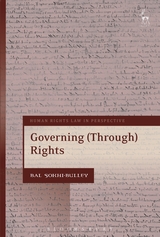
sokhi-bulleyBal Sokhi-Bulley, Governing (Through) Rights, Hart Publishing, 2016

About Governing (Through) Rights
Taking a critical attitude of dissatisfaction towards rights, the central premise of this book is that rights are technologies of governmentality. They are a regulating discourse that is itself managed through governing tactics and techniques – hence governing (through) rights. Part I examines the ‘problem of government’ (through) rights. The opening chapter describes governmentality as a methodology that is then used to interrogate the relationship between rights and governance in three contexts: the international, regional and local. How rights regulate certain identities and conceptions of what is good governance is examined through the case study of non-state actors, specifically the NGO, in the international setting; through a case study of rights agencies, and the role of experts, indicators and the rights-based approach in the European Union or regional setting; and, in terms of the local, the challenge that the blossoming language of responsibility and community poses to rights in the name of less government (Big Society) is problematised. In Part II, on resisting government (through) rights, the book also asks what counter-conducts are possible using rights language (questioning rioting as resistance), and whether counter-conduct can be read as an ethos of the political, rights-bearing subject and as a new ethical right. Thus, the book bridges a divide between critical theory (ie Foucauldian understandings of power as governmentality) and human rights law.

Table of contents
Part I: Government (Through) Rights
1. Introduction
2. Governing (Through) Agencies: The EU and Rights in EUrope
3. Governing (Through) Non-Governmental Actors: The Global Human Rights Architecture and the International NGO
Part II: Resisting Government (Through) Rights
4. Resisting Rights with Responsibility
5. Counter-Conduct as Right and as Ethics
6. Conclusion: A Permanent State of Dissatisfaction

Murphy, Brendon (2015), Zone of Impeachment: A Post-Foucauldian Analysis of Controlled Operations Law and Policy, PhD
University of Newcastle. Faculty of Business & Law, Newcastle Law School

Full PDF

Description
This thesis presents a Post-Foucauldian analysis of Australian controlled operations law. The purpose was to extend current doctrinal scholarship by exploring the discursive forces that shape this highly invasive and controversial investigative power. This thesis contends that the present doctrinal understanding is incomplete, and largely unaware of the epistemological forces operating within law and policy. By deploying a Post-Foucauldian analytic we can extend our understanding of the complex relationship between knowledge systems, discourse, power and law. Through the deployment of a nomadic, grounded genealogy in the analysis of controlled operations Second Reading Speeches, this research found that the governing rationalities of controlled operations law and policy is linked to an imperative logic dominated by discourses of risk, audit and exceptions. This dynamic explains why controlled operations legal architecture and policy is in its current form. Far from being a reaction to the decision in Ridgeway, controlled operations law is part of a legal and cultural shift in law enforcement, characterised by complex relationships between risk, rights, law and citizenship. The controlled operation is revealed as a form of apparatus: a technology of truth and power, facilitated by law. This insight allows us to reimagine the relationship between law, rights, citizenship and sovereignty in late modernity. In this environment the investigative apparatus of the controlled operation creates a field of governance within the private space of liberal citizenship, revealing the true character of citizenship in late modernity as a zone of impeachment – a location in which rights are fragile and open to perpetual potential derogation and modification. In this zone the rights attached to liberal conceptions of citizenship are increasingly the subject of subordination to a risk imperative and a logic of exception.

Feely, M.
Sexual surveillance and control in a community-based intellectual disability service
(2016) Sexualities, 19 (5-6), pp. 725-750.

DOI: 10.1177/1363460715620575

Abstract
Within contemporary policy documents regarding intellectual disability and sexuality we often find a progress narrative that contrasts a dark past, when the sexuality of disabled people was suppressed, with an enlightened present, when we recognize the sexual rights of all human beings. In this paper – which pertains to the Republic of Ireland – I take up the Foucauldian and Deleuzian position of treating such progress narratives with suspicion. From this perspective, I offer an alternative reading of the treatment of intellectual disability and sexuality in the present, and I seek to map just some of the subtle but effective ways this population’s sexuality continues to be controlled today. © 2016, © The Author(s) 2016.

Author Keywords
Assemblage; Deleuze; Foucault; intellectual disability; sexuality; surveillance