
Foucault News

News and resources on French thinker Michel Foucault (1926-1984)

Sébastien Roman Hétérotopie et utopie pratique : comparaison entre Foucault et Ricœur, Le Philosophoire 2015/2 (n° 44)

Résumé

Français
L’utopie, aujourd’hui, a mauvaise presse. Elle est réduite, très souvent, à sa forme littéraire – le rêve ou la fiction – qui pourrait paraître inoffensive ou prêter à sourire, si le xxe siècle ne l’avait pas discréditée par les expériences totalitaires. L’utopie serait une notion désuète dont il conviendrait de se débarrasser, pour accepter une restriction du champ des possibles. Contre ces préjugés, le présent article insiste sur la figure de l’utopie pratique, et sur sa force critique pour contester un ordre social donné, dans les sociétés contemporaines, à partir d’une étude comparative des travaux de Michel Foucault et de Paul Ricœur, qu’il est intéressant de faire pour souligner l’importance d’espaces autres – des hétérotopies – en démocratie.

English
Utopia, today, has a bad reputation. It is reduced to its literary form – a dream or a fiction – which may seem insignificant or make us smile, if it had not been discredited by the totalitarian experiments of the twentieth century. Utopia would be an obsolete notion that should no longer be used, and it would be better to accept a restriction to the field of possibilities. To combat such prejudices, the present paper focuses on the idea of practical utopia, and its critical strength to contest a social order, in contemporary societies, based on a interesting comparison between Michel Foucault’s and Paul Ricœur’s thoughts, in order to underline the importance of other spaces – heterotopias – in democracy.
Demazeux, S.
Philosopher contre la psychiatrie, tout contre
(2016) Revue de Synthese, 137 (1-2), pp. 11-34.

DOI: 10.1007/s11873-016-0290-x

Résumé
Depuis le début des années 1990, les recherches interdisciplinaires au croisement entre philosophie et psychiatrie ont connu un formidable regain d’intérêt sur le plan international. Elles ont été stimulées par la mise en place d’une association, d’un journal, et même d’une collection spécifiquement dédiée. Cet article cherche à reconstituer, à travers la profusion et la grande diversité des travaux individuels, la dynamique intellectuelle de ce qu’il est désormais convenu d’appeler « la nouvelle philosophie de la psychiatrie ». Il s’agit là de cerner les lignes de force, mais aussi les rejets silencieux qui structurent de l’intérieur ce champ d’études devenu très prolifique depuis 25 ans.

Mots-clés
Philosophie de la psychiatrie psychiatrie critique Foucault Jaspers

Philosophy against psychiatry, right up against it

Abstract
Since the early 1990s, there has been a tremendous new interest at the international level for researches at the crossroad between philosophy and psychiatry. This interest has been supported and quite stimulated by the foundation of a dedicated association, as well as by the establishment of a journal and the promotion of a new collection. My aim in this paper is to trace the origins of the so-called “new philosophy of psychiatry” field and to reconstruct its global intellectual dynamics during the past two decades. I try to identify, through the big diversity of the individual contributions, its dominant theoretical orientations but also what may appear as some of its philosophical blind spots. © 2016, Springer-Verlag France.

Author Keywords
Critical Psychiatry; Foucault; Jaspers; Philosophy of psychiatry

Heller, M.
Foucault, Discourse, and the Birth of British Public Relations
(2016) Enterprise and Society, 17 (3), pp. 651-677.

DOI: 10.1017/eso.2015.101

Abstract
This article analyzes the emergence of public relations among corporations in interwar Britain. It adopts a discursive approach and applies the philosophy of Michel Foucault. It argues that public relations was a result of state propaganda during World War I, the emergence of a mass-media society, and criticism from a range of groups toward corporations during the period. It acted as an emergent institutional text, which taught corporations how to create corporate identities so as to garner public good will and institutional legitimacy. This was achieved by a range of strategies, including social programs and the creation of corporate narratives. © The Author 2016.

Fernández-Morales, M., Menéndez-Menéndez, M.I.
“When in Rome, Use What You’ve Got” : A Discussion of Female Agency through Orange Is the New Black
(2016) Television and New Media, 17 (6), pp. 534-546.

DOI: 10.1177/1527476416647493

Abstract
Drawing on the work of Lois McNay as a feminist extender of Foucault’s ideas about power and the possibility of resistance, this article offers a discussion of her theories of female agency as transferred onto Jenji Kohan’s TV adaptation of Piper Kerman’s prison autobiographical narrative Orange Is the New Black (2010). Situated within feminist epistemology, our approach is interdisciplinary, and we argue that the series is an instance of McNay’s neo-Foucauldian framework in practice, with her three dimensions of agency integrated in a critical discourse about life in women’s prisons. We contend that Kohan presents the protagonists as active subjects with potential for transformation. In our view, her narratives of resistance against the disciplinary practices of the institution can be read as political statements that promote consciousness-raising among viewers. © The Author(s) 2016.

Author Keywords
agency; Foucauldian feminism; resistance; TV series; women in prison

Grégoire Canlorbe and Stephen Hicks, Capitalism versus the Philosophers, FEE: Foundation for Economic Education, 2 May 2016

Stephen Hicks is a Canadian-American philosopher who teaches at Rockford University, where he also directs the Center for Ethics and Entrepreneurship.

Hicks is the author of Explaining Postmodernism: Skepticism and Socialism from Rousseau to Foucault, which argues that postmodernism is best understood as a rhetorical strategy of far-left intellectuals and academics in response to the failure of socialism and communism.

FEE contributor Grégoire Canlorbe sat down with Professor Hicks to discuss how philosophers confront economic freedom.

Extract

Grégoire Canlorbe: According to French philosopher Michel Foucault, the rise of economic freedom after the 18th century coincides with the deployment of new techniques of control operating at local level through prisons, factories, schools, and hospitals. Economic policy, then, is the product of a new practice of power, present at all levels of society, whose aim is to “rationalize the problems posed to [society] by phenomena characteristic of a set of living beings forming a population: health, hygiene, birthrate, life expectancy, race.”

How would you sum up the main strengths and weaknesses of Foucault’s analysis?

Stephen Hicks: There’s a libertarian streak in Foucault that sometimes appeals to me, and of course he’s right that the rise of centralized and controlling bureaucracy is one feature of the modern world. I think Foucault can often be good psychologically and insightful philosophically, but ultimately he’s weak as a historian.

As a start on this huge topic, I’ll just say two things here. One is that the modern era is characterized by at least three types of social philosophy. The great debate between free-market liberalism and socialism highlights two of the three types. The third type is bureaucratic centralization, and that social philosophy cuts across the free-market/socialist debate.

The idea that society can be organized centrally with concentrated power used in all of the ways that Foucault diagnoses — that paradigm of technocratic efficiency is often committed to neutrally and can then be applied in either market or governmental contexts. One can envision and find examples of private factories, corporations, and government bureaucracies applying those techniques.

So the question of both history and philosophy is whether the hegemonic-controlling-power model best fits with the theory and practice of modern free-market capitalism or with the theory and practice of modern collectivism-socialism.

The other point I’ll make quickly is that Foucault consistently embraces a Nietzschean understanding of power as fixed and zero-sum. In that model, power may be constantly evolving, but it is also constantly agonistic and antagonistic. Hence the consistent undercurrent of cynicism in any Foucauldian discussion of power.

That contrasts to those understandings of power that recognize some forms of it — cognitive, economic, personal-relational, for example — as potentially generative and increasing, resulting in a net growth.

Read more

Philippe Raynaud, Michel Foucault, Commentaire 2016/1 (Numéro 153)

Premières lignes
Dirigée par Frédéric Gros avec le concours de quelques bons spécialistes, l’édition de la Pléiade présente la plupart des livres publiés du vivant de Foucault ou revus par lui avant sa mort (à l’exception regrettable de ses premiers travaux sur la « maladie mentale »), ainsi qu’un choix judicieux d’articles, de conférences et d’interviews qui permettent de mieux comprendre les sources philosophiques…

Plan de l’article
Nietzsche et Heidegger
Histoire de la folie
Naissance de la clinique
Les Mots et les Choses
Mai 1968
Philosophe et historien

The Deflationary Mind
Mark Lilla’s prosecution of radical thinkers in the name of intellectual seriousness can only lead to a flat and lifeless politics.
by David Sessions, Jacobin, 27 October 2016

During the 1990s, some of the most prominent Anglo-American interpreters of European intellectual history decided it was time to settle accounts. They brought important thinkers of the past two centuries — Friedrich Nietzsche, Martin Heidegger, Georges Bataille, Jean-Paul Sartre, Louis Althusser, Michel Foucault, Jacques Derrida, just to name a few — before end-of-history tribunals, and, more often than not, declared them guilty of intellectual irresponsibility, a weakness for tyranny or mythology (or both), and crazed utopianism.

The liberal reading public was delighted to read these verdicts, which convicted twentieth-century European philosophy of failing to submit to the global triumph of English-speaking liberal capitalism. The idea of “intellectual responsibility” guided both the late British historian Tony Judt’s excoriation of French intellectuals’ postwar communism, and Mark Lilla’s portrait-essays of European theorists who looked beyond the pragmatic, deflated liberal politics he presented as the exclusive terrain of legitimate intellectual engagement.

Things look different now. The limits of American power, as well as the strength of recent resistance to the global neoliberal order, have come into clearer view, making the questions Europeans faced in the first half of the twentieth century — and some of the answers they proposed — seem more current. Less prosecutorial scholars have approached the difficult ideas of European thinkers with greater theoretical subtlety, intellectual empathy, and political open-mindedness, grounding their work in its historical context.

From this vantage point, the “realism” of the fin-de-siècle American elite looks more like myopic hubris than sober responsibility. Its assessment of twentieth-century theory looks less like a reckoning with the past and more like the euphoric sanctification of what they allowed themselves to believe was the permanent overcoming of history.

read more

sociale-ii

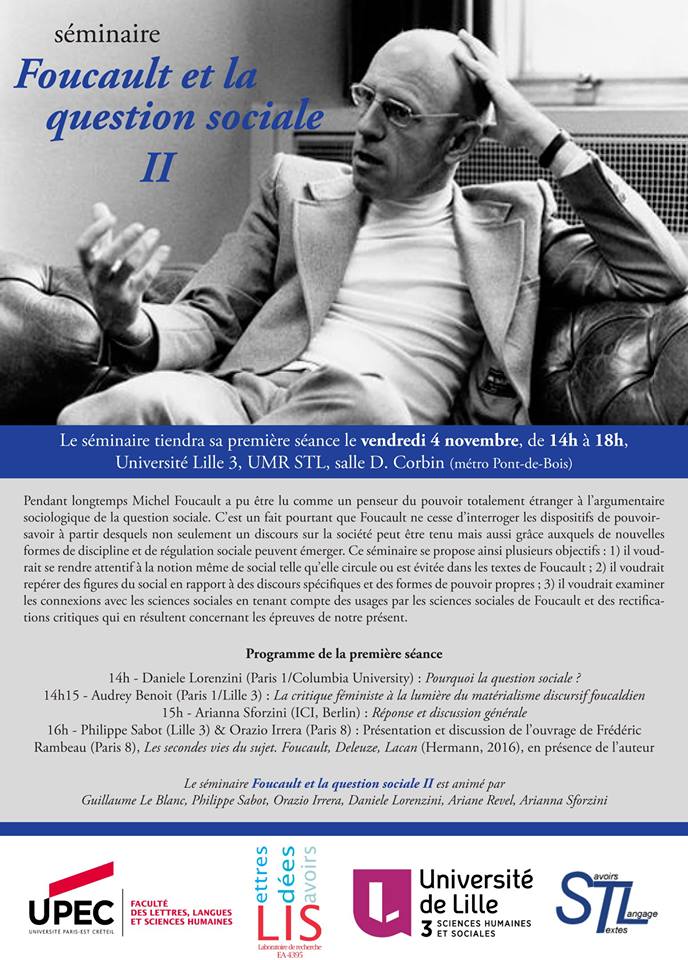
Le séminaire “Foucault et la question sociale II”
tiendra sa première séance vendredi prochain, le 4 novembre, de 14h à 18h,
à l’Université Lille 3,
UMR STL, salle D. Corbin (métro Pont-de-Bois)

Programme :

14h – Daniele Lorenzini (Paris 1/Columbia University) : Pourquoi la question sociale ?
14h15 – Audrey Benoit (Paris 1/Lille 3) : La critique féministe à la lumière du matérialisme discursif foucaldien
15h – Arianna Sforzini (ICI, Berlin) : Réponse et discussion générale
16h – Philippe Sabot (Lille 3) & Orazio Irrera (Paris 8) : Présentation et discussion de l’ouvrage de Frédéric Rambeau (Paris 8), “Les secondes vies du sujet. Foucault, Deleuze, Lacan” (Hermann, 2016), en présence de l’auteur

bartky-obit-1-blog427 Sandra Lee Bartky, at the Vanguard of Feminist Philosophy, Dies at 81
By Sam Roberts, New York Times 23 October 2016

Sandra Lee Bartky, an influential feminist philosopher who argued that women were subconsciously submitting to men by accepting an unnatural cultural standard for the ideal female body — what she called the “tyranny of slenderness” — died on Oct. 17 at her home in Saugatuck, Mich. She was 81.

[…]

Professor Bartky, who taught philosophy and gender and women’s studies at the University of Illinois at Chicago, contended that women suffered from self-loathing, shame and guilt — internalized oppression, she called it — fostered by cultural cues about their bodies that devalue them if they do not meet the prescribed standard.

Through the diminishment of dieting and by being undemonstrative, she said, women are encouraged “to take up as little space as possible.”

“The body by which a woman feels herself judged and which by rigorous discipline she must try to assume is the body of early adolescence, slight and unformed, a body lacking flesh or substance, a body in whose very contours the image of immaturity has been inscribed,” Professor Bartky wrote in an essay published in an anthology, “Feminism and Foucault: Reflections on Resistance,” in 1988.

read more

Emmanuel Delille and Marc Kirsch,
Natural or interactive kinds ? Les maladies mentales transitoires dans les cours de Ian Hacking au Collège de France (2000–2006)
(2016) Revue de Synthese, 137 (1-2), pp. 87-115.

https://doi.org/10.1007/s11873-016-0298-2

Résumé
Les concepts de Ian Hacking ont apporté une contribution importante aux débats dans le domaine de la philosophie de la psychiatrie, qui est aussi au coeur de son Cours au Collège de France (2000-2006). Titulaire de la « Chaire de philosophie et d’histoire des concepts scientifiques » après Michel Foucault, il est l’auteur d’une réflexion sur la classification des troubles mentaux à partir de la problématique des natural kinds. Pour expliquer les cas d’études développés dans son enseignement parisien, nous revenons d’abord sur une série de concepts, pour ensuite poser la question du statut des métaphores scientifiques, et enfin discuter les rapports entre les notions de « maladie mentale transitoire » et de culture-bound syndrome – cette dernière étant issue de la psychiatrie transculturelle canadienne.

Mots-clés
Ian Hacking histoire de la psychiatrie Collège de France culture-bound syndromeontologie historique

Emmanuel Delille, né en 1974, est chercheur associé au Centre Marc Bloch (Berlin) et au CAPHÉS (Paris), spécialiste d’histoire de la santé. Ses dernières publications analysent la réforme de l’enseignement médical de 1968, l’histoire de la psychiatrie culturelle et la problématique de la normativité : « La psychose débutante comme catégorie productrice de normes. Contribution à l’histoire des pratiques de santé, France-Allemagne 1945-1989 », Bulletin Canadien d’Histoire de la Médecine, 2016.

Marc Kirsch, né en 1963, est rattaché à l’équipe AIDDA (UMA 1048, SAD-APT, INRA), assistant du professeur Ian Hacking au Collège de France de 2001 à 2006 (chaire de Philosophie et histoire des concepts scientifiques). Il a publié notamment « Sur la classification et sa signification en psychiatrie », Psychiatrie française, vol. 43, 4/12, mai 2013.

Natural or interactive kinds? The transient mental disorders in Ian Hacking’s lectures at the Collège de France (2000–2006)

Abstract
The concepts developed by Ian Hacking during his lectures at the Collège de France (2000-2006) have provided an important contribution to the debates within the field of philosophy of psychiatry. Professor at the Chair of Philosophy and History of Scientific Concepts after Michel Foucault, Hacking is the author of a reflection on the classification of mental disorders, which arises from the problem of the natural kinds. In order to explain the case studies developed in Hacking’s Paris lectures, we first go back to the definition of a series of concepts, then we discuss the status of his scientific metaphors. Finally we analyze the relationship between the notions, respectively, of “transient mental illness” and “culture-bound syndrome”. We emphasize that the latter derives from the Canadian transcultural psychiatry. © 2016, Springer-Verlag France.

Author Keywords
Collège de France; culture-bound syndrome; History of Psychiatry; Ian Hacking; ontological history