Foucault News

News and resources on French thinker Michel Foucault (1926-1984)

cultural-historyRevisiting The History of Sexuality: Thinking with Foucault at Forty, Guest edited by Howard Chiang, Cultural History, Volume 5, Issue 2, October, 2016

Articles

Revisiting Foucault: Thinking with The History of Sexuality at Forty
Howard Chiang

‘The Party with God’: Michel Foucault, the Gay Left and the Work of Theory
Steven Maynard

Sex and Truth: Foucault’s History of Sexuality as History of Truth
Marek Tamm

Nous autres, victoriens: Punctuation, Power and Politics in Foucault’s History of Sexuality
Patrick Singy

The History of Sexuality and Historical Methodology
Andrew E. Clark-Huckstep

Acts or Identities? Rethinking Foucault on Homosexuality
Umberto Grassi

Reviews

Elaine Jeffreys with Haiqing Yu, Sex in China
Hongwei Bao

Joseph A. Boone, The Homoerotics of Orientalism
Eng-Beng Lim

Donna J. Drucker, The Classification of Sex: Alfred Kinsey and the Organization of Knowledge
Carrie Pitzulo

Robert Beachy, Gay Berlin: The Birthplace of a Modern Identity
Christopher Ewing
Interview with Stuart Elden by Dave O’Brien (podcast) on the New Books Network

In relation to Foucault’s Last Decade Polity Press 2016

Why did Michel Foucault radically recast the project of The History of Sexuality? How did he work collaboratively? What was the influence of Antiquity on his thought? In Foucault’s Last Decade (Polity Press, 2016) Stuart Elden, Professor of Political Theory and Geography at the University of Warwick explores these, and many more, questions about the final years in a rich intellectual life. The book combines detailed studies of Foucault’s recently collected lecture series with archival material and his publications, to give an in depth engagement with the changes and continuities in his thought during the last decade. Addressing questions associated with key terms, such as governmentality, as well as confession, the self, power, truth telling, and many other core ideas and themes, the book will be essential reading for anyone interested in this most important of Western thinkers.

Jason Read, Cutting Off Heads. A review of Foucault with Marx by Jacques Bidet (Zed Books: London, 2016)

Jacques Bidet’s Foucault with Marx represents yet another contribution to the eventual overcoming of an academic skirmish between advocates of Foucault and Marx, itself a smaller conflict in the larger battle of postmodernism versus Marxism. The perspective which saw Marx and Foucault as mutually opposed theoretical camps has begun to fade thanks to both the publication of Foucault’s courses and lectures, most importantly the short essay on “The Mesh of Power,” and the publication of several texts, such as the monumental collection Marx & Foucault: Lectures, usages, confrontations in France. However, the dissipation of Team Foucault and Team Marx is only a first step; it remains to be seen how Foucault and Marx are related and how their different examinations into history, modernity, and society can be brought together through their points of connection and differences.

read more

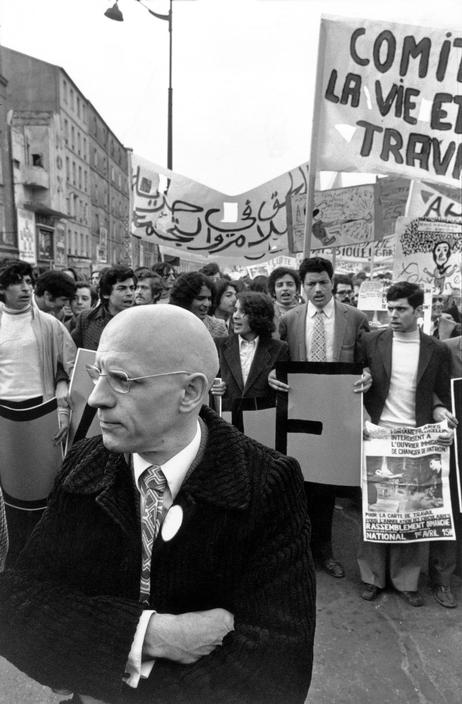
Demonstration in support of immigrant workers. Michel Foucault in the foreground. Paris, 1973. Photo: Gilles Peress.

Demonstration in support of immigrant workers. Michel Foucault in the foreground. Paris, 1973. Photo: Gilles Peress.

bidetJacques Bidet, Foucault with Marx
Translated by Steven Corcoran, Zed Books, 2016

The first synthesis of Foucauldian and Marxist theory, constituting a twenty-first century paradigm shift in political and philosophical thinking.

With this timely commitment, Jacques Bidet unites the theories of arguably the world’s two greatest emancipatory political thinkers. In this far-reaching and decisive text, Bidet examines Marxian and Foucauldian criticisms of capitalist modernity.

For Marx, the intersection between capital and the market is crucial, while for Foucault, the organizational aspects of capital are what really matter. According to Marx, the ruling class is identified with property; with Foucault, it is the managers who hold power and knowledge that rule. Bidet identifies these two sides of capitalist modernity as ‘market’ and ‘organization’, showing that each leads to specific forms of social conflict; against exploitation and austerity, over wages and pensions on the one hand, and against forms of ‘medical’ and work-based discipline, control of bodies and prisons on the other.

Bidet’s impetus and clarity however serve a greater purpose: uniting two souls of critical social theory, in order to overcome what has become an age-long separation between the ‘old left’ and the ‘new social movements’.

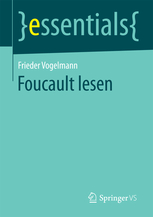
vogelmannFrieder Vogelmann, Foucault lesen, Springer, 2017

Dieses Springer essential stellt einen systematischen und philosophischen Lektürevorschlag zur Diskussion: Systematisch werden Foucaults Schriften von seiner methodologischen Perspektive her als nihilistische, nominalistische und historizistische Analyse von Praktiken und den in ihnen produzierten Wirklichkeiten entlang der drei Achsen des Wissens, der Macht und der Selbstverhältnisse gedeutet. Die Konsequenzen dieser Interpretation werden anhand der Positionen umrissen, die sich in Bezug auf Foucaults Kritikbegriff, seine Attacke auf die Human- und, als Teil davon, die Sozialwissenschaften und sein Verhältnis zum Neoliberalismus ergeben. Philosophisch ist dieser Lektürevorschlag, weil er die Historisierung von Wahrheit als Kern von Foucaults philosophischem Verfahren behauptet.

Affiche SemFouc 16-17

PDF

Université Paris 1 Panthéon-Sorbonne
Institut des sciences juridique et philosophique de la Sorbonne (UMR8103)
Centre de philosophie contemporaine de la Sorbonne (PhiCo)

Séminaire Foucault 2016-2017

AUTOUR DE L’ARCHÉOLOGIE DU SAVOIR

Animé par Jean-François Braunstein et Daniele Lorenzini

Les séances ont lieu de 10h30 à 12h30 à l’Université Paris 1, UFR de Philosophie, 17 rue de la Sorbonne, Paris 5e, escalier C, 1er étage, salle Lalande

15 octobre 2016
David SIMONETTA (Collège de France)
« Histoire des idées et histoire des sciences dans L’archéologie du savoir et les épreuves inédites »

19 novembre 2016
Martin RUEFF (Université de Genève)
Titre à préciser

17 décembre 2016
Philippe SABOT (Université Lille 3)
« Le statut de l’événement dans L’archéologie du savoir »

21 janvier 2017
Judith REVEL (Université Paris Ouest Nanterre)
« Le visible et le caché. Quelques remarques sur la place des problèmes historiographiques dans L’archéologie du savoir »

18 mars 2017
Matteo VAGELLI (Université Paris 1 Panthéon-Sorbonne)
« L’archéologie aux États-Unis. Remarques pour une relecture du “Foucault américain” »

20 mai 2017
Jocelyn BENOIST (Université Paris 1 Panthéon-Sorbonne)
« L’histoire en extériorité »

Pour pouvoir assister au séminaire, l’inscription est obligatoire. Veuillez envoyer un mail, d’ici le vendredi 14 octobre, à l’adresse suivante : seminairefoucault@gmail.com. Une pièce d’identité vous sera demandée à l’entrée du bâtiment de la Sorbonne.
___

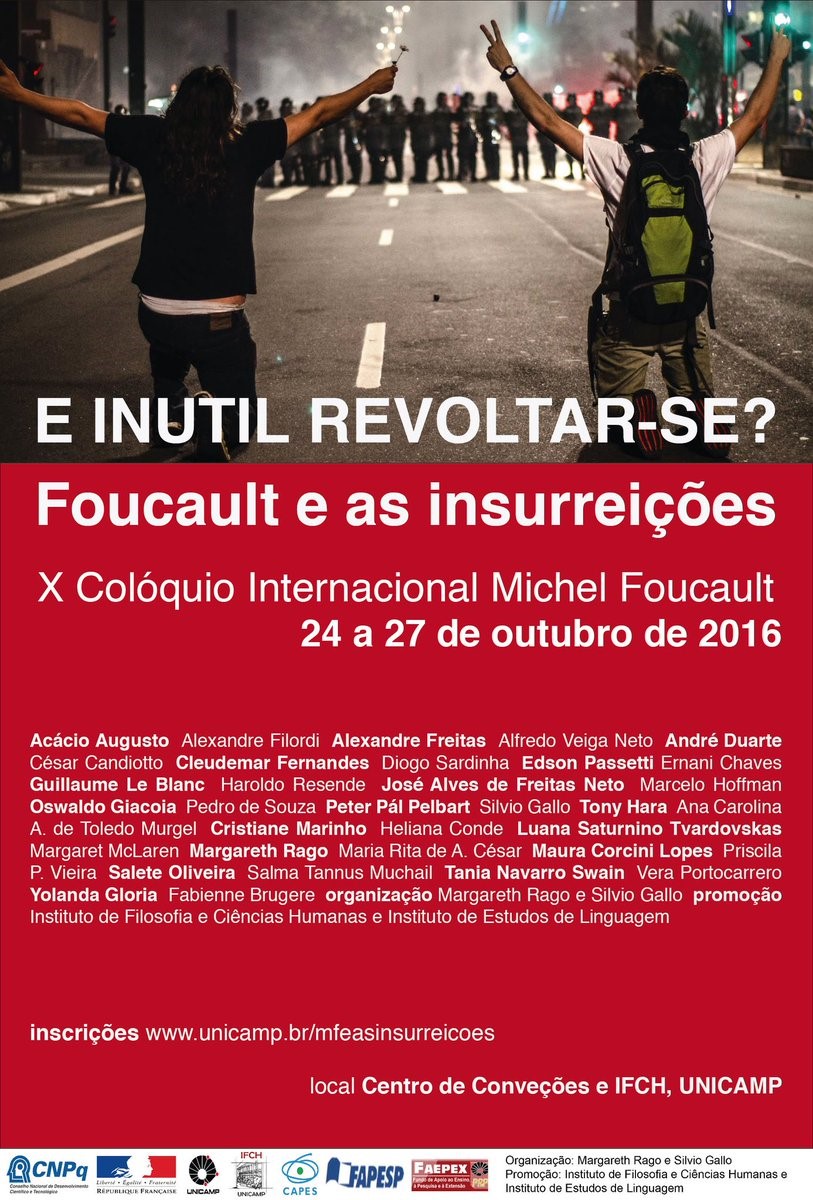
Foucault e as insurreições

revoltar

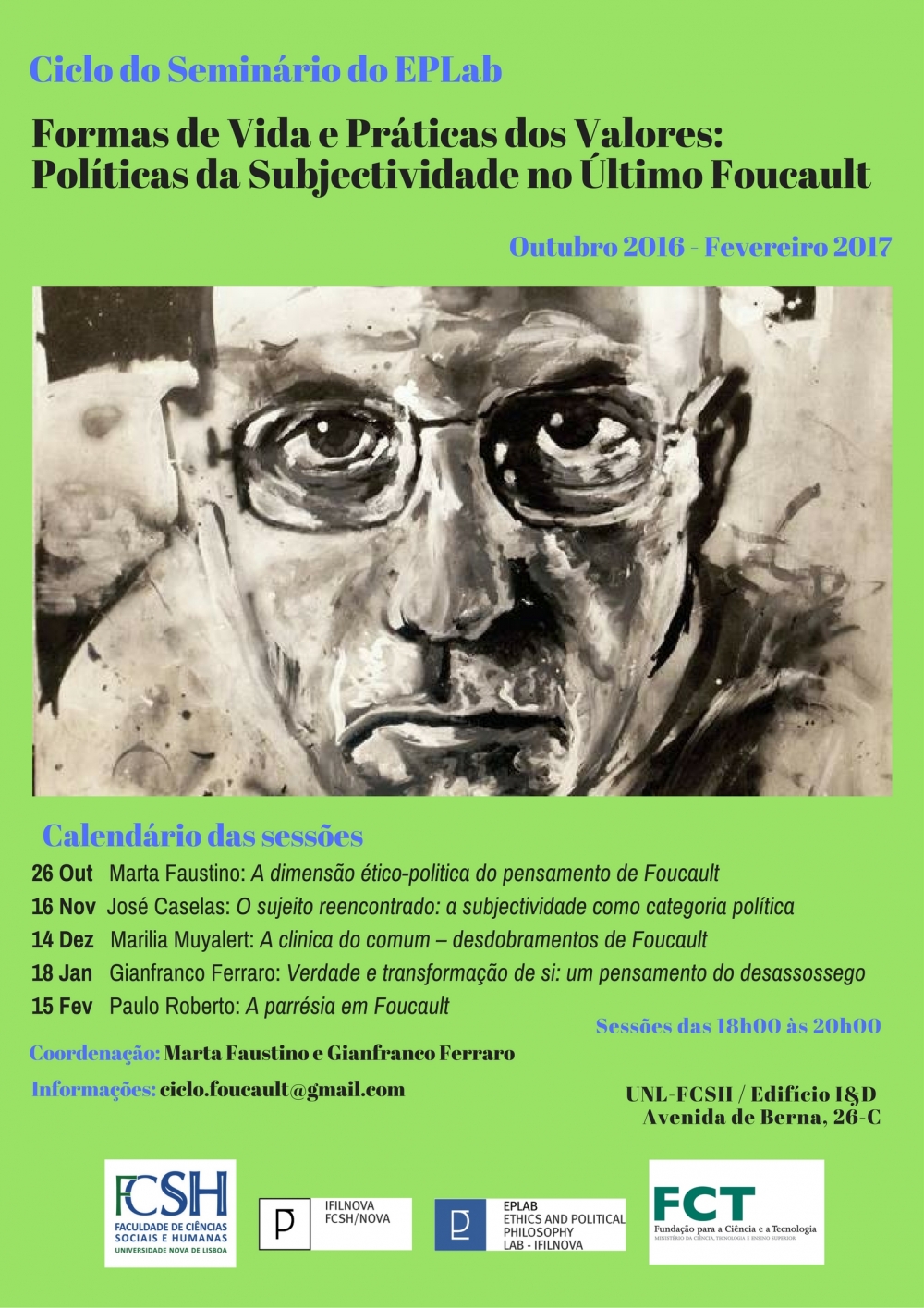
Formas de vida e práticas dos valores: políticas da subjectividade no último Foucault
October 26, 2016 – February 15, 2017
Ciclo de seminários do EPLab

Todas as sessões se realizarão das 18h00 às 20h00, em sala a anunciar.

IFILNOVA – Instituto de Filosofia da Nova
Faculdade de Ciências Sociais e Humanas – Universidade Nova de Lisboa
Av. Berna 26, Lisboa

lisboa

Coordenação: Marta Faustino e Gianfranco Ferraro

26 Out – Marta Faustino: “A dimensão ético-politica do pensamento de Foucault”
16 Nov – José Caselas: “O sujeito reencontrado: a subjectividade como categoria política”
14 Dez – Marilia Muyalert: “A clinica do comum – desdobramentos de Foucault”
18 Jan – Gianfranco Ferraro: “Verdade e transformação de si: um pensamento do desassossego”
15 Fev – Paulo Roberto: “A parrésia em Foucault”

CALL FOR PAPERS

The seventeenth annual meeting of the Foucault Circle

Los Angeles, California
March 23-25, 2017
(hosted by Loyola Marymount University)

We invite individual papers on any aspect of Foucault’s work. Studies, critiques, and applications of Foucauldian thinking are all welcome. We will aim for a diversity of topics and perspectives.

Abstracts should be prepared for anonymous review, and are to be submitted to the program committee chair, Nicole Ridgway, by email (ridgwayn@uwm.edu) on/before Friday, Nov. 18, 2016. Please indicate “Foucault Circle submission” in the subject heading, and include the abstract as a “.docx” attachment.
Individual paper submissions require an abstract of no more than 750 words.
Program decisions will be announced in December.

Each speaker will have approximately 35 minutes for paper presentation and discussion combined—papers should be a maximum of 3000 words (15-20 minutes reading time). In addition to paper sessions, the conference will also feature a screening and discussion of Sur les toits, a documentary film on the 1970s prison revolts in France. This session will be open to all participants.

Logistical information about lodging, transportation, and other arrangements will be available after the program has been announced.

For more information about the Foucault Circle, please see our website: