Foucault News

News and resources on French thinker Michel Foucault (1926-1984)

Guy Roberts-Holmes, Alice Bradbury,
Governance, accountability and the datafication of early years education in England
(2016) British Educational Research Journal, 42 (4), pp. 600-613.

https://doi.org/10.1002/berj.3221

Abstract
In this paper we attempt to critically ‘make visible the flow and circulation of data’ through analysing the datafication of the early years education sector in England (children aged 2–5). The concept of datafication is used to understand the processes and impacts of burgeoning data-based governance and accountability regimes. This analysis builds upon early childhood researchers who were influenced by Foucault and others, who have noted the ways in which the surveillance and performative culture of accountability both affirms, legitimates and seduces through discourses of quality while increasingly regulating and governing the early years. Using data from three research sites (a children’s centre, a primary school and a combined nursery school and children’s centre) as well as an interview with a local authority early years advisor, we examine how comparative data-based accountability increasingly governed early years teachers’ professionalism and pedagogies. We argue that the planned tracking of children’s performance from baseline assessment at four years old to eleven years old may further govern and constrain early years professionalism as young children are reconfigured as ‘miniature centres of calculation’. © 2016 British Educational Research Association

Author Keywords
accountability; data; early years; governance
Michel Foucault: Die Spur der Macht in uns allen
Von Christoph David Piorkowski, LANGE NACHT | Beitrag vom 08.10.2016, DEUTSCHLANDRADIO KULTUR

[Editor: With thanks to Stefanie Petschick for this news. Unfortunately I can’t see a podcast link to this 3 hour broadcast.]

Als Michel Foucault 1984 im Alter von 57 Jahren stirbt, ist er längst zum internationalen Pop-Star der Wissenschaften vom Menschen geworden. Er zeigte, wie eng Macht mit Wissen und körperlich wirksamen Disziplinen verbunden ist.

Viele seiner Gedanken, Begriffe und Methoden sind in jene Gebiete der Kultur aufgenommen werden, die er zuvor kritisiert hatte. Foucaults Diskursanalyse, mit der er jene Strukturen herausarbeitete, die dem Denken und Handeln der Menschen in einer bestimmten Zeit ihr Gepräge geben, ist eine anerkannte Methode in etlichen wissenschaftlichen Disziplinen geworden: in der Soziologie, Ethnologie, Literatur- und Geschichtswissenschaft und in der Philosophie.

Suche nach Formen der Selbstgestaltung
Seine Schriften zu modernen Machttechniken zeigen, wie eng Macht mit Wissen und körperlich wirksamen Disziplinen verbunden ist. Sie haben einen neuen Typus wissenschaftlichen Denkens geprägt. Die intellektuelle und biografische Unrast des Michel Foucault machte es schon zu seinen Lebzeiten schwer, ihm einen Stempel zu verpassen. Wahlweise als Kommunist, Dandy, Reaktionär, Antihumanist oder Anarchist bezeichnet, wurde ihm keine dieser Zuschreibungen gerecht. Vor allem in seiner letzten Schaffensphase bestand er auf der Möglichkeit zur Wandlung der eigenen Gestalt und suchte jenseits des Zugriffs moderner Macht nach Formen der Selbstgestaltung.

Bis zuletzt hat sich Foucault philosophisch wie politisch, im Hörsaal und auf der Straße bemüht, für jene zu sprechen, die in der herrschenden Ordnung keine Stimme haben – die Wahnsinnigen, die Inhaftierten, diejenigen, deren Begehren die Gesellschaft als pervers bezeichnet.

MEHR ZUM THEMA

“Die Strafgesellschaft” von Michel Foucault – Warum wir Menschen einsperren
(Deutschlandradio Kultur, Lesart, 09.07.2015)

Michel Foucault – Ein radikaler Denker
(Deutschlandradio Kultur, Sein und Streit, 22.06.2014)

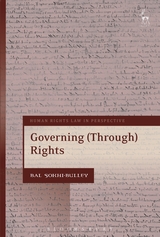
sokhi-bulleyBal Sokhi-Bulley, Governing (Through) Rights, Hart Publishing, 2016

About Governing (Through) Rights
Taking a critical attitude of dissatisfaction towards rights, the central premise of this book is that rights are technologies of governmentality. They are a regulating discourse that is itself managed through governing tactics and techniques – hence governing (through) rights. Part I examines the ‘problem of government’ (through) rights. The opening chapter describes governmentality as a methodology that is then used to interrogate the relationship between rights and governance in three contexts: the international, regional and local. How rights regulate certain identities and conceptions of what is good governance is examined through the case study of non-state actors, specifically the NGO, in the international setting; through a case study of rights agencies, and the role of experts, indicators and the rights-based approach in the European Union or regional setting; and, in terms of the local, the challenge that the blossoming language of responsibility and community poses to rights in the name of less government (Big Society) is problematised. In Part II, on resisting government (through) rights, the book also asks what counter-conducts are possible using rights language (questioning rioting as resistance), and whether counter-conduct can be read as an ethos of the political, rights-bearing subject and as a new ethical right. Thus, the book bridges a divide between critical theory (ie Foucauldian understandings of power as governmentality) and human rights law.

Table of contents
Part I: Government (Through) Rights
1. Introduction
2. Governing (Through) Agencies: The EU and Rights in EUrope
3. Governing (Through) Non-Governmental Actors: The Global Human Rights Architecture and the International NGO
Part II: Resisting Government (Through) Rights
4. Resisting Rights with Responsibility
5. Counter-Conduct as Right and as Ethics
6. Conclusion: A Permanent State of Dissatisfaction

Murphy, Brendon (2015), Zone of Impeachment: A Post-Foucauldian Analysis of Controlled Operations Law and Policy, PhD
University of Newcastle. Faculty of Business & Law, Newcastle Law School

Full PDF

Description
This thesis presents a Post-Foucauldian analysis of Australian controlled operations law. The purpose was to extend current doctrinal scholarship by exploring the discursive forces that shape this highly invasive and controversial investigative power. This thesis contends that the present doctrinal understanding is incomplete, and largely unaware of the epistemological forces operating within law and policy. By deploying a Post-Foucauldian analytic we can extend our understanding of the complex relationship between knowledge systems, discourse, power and law. Through the deployment of a nomadic, grounded genealogy in the analysis of controlled operations Second Reading Speeches, this research found that the governing rationalities of controlled operations law and policy is linked to an imperative logic dominated by discourses of risk, audit and exceptions. This dynamic explains why controlled operations legal architecture and policy is in its current form. Far from being a reaction to the decision in Ridgeway, controlled operations law is part of a legal and cultural shift in law enforcement, characterised by complex relationships between risk, rights, law and citizenship. The controlled operation is revealed as a form of apparatus: a technology of truth and power, facilitated by law. This insight allows us to reimagine the relationship between law, rights, citizenship and sovereignty in late modernity. In this environment the investigative apparatus of the controlled operation creates a field of governance within the private space of liberal citizenship, revealing the true character of citizenship in late modernity as a zone of impeachment – a location in which rights are fragile and open to perpetual potential derogation and modification. In this zone the rights attached to liberal conceptions of citizenship are increasingly the subject of subordination to a risk imperative and a logic of exception.

Feely, M.
Sexual surveillance and control in a community-based intellectual disability service
(2016) Sexualities, 19 (5-6), pp. 725-750.

DOI: 10.1177/1363460715620575

Abstract
Within contemporary policy documents regarding intellectual disability and sexuality we often find a progress narrative that contrasts a dark past, when the sexuality of disabled people was suppressed, with an enlightened present, when we recognize the sexual rights of all human beings. In this paper – which pertains to the Republic of Ireland – I take up the Foucauldian and Deleuzian position of treating such progress narratives with suspicion. From this perspective, I offer an alternative reading of the treatment of intellectual disability and sexuality in the present, and I seek to map just some of the subtle but effective ways this population’s sexuality continues to be controlled today. © 2016, © The Author(s) 2016.

Author Keywords
Assemblage; Deleuze; Foucault; intellectual disability; sexuality; surveillance

Noguera-Ramírez, C.E.
The pedagogical effect: On Foucault and Sloterdijk
(2016) Educational Philosophy and Theory, pp. 1-14. Article in Press.

DOI: 10.1080/00131857.2016.1204738

Abstract
Although Foucault did not produce any particular work devoted to teaching or education, following authors like Hoskin this text aims to show the importance that teaching practices and discourses have in Foucault’s analysis, particularly in the analysis of what he called governmentality . If we associate these analyses with the concept of ‘ Antropotécnicas ‘ developed by the German philosopher Peter Sloterdijk, then we have a transparent toolbox for analyzing learning, recognizing that contemporary society is an educating society. © 2016 Philosophy of Education Society of Australasia

Author Keywords
anthropotechniques; educating society; Government; pedagogical practices; practices of the self

Dolly Jørgensen,
Rethinking rewilding
(2015) Geoforum, 65, pp. 482-488.

https://doi.org/10.1016/j.geoforum.2014.11.016

Abstract
The term ‘rewilding’ sounds as if it should have a straightforward meaning ‘to make wild again’. But in truth the term has a complex history and a host of meanings have been ascribed to it. Rewilding as a specific scientific term has its beginnings as a reference to the Wildlands Project, which was founded in 1991 and aimed to create North American core wilderness areas without human activity that would be connected by corridors. Words, however, do not stand still-they change over time and take on new meanings, while sometimes simultaneously retaining the older sense. Employing Foucault’s idea of historical genealogy, this article examines how the term rewilding was historically adopted and modified in ecological scientific discourse over the last two decades. This investigation probes what and, by extension, when and where, rewilding refers to as it has moved into various geographies across the globe. It then examines how the term has moved outside of science and been adopted by environmental activists as a plastic word. Taken as a whole, rewilding discourse seeks to erase human history and involvement with the land and flora and fauna. Such an attempted split between nature and culture may prove unproductive and even harmful. A more inclusive rewilding is a preferable strategy. © 2014 Elsevier Ltd.

Author Keywords
Ecological restoration; Environmental discourse; Historical genealogy; Plastic words; Science communication; Wilderness

Index Keywords
adaptive management, environmental planning, fauna, flora, restoration ecology, strategic approach, wildlife management; North America

Beer, D.
The social power of algorithms
(2016) Information Communication and Society, pp. 1-13. Article in Press.

DOI: 10.1080/1369118X.2016.1216147

Abstract
This article explores the questions associated with what might be thought of as the social power of algorithms. The article, which introduces a special issue on the same topic, begins by reflecting on how we might approach algorithms from a social scientific perspective. The article is then split into two sections. The first deals with the issues that might be associated with an analysis of the power of the algorithms themselves. This section outlines a series of issues associated with the functionality of the algorithms and how these functions are powerfully deployed within social world. The second section then focuses upon the notion of the algorithm. In this section, the article argues that we need to look beyond the algorithms themselves, as a technical and material presence, to explore how the notion or concept of the algorithm is also an important feature of their potential power. In this section, it is suggested that we look at the way that notions of the algorithm are evoked as a part of broader rationalities and ways of seeing the world. Exploring the notion of the algorithm may enable us to see how algorithms also play a part in social ordering processes, both in terms of how the algorithm is used to promote certain visions of calculative objectivity and also in relation to the wider governmentalities that this concept might be used to open up. © 2016 Informa UK Limited, trading as Taylor & Francis Group

Author Keywords
Algorithm; big data; code; Foucault; power; software

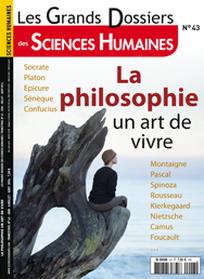
gdsh_043_l204Daniele Lorenzini, Pierre Hadot (1922/2010) et Michel Foucault (1926/1984) – La culture de soiLa philosophie, un art de vivre, Les Grands Dossiers des Sciences Humaines, 2016/6 (N° 43)

Premières lignes
Qu’est-ce que la philosophie ? En posant cette question, dans un article intitulé « La philosophie est-elle un luxe ? », Pierre Hadot remarque que le plus souvent les non-philosophes considèrent la philosophie comme un discours abstrus et abstrait, développé par quelques privilégiés pour répondre à des questions incompréhensibles et sans intérêt. La philosophie serait donc un vain bavardage, infiniment…

Mots-clés
Antiquité Foucault philosophie Hadot histoire de la philosophie Lorenzini

Plan de l’article
La philosophie : discours ou mode de vie ?
Pierre Hadot et les exercices spirituels
Michel Foucault : techniques de soi et esthétique de l’existence
Actualité de la philosophie antique ?

Jiménez, M.A., Valle, A.M.
Pedagogy and the care of the self: A reading from Foucault
(2016) Educational Philosophy and Theory, pp. 1-8. Article in Press.

DOI: 10.1080/00131857.2016.1204736

Abstract
This text reflects about the need to consider an additional institutional alternative that matters, not only to the ones that advocate for pedagogy, but also to all of those involved in different educational processes. It is, so to speak, a Paideia that privileges the care of the self as a substantial value, and, as such, it is not dedicated to a unique moment on people’s lives and it does not correspond to a specific institution, but to the universal and singular spirit of the human affairs. © 2016 Philosophy of Education Society of Australasia

Author Keywords
Care of the self; pedagogy; subject-truth