Foucault News

News and resources on French thinker Michel Foucault (1926-1984)

Philippe Raynaud, Michel Foucault, Commentaire 2016/1 (Numéro 153)

Premières lignes
Dirigée par Frédéric Gros avec le concours de quelques bons spécialistes, l’édition de la Pléiade présente la plupart des livres publiés du vivant de Foucault ou revus par lui avant sa mort (à l’exception regrettable de ses premiers travaux sur la « maladie mentale »), ainsi qu’un choix judicieux d’articles, de conférences et d’interviews qui permettent de mieux comprendre les sources philosophiques…

Plan de l’article
Nietzsche et Heidegger
Histoire de la folie
Naissance de la clinique
Les Mots et les Choses
Mai 1968
Philosophe et historien

The Deflationary Mind
Mark Lilla’s prosecution of radical thinkers in the name of intellectual seriousness can only lead to a flat and lifeless politics.
by David Sessions, Jacobin, 27 October 2016

During the 1990s, some of the most prominent Anglo-American interpreters of European intellectual history decided it was time to settle accounts. They brought important thinkers of the past two centuries — Friedrich Nietzsche, Martin Heidegger, Georges Bataille, Jean-Paul Sartre, Louis Althusser, Michel Foucault, Jacques Derrida, just to name a few — before end-of-history tribunals, and, more often than not, declared them guilty of intellectual irresponsibility, a weakness for tyranny or mythology (or both), and crazed utopianism.

The liberal reading public was delighted to read these verdicts, which convicted twentieth-century European philosophy of failing to submit to the global triumph of English-speaking liberal capitalism. The idea of “intellectual responsibility” guided both the late British historian Tony Judt’s excoriation of French intellectuals’ postwar communism, and Mark Lilla’s portrait-essays of European theorists who looked beyond the pragmatic, deflated liberal politics he presented as the exclusive terrain of legitimate intellectual engagement.

Things look different now. The limits of American power, as well as the strength of recent resistance to the global neoliberal order, have come into clearer view, making the questions Europeans faced in the first half of the twentieth century — and some of the answers they proposed — seem more current. Less prosecutorial scholars have approached the difficult ideas of European thinkers with greater theoretical subtlety, intellectual empathy, and political open-mindedness, grounding their work in its historical context.

From this vantage point, the “realism” of the fin-de-siècle American elite looks more like myopic hubris than sober responsibility. Its assessment of twentieth-century theory looks less like a reckoning with the past and more like the euphoric sanctification of what they allowed themselves to believe was the permanent overcoming of history.

read more

sociale-ii

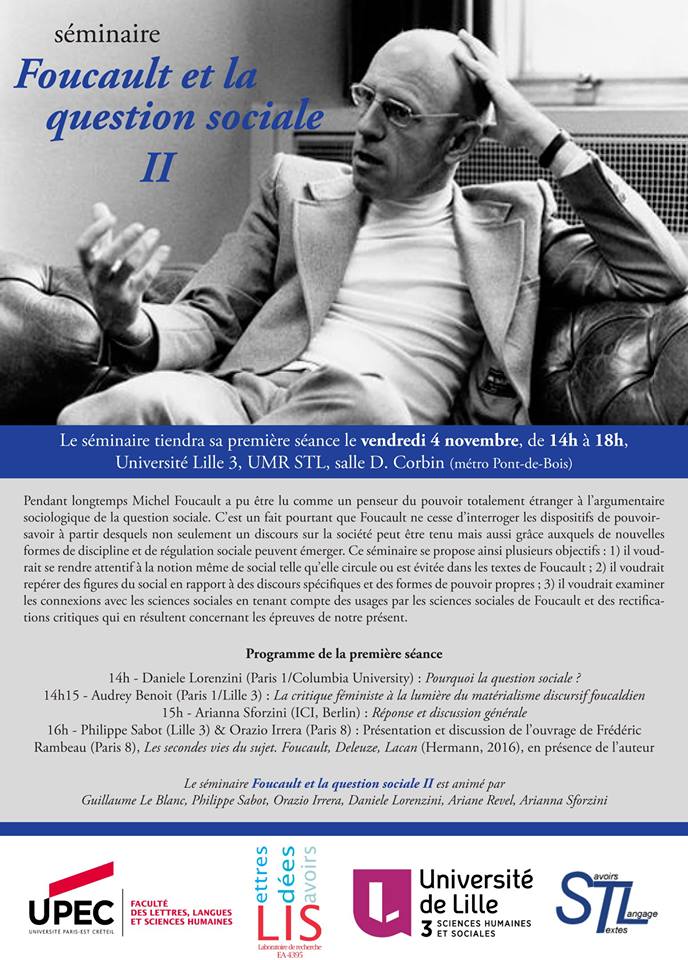
Le séminaire “Foucault et la question sociale II”
tiendra sa première séance vendredi prochain, le 4 novembre, de 14h à 18h,
à l’Université Lille 3,
UMR STL, salle D. Corbin (métro Pont-de-Bois)

Programme :

14h – Daniele Lorenzini (Paris 1/Columbia University) : Pourquoi la question sociale ?
14h15 – Audrey Benoit (Paris 1/Lille 3) : La critique féministe à la lumière du matérialisme discursif foucaldien
15h – Arianna Sforzini (ICI, Berlin) : Réponse et discussion générale
16h – Philippe Sabot (Lille 3) & Orazio Irrera (Paris 8) : Présentation et discussion de l’ouvrage de Frédéric Rambeau (Paris 8), “Les secondes vies du sujet. Foucault, Deleuze, Lacan” (Hermann, 2016), en présence de l’auteur

bartky-obit-1-blog427 Sandra Lee Bartky, at the Vanguard of Feminist Philosophy, Dies at 81
By Sam Roberts, New York Times 23 October 2016

Sandra Lee Bartky, an influential feminist philosopher who argued that women were subconsciously submitting to men by accepting an unnatural cultural standard for the ideal female body — what she called the “tyranny of slenderness” — died on Oct. 17 at her home in Saugatuck, Mich. She was 81.

[…]

Professor Bartky, who taught philosophy and gender and women’s studies at the University of Illinois at Chicago, contended that women suffered from self-loathing, shame and guilt — internalized oppression, she called it — fostered by cultural cues about their bodies that devalue them if they do not meet the prescribed standard.

Through the diminishment of dieting and by being undemonstrative, she said, women are encouraged “to take up as little space as possible.”

“The body by which a woman feels herself judged and which by rigorous discipline she must try to assume is the body of early adolescence, slight and unformed, a body lacking flesh or substance, a body in whose very contours the image of immaturity has been inscribed,” Professor Bartky wrote in an essay published in an anthology, “Feminism and Foucault: Reflections on Resistance,” in 1988.

read more

Emmanuel Delille and Marc Kirsch,
Natural or interactive kinds ? Les maladies mentales transitoires dans les cours de Ian Hacking au Collège de France (2000–2006)
(2016) Revue de Synthese, 137 (1-2), pp. 87-115.

https://doi.org/10.1007/s11873-016-0298-2

Résumé
Les concepts de Ian Hacking ont apporté une contribution importante aux débats dans le domaine de la philosophie de la psychiatrie, qui est aussi au coeur de son Cours au Collège de France (2000-2006). Titulaire de la « Chaire de philosophie et d’histoire des concepts scientifiques » après Michel Foucault, il est l’auteur d’une réflexion sur la classification des troubles mentaux à partir de la problématique des natural kinds. Pour expliquer les cas d’études développés dans son enseignement parisien, nous revenons d’abord sur une série de concepts, pour ensuite poser la question du statut des métaphores scientifiques, et enfin discuter les rapports entre les notions de « maladie mentale transitoire » et de culture-bound syndrome – cette dernière étant issue de la psychiatrie transculturelle canadienne.

Mots-clés
Ian Hacking histoire de la psychiatrie Collège de France culture-bound syndromeontologie historique

Emmanuel Delille, né en 1974, est chercheur associé au Centre Marc Bloch (Berlin) et au CAPHÉS (Paris), spécialiste d’histoire de la santé. Ses dernières publications analysent la réforme de l’enseignement médical de 1968, l’histoire de la psychiatrie culturelle et la problématique de la normativité : « La psychose débutante comme catégorie productrice de normes. Contribution à l’histoire des pratiques de santé, France-Allemagne 1945-1989 », Bulletin Canadien d’Histoire de la Médecine, 2016.

Marc Kirsch, né en 1963, est rattaché à l’équipe AIDDA (UMA 1048, SAD-APT, INRA), assistant du professeur Ian Hacking au Collège de France de 2001 à 2006 (chaire de Philosophie et histoire des concepts scientifiques). Il a publié notamment « Sur la classification et sa signification en psychiatrie », Psychiatrie française, vol. 43, 4/12, mai 2013.

Natural or interactive kinds? The transient mental disorders in Ian Hacking’s lectures at the Collège de France (2000–2006)

Abstract
The concepts developed by Ian Hacking during his lectures at the Collège de France (2000-2006) have provided an important contribution to the debates within the field of philosophy of psychiatry. Professor at the Chair of Philosophy and History of Scientific Concepts after Michel Foucault, Hacking is the author of a reflection on the classification of mental disorders, which arises from the problem of the natural kinds. In order to explain the case studies developed in Hacking’s Paris lectures, we first go back to the definition of a series of concepts, then we discuss the status of his scientific metaphors. Finally we analyze the relationship between the notions, respectively, of “transient mental illness” and “culture-bound syndrome”. We emphasize that the latter derives from the Canadian transcultural psychiatry. © 2016, Springer-Verlag France.

Author Keywords
Collège de France; culture-bound syndrome; History of Psychiatry; Ian Hacking; ontological history

Jocelyn Benoist, Des actes de langage à l’inventaire des énoncés, Archives de Philosophie 2016/1 (Tome 79)

Résumé

Français
L’article essaie de comprendre la notion d’« énoncé » telle que Foucault l’emploie dans L’Archéologie du Savoir. Il situe la perspective de Foucault dans le contexte du débat philosophique et linguistique sur le langage après la seconde guerre mondiale. Il la compare avec la philosophie du langage ordinaire, en se concentrant sur la notion d’acte de langage. Dans les deux genres d’analyse on trouve un intérêt similaire pour les performances linguistiques effectives. Cependant, la notion d’acte de langage, en elle-même, demeure trop abstraite à l’aune de l’analyse foucaldienne, et le philosophe français s’ntéresse plus à ce qu’on pourrait appeler les matériaux disponibles pour la performance en un temps donné qu’à la performance prise isolément. L’article essaie de mieux comprendre les ressorts de la ré-historicisation du langage à l’œuvre dans l’analyse de Foucault.

Mots clés
Foucault Austin Langage Acte de langage Énoncé Discours

English
The paper tries to make sense of the notion of a ‘statement’ such as Foucault uses it in his Archeology of Knowledge. It situates Foucault’s perspective within the context of the philosophical and linguistic debate on language after the Second World War. It draws a comparison with ordinary language philosophy, by focusing on the notion of speech act. In both kinds of analysis one finds a similar interest in the actual linguistic performances. However, the notion of a speech act remains as such too abstract by the standard of Foucault’s analysis and, on the other hand, the French philosopher is more interested in what could be called the materials available for a performance at a given time than in the performance taken in isolation. The paper tries to better understand the principles of the re-historicization of language in Foucault’s analysis.

Mots-clés (en)
Foucault Austin Language Speech Act Statement Discourse

Lewis, K.
Social justice leadership and inclusion: a genealogy
(2016) Journal of Educational Administration and History, 48 (4), pp. 324-341.

DOI: 10.1080/00220620.2016.1210589

Abstract
The purpose of this article is to engage in an historical analysis of research about two concepts: social justice leadership and leadership for inclusion. Recent experiences have caused me to wonder about our interpretations of justice, equity, and inclusion. Analysis of the relevant literature revealed a lack of consensus among scholars as to a clear, operational definition of both social justice leadership and inclusion. I use a Foucauldian genealogical method to examine texts and uncover the historical development of social justice leadership and leadership for inclusion in the United States. Uncovering past meanings and contexts should help illuminate current meanings and uses of these concepts. It is recommended that leaders engage in critical reflection to uncover the common sense language of equity-oriented leadership practices and that researchers take a more critical, historical, open stance of social justice leadership, and inclusion. © 2016 Informa UK Limited, trading as Taylor & Francis Group.

Author Keywords

Educational leadership; Foucault; genealogy; inclusion; inclusive leadership; social justice

Nicolas Vallois, « Michel Foucault and the history of economic thought », Œconomia, 5-4 | 2015, 461-490.
https://doi.org/10.4000/oeconomia.2181

Open access

Michel Foucault dedicated a significant part of his works to the study of political economy. In the late 1980s, these analyses attracted the interest of historians of economic thought (Amariglio, 1988, 1900; Birken, 1990). The primary purpose of this article is to provide a review survey of Foucault’s reception among historians of economic thought. Reading and interpreting Foucault is not straightforward. In reflecting on his work, Foucault refused to consider himself an “author” who could be characterized by a single, consistent framework. However, he elaborated a coherent historiographical method which we characterize as politically engaged journalism. The principles of that method allow us to identify two common confusions in interpretations of Foucault’s work. First, advocates of Foucault in the history of economic thought literature consider him a “heterodox economist” who would be opposed to “mainstream economics”. However, Foucault did not intend to criticize economic theories in this particular sense. The second source of confusion involves interpreting Foucault as a sociologist interested in the analysis of power, or a social historian, although he rejected context-based historiographical approaches. We would suggest that Foucault she be considered more a “postmodernist philosopher” than a historian of economic thought per se. In this respect, the association of “Foucauldian theory” with postmodernism is a major distortion in his reception by historians of economic thought.

Ferreira, V.S.
Aesthetics of Youth Scenes: From Arts of Resistance to Arts of Existence
(2016) Young: Nordic Journal of Youth Research, 24 (1), pp. 66-81.

DOI: 10.1177/1103308815595520

Abstract
The aesthetic expressions produced and reproduced within post-war spectacular youth (sub)cultures used to be seen as a display of resistance to and subversion of ‘social order’, perceived as opressive of youth life experiences and chances. Under the traditional subculturalist paradigm, both artefacts or performances were subsumed to the class status of their young practicioners and seen as ideological expression of their dominated and disadvantadged social position. Nowadays, however, the stylistic resources used in youth scenes has taken on new meanings for which the concept of resistance is not enough and/or adequate to explain. Therefore, departing from a post-subcultural approach, this essay intends to highlight the social changes recently occurred in the political culture of spectacular youth scenes and, consequently, to contribute to overcome resistance as nuclear concept on the debate, relocating it towards the concept of existence. Following this idea, and to close this essay, I suggest the concept of arts of existence as analytical point of view on the new expressiveness of the aesthetics of contemporary youth scenes. Inspired in Foucault, that concept allows to go further in the understanding of youth scenes aesthetics as arts of a good living (in the consumption sphere), and arts of making a living (in the production sphere). © 2016, © 2016 SAGE Publications and Young Editorial Group.

Author Keywords
aesthetics; arts of existence; arts of resistance; Subcultures; youth scenes

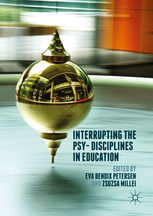
petersenBendix Petersen, Eva, Millei, Zsuzsa (Eds.), Interrupting the Psy-Disciplines in Education, Palgrave Macmillan, 2016

This book offers critical explorations of how the psy-disciplines, Michel Foucault’s collective term for psychiatry, psychology and psycho-analysis, play out in contemporary educational spaces. With a strong focus on Foucault’s theories, it critically investigates how the psy-disciplines continue to influence education, both regulating and shaping behaviour and morality. The book provides insight into different educational contexts and concerns across a child’s educational lifespan; early childhood education, inclusive education, special education, educational leadership, social media, university, and beyond to enable reflection and critique of the implications of psy-based knowledge and practice.

With chapters by a mixture of established and emerging international scholars in the field this is an interdisciplinary and authoritative study into the role of the psy-disciplines in the education system. Providing vivid illustrations from throughout the educational lifespan the book serves as an invaluable tool for reflection and critique of the implications of psy-based practice, and will be of particular interest to academics and scholars in the field of education policy and psychology.

Contents

‘Silences’ in the ‘Inclusive’ Early Childhood Classroom: Sustaining a ‘Taboo’
Watson, Karen
Pages 13-31

Binds of Professionalism: Attachment in Australian and Finnish Early Years Policy
Millei, Zsuzsa (et al.)
Pages 33-57

Becoming a ‘Learner’ in the Australian Primary School: An (Auto)ethnographic Exploration
Petersen, Eva Bendix
Pages 59-74

The Principal Is Present: Producing Psy-ontologies Through Post/Psychology-Informed Leadership Practices II
Staunæs, Dorthe (et al.)
Pages 75-92

Positive Education as Translation and Conquest of Schooling
Saari, Antti (et al.)
Pages 93-110

Labouring Over the Truth: Learning to Be/Come Queer
Bansel, Peter (et al.)
Pages 111-127

Re-thinking ‘Pointiness’: Special Education Interrupted
Laws, Cath
Pages 129-144

Confusions and Conundrums During Final Practicum: A Study of Preservice Teachers’ Knowledge of Challenging Behaviour
McMahon, Samantha (et al.)
Pages 145-166

‘No, I’m Not OK’: Disrupting ‘Psy’ Discourses of University Mental Health Awareness Campaigns
Saltmarsh, Sue
Pages 167-183

The Risk Factors For Psy-Diagnosis? Gender, Racialization and Social Class
Allan, Julie (et al.)
Pages 185-202

‘How Do You Solve a Problem Like Maria?’ Troubling the Psy-gaze in the Qualitative Analysis and Representation of Educational Subjects’
Wilson-Wheeler, Matthew
pages 203-220