Foucault News

News and resources on French thinker Michel Foucault (1926-1984)

Jean-François Favreau, Artaud mis en scène par Foucault : une « fiction critique », Les Temps Modernes 2016/1 (n° 687-688)

Premières lignes
Ce que nous nous proposons d’aborder ici, ce sont les usages d’Artaud par Foucault, ce qui nous permet d’un côté de considérer un Foucault critique, metteur en scène de la pensée et de l’écriture d’Artaud, et de l’autre de réévaluer, en regardant du côté de sa réception, ce qu’on pourrait appeler les capacités de comédien d’Artaud. Ces capacités de comédien, appliquées à l’œuvre d’Artaud, font que…

Plan de l’article
La « scène de la folie »
Une histoire secrète de l’occident ou « la matérialité de la pensée »
L’absence d’œuvre, le héros
Artaud penseur
Les années 1970, la via negativa, l’effectivité
« Fiction critique » et figures de la littérature
Artaud irréductible

CALL FOR PAPERS

International Conference

GOVERNMENT OF SELF, GOVERNMENT OF OTHERS

Ethical and political questions in the late Foucault

IFILNOVA / EPLab, Lisbon, 6th-7th March 2017

Organizers

Marta Faustino, Gianfranco Ferraro, Luís de Sousa

The Laboratory of Ethics and Political Philosophy of IFILNOVA invites submissions for its international conference “Government of Self, Government of Others. Ethical and Political Questions in the Late Foucault”, to be held at the New University of Lisbon, on the 6th-7th of March, 2017.

Michel Foucault’s last lecture series at Collège de France constitute a unity that testifies a shift in his thought. This shift deepens and expands the course of his preceding works concerning the genealogy of subjectivity, while, at the same time, adding to it a significant ethical and political dimension. Foucault returns to the practices of the self in antiquity and looks at the birth of the techniques of truth that allow us to understand how the Western subject has developed from the creation of particular relationships with its own body and other subjectivities. At the same time, these courses put in evidence the relationship between truth and power which lies at the core of Western forms of power and even Western democracy, thus inciting us to question our current political environment and face some political challenges of our time. Finally, Foucault’s concern in these last years with the technologies of ethical self-formation through what he calls “care of the self” sheds new light on his philosophical endeavor as a whole and situates his reflections at the center of contemporaneous moral debates.

On the occasion of the 35th anniversary of The Hermeneutics of the Subject (1981-1982) and celebrating the conclusion of the publication of all the lecture courses from the 1980s – from On the Government of the Living (1979-1980) to The Courage of Truth (1984) -, this conference aims to (re)launch the critical debate on the last stage of Foucault’s thought, evaluating in what way and to which extent the perspectives that Foucault offers in this period might help us to unravel modernity and also give us tools to ethically and politically understand and transform our present.

We accept proposals on any of Foucault’s lecture courses from the 1980s or any interrelated aspect of the last period of his thought. The dialogue with other authors from the philosophical, sociological or political tradition is strongly encouraged. Possible topics include, but are not restricted to:

  • Genealogy of subjectivity
  • Hermeneutics and truth
  • Care of the self and aesthetics of existence
  • Governmentality
  • Technologies of power and subjectivation
  • Will to truth and parrhesia
  • Knowledge and identity
  • Ethics and practices of freedom
  • Asceticism and philosophy
  • Foucault’s actuality

We welcome submissions from doctoral students, early career researchers or established academics. Paper proposals of 300 to 500 words, accompanied by a short biography (150 words), should be submitted (in either English, French or Portuguese) to ciclo.foucault@gmail.com by the 30th of November of 2016. Notifications of acceptance will be given by the 15th of December of 2016.

For further information, please contact ciclo.foucault@gmail.com.

Michael Ashworth, Affective Governmentality. Governing Through Disgust in Uganda, Social & Legal Studies, September 23, 2016
doi: 10.1177/0964663916666630

Abstract
This article questions the extent to which calculable numbers are indispensable to the government of conduct. By focusing on the role played by disgust in the government of sexual minorities in Uganda, it provides an account of government by emotion, or affective governmentality. This article draws on the literature on disgust, appropriating elements from the various disciplines and perspectives and bringing them under a Foucauldian umbrella. It explores two techniques through which attempts were made to arouse disgust: the sermon and the tabloid exposé. Although such techniques were performed by agents who operated beyond the state, this article contends that the emergence of the Anti-Homosexuality Act 2014 cannot be accounted for without considering the role played by disgust.

Keywords
Affect Anti-Homosexuality Bill 2009 Anti-Homosexuality Act 2014 disgust Foucault LGBT sexual minorities techniques of government Uganda

Archeologia Filosofica Laboratorio

Sull’archeologia filosofica
Le ragioni di un laboratorio

L’archeologia filosofica è quel sapere delle formazioni discorsive indagate a partire dagli enunciati in cui si determinano i rapporti tra storia e filosofia. L’archeologia retrocede alle condizioni di possibilità del pensiero, a partire dalle relazioni tra saperi, poteri e soggetti. Il metodo archeologico genera genealogie di sopravvivenze, risalendo alla zona di indistinzione di storia e filosofia, natura e cultura, sapere e non sapere.

L’ “invenzione” epistemologica di Foucault, intesa nelle indagini filosofiche di Enzo Melandri e riproposta nella metodologia genealogica di Giorgio Agamben, è il modo della ricerca di una certa posizione in rapporto alla tradizione filosofica, all’etica (politica) e alla storia della verità.

L’archeologia filosofica ci consente la critica del presente, nell’inattualità di questa posizione che prevede l’esposizione dei dispositivi, lasciando emergere l’ apriori storico che ne è all’origine.

Continua a leggere

Chi siamo

Alessandro Baccarin

Autore di articoli sulla filosofia antica e della monografia Il sottile discrimine. I corpi tra dominio e tecnica del sé (Ombre corte, 2014).

Stefano Gambari

si interessa di sistemi scientifici e popolari di classificazione, di metadati e sistemi di descrizione delle risorse; è autore di saggi e monografie di biblioteconomia.

Giacomo Gambaro

studia l’idealismo tedesco, le implicazioni pratiche della filosofia trascendentale di Fichte, la filosofia francese contemporanea di Foucault e Deleuze. Ha pubblicato gli articoli: Antonio Gramsci: dal liberismo ai consigli di fabbrica, in Il fantasma dell’Unità. Riletture del Risorgimento tra Grande Guerra e Fascismo (Mimesis, 2013); Dal teatro allo scacchiere. La concezione del potere in Bernard Mandeville, in Prima e dopo il Leviatano, (Cleup, 2014).

Walter Tossici

studia filosofia a “Sapienza” Università di Roma. E’ interessato alle tematiche del potere e del linguaggio in rapporto alle possibilità degli individui nelle condizioni di vita attuali.

Paolo B. Vernaglione

autore di saggi e testi tra i quali Il sovrano, l’altro, la storia (2006), Dopo l’Umanesimo (2008), Filosofia del comune (2013), Michel Foucault. Genealogie del presente (2014).

Editor: I am delighted to announce that my long out of print 1989 book (originally published with Macmillan) has been republished as an ebook.


fhpClare O’Farrell, Foucault: Historian or Philosopher? ebook, Palgrave Macmillan, 2016.

PDF flyer

Description
The controversial French thinker, Michel Foucault, was famous not only for the variety of his interests but also for his frequent changes of position. Clare O’Farrell, in a lively and lucid account argues that for all this diversity his work was held together by a coherent theme, namely the idea that philosophy should be practised as an historical inquiry into the limits of ordered experience. At the same time, Foucault’s work is situated in its intellectual and social context in France and striking differences between its French- and English-language reception are discussed and explained.

Short previews of two chapters are available on the Springer site

1. A New Generation of Thinkers
2. The Same, the Other and the Limit
3. Discontinuity and Order
4. In Search of the Limit
5. The Limits Forgotten
6. The Return of the Limits

Geoffroy de Lagasnerie, Du droit à l’émancipation. Sur l’État, Foucault et l’anarchisme

Séminaire ETAPE n°19
1 DÉCEMBRE 2015

A voir aussi

PDF

Séance à partir d’un texte de Geoffroy de Lagasnerie, sociologue et philosophe, auteur notamment de : La dernière leçon de Michel Foucault. Sur le néolibéralisme, la théorie et la politique (Fayard, 2012), L’Art de la révolte. Snowden, Assange, Manning (Fayard, 2015) et Juger. L’État pénal face à la sociologie (Fayard, janvier 2016)

Rapporteur « compréhensif » : Manuel Cervera-Marzal, docteur en science politique
Rapporteur « critique » : Rafael Perez, doctorant en histoire de la philosophie et co-fondateur des éditions libertaires Albache
Rapport compréhensif contribution Phillippe Corcuff

Du droit à l’émancipation. Sur l’État, Foucault et l’anarchisme
Geoffroy de Lagasnerie

La réflexion que je voudrais proposer porte sur la question du pouvoir, de la théorie du pouvoir et, plus spécifiquement, du problème de l’Etat. Je voudrais réfléchir sur la place que la théorie critique et la théorie de l’émancipation doivent accorder à l’Etat et sur l’image de l’Etat que, pour nous aider dans cette tâche, nous pouvons tirer des analyses de Michel Foucault. C’est une réflexion que j’ai été amené à conduire dans le cadre de mon dernier livre sur le système pénal et l’appareil répressif, puisque réfléchir sur le Jugement, la forme-Tribunal, la peine, c’est nécessairement rencontrer la problématique de l’Etat, du droit et du pouvoir d’Etat.

Je voudrais essayer de dire pourquoi, alors que j’ai longtemps pensé mon travail comme « anarchiste », je le suis de moins en moins – ou autrement dit comment écrire et réfléchir pour moi a consisté à m’éloigner de l’anarchisme et à renouer avec une certaine croyance dans l’Etat et dans le droit.

[…]
Cependant, contrairement à ce que pourrait laisser penser une lecture rapide, cela ne signifie en aucun cas que l’Etat soit absent de la vision de Foucault. L’idée selon laquelle le pouvoir vient d’en bas ne conduit pas à de désintéresser de l’Etat ou à l’éliminer comme objet de la théorie. Au contraire, la vision foucaldienne est solidaire d’une certaine image de l’Etat, d’une certaine conception de l’Etat dans ses rapports aux pouvoirs.

Pour en savoir plus

soussloffFoucault on the Arts and Letters – Exclusive 30% pre-order discount

Rowman & Littlefield International is proud to announce the forthcoming publication of Foucault on the Arts and Letters: Perspectives for the 21st Century edited by Catherine M. Soussloff. This book is a collection of new essays addressing Foucault’s thought and its impact on thinking about the visual arts, literature and aesthetic discourse in the 21st century.

As one of the most important philosophers of the 20th century, Michel Foucault’s reputation today rests on his political philosophy in relation to the contemporary subject in a neo-liberal and globalized society. This book offers insight into the role of the arts in Foucault’s thought as a means to better understanding his contribution to larger debates concerning contemporary existence. Visual culture, literary, film and performance studies have all engaged with Foucauldian theories, but a full examination of Foucault’s significance for aesthetic discourse has been lacking until now. This book argues that Foucault’s particular approach to philosophy as a way of thinking the self through the work of art provides significant grounds for rethinking his impact today. The volume moves across as many disciplinary boundaries as Foucault himself did, demonstrating the value of Foucault’s approach to aesthetic discourse for our understanding of how the arts and humanities reflect upon contemporary existence in a globalized society.

“This collection demonstrates the continuing productivity of Foucault’s thinking for understanding a surprisingly wide range of the arts: literature, painting, photography, even dance and music. The essayists offer insightful commentaries on concepts such as archaeology, heterotopia, and the aesthetics of existence, while interpreting Foucault’s explorations on figures from Shakespeare to Beckett, from Bosch to Bacon, and many others.” – Gary Shapiro, Tucker-Boatwright Professor in the Humanities-Philosophy, University of Richmond

“As transdisciplinary methods in the arts and sciences are ascending, Foucault emerges as a central thinker, again, because his oeuvre embodies knowledge that defies disciplinary boundaries. Foucault on the Arts and Letters comprises essays engaging a creative display of figures and concepts while enacting the very transdisciplinarity Foucault helped to craft. This volume should engender similar research well beyond Foucault alone.” – Michael Kelly, Professor of Philosophy, UNC Charlotte and President, Transdisciplinary Aesthetics Foundation

Use code OCT1630 to save 30% on the print or eBook when ordering online at www.rowmaninternational.com or call +44 (0)1752 202301.

(This discount cannot be combined with any other special offers and only applies to purchases made directly from R&L or RLI.  Print and eBooks cannot be combined in the same order. eBooks can only be ordered online, and are currently sold individually. Delivery charges will be additional. Quotations for international shipping can be provided on request.)

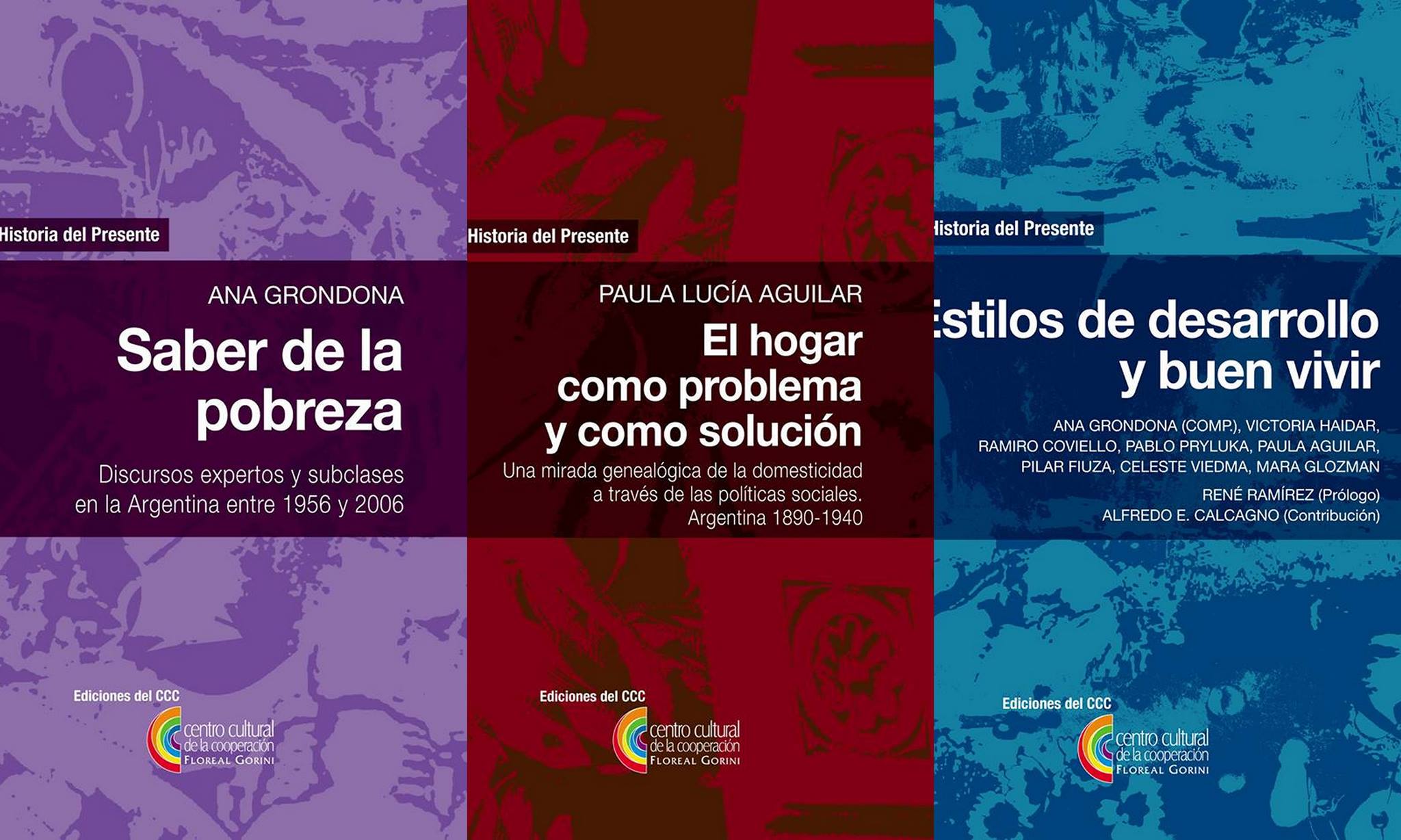
The History of the Present Collection / Colección Historia del Presente

History of the present is a collection that inquires about the historical and political conditions that shape our present and its evidences. Daily and through various fields -the mass media, political discourse and interventions of “experts”- we are exposed to discourses that address various objects as taken for granted: the problem of poverty, development limits and dependency, household and family crisis, threats to the national language, insecurity, exhaustion of the revolutionary way. This movement, however, closes the historical and political conditions under which these and other objects are identified and problematized. This collection proposes the practice of archival work as a way to denature- deconstruct some of the truths and evidences that are imposed as such, as well as account for the constitutive heterogeneity of what is presented as homogeneous.
buen-vivre
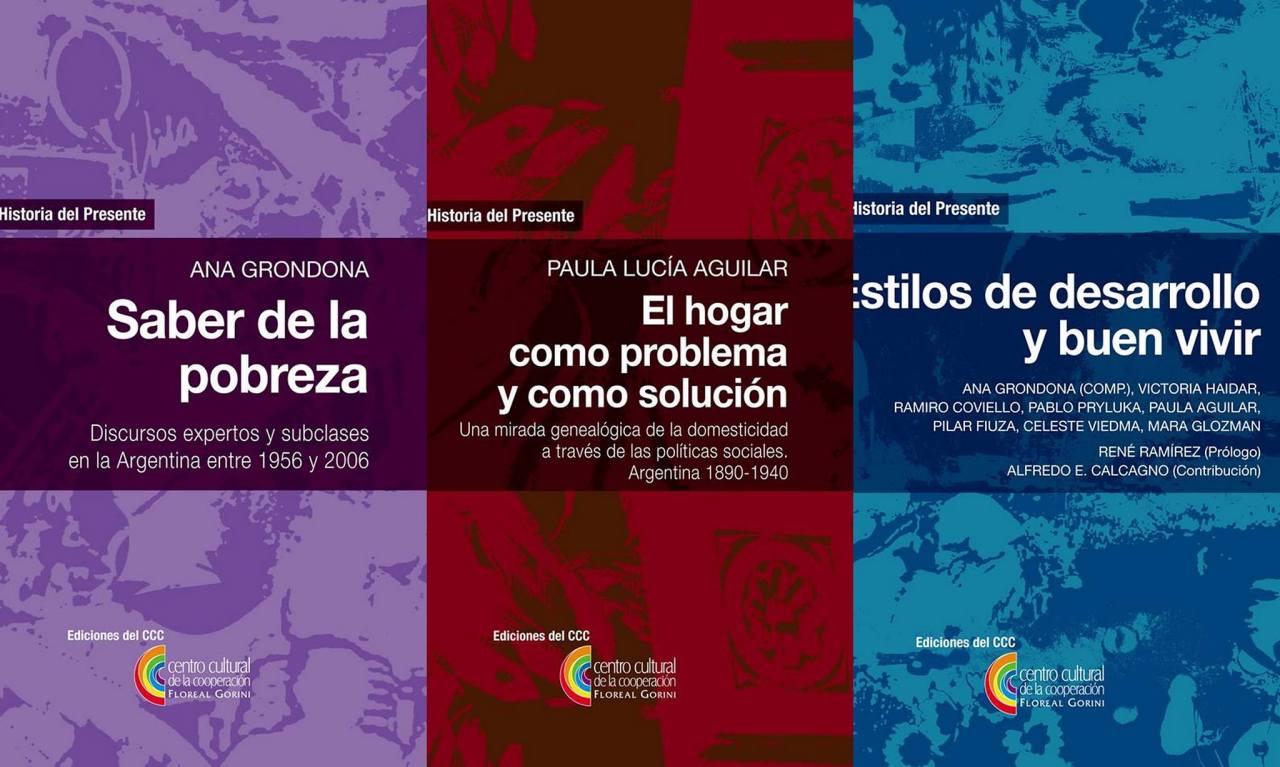
Estilos de Desarrollo y Buen Vivir. 

Development Styles and Good Living 
Ediciones Centro Cultural de la Cooperación Floreal Gorini (2016) 212 p.

The book puts into dialogue discussions of “good living” alternatives to development with a series of proposals that were designed between  mid 1960s and early 1980s in Latin America. In that context , Fundación Bariloche, Oscar Varsavsky and largely ECLAC work hard to formulate alternatives to the pattern of development centered on economic growth , while showed the feasibility of these other styles of development by calculating their main features with  multivariate mathematical complex models . More recently , proposals of good living, inspired by the Sumak Kawsay mainly in andean countries have involved a profound critique of neoliberalism and its civilizational model. The challenge of the book is to destabilize the effect of homogeneity and evidence which usually defines “development” as a one way (North to South) debate and show its conflicts and struggles under different social and historical circumstances.

The book is the result of an investigation conducted at the Cultural Center of Cooperation Floreal Gorini , who also received a subsidy UBACyT under the Faculty of Social Sciences of the UBA . It is an interdisciplinary team, made up of Paula Aguilar ( Sociologist ) , Victoria Haidar ( lawyer ) , Mara Glozman ( linguist ), Paul Pryluka ( historian ) , Ramiro Coviello ( sociologist ), Pilar Fiuza ( Sociologist ) , Celeste Viedma ( sociologist ) and Ana Grondona ( sociologist ).

El Hogar como problema y como solución. Una mirada genealógica de la domesticidad a través de las políticas sociales. Argentina 1890-1940

Home as a problem and as a solution. A genealogical view of domesticity through social policies debate. Argentina, 1890- 1940. 
Ediciones Centro Cultural de la Cooperación Floreal Gorini (2014) 310 p.

Paula Lucía Aguilar (aguilarpl@gmail.com)

The book traces the formation of “modern domesticity” by analyzing the discourses of diagnosis and possible responses to the social question in dispute between 1890- 1940. Through the problematization of the boundaries between the domestic realm and work, the public housing debate, Home Economics knowledge prescribed for household management and statistical records of the lives and work of the working family, domesticity is increasingly defined as an arena for reflection and action in Social Policy debate. In this context the “Home” emerges and condenses both real and utopian concerns about population life and work conditions and the possibility of social reform. From a perspective that seeks to destabilize evidence, this book invites to review the configuration of domesticity, its organization and responsibilities that still resonate today and guide the design and implementation of specific policies.

Paula Lucia Aguilar has a degree in Sociology and a PhD in Social Sciences from the University of Buenos Aires. She is a researcher at CONICET / IIGG and at Centro Cultural de la Cooperación Floreal Gorini. Currently part of the Group Study Group in History and Discourse (GEHD).

Saber de la Pobreza: Discursos expertos y subclases en la Argentina entre 1956 y 2006 

Poverty knowledge: expert discourses and subclasses in Argentina between 1956-2006
Ediciones Centro Cultural de la Cooperación Floreal Gorini (2014) 221 p.

Ana Grondona (antrondona@hotmail.com)

This book discusses the various ways in which expert knowledge defined the problem of “subclasses” in Argentina between 1956-2006. By means of archival work and interviews with key actors of the process, it investigates the diagnoses of marginality, informality, basic needs, poverty and vulnerability. It revisits various discussions –many of them forgotten- and proposed categories from which at present we map the social question. The analysis of multiple memories involved in the production of these categories, allows to account for different regimes of enunciation that, at every historical and political circumstances, organized what could and should be said about the “subclasses”. In particular, it explores the decline of diagnoses focused on macro-causality and consolidation, as from the 80s, of a descriptivist perspective. This mutation is part of a more general transformation that relegated the questioning of capitalism to a marginal position

Grondona Ana has a degree in Sociology and a PhD in Social Sciences from the University of Buenos Aires. She is a researcher of CONICET / IIGG and Centro Cultural de la Cooperación Floreal Gorini. Currently part of the Group Study Group in History and Discourse (GEHD).

Hörberg, U., Dahlberg, K.
Caring potentials in the shadows of power, correction, and discipline-Forensic psychiatric care in the light of the work of Michel Foucault
(2015) International Journal of Qualitative Studies on Health and Well-being, 10, art. no. 28703.

DOI: 10.3402/qhw.v10.28703

Abstract
The aim of this article is to shed light on contemporary forensic psychiatric care through a philosophical examination of the empirical results from two lifeworld phenomenological studies from the perspective of patients and carers, by using the French philosopher Michel Foucault’s historical-philosophical work. Both empirical studies were conducted in a forensic psychiatric setting. The essential results of the two empirical studies were reexamined in a phenomenological meaning analysis to form a new general structure in accordance with the methodological principles of Reflective Lifeworld Research. This general structure shows how the caring on the forensic psychiatric wards appears to be contradictory, in that it is characterized by an unreflective (non-)caring attitude and contributes to an inconsistent and insecure existence. The caring appears to have a corrective approach and thus lacks a clear caring structure, a basic caring approach that patients in forensic psychiatric services have a great need of. To gain a greater understanding of forensic psychiatric caring, the new empirical results were further examined in the light of Foucault’s historical-philosophical work. The philosophical examination is presented in terms of the three meaning constituents: Caring as correction and discipline, The existence of power, and Structures and culture in care. The philosophical examination illustrates new meaning nuances of the corrective and disciplinary nature of forensic psychiatric care, its power, and how this is materialized in caring, and what this does to the patients. The examination reveals embedded difficulties in forensic psychiatric care and highlights a need to revisit the aim of such care. © 2015 U. Hörberg & K. Dahlberg.

Author Keywords
Caring science; Forensic psychiatric care; Foucault; Philosophical examination

Marc Djaballah, Foucault, trente ans après, Revue philosophique de la France et de l’étranger 2016/1 (Tome 141)

Résumé

Français

Revue critique d’un ensemble d’ouvrages éditant des textes de Michel Foucault (1926-1984) ou portant sur son oeuvre, parus en français à l’occasion du trentième anniversaire de sa mort.

English
Michel Foucault after Thirty Years
Critical review of a few books either compiling texts by Michel Foucault (1926-1984) or studying his work, published in French on the occasion of the 30th celebration of his death.