Foucault News

News and resources on French thinker Michel Foucault (1926-1984)

French intellectuals lament loss of influence as populism surges, Financial Times, 21 April 2017


National Front has given voice to much of working class once represented by the left

Sipping a coffee at Le Rouge Limé café in central Paris, Michael Foessel, professor of philosophy at the École Polytechnique, harks back to a time when leftwing intellectuals really mattered.

Long gone are the days, he says, of Pierre Bourdieu leading strikes by railway workers, Michel Foucault shifting the debate on prison reforms, or Émile Zola and his plea for justice during the Dreyfus Affair.

“We are no longer the intellectual leaders of this country,” says the 42-year-old, wearing jeans and a tweed jacket. “In the media, it is the conservative voices that make a big impact. In politics, it is the technocrats.”

He is talking just ahead of an election that has been dominated by the rise of populist far-right leader Marine Le Pen, who, through a blend of nativism and economic nationalism, has given a voice to much of the disenfranchised working class once represented by the left.

read more

Alberto Comparini, Between Philosophy and History: On Guido Mazzoni’s “Theory of the Novel”, Los Angeles Review of Books, April 15, 2017

BETWEEN 1995 AND 2010, Guido Mazzoni worked on three books: a study of modern poetry (Sulla poesia moderna, 2005); a collection of poems (I mondi [Worlds], 2010); and, finally, a theory of the novel (Teoria del romanzo, 2011).

[…]

In Mazzoni’s analysis, the novel emerges as a “game of truth.” In 1984, under the pseudonym “Maurice Florence,” the French philosopher Michel Foucault contributed an entry titled “Michel Foucault” to a dictionary of philosophers. In that entry, the term “game of truth” is used to describe the “discursive practices that define what is true and what is false, what form the discourse of truth must take, and who and what the subject and object of knowledge are.” Mazzoni is similarly concerned with the “structures of sense that still shape our discourses today,” namely those of mimesis (imitation) and concept (reflection), whose separation was ratified by Plato in Books II, III, and X of the Republic. Theory of the Novel can be read as a history of mimesis, whose rise coincides with the development of modern aesthetics, according to which truth can be represented in a medium different from that of the concept. In the absence of both meaning and telos from history, it is only the mimetic novel — not the concept — that is still capable of depicting the complexities of human consciousness as well as of society at large. It is a “genre in which one can tell absolutely any story in any way whatsoever.”

read more

Reveley, J. (2015). Foucauldian critique of positive education and related self-technologies: Some problems and new directions. Open Review of Educational Research, 2(1), 78-93.

DOI: 10.1080/23265507.2014.996768

Abstract
By focusing on positive education, this article draws out the educational implications of Binkley’s Foucauldian critique of neoliberal subjects being pressured to learn how to manage their emotions. From the latter author’s perspective, positive education self-technologies such as school-based mindfulness training can be construed as functioning to relay systemic neoliberal imperatives down to individuals. What this interpretation overlooks, however, is that young people are not automatically and unambiguously disempowered by the emotion management strategies they are taught at school. Arguably, positive education contributes to the formation of resistant educational subjects with an emotional toolkit that equips them to mount oppositional action against neoliberalism. Foucault’s work can be interpreted in a way that is not inconsistent with seeing positive education as having such liberatory potential.

Keywords: critical pedagogy, review, Philosophy of Education, critical theory

Fhulufhuwani Hastings Nekhwevha, Freire contra Foucault on Power/Knowledge and Truth Discourses. The Constitution of a Subject for Authentic Educational Praxis in South Africa, LAP Lambert Academic Publishing, 2012

This is a partly theoretical and partly historical study whose ‘focus-down’ approach has as a main objective a detailed comparative dissection of Freire and Foucault’s conceptions of knowledge, power, truth and the subject for authentic educational praxis and the implication these have for the practice of education for liberation in South Africa. The core argument in the study is that despite the existence of some points of convergence between Freire and Foucault’s projects, for instance, the similarity between Freire’s concern for the cultural experience of the learner and Foucault’s view that marginalised local knowledge need to be rescued from subjugation, Foucault’s notion of power does not allow for liberatory education praxis. Only the pedagogy of knowing within the Freirian mould with its emphasis on dialogue and conscientisation makes liberatory praxis in education possible. Hence it is argued in this study that the most suitable framework to illuminate these processes would necessarily combine Giddens and Thompson’s concept of ideology critique and Habermas’ notion of communicative action for purposes of ensuring dialogical action for freedom to take place.

Lotier, Kristopher M. “On Not Following Freire Foucault and the Critique of Human Capital.” Pedagogy 17, no. 2 (2017): 151-175.

Abstract:
Rather than ignoring or criticizing students’ vocational concerns, critical pedagogy can work on, in, and through them, thereby gaining persuasive credibility and simultaneously extending Paulo Freire’s educational project. Following Freire’s command to “rediscover power,” this article employs Michel Foucault’s analysis of neoliberal biopolitics to imagine possibilities for both personal and systemic transformation.

Rodrigo Cordero, Crisis and Critique: On the Fragile Foundations of Social Life. Routledge, 2017

Fragility is a condition that inhabits the foundations of social life. It remains mostly unnoticed until something breaks and dislocates the sense of completion. In such moments of rupture, the social world reveals the stuff of which it is made and how it actually works; it opens itself to question.

Based on this claim, this book reconsiders the place of the notions of crisis and critique as fundamental means to grasp the fragile condition of the social and challenges the normalization and dissolution of these ‘concepts’ in contemporary social theory. It draws on fundamental insights from Hegel, Marx, and Adorno as to recover the importance of the critique of concepts for the critique of society, and engages in a series of studies on the work of Habermas, Koselleck, Arendt, and Foucault as to consider anew the relationship of crisis and critique as immanent to the political and economic forms of modernity.

Moving from crisis to critique and from critique to crisis, the book shows that fragility is a price to be paid for accepting the relational constitution of the social world as a human domain without secure foundations, but also for wishing to break free from all attempts at giving closure to social life as an identity without question. This book will engage students of sociology, political theory and social philosophy alike.

Table of Contents

Introduction

Part I. Sociology of crisis/Critique of sociology

1. The critique of crisis

2. The crisis of critique

Part II. Models of crisis/Forms of critique

3. Diremptions of social life: Bringing capitalist crisis and social critique back together —Jürgen Habermas

4. The non-closure of human history: Misfortunes of social critique and the political foundations of concepts —Reinhart Koselleck

Part III. Fragile foundations/Political struggles

5. The fragile world in-between: Totalitarian destruction and the modesty of critical thought —Hannah Arendt

6. Making things more fragile: The persistence of crisis and the neoliberal disorder of things —Michel Foucault

Postscript

Decoding social hieroglyphics: Notes on the philosophical actuality of sociology
—Theodor Adorno
Teresa Lloro-Bidart and Keri Semenko, Toward a feminist ethic of self-care for environmental educators (2017) Journal of Environmental Education, 48 (1), pp. 18-25.
https://doi.org/10.1080/00958964.2016.1249324

Abstract
Feminist theory and philosophy have examined how dominant ideologies oppress women, nonhuman animals, and the environment. Feminist scholars also have begun to discuss how neoliberalism problematically re-inscribes women as the primary providers of care, regardless of the impact of this care work on their own well-being. This article synthesizes feminist writings about temporality, relationality, and self-care alongside Foucault’s ideas about “care for self” and feminist environmental education scholarship that considers care in order to develop a feminist ethic of self-care for environmental educators that challenges neoliberal ideologies. © 2017 Taylor & Francis Group, LLC.

Author Keywords
animal studies; feminist care theory; Foucault; neoliberalism; self-care

Hugo Durieux, La CIA et les intellectuels français, Durieux.eu blog, 31 Mars 2017

Après l’avoir purifiée (sanitized), la CIA états-unienne (Central Intelligence Agency) a  rendu publique en 2011 une note de recherche intitulée France : Defection of the Leftist Intellectuals (France : la défection des intellectuels de gauche)[i]. Le document original confidentiel date de fin 1985 et fut élaboré au sein de l’Office for European Analysis.

D’abord rappelez-vous le contexte politique. On est encore en période de guerre froide. L’OTAN a l’intention de déployer en Europe de l’ouest près de six cents  missiles de croisière conçus pour le transport de têtes nucléaires. Partout en Europe se tiennent d’énormes manifestations contre l’OTAN et les Etats-Unis et leur politique d’armement. L’Union Soviétique existe encore, même si elle fait déjà l’expérience de fortes résistances organisées en Europe de l’est. En France, François Mitterrand a entamé la deuxième moitié de son premier  septennat présidentiel. Le gouvernement va de crise en crise. Sa politique économique et sociale ne cesse de décevoir l’électorat de gauche ; au gouvernement  Fabius de 1984 les quatre ministres communistes du PCF ont été remplacés. Une année plus tard, en 1986, l’union de la gauche perdra sa majorité à l’Assemblée Nationale.

suite

stuartelden's avatarProgressive Geographies

Update 6.JPG

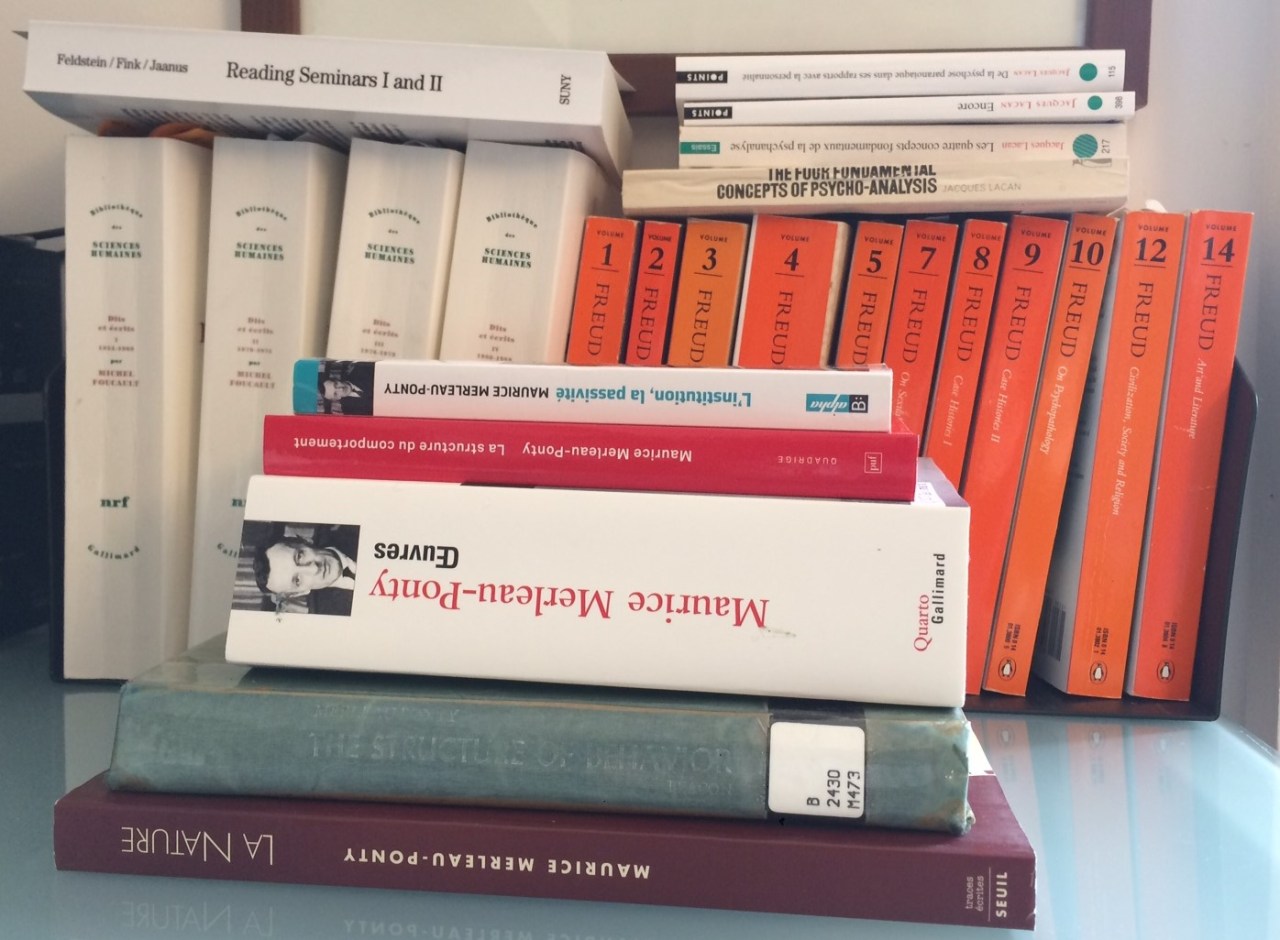
I’ve largely been able to continue the focus of the last update, with a series of fairly uninterrupted days’ research and writing. Aside from continuing work on Lacan, I’ve also been looking at the people who taught Foucault. Merleau-Ponty is the key figure, as I’ve mentioned before, and I’ve done a bit more work on him, but Jean Wahl, Jean Hyppolite, Jean Beaufret, Henri Gouhier, and Daniel Lagache are all important. It’s taken a bit of digging around, but quite a lot of the lectures Foucault attended have been published. So, where possible, I’ve been tracking these down and doing some selective reading. Warwick has a pretty good collection, often in French and English. I was back in London for a couple of days, so did some work in the British Library, though my list of things to do there, and in Paris, is still quite extensive. I have the…

View original post 695 more words

Fully automated episode 2: biopolitical imperialism, with Mark G.E. Kelly

Podcast

Our guest this week is Mark G. E. Kelly, an Associate Professor in the School of Humanities and Communication Arts at Western Sydney University. He is the author of The Political Philosophy of Michel Foucault (2009), as well as of Biopolitical Imperialism (from Zer0 books, in 2015) and he is also working on a book called ‘For Foucault: Against Normative Political Theory’ (SUNY, expected 2018).

Kelly has weighed in a number of recent ‘Foucault’ controversies, including the question of whether Foucault was a neoliberal. In this interview, we get into that debate. But I think for most listeners, the interesting stuff will be towards the end, where Kelly talks about Biopolitical Imperialism, and addresses the conflict in Syria.

The podcast was recorded on Wednesday, April 5, 2017. In the interview, you’ll hear Kelly comment on Donald Trump’s pivot a few days previous, on Syria. Two days after the recording, on April 7, the US military launched a cruise missile attack on a Syrian airfield. The attack was carried out in response to a chemical weapons incident in Idlib province, perpetrated allegedly by Syrian state forces. It would be hard to imagine a stronger confirmation of Kelly’s arguments about Biopolitical Imperialism.