Foucault News

News and resources on French thinker Michel Foucault (1926-1984)

Disney+ Lands Exclusive French Broadcast Rights to 2025 Oscars, by Ben Croll, Variety, Dec 10, 2024

[…]
Disney execs also announced a brand new French original, “Surveiller et punir” (a name that plays as a wink to the French title of Michel Foucault’s “Discipline and Punish”). Described as a workplace comedy about a pair of prison guards, the series comes courtesy of “Simply Black” creators John Wax and Jean-Pascal Zadi.
[…]

Disney+ va diffuser “en exclusivité” les Oscars et prépare de nouvelles séries produites en France, franceinfo Culture avec AFP 11/12/2024

[…]
La plateforme, qui revendique la place de 3e en France, entend renforcer sa présence avec des programmes produits dans l’Hexagone, via notamment une série comique portée par Jean-Pascal Zadi et située en prison. Titrée Surveiller et Punir, la nouvelle production tricolore de Disney+ suivra “avec humour les seules personnes qui ont volontairement décidé de passer toute leur vie derrière les barreaux : les surveillants”, a annoncé mardi Kévin Deysson, directeur des productions originales Disney+.

Incarnée par Jean-Pascal Zadi (Tout simplement noir), cette fiction en huit épisodes de 30 minutes est présentée comme une comédie de bureau “dans la plus grande tradition des sitcoms américaines”. La date de diffusion n’est pas connue.
[…]

The Bibliography of Foucault’s shorter works in English translation which is maintained by Daniele Lorenzini and hosted on this site has been updated.

As always if you notice anything missing please either post in the comments on the page or email Daniele Lorenzini directly.

Wang, C., Wang, S.
Educating the Autonomous Learner in a Confucian School: Subjectivity, Memorisation, and Dilemma
(2023) China Perspectives, 2023 (135), pp. 61-70.

Abstract
The current literature on Chinese governmentality and subjectivity lacks rigorous discussion of the involvement of Confucian education. This article applies Foucauldian conceptual tools to explore this scholarship gap empirically. Based on ethnographic fieldwork at a Confucian school, we explore how Confucian pedagogical techniques are used to create a type of subject. This article first presents pedagogical reform in a Confucian school. The resultant pedagogy of individualised memorisation combines two paradoxical knowledge sources: the individualised teaching principle and the method of repetitive memorisation. We then demonstrate how the Confucian teaching techniques used in the classroom result in contradictory processes of subject-making. Students are governed by the technologies of power in the disciplined classroom but are also encouraged to be the “master” of their own study according to the technologies of the self, so as to become autonomous learners. The revived Confucian education is encountering a profound cultural dilemma between autonomy/individuality and coercion/authority in the making of subjects. © 2023, Francais sur la Chine Contemporaine China. All rights reserved.

Author Keywords
Confucian education; Foucault; governmentality; power; subjectification

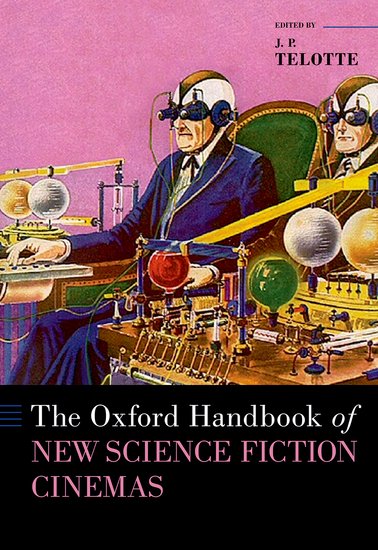
Vint, S. Biopolitics and Bioethics (2023) The Oxford Handbook of: New Science Fiction Cinemas, Ed. J. P. Telotte, Oxford University Press, pp. 193-205.

DOI: 10.1093/oxfordhb/9780197557723.013.12

Abstract
This chapter outlines ideas central to biopolitical theory and demonstrates how they have proven especially useful for analyzing science fiction (sf) films, particularly those concerned with the social reproduction of humanity into the future, and those exploring themes about society’s differentiation between valued and disposable life-a distinction that sf has often represented as a matter of species difference. The primary text used to examine ideas about the valuation of life is Claire Denis’s High Life. © Oxford University Press 2023. All rights reserved.

Author Keywords
body; governance; medicine; Michel Foucault; population; reproduction; violence

Gordon, J. Heterotopias The Oxford Handbook of: New Science Fiction Cinemas, Ed. J. P. Telotte, Oxford University Press, (2023) pp. 101-112.

DOI: 10.1093/oxfordhb/9780197557723.013.6

Abstract
Drawing on the intellectual archaeologies of Michel Foucault, the notion of the heterotopic-of the other place that is neither utopian nor dystopian, and of the other figures who might inhabit such places-uses configurations of abnormality as a way of interrogating our sense of the normal. Capitalizing on the new digital technologies common to science fiction (sf) film, sf heterotopias are able to visualize, almost effortlessly, other possible spaces and beings, in the process doing the most fundamental work of sf-challenging a set and bounded sense of world and self, while hinting at better alternatives. This chapter primarily considers District 9 (2009) and Arrival (2016) in terms of Foucault’s formulation and Mary Louise Pratt’s notion of the “contact zone,” a contested site of colonialist heterotopias. © Oxford University Press 2023. All rights reserved.

Author Keywords
aliens; contact zone; culture; dystopia; invasion; language; Michel Foucault; utopia

PhD course: Foucault: Organization, Technology, and Subject-formation – 4 ECTS

Copenhagen: Monday 16 June 2025 at 09:00 to Thursday 19 June 2025 at 16:00

Registration Deadline: Monday 5 May 2025 at 23:55.

Course coordinator: Kaspar Villadsen, Department of Business Humanities and Law (BHL)

Faculty
Professor Sverre Raffnsøe
Department of Business Humanities and Law, CBS

Associate Professor Marius Gudmand-Høyer
Department of Business Humanities and Law, CBS

Professor (mso) Kaspar Villadsen
Department of Business Humanities and Law, CBS

Prerequisites
Only PhD students can participate in the course.Participation requires submission of a short paper (see more below). Papers must be in English and deadline for submission is 1 June 2025.

It is a precondition for receiving the course diploma that the PhD student attends the whole course.

Aim
The course will provide the participants with:
1) An introduction to key analytical potentials reconstructed from Foucault’s wide-ranging authorship as well as the lecturers’ own research projects.

2) In particular, we will discuss different approaches to themes of organization, technology, and subject-formation as they are deployed in state-of-the-art Foucault-inspired scholarship.

3) The potentials and limits of the particular way Foucauldian analytics can be applied in the participant’s research will be discussed. Hence, a range of analytical resources and potentials will be explored and discussed in relation to the participants’ current research.

Course content
Michel Foucault’s work continues to offer a major source of inspiration for PhD projects across a wide range of disciplinary domains. This PhD course explores how Foucault’s work speaks to three broad themes in contemporary business school research and beyond: Organization, technology, and subject-formation. The lecturers on the course have all pursued substantive research on these themes, drawing upon different parts of Foucault’s authorship, and they will base their teaching on this research experience. A key aim of the course is that the participants acquire an effective overview of analytical possibilities in Foucault’s work, effective for selecting and deploying such analytics in their own research.

Overall, Foucault’s thinking can help to inquire into the organizations, technologies and techniques of self-formation that make up the conditions of possibility for our contemporary experiences. First, Foucault’s usual genealogical approach (Foucault 1977, 1984) works by tracing how contemporary forms of organization emerged from past struggles, political strategies, and accidental events. From this perspective, the prevailing modes of organizing can be better grasped by recovering their historical conditions of emergence and dispersion. Genealogy takes as its basic premise that history, as well as our present, is a site of evolving struggle, including contest over divergent interpretations, which the development of modern modes of organizing and managing clearly displays. Hence, struggles around definitions and uses of appropriate management, leadership, accountability, transparency or sustainability make up pertinent material for genealogical inquiry.

Foucault developed his own notion of technology during the 1970s, namely the concept of “the dispositive”. A dispositive is defined as a historical configuration, which connects a series of discursive and non-discursive elements such as laws, practices, material artefacts, procedures, and techniques (Foucault, 1980). It designates a propensity in knowledge production and social practice as well as a “dispositionality” in how institutions emerge and transform. The concept opens for analyzing how our practices – for example, risk assessments or anti-pandemic strategies – are conditioned by dispositives that have been formed in historical processes often spanning several centuries. Foucault (2007) suggested that the dispositives of law, discipline and security have been particularly important as responses to thorny governmental problems such as crime, infectious diseases, population welfare, and labor unrest. Current problems such as climate change, environmental degradation and extreme inequality could be analyzed as straddling between these deep-rooted frameworks of calculation, intervention and rationalization. The dispositive has recently been introduced into Foucauldian scholarship as a highly promising analytical resource (##), and the course will explore how it can be used for empirical inquiries.

Finally, Foucault’s late authorship in the early 1980s, often termed his “ethical turn”, took him back to techniques of self-formation in Early Christianity and Greco-Roman antiquity. There, Foucault noticed a “technical” notion of ethics less defined by submission to universal moral codes and instead focused more on the self’s work upon the self.

Foucault’s attention to ethics in the early 1980s hardly signified a departure from political issues, but a re-conception of politics as an ethical politics. The work on your own freedom that ethics comprise is political, Foucault argued, in the sense that our self-fashioning involves what we are willing to accept or want to change in ourselves as well as in our circumstances: “[T]here is no first or final point of resistance to political power other than in the relationship one has to oneself” (Foucault, 2005: 252). Perhaps, the urgent issues of our time call for developing another form of ethics rather than models rooted in legal frameworks and Christian morality. The recent emergence of responsible consumers, ‘life-long learners’, climate conscious youths, “freeganism”, and fluid gender identity could be analyzed with inspiration from Foucault’s work on ethics and self-formation. An analytical key task that will be addressed in this part of the course is how to integrating Foucault’s notion of technology, the dispositive, with his analysis of self-technology, hence bridging the mid-career Foucault’s analytics of power with the late Foucault’s ethics.

The theme of this PhD course requires that the participants engage in some way with Foucault’s historical work, his analytical frameworks, his concepts, or his approach to organization, technology, and subjectivity. Papers that are not underpinned exclusively by Foucauldian analytics but also derive from other thinkers and traditions are welcome too. Our point of departure is that Foucauldian analytics is not only pertinent to philosophical research, since such analytics can also find application in ethnographic, sociological, organizational, historical, and anthropological research.

Teaching style

The goal is to sharpen the participants’ knowledge of the Foucauldian toolbox of analytical resources and how these can be applied in PhD projects. To that end we will set aside sufficient time to carefully examine and discuss the papers submitted by the participants. The course will consist of both workshops and lectures/presentations by scholars who are specialist in Foucault’s work and subsequent Foucauldian scholarship. The goal of the lectures is, first, to clarify the ways in which Foucault worked with his most significant analytics and, second, to demonstrate how to put the analytics at work in specific analysis. The aim of the workshops is to explore how Foucauldian analytics function (or possible may be employed) in each participant’s research – with the aim of strengthening, deepening and nuancing the participants’ dissertations or research articles. In the workshops, the course participants are divided into smaller groups (using shared topics and/or approaches as choice criteria) enabling a substantial peer discussion of both paper and their research project. Each workshop will be supervised and organized by one of lecturers.

All participants are required to submit a paper that deals with the key theme(s) of the PhD project in question. Papers that apply Foucauldian analytics to empirical problems in a variety of domains are welcomed, but so are papers that draw upon other thinkers and traditions. Perhaps the PhD student is interested in considering whether it would be interesting to include perspectives drawn from Foucault and Foucauldian scholarship in their PhD project.

It is possible to submit two kinds of papers. The first option is a short paper/abstract, which briefly presents the PhD student’s project and perhaps poses some questions regarding how it could include perspectives from Foucault. The second option is to submit a brief paper (5-10 pages), which presents the PhD project and some key theoretical and/or empirical considerations, and it can perhaps include notions from Foucault such as power, knowledge, governmentality, technologies of power, self-technology, etc. The key idea is that each participant will take home lots of beneficial inputs to his/her PhD project based on a discussion of challenges and potentials in the project. Papers must be in English.

Learning objectives
• Achieve a strong reflexivity regarding how the choice of analytics from Foucault’s authorship brings certain questions, problems, entities and processes into the foreground of analysis and critical consideration.

• Awareness of different ways of working with Foucauldian analytics in PhD dissertations, articles and academic writing in general. This awareness will particular concern and be exemplified by the themes of organization, technology, and subjectivity. However, as mentioned above, these themes are not exclusive.

• The course will increase participant’s critical ability to account for the potential role of Foucauldian analytics, in general, and how it is applied in the participant’s research, specifically. This reflexivity concerns, inter alia, the epistemological distinctiveness of Foucauldian analytics, the social ontology its assumes, the analytical practices involved in Foucauldian scholarship, and the potential critical effects of such scholarship. Finally, the increased reflexivity relates to the range of Foucauldian analytical resources that can be effectively explored in relation to the participants’ current research.

Giorgi Vachnadze, The Incomputability of Calculation: Wittgenstein, Turing and the Question of Artificial Intelligence, Newsletter on the Results of Scholarly Work in Sociology, Criminology, Philosophy and Political Science, Vol. 5 No. 1 (2024). Special Issue Tune-Changing World – Every Single Minute

DOI: https://doi.org/10.61439/URSA3237
Open access

Abstract
Calculation is one of the foundational concepts operating at the basis of the notion of an algorithm. Seemingly intuitive, it remains nonetheless no small task to provide a rigid theoretical framework for articulating an ontology of computation. The central and primary point of oscillation around which the following paper will revolve, is concerned therefore not only with the complicated questions that make up the foundations of logic and mathematics, but the social and political implications that follow directly therefrom. Whether a machine can think is directly tied to the question of whether calculation is a form of thinking. That is, whether human thinking is a form of calculation. Subversively, Wittgenstein claims not only that human thought is irreducible to computation, but that human calculation itself is a form of thinking that is entirely different from anything that could be labeled “mechanical”. Wittgenstein’s critique of the Turing Thesis paves the way for a new variety of Foucauldian Biopolitics aimed specifically at the discourse surrounding Artificial Intelligence. A discourse that bears a suspicious resemblance to Christian pastoralism.

Colloque international
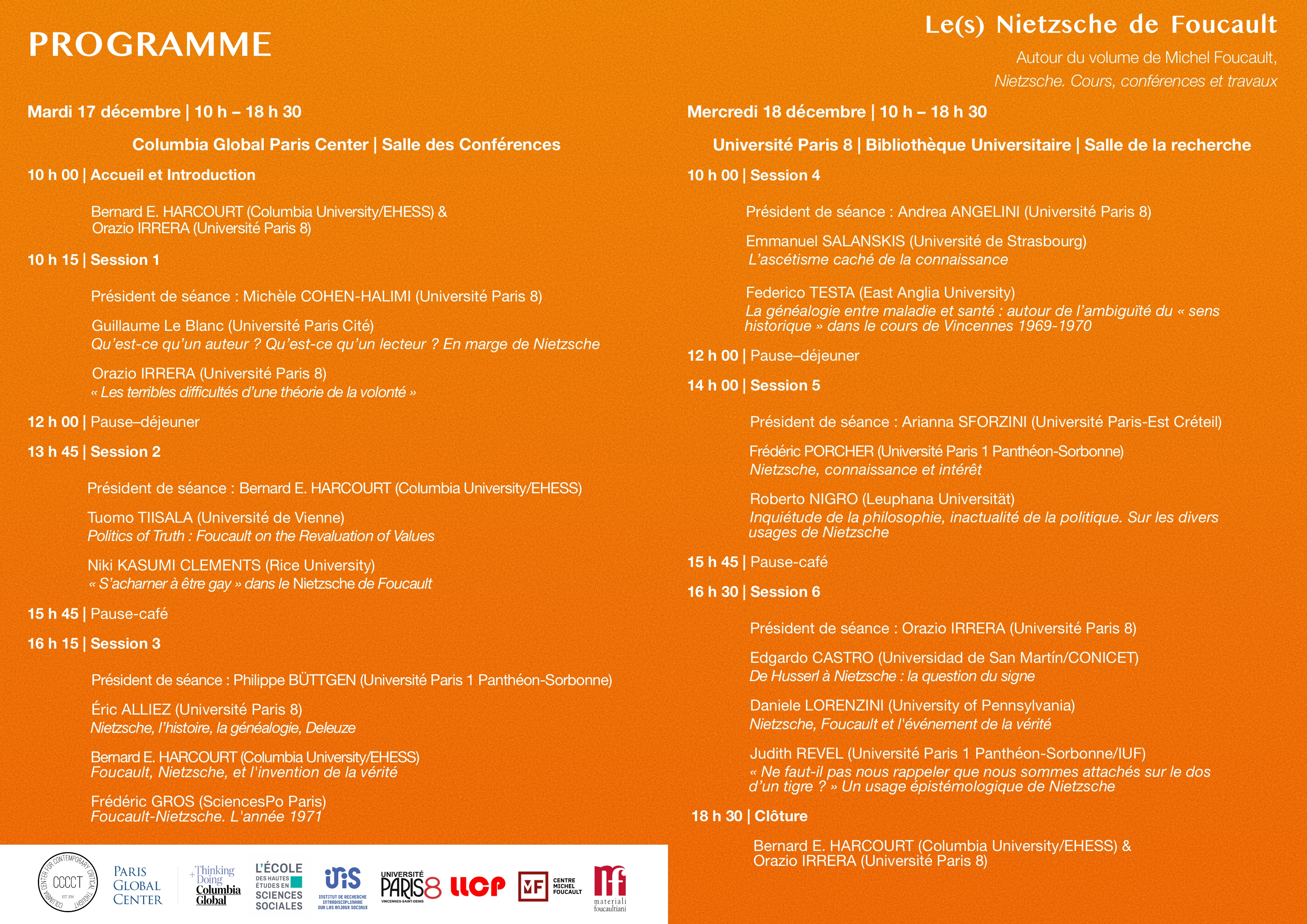
Le(s) Nietzsche de Foucault
Autour du volume de Michel Foucault, Nietzsche. Cours, conférences et travaux

17 et 18 décembre 2024
Columbia University | EHESS | Université Paris 8

Événement coorganisé par le Columbia Center for Contemporary Critical Thought (CCCCT), le Columbia Global Paris Center, le Laboratoire IRIS (UMR 8156) de l’École des Hautes Études en Sciences Sociales (EHESS), le Laboratoire d’études et de recherches sur les Logiques Contemporaines de la Philosophie (LLCP, EA 4008) de l’Université Paris 8 ; avec le soutien du Centre Michel Foucault et de la revue « materiali foucaultiani ».

Organisateurs :
Bernard E. Harcourt (Columbia University/EHESS) et Orazio Irrera (Université Paris 8).

17 déc. 10h-18h30 : Columbia Global Paris Center, Salle des Conférences, 4 rue de Chevreuse, 75006, Paris (Métro : Ligne 4, Vavin – RER B : Luxembourg)

18 déc. 10h-18h30 : Université Paris 8, Bibliothèque Universitaire, Salle de la recherche, 41 rue Guynemer, 93200 Saint-Denis (Métro : Ligne 13, Saint-Denis Université)

Programme

17 décembre 2024 | 10h-18h30 |
Columbia Global Paris Center, Salle des Conférences

10h | Accueil et introduction : Bernard E. HARCOURT (Columbia University/EHESS) et Orazio IRRERA (Université Paris 8).

10h15-12h | Session 1

Présidence de séance : Michèle COHEN-HALIMI (Université Paris 8)

• Guillaume LE BLANC (Université Paris Cité) : Qu’est-ce qu’un auteur ? Qu’est-ce qu’un lecteur ? En marge de Nietzsche

• Orazio IRRERA (Université Paris 8) : « Les terribles difficultés d’une théorie de la volonté »

12h-14h | Pause déjeuner

14h-15h45 | Session 2

Présidence de séance : Bernard E. HARCOURT (Columbia University/EHESS)

• Tuomo TIISALA (Université de Vienne) : Politics of Truth : Foucault on the Revaluation of Values

• Niki KASUMI CLEMENTS (Rice University) : « S’acharner à être gay » dans le Nietzsche de Foucault

15h45-16h15 | Pause-café

16h15-18h30 | Session 3

Présidence de séance : Philippe BÜTTGEN (Université Paris 1 Panthéon-Sorbonne)

• Éric ALLIEZ (Université Paris 8) : Nietzsche, l’histoire, la généalogie, Deleuze

• Bernard E. HARCOURT (Columbia University/EHESS) : Foucault, Nietzsche, et l’invention de la vérité

• Frédéric GROS (SciencesPo Paris) : Foucault-Nietzsche. L’année 1971

18 décembre 2024 | 10h-18h30 |
Université Paris 8, Bibliothèque Universitaire, Salle de la recherche

10h-12h | Session 4

Présidence de séance : Andrea ANGELINI (Université Paris 8)

• Emmanuel SALANSKIS (Université de Strasbourg) : L’ascétisme caché de la connaissance

• Federico TESTA (East Anglia University) : La généalogie entre maladie et santé : autour de l’ambiguïté du « sens historique » dans les cours de Vincennes 1969-1970

12h-14h | Pause déjeuner

14h-15h45 | Session 5

Présidence de séance : Arianna SFORZINI (Université Paris-Est Créteil)

• Frédéric PORCHER (Université Paris 1 Panthéon-Sorbonne) : Nietzsche, connaissance et intérêt

• Roberto NIGRO (Leuphana Universität) : Inquiétude de la philosophie, inactualité de la politique. Sur les divers usages de Nietzsche

15h45-16h15 | Pause-café

16h15-18h30 | Session 6

Présidence de séance : Orazio IRRERA (Université Paris 8)

• Edgardo CASTRO (Universidad de Buenos Aires/CONICET) : De Husserl à Nietzsche : la question du signe

• Daniele LORENZINI (University of Pennsylvania) : Nietzsche, Foucault et l’événement de la vérité

• Judith REVEL (Université Paris 1 Panthéon-Sorbonne/IUF) : « Ne faut-il pas nous rappeler que nous sommes attachés sur le dos d’un tigre ? » Un usage épistémologique de Nietzsche

18h30 | Clôture : Bernard E. HARCOURT (Columbia University/EHESS) et Orazio IRRERA (Université Paris 8)

Iván Torres Apablaza, Michel Foucault, una lectura posthumanista. Ética, política, porvenir, Alma Negra, 2024

Extracto (PDF)

«El lente a través de la cual este trabajo reconstruye la vertiginosa, en ocasiones aparentemente contradictoria y, en todo caso, intrincada trayectoria foucaultiana –permítaseme: uno de los grandes filósofos del siglo XX– es la continuidad del problema, estrictamente filosófico y político a la vez, que atraviesa toda la producción del pensador francés. […]

Lo que está en juego aquí, no es sólo el resultado de aquella “anarqueología del extravío”, como la denomina el autor de este libro, que descentra el análisis del Sujeto […], sino también la posibilidad misma de abordarlo como un complejo entramado de fuerzas activas e impersonales que permita acceder al proceso de formación, tanto de la agentividad subjetiva como de los poderes que trabajan en su domesticación. Para Foucault, atacar al humanismo y la metafísica significa atacar al último reducto del cartesianismo: la separación entre res cogitans y res extensa, entre interioridad soberana y exterioridad pasiva, para situar, en cambio, en el centro del análisis, el complejo juego de fuerzas entre poder y contrapoder asumido por la investigación genealógica como un inmanente, contradictorio y siempre resistido circuito de regulación.

Es mérito indudable del libro, que confío al lector, haber captado la relevancia de muchos de estos temas en todo el recorrido teórico de Foucault. Pero también –y quiero subrayarlo–, dado que también Iván Torres Apablaza hace referencia explícita a ellos, por la responsabilidad que, todavía y permanentemente, tenemos por delante».

Del Prólogo, Sandro Chignola, Università di Padova

Iván Torres
Apablaza es Doctor en Filosofía por la Universidad de Chile. Es vicepresidente del Comité de Ética de la Investigación en Ciencias Sociales y Humanidades en la Facultad de Filosofía y Humanidades de Universidad de Chile. Es fundador y director editorial de Disenso, Revista de Pensamiento Político. Durante años ha dedicado su trabajo de investigación al pensamiento de Michel Foucault y campos afines. Actualmente desarrolla una investigación postdoctoral financiada por ANID-Chile titulada «Antropoceno y Filosofía: problematizaciones arqueológicas para un descentramiento ecológico de la antropología política» (2024-2027).

Lee Ludvigsen, J.A.
Beyond ‘good’ and ‘bad’ fans: exploring the mechanisms enabling football fans’ position as a stakeholder in the management of circulations
(2024) Soccer and Society

DOI: 10.1080/14660970.2024.2332089

Abstract
This article explores mechanisms enabling football fans’ position as a (safety) stakeholder in the context of European football. It is clear that fans, in the eyes of some football and political authorities, are considered to be ‘potential troublemakers’ or ‘risks’ that must be governed or controlled. However, at the same time, fans are also increasingly considered as contributors towards ‘safe’, ‘secure’, and ‘enjoyable’ football events. Borrowing theoretical insights from Foucault’s writings on security and circulations, this article locates the football fan within what he calls a ‘security dispositif’. By examining processes through which ‘bad’ and ‘good’ fan circulations and populations are enabled, this article looks at the conflicting and (sometimes) contradictory public fan identities that football and political authorities attribute to football fans. It is argued that fans’ stakeholder role represents a counter to ‘security’ becoming defined solely on the terms of football’s governing bodies and political authorities. © 2024 The Author(s). Published by Informa UK Limited, trading as Taylor & Francis Group.