Foucault News

News and resources on French thinker Michel Foucault (1926-1984)

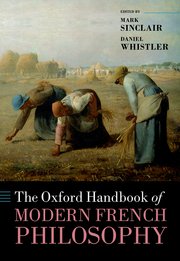
Daniel Whistler and Mark Sinclair, eds. The Oxford Handbook of Modern French Philosophy, Oxford University Press, 2024

-A rich and authoritative guide to French philosophy since 1800
-No other book gives such broad coverage of modern French philosophy
-Discusses the ideas in their historical context
-Written by an international team of specialists in French philosophy and its history

French philosophy is an internationally celebrated national philosophical tradition, and this Oxford Handbook offers a comprehensive approach to its history since 1800. The Handbook features essays written by renowned international specialists, illuminating key movements and positions, themes and thinkers in nineteenth-, twentieth- and even twenty-first-century French philosophy. The volume takes into account developments in recent historical scholarship by broadening the notion of Modern French Philosophy in two ways.

Whereas recent approaches in the field have often ignored early nineteenth-century developments, this volume offers comprehensive treatment of French thought of this period in order to grasp better later developments. Moreover, the volume extends the canon at the other end of the period of Modern French Philosophy by including work on philosophers who have come to prominence only in the last ten or twenty years. The volume takes ‘French philosophy’ in a broad sense to include all philosophy carried out in France over the last 200 years, and it illuminates the institutional and cultural background of this national philosophical tradition in such a way as to provide a fuller and more comprehensive understanding of its unity and of its more famous moments in the twentieth century.


Miotto, M. & Daflon, Alessandra (eds.) (2024). Corpo, vida e biopolítica: encontros extensionistas em torno de Michel Foucault. Cachoeirinha: Editora Fi.

Open access

O livro que o leitor tem em mãos é resultado do I e II Encontro de Estudos sobre Michel Foucault, eventos nacionais ocorridos em 2020-2021 e organizados pelo projeto de extensão da UFF – IHS – RPS intitulado “Introdução ao pensamento de Michel Foucault – Grupo de Estudos Jaguar do Fucô”, coordenado por Alessandra Daflon e Marcio Miotto. Os temas dos dois eventos foram “História da Sexualidade e Biopolítica” e “Corpo e Vida em Foucault”. Os capítulos aqui reunidos desdobram as temáticas do “corpo”, da “vida” e da “biopolítica” em assuntos que percorrem a epistemologia das ciências da vida, a arqueologia foucaultiana das ciências empíricas, a crítica de Foucault à psicanálise, a questão da loucura e da psiquiatria em torno da mulher e das questões de gênero, os dispositivos de segurança e biopolíticos envolvendo a noção de população, as relações entre subjetividade e verdade, o problema do governo de si e dos outros e as novas publicações atribuídas a Foucault desde a recente publicação de As Confissões da Carne. As contribuições – de Gustavo Caponi (UFSC), José Ternes (UFG), Pedro Cattapan (UFF), Sandra Caponi (UFSC), Regiane Collares (UFCA), Fabio Gesueli (UNICAMP) e Malcom Rodrigues (UEFS/UFBA) contribuem com diversas discussões em torno de Foucault. Elas fomentaram verdadeiros diálogos extensionistas a partir dos estudantes de graduação da UFF. O livro é dedicado a Roberto Machado e Heliana Conde, entusiastas do evento e do grupo de extensão.

Capítulos:

Gustavo A. Caponi – Da vida como causa à vida como efeito: do vitalismo de Xavier Bichat ao determinismo experimental de Claude Bernard

José Ternes – Conhecimento e vida

Pedro Cattapan – As críticas foucaultianas da hipótese repressiva e do tema da lei na psicanálise

Sandra Caponi – Gênero e psiquiatria: os estigmas das loucuras femininas

Regiane Lorenzetti Collares – Vidas desejantes e vidas indesejáveis em Foucault

Fábio Gonzaga Gesueli – Agostinho e o diabo do corpo: uma leitura da libidinização do sexo em As Confissões da Carne

Malcom Guimarães Rodrigues – Foucault, a genealogia da vontade e o problema da liberdade

Zeytin, E.
Constructivist heterotopia or taylorist dystopia? Layers of cinematic space in Chaplin’s “modern times”(2024) Architecture in Cinema, Editors: Nevnihal Erdoğan, Hikmet Temel Akarsu , Bentham Books, pp. 120-128.

Abstract
In a metaphorical reading, the industrialized modern city of Modern Times is a gigantic factory designed to produce the modern man. It tries to regulate the movements of the body, actions, and mind through modernist spatial layouts of institutions such as factories, hospitals, and prisons. In this respect, the film can be seen as a criticism of modern architecture and feedback for architects about the consequences of the modernist approach. On the other hand, it would not be right to look for the spatial approaches of the modern age only in the cinematic space of the film. The film studio where the film was produced is also the product of modernism. In Chaplin’s silent cinema; the film set is not only background for the actions of the actors, but also a part and catalyst of their creative and spontaneous performance. Therefore, ironically, the criticism of the mechanizing effect of modern architecture on the body was produced through the constructivist modern stages of the silent film studios. This study examines these two different aspects of modern architecture: the modernist disciplinary approach and the constructivist avant-garde approach, through the cinematic space and production space of the film Modern Times. By using Foucault’s concepts of disciplinary society and heterotopia, and based on Chaplin’s memoirs as a witness of the modern era, the study aims to analyze different layers of modern architecture. © 2024 Bentham Science Publishers. All rights reserved.

Author Keywords
Adaptive space; Biopolitics; Cinematic space; Constructivist architecture; Disciplinary society; Fordism; Foucault; Heterotopia; Industrial architecture; Industrial architecture; Industrialized city; Mechanization of the body; Modern city; Modernist architecture; Panopticon; Set design; Silent movie; Studio; Taylorism; Theatrical space

Forlenza, R., Thomassen, B.
Christian democracy as political spirituality: transcendence as transformation—Italian politics, 1942–1953 (2024) Politics and Religion

DOI: 10.1017/S1755048324000063

Abstract
This article deals with the transformation of Catholic politics in Italy between 1942 and 1945 and the emergence of Christian Democracy as the dominant political party in the postwar years. It analyzes how Catholic politicians turned from reactionary critics of democracy to its champion. The article foregrounds a dimension that has not been given sufficient attention in scholarly works on political Catholicism and Christian Democracy, namely the religious content of thought. In the experiences of politicians and thinkers living through Fascism and war, transcendence and spirituality emerged as new markers of certainty that came to re-direct and ground democracy. Our conceptual argument is that Christian Democracy can be understood as a distinct form of “political spirituality,” pace Foucault. The article further shows how this political spirituality became “applied” in a series of ways in the immediate postwar period. © The Author(s), 2024.

Author Keywords

Christian Democracy; democratic transition; political spirituality; religious politics; war experiences

Inowlocki, S.
From Text to Relics: The Emergence of the Scribe-Martyr in Late Antique Christianity (Fourth Century–Seventh Century) (2024) Journal of Early Christian Studies, 32 (3), pp. 403-430.

DOI: 10.1353/earl.2024.a936760

Abstract
This paper delves into the conflation of two prominent figures of authority in the early Christian world: the scribe-scholar and the martyr. While previous scholarship has largely examined these figures separately, this study focuses on their association and argues that they were meaningfully combined to establish a new form of textual authority. The motif of the scribe-martyr is explored in a series of Christian texts, from Pseudo-Pionius to John Moschus and late ancient hagiographic texts, tracing its origins to the fourth century. This development emerged from the growing association between the authority of written texts as physical objects and the rise of the cult of saints and their relics.

In parallel with Foucault’s concept of the author-function, a distinct Christian “scribe-function” emerged within this context, i.e., discourses of authority, fictitious or historical, involving the individuals who reproduced or corrected texts. The paper posits that the motif of the scribe-martyr was then strategically employed in legal, scholarly, and institutional contexts to express faithfulness, resistance, authorization, and legitimation. As a result, this conflation contributed significantly to the attribution of holiness and authority to texts, sacred places, and religious institutions. Thus, the scribe-martyr, connected to the revered relic-texts, assumed a particularly potent role as a figure of theological authority within late ancient Christianity. © 2024 Johns Hopkins University Press.

With all my very best wishes for the festive season and the new year from Foucault News.


(This picture was found some years ago on the Blingee site)

Leonard D’Cruz, The Limits of Radical Historicism: The Methodological Significance of Foucault’s Relationship to Transcendental Philosophy, Angelaki, 29(6), 2024, 53–76.

DOI: https://doi.org/10.1080/0969725X.2024.2430899

Abstract:
This article examines the methodological significance of Foucault’s relationship to transcendental philosophy. While Foucault presents his work as a historicist transformation of Kant’s critical project, some commentators question whether he succeeds in eradicating the transcendental dimension of critique. In this way, they raise doubts over whether he can sustain his methodological commitment to radical historicism. In response, I argue that Foucault can reflexively account for his use of transcendental motifs while remaining faithful to his historicist methodology. More specifically, I show how the concept of sedimentation can give coherence to the supposedly paradoxical notion of the historical a priori. Furthermore, I demonstrate that Foucault’s ostensibly transcendental assumptions about power and subjectivity are best understood as contingent features of his analytical framework rather than earnest metaphysical claims.

Keywords:
Foucault genealogy transcendental critique historical a priori sedimentation

Rainsborough, M.
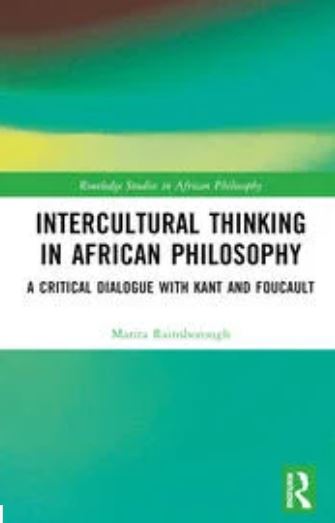
Intercultural Thinking in African Philosophy: A Critical Dialogue with Kant and Foucault, Routledge (2024)

Abstract
This book sets up a rich intercultural dialogue between the philosophy of Immanuel Kant and Michel Foucault, and that of key African thinkers such as Kwame Anthony Appiah, Achille Mbembe, Kwasi Wiredu, Kwame Gyekye, Tsenay Serequeberhahn, and Henry Odera Oruka.

The book challenges western-centric visions of an African future by demonstrating the richness of thought that can be found in African and Afrodiasporic philosophy. The book shows how thinkers such as Serequeberhan have criticised the inconsistencies in Kant’s work, whereas others such as Wiredu, Gyekye, Appiah and Mbembe have referenced his work more positively and developed progressive political concepts such as the metanational state; partial cosmopolitanism and Afropolitanism. The book goes on to consider how Mbembe and Mudimbe have responded to Foucault’s ideas in deciphering the various Western, African and Afrodiasporic discourses of knowledge on Africa.

The book concludes by considering various theories of intercultural exchange, from Gyekye’s cultural borrowing, to Appiah’s conversation across boundaries, Wiredu’s cross cultural dialogue, Mbembe’s thinking outside the frame, Serequeberhan’s dialogue at a distance, and Oruka’s call for global re-distribution and a new ecophilosophical attitude to safeguard human existence on the planet.

This book invites us all to engage in intercultural dialogue and mutual respect for different cultural creations. It will be an important read for researchers in Philosophy wherever they are in the world. © 2024 Marita Rainsborough.

Ratcliffe, J.
Genealogy: A conceptual map (2024) European Journal of Philosophy

DOI: 10.1111/ejop.12949

Abstract
The blossoming literature on genealogy in recent years has come as somewhat of a pleasant surprise to the historically inclined among us. It has not, however, come without its difficulties. As I see it, the literature on genealogy is guilty of two conflations, what I call the “debunking/problematizing conflation” and the “problematizing/rationalizing conflation.” Both are the result of the inadequate typological maps currently used to organize the literature. As a result, what makes many genealogies philosophically interesting often remains obscure. In response, I propose a new two-dimensional typology that avoids these conflations and outfits us with a richer conceptual vocabulary with which to understand and organize the genealogies which populate the literature. By identifying a second dimension of analysis which has thus far gone untheorized, my typology enables us to elucidate the various normative objectives and objects of investigation structuring a literature which is more diverse than previously acknowledged. We can thus get a clearer understanding of the problems those genealogies face, of their critical potential, and of their implications for our conception of critique. © 2024 The Authors. European Journal of Philosophy published by John Wiley & Sons Ltd.

Author Keywords
background frameworks; Brandom; debunking; debunking/problematizing conflation; Foucault; genealogy; genetic fallacy; problematizing; problematizing/rationalizing conflation; rationalizing; self-defeat; two-dimensional typology; vindicatory; Wittgenstein

Bigoni, M., Maran, L., Occhipinti, Z.
Of power, knowledge and method: The influence of Michel Foucault in accounting history
(2024) Accounting History

DOI: 10.1177/10323732241243088

Abstract
Michel Foucault’s work had a strong influence not only in philosophy but also in a wide range of humanistic and social disciplines, including accounting. Notably, the first studies which brought Foucault’s thought to the attention of interdisciplinary accounting scholars were historical. This article documents how Foucault’s ideas have directly inspired accounting history scholars, how the latter have interpreted and brought Foucault’s work into their field as well as what future research paths may lie ahead. The article offers a systematisation of how the complex ideas of Foucault have been translated into eight key themes that have provided a crucial interpretive prism to many studies in accounting history. In doing so, it assists scholars wishing to familiarise themselves with Foucault’s work and employ it in their research. © The Author(s) 2024.

Author Keywords
accounting history; Foucault; interdisciplinary; knowledge; literature review; power