
Foucault News

News and resources on French thinker Michel Foucault (1926-1984)

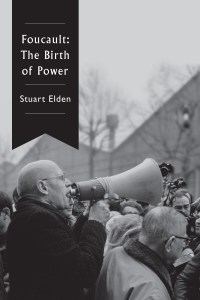
elden-bopStuart Elden, Foucault: The Birth of Power, Polity, 2017

Michel Foucault’s The Archaeology of Knowledge was published in March 1969; Discipline and Punish in February 1975. Although only six years apart, the difference in tone is stark: the former is a methodological treatise, the latter a call to arms. What accounts for the radical shift in Foucault’s approach?

Foucault’s time in Tunisia had been a political awakening for him, and he returned to a France much changed by the turmoil of 1968. He taught at the experimental University of Vincennes and then moved to a prestigious position at the Collège de France. He quickly became involved in activist work concerning prisons and health issues such as abortion rights, and in his seminars he built research teams to conduct collaborative work, often around issues related to his lectures and activism.

Foucault: The Birth of Power makes use of a range of archival material, including newly available documents at the Bibliothèque nationale de France, to provide a detailed intellectual history of Foucault as writer, researcher, lecturer and activist. Through a careful reconstruction of Foucault’s work and preoccupations, Elden shows that, while Discipline and Punish may be the major published output of this period, it rests on a much wider range of concerns and projects.

Table of Contents
Acknowledgements
Abbreviations
Introduction: Out of the 1960s
1. Measure: Greece, Nietzsche, Oedipus
2. Inquiry: Revolt, Ordeal, Proof
3. Examination: Punishment, War, Economy
4. Madness: Power, Psychiatry and the Asylum
5. Discipline: Surveillance, Punishment and the Prison
6. Illness: Medicine, Disease and Health
Conclusion: Towards Foucault’s Last Decade
Notes
Index

About the Author
Stuart Elden is Professor of Political Theory and Geography at the University of Warwick and Monash Warwick Professor in the Faculty of Arts, Monash University.

tippetRandell-Moon, Holly, Tippet, Ryan (Eds.) Security, Race, Biopower. Essays on Technology and Corporeality, Palgrave Macmillan, 2016

This book explores how technologies of media, medicine, law and governance enable and constrain the mobility of bodies within geographies of space and race. Each chapter describes and critiques the ways in which contemporary technologies produce citizens according to their statistical risk or value in an atmosphere of generalised security, both in relation to categories of race, and within the new possibilities for locating and managing bodies in space. The topics covered include: drone warfare, the global distribution of HIV-prevention drugs, racial profiling in airports, Indigenous sovereignty, consumer lifestyle apps and their ecological and labour costs, and anti-aging therapies.

Security, Race, Biopower makes innovative contributions to multiple disciplines and identifies emerging social and political concerns with security, race and risk that invite further scholarly attention. It will be of great interest to scholars and students in disciplinary fields including Media and Communication, Geography, Science and Technology Studies, Political Science and Sociology.

Table of contents (10 chapters)

Death by Metadata: The Bioinformationalisation of Life and the Transliteration of Algorithms to Flesh
Pugliese, Joseph

Of Bodies, Borders, and Barebacking: The Geocorpographies of HIV
Pocius, Joshua

Body, Crown, Territory: Geocorpographies of the British Monarchy and White Settler Sovereignty
Randell-Moon, Holly

What Are You Doing Here? The Politics of Race and Belonging at the Airport
Kamaloni, Sunshine M.

Corporate Geocorpographies: Surveillance and Social Media Expansion
Tippet, Ryan

Everyday Modulation: Dataism, Health Apps, and the Production of Self-Knowledge
Nicholls, Brett

Invisible Bodies and Forgotten Spaces: Materiality, Toxicity, and Labour in Digital Ecologies
Taffel, Sy

Domesticating Drone Technologies: Commercialisation, Banalisation, and Reconfiguring ‘Ways of Seeing’
Phan, Thao (et al.)

The Somatechnics of Desire and the Biopolitics of Ageing
Fletcher, David-Jack

Securing Sovereignty: Private Property, Indigenous Resistance, and the Rhetoric of Housing
Kramer, Jillian

Jordi Collet-Sabé, ‘I do not like what I am becoming but…’: transforming the identity of head teachers in Catalonia, Journal of Education Policy, Volume 32, 2017 – Issue 2. Pages 141-158
https://doi.org/10.1080/02680939.2016.1253873

Abstract
The aim of this article is to elucidate how a new system of school and teacher assessment in Catalonia is transforming the conceptions, practices and identity of head teachers, especially younger ones. It begins by considering the impact of global neoliberal policies on educational practices, highlighting their Foucauldian productive nature. It then examines the educational context of Catalonia during the last 30 years, emphasising the changing role of head teachers and the impact of neoliberal governance. This is followed by an account and analysis of in-depth interviews with four head teachers, focusing especially on how the head teacher’s objectives, practices and identities are being transformed, or produced, as a result of the new neoliberal ‘assessment regime’. It ends with a discussion on the importance of refusal and resistance to this process and the need to reconsider basic educational and social questions.

Keywords: Head teacher identity, school assessment, New Public Management, OECD, school governance

Foucault in Ireland
24 March 2017
Royal Irish Academy, Dawson Street, Dublin 2, Ireland
Attendance is free but you are required to register

A symposium focused on the engagement of the ideas of Michel Foucault by scholars working on the island of Ireland. It begins with a roundtable on the recent works on Foucault by Stuart Elden and then has papers from academics working in Ireland or on Irish topics – including criminology, international relations, social work, philosophy, geography, literary studies, cultural studies, English, etc.

Preliminary Programme
9.30. Registration, Royal Irish Academy, Dawson Street, Dublin 2
9.45. Introductions
10.00. Roundtable on Stuart Elden’s Foucault: the birth of power (Polity, 2017) and Foucault’s Final decade (Polity, 2016). With Stuart Elden,
Gerry Kearns, Mick Wilson, and Audronė Žukauskaitė. There will be flyers on the day so that people can order the books at a discount
price.
11.00. Session 1
12.00. Lunch
13.00. Session 2
14.00. Session 3
15.00. Tea
15.30. Session 4
16.30. Final Roundtable
17.30. Reception and book launch for S.E. Wilmer and Audronė Žukauskaitė (eds.), Resisting Biopolitics: Philosophical, Political and Performative Strategies (Routledge, 2016). Trinity College

cover_issue_703_en_usFoucault Studies
Number 22: January 2017:
Foucault and Roman Antiquity: Foucault’s Rome

Editor’s note: I have now returned to the journal, of which I was one of the co-founders, as part of an expanded editorial team. An interview with another of the three founding editors of the journal, Stuart Elden, also appears in this issue, as does a review of his latest book. The opening editorial states:

With this issue of Foucault Studies, a new and markedly expanded editorial team takes over. While Sverre Raffnsøe, Alain Beaulieu, Barbara Cruikshank, Knut Ove Eliassen, Marius GudmandHøyer, Johanna Oksala and Alan Rosenberg continue on the editorial team, Foucault Studies is delighted to welcome Thomas Götselius, Daniele Lorenzini, Hernan Camilo Pulido Martinez, Clare O’Farrell, Rodrigo Castro Orellana, Eva Bendix Petersen and Dianna Taylor as co-editors.

Table of contents

Special Issue on Foucault and Roman Antiquity: Foucault’s Rome

Introduction: Foucault’s Rome
Richard Alston

Lucan, Reception, Counter-history
Ika Willis

Foucault, Sovereignty, and Governmentality in the Roman Republic
Dean Hammer

The Augustan Principate and the Emergence of Biopolitics: A Comparative Historical Perspective
Shreyaa Bhatt

Foucault’s Empire of the Free
Richard Alston

Time for Foucault? Reflections on the Roman Self from Seneca to Augustine
James I. Porter

Articles
From Race War to Socialist Racism: Foucault’s Second Transcription
Verena Erlenbusch

Foucault and Weber on Leadership and the Modern Subject
Tahseen Kazi

Protestation and Mobilization in the Middle East and North Africa: A Foucauldian Model
Navid Pourmokhtari

Translations
Cuvier’s Situation in the History of Biology
Lynne Huffer

Interviews
Foucault and Intellectual History: An interview with Stuart Elden on his book Foucault’s Last Decade (Polity Press, 2016)
Antoinette Koleva

Julian Reid on Foucault – applying his work on war, resilience, imagination and political subjectivity
Kristian Haug

Book Reviews
Stuart Elden, Foucault’s Last Decade (Cambridge: Polity Press, 2016), 272pp, pb £17.99, ISBN: 9780745683928
Kurt Borg

Paul Colilli, Agamben and the Signature of Astrology. Spheres of Potentiality (Lanham: Lexington Books, 2015), i-xx, 214 pp. hard cover, $85.00 (US) ISBN: 978-1-4985-0595-6
Alain Beaulieu

Peter Sloterdijk, Philosophical Temperaments: From Plato to Foucault, trans. Thomas Dunlap (New York: Columbia University Press, 2013), ISBN: 978-0231153737
Jonathan G. Wald

Posts will be intermittent through the month of January. I will still post up any news that is sent on to me directly.

Lenneis, V., Pfister, G.
Health messages, middle-aged women and the pleasure of play
(2016) Annals of Leisure Research, pp. 1-20. Article in Press.

DOI: 10.1080/11745398.2016.1207091

Abstract
Western societies glorify youth and consider middle age as the onset of deterioration. The prevalent discourses on middle-aged women focus primarily on negative developments in their lives such as increased health risks after menopause. Little is known, however, about the lived experiences of this age group. In this article, we share information about the health- and ageing-related attitudes of women aged 45–55 years who took part in a physical activity intervention in Denmark. Drawing on Foucault’s concepts of disciplinary power and governmentality, we explored via 15 semi-structured interviews the women’s reasons for participation and their experiences with playing a team game. The interviews revealed that they had internalized the messages of ‘healthy ageing’ and felt guilty about their previous inactive lifestyle. However, their participation was also influenced by changing life circumstances. Now they had time to exercise and, contrary to previous experiences, they found that playing games provided pleasure. © 2016 Australia and New Zealand Association of Leisure Studies

Author Keywords
ageing; Gender; leisure time physical activity; midlife; qualitative research

As part of the Women, Gender, and Sexuality in Religion Forum 2009-10 Lecture Series, Mark D. Jordan, Richard Reinhold Niebuhr Professor of Divinity at HDS, presented “Reading Foucault: Becoming Again What We Never Were” on April 12, 2010. This event was sponsored by the Committee on Women, Gender, and Sexuality in Religion at Harvard.

History and Theory: Special Issue: Words, Things, and Beyond: Foucault’s Les mots et les choses at 50

INTRODUCTORY REMARKS: FOUCAULT’S LES MOTS ET LES CHOSES AT 50 (pages 3–6)
PETER E. GORDON

PHENOMENOLOGY AND ANTHROPOLOGY IN FOUCAULT’S “INTRODUCTION TO BINSWANGER’S DREAM AND EXISTENCE“: A MIRROR IMAGE OF THE ORDER OF THINGS? (pages 7–22)
BÉATRICE HAN-PILE

VANISHING POINT: LES MOTS ET LES CHOSES, HISTORY, AND DIAGNOSIS (pages 23–34)
JEAN-CLAUDE MONOD

FOUCAULT’S ICONIC AFTERLIFE: THE POSTHUMOUS REACH OF WORDS AND THINGS (pages 35–53)
NANCY PARTNER

THE POLITICS OF THE ORDER OF THINGS: FOUCAULT, SARTRE, AND DELEUZE (pages 54–65)
GARY GUTTING
Version of Record online: 15 DEC 2016 | DOI: 10.1111/hith.10828

The Sixth Annual History and Theory Lecture
THE ORDER OF THINGS: AN ARCHAEOLOGY OF WHAT? (pages 66–81)
VINCENT DESCOMBES

UNEXPECTED AND VITAL CONTROVERSIES: FOUCAULT’S LES MOTS ET LES CHOSES IN ITS PHILOSOPHICAL MOMENT AND IN OURS (pages 82–92)
FRÉDÉRIC WORMS

NATURE AND THE IRRUPTIVE VIOLENCE OF HISTORY (pages 93–111)
JULIAN BOURG

MONSTERS AND PATIENTS: AN ARCHAEOLOGY OF MEDICINE, ISLAM, AND MODERNITY (pages 112–130)
AHMED RAGAB

OUT OF THEIR DEPTHS: “MORAL KINDS” AND THE INTERPRETATION OF EVIDENCE IN FOUCAULT’S MODERN EPISTEME (pages 131–147)
LAURA STARK

Nancy Partner, Foucault’s iconic afterlife: The posthumous reach of words and things, History & Theory Volume 55, Issue 4, December 2016, Pages 35–53
https://doi.org/10.1111/hith.10827

ABSTRACT
The lasting influence of Michel Foucault’s work is both instantly recognizable in that his very name can be invoked as a noun or adjective (“Foucauldian”), as a critical stance or attitude without further elaboration, and yet his signature concepts have been flattened, stretched, exaggerated, and thinned as they have been applied by his most enthusiastic followers. Although Foucault has entered the canon of philosophers, he also became iconic, most notably with the typographic icon, power/knowledge, a (possibly unwanted) achievement of recognition and compression virtually unknown to other philosophers. In this essay, I consider the Foucault of the philosophical canon, and I trace some of the main routes of the iconic Foucault into acceptance or nonacceptance by the academic disciplines, notably history and anthropology, and numerous other unexpected venues where variants of Foucault’s ideas have found surprising homes. I also contemplate the meaning of the status of “iconicity” as it has been analyzed by sociologists, and the possibility that iconic misreadings of Foucault’s concepts have been extraordinarily “good to think with” by his critics.

Keywords:

Sahlins;power/knowledge;icon;iconic;iconicity;history;anthropology;Leviathan