Foucault News

News and resources on French thinker Michel Foucault (1926-1984)

Patricio Lepe-Carrión, Predicación, verdad y sujeto colonial: genealogías de la obediencia en contexto mapuche, Chasqui. Revista Latinoamericana de Comunicación N.º 132, agosto -noviembre 2016 (Sección Ensayo, pp. 245-260)

Texto completo

Resumen
El presente texto examina las formas de predicación jesuita, contenidas en el esquema de subjetividad cristiana, y que entran en juego con las estrategias de conquista, expansión y explotación en el reino de Chile durante el siglo XVII. Se propone una lectura del pasado colonial, de sus relaciones de poder imbricadas en las ‘tecnologías del yo’, en el marco de un proyecto Fondecyt de Iniciación (nº11140804) que tiene como objeto de análisis los efectos de despolitización que tiene la Educación Intercultural durante las últimas décadas de postdictadura. El eje que orienta este trabajo está en pensar cómo el núcleo de la subjetividad mapuche (weichafe) ha sido durante siglos el foco de interés en las políticas o prácticas de dominación imperial.

Palabras clave
gubernamentalidad; predicación cristiana; tecnologías del yo; sujeto colonial; mapuche

Patricio Lepe-Carrión, Intercultural Education in Chile: Colonial Subjectivity and Ethno-Governmental Rationality, SISYPHUS Journal of Education volume 3, issue 3, 2015, pp. 60-87

Full PDF

Abstract
This article is the product of research conducted in the frame of FONDECYT Research Initiation project nº 11140804, entitled “Education and Cultural Racism: Evidence and Discursivities in Agents Who Implement the Bilingual Intercultural Education Program (PEIB)”, jointly conducted by the University of Chile’s Department of Pedagogical Studies and the University of Sao Paulo’s Faculty of Education Postdoctoral Program. The text explores the problem of “cultural racism” in intercultural education programs developed for Mapuche indigenous children in Chile. In order to do so, we first examine the production of subjectivity during the colonial era and later the emergence of ethnic issues in the current government agenda. Our evidence and analysis display how the degradation of indigenous peoples is objectified in the Chilean State’s discursive practices, perpetuating social and economic inequality through the production and administration of identities, as well as efficiently controlling ethnic conflicts.

Keywords
Racism, Governmentality, Intercultural education, Mapuche people, Chile

Announcing the
International Consortium of Critical Theory Programs

In December 2016, the Andrew W. Mellon Foundation awarded a three-and-a-half year, $1,525,000 grant to the University of California, Berkeley and $1,020,000 to Northwestern University to establish the International Consortium of Critical Theory Programs (ICCTP). The task of this international consortium is to document, connect, and support the various programs and projects that now represent critical theory across the globe, especially in light of contemporary global challenges to thinking about democracy, violence, memory, and the critical tasks of the university. The Consortium rests on the view that critical theory is not only an important interdisciplinary field of research and teaching within the university, but crucially informs the university as an institution charged with the task of safeguarding and promoting critical thought. The Consortium is co-directed by Professor Judith Butler (UC Berkeley) and Professor Penelope Deutscher (Northwestern University).

As a special project of the Program in Critical Theory at UC Berkeley, the Consortium maintains a multi-lingual website, criticaltheoryconsortium.org, that provides information on critical theory programs and initiatives throughout the world, seeking to connect projects that have for too long remained unknown to one another. The website features an interactive map and a growing directory of nearly 300 critical theory programs, centers, and projects from throughout the world, including programs in Africa, South and Southeast Asia, Latin America, the United States, Europe and its peripheries, the Balkans as well as the Middle East, Russia, and East Asia. The website links to journals and publishing series, archives, organizations and networks, summer institutes, fellowships and potential scholarly affiliations. The platform is currently searchable in English, Spanish, and French.

The Consortium will also publish a book series, Critical South, with Polity Press supporting translations from Spanish, Portuguese, and French, as well as an online journal called Critical Times: Interventions in Global Critical Theory, and will convene biannual conferences focused on contemporary critical issues of global concern. The Consortium also invites international scholars to engage with faculty and students through UC Berkeley’s Program in Critical Theory. Under the direction of Northwestern University, a curricular initiative of the Consortium, Critical Theory in the Global South, will develop new teaching curricula reflective of critical theory’s global reach in conjunction with an associated program of international faculty and graduate student exchange and a translation project. It will allow the establishment of new international cooperative relations among critical theory scholars through cross-university projects linking institutions in Latin America, North America, and South Africa. The Consortium also supports the University of California, Irvine Libraries Critical Theory Archive Research Resources Development Project, which will expand the Archive to more clearly reflect the global reach and shape of the field.

With all of these initiatives, the Consortium seeks to establish the new global contours of critical theory today, supporting critical thought both inside and outside the university in the arts, humanities, and social sciences, and seeking collaborative ways to become more responsive to pressing global challenges. The Consortium undertakes both to preserve and to galvanize the study of critical theory in its myriad global forms, underscoring the crucial place of critical thought in the university and in its various public engagements and worldly obligations. The Consortium also aims to incite new forms of collaborative research among a wide range of regions and languages, connecting the disconnected and foregrounding the periphery in an effort to respond critically to contemporary global challenges. These include evaluative metrics and forms of censorship that devalue or suppress the critical and transformative potential of thought itself.

For more information, please contact: info.ictconsortium@berkeley.edu

Letzlove, portrait(s) Foucault
Adaptation de Pierre Maillet
d’après Vingt ans et après / Letzlove l’anagramme d’une rencontre de Thierry Voeltzel
mise en scène Pierre Maillet

Du mar. 28/02/17 au sam. 04/03/17
Rouen
Du mar. 25/04/17 au jeu. 27/04/17
Brest

Critiques

Présentation

Eté 1975. Un jeune homme fait du stop sur l’autoroute en direction de Caen. Le conducteur qui s’arrête a un look inhabituel : un homme chauve, avec des lunettes cerclées d’acier, un polo ras du cou et une curiosité constante pour son jeune passager. Ils échangent leurs coordonnées avant de se dire au revoir… Trois ans plus tard paraîtra un livre d’entretiens entre cet inconnu de vingt ans, Thierry Voeltzel, et ce célèbre philosophe, Michel Foucault, qui avait alors tenu à garder l’anonymat. Au cours de la conversation qui se noue entre eux, sont abordées les mutations existentielles de la jeunesse dans son rapport avec la sexualité, les drogues, la famille, le travail, la religion, la musique, les lectures… et la révolution. Quarante ans après, l’intérêt de ce document réside autant dans les expériences vécues de Thierry que dans le portrait en creux de son interviewer.

Le passage au théâtre de ces entretiens rendra donc palpable, physique et vivante l’impression directe provoquée à leur lecture. Mettre en avant la rencontre, et surtout le jeune homme. En faire le portrait avec une chaise, un projecteur diapos et deux micros. Utiliser les outils de tout conférencier, professeur, ou rencontre publique quelconque (du moins en 1975) pour mettre l’intime en lumière avec la même franchise et la même décontraction que son interlocuteur il y a quarante ans. Nous serons deux, comme dans le livre. En lumière le jeune Thierry, qui sera un garçon d’aujourd’hui et surtout du même âge. Quant à moi je me chargerai des questions. L’idée de cette forme, très autonome et très simple permettrait au spectacle de circuler le plus possible : à l’université, dans les librairies, bibliothèques, divers lieux culturels et sociaux, en appartements, mais aussi bien sûr au théâtre, dans les décors des spectacles qui joueraient au même moment, pourquoi pas… La circulation presque interventionniste de cette parole intime et libertaire me paraît juste, excitante, et permet de poser simplement par le biais d’une attention particulière à la jeunesse et au dialogue inter générationnel, la question de la liberté et de l’engagement.

Letzlove – portrait(s) Foucault, d’après « Vingt ans et après », de Michel Foucault et Thierry Voeltzel (éd. Verticales, 2013). Adaptation et mise en scène Pierre Maillet. Le Monfort Théâtre, 106, rue Brancion, Paris 15e. Tél. : 01-56-08-33-88. Du mardi au samedi à 20 h 30, jusqu’au 21 janvier. Durée : 1 h 20. Puis à Rouen du 28 février au 4 mars, et à Brest du 25 au 27 avril.

17th Annual Meeting of the Foucault Circle
Loyola-Marymount University
Los Angeles, CA
March 23-25, 2017

Thursday 23 March

4:00-4:45 Foucault Circle Welcome

5:00-7:15 Film Screening of “Sur les toits” and Roundtable Discussion with director Nicolas Drolc

Moderator: Andrew Dilts
7:15-8:15 Reception with Filmmaker

Friday 24 March

8:30-9:00 Coffee/Tea, Light Breakfast

9:00-10:15
Moderator: Anthony Ristow
1. Kevin Jobe (Morgan State University, USA), Foucault & the Meaning of Politics: Towards a Genealogy of Tyrannical Power
2. Stephanie Martens (Laurentian University, Canada) Foucault’s Game(s): Jeu, Metaphors and Translations

10:30-11:45

Moderator: Ed McGushin
1. Verena Erlenbusch (University of Memphis, USA), The Spatiality of History: Foucaultian Genealogy and Coloniality of Power
2. Valentina Moro (Università di Padova, Italy, Brown University, USA), Politics of Refusal: Criticizing the Notion of Exclusion through the Interruption of the Settlers’ Narration

12:00-1:15
Moderator: Brad Stone
1. Selin Islekel (Loyola Marymount University, USA), Haunting Dead: Necropolitics of Mourning and Grief
2. Sarah Earnshaw (Ludwig-Maximilians-Universität, Germany), Foucault in Foreign Policy: Interrogating the Global Society to Be Defended

1:15-2:30 LUNCH

2:30-4:15
Moderator: Joanna Crosby
1. Dianna Taylor (John Carroll University, USA), The Relation of Self to Self and (Counter)Normalization: Irish Republican Women During and After the Troubles
2. Don Deere (Loyola Marymount University, USA), Truth, Terror, and Dangerous Speech: Foucault and León Rozitchner
3. Sanem Guvenc-Salgirli (Emily Carr University, Canada, Fernand Baudel Center, USA), Governmentality, Sovereignty, and Critique: Revisiting Foucault’s Contemporary Relevance

4:30-5:30 Business Meeting

6:30 DINNER (Location TBD)

Saturday 25 March

8:30-9:00 Coffee/Tea, Light Breakfast

9:00-10:45
Moderator: Kevin Jobe
1. Martín Bernales Odino (Boston College, USA), Towards a Genealogy of Latin American Poverty: La Buena Policía de los Pobres (The Good Police of the Poor)
2. Berndt Clavier (Malmö University, Sweden), On Veridiction: Metrologies of Art in the European Welfare State
3. Diana Young (Carleton University, Canada), Images of the Individual Rights and Governmental Power in Canadian Criminal Law

11:00-12:15
Moderator: Dana Belu
1.Kevin Thompson (DePaul University, USA) Intolerable: Foucault’s Historical Constructivism
2. Shruti Rao and Kristi Carey (University of British Columbia, Canada) Error Signals: Registering Intimacies and Occlusions of the Female Body Politic

12:10-1:30 LUNCH

1:30-3:00
Moderator: Nicole Ridgway
1. Alex Feldman (Pennsylvania State University, USA) Foucault and Meinecke at the Intersection of Raison d’Etat, Historicism, and Ethics: The Problem of History
2. Andrew LaZella (University of Scranton, USA), Vie Autre: Foucault’s Neo-nominalism and the Invention of the Improbable

ley-y-ser_faja MARCO DÍAZ MARSÁ, Ley y ser, Derecho y ontología crítica en Foucault (1978-1984)
Editorial: Escolar y Mayo
Año de publicación: 2016.
País de publicación: España

Ficha
Indice

“Sorprende descubrir en este libro una lectura de Foucault muy a contracorriente de lo habitual. Muchos se extrañarán de comprobar hasta qué punto, para Foucault, el cuidado de la libertad es también el cuidado del derecho y de la ley. Toda una invitación para la recuperación crítica de las mejores armas de la razón y de la Ilustración, en polémica directa con los grandes profetas de la sospecha radicalizada.” Carlos Fernández Liria

Repárese en que el principio de limitación gubernamental no es aquí el mercado ni el interés, sino algo que se habrá de ubicar al exterior de la dinámica de los intereses, justamente los derechos humanos. Con todo, lo que resulta más sobresaliente es el vínculo que Foucault establece entre el «afecto político» y una «política de los derechos humanos». ¿Es posible fundar una política de los derechos humanos en un afecto, en un sentimiento –y no en una idea positiva de «humanidad»? ¿Cómo fundar a partir de las indignaciones, de la détestation, de lo inaguantable o de lo intolerable una política de los derechos humanos? Las indicaciones que Foucault procura para elaborar una posible respuesta a esta cuestión vendrían a desconcertar y a incordiar en todo lo esperado.

Published on Dec 8, 2016
Course: Contemporary Sociology Theory – WEEK 10 – Foucault and History of Sexuality – 1
Instructor: Assoc. Prof. Erdoğan Yıldırım

Daniele Lorenzini Martina Tazzioli, Confessional Subjects and Conducts of Non-Truth: Foucault, Fanon, and the Making of the Subject, Theory, Culture and Society, First Published January 1, 2016

Full article available online

Abstract
This article puts Michel Foucault and Frantz Fanon into dialogue in order to explore the relationships between the constitution of subjects and the production of truth in modern Western societies as well as in colonial spaces. Firstly, it takes into account Foucault’s analysis of confessional practices and the effects of subjection, objectivation, and subjectivation generated by the injunction for the subject to tell the truth about him or herself. Secondly, it focuses on the question of interpellation that emerges in the colonial context and on the colonized who, as Fanon illustrates, is always seen as a deceitful subject. Finally, it shows that, despite the difference in the relationships between the constitution of subjectivity and the production of true discourses described by Foucault and Fanon, the transformative dimension enacted by the processes of subjectivation and by the practices of resistance constitutes a shared conceptual and political ground between the two authors.

Keywords confession, Fanon, Foucault, subjectivation, truth

Journée d’étude
“Foucault est-il incontournable pour les études de genre ?”

Samedi 4 février 2017
9h15 – 17h
Université Paris 1 Panthéon-Sorbonne, UFR de Philosophie
17 rue de la Sorbonne, Paris 5e
Salle Halbwachs (escalier C, 1er étage)

9h15 – Sandra Laugier & Daniele Lorenzini (philosophie, Paris 1) : Accueil

9h30 – Pascale Molinier (psychologie sociale, Paris 13 SPC) & Olivier Ouvry (psychiatrie, psychanalyse, Paris 13 SPC) : Introduction. Problématiques

9h45 – Laurie Laufer (psychanalyse, Paris Diderot) : Une psychanalyse foucaldienne ?

10h30 – Rostom Mesli (littérature comparée, University of Pittsburgh) : « Et la Queer Theory créa Foucault à son image… »

11h15 – Pause

11h30 – Aurélie Pfauwadel (psychanalyse, philosophie, Paris 1) : « Il n’y a pas de normes sexuelles : il n’y a que des normes sociales ». Lacan, réponse à Foucault

12h15 – Manuela Salcedo (sociologie, EHESS) : La sexualité des migrant.e.s : comment la France trie, vérifie et juge via le dispositif de soupçon

13h – Pause déjeuner

14h30 – Thamy Ayouch (philosophie, psychanalyse, Lille 3) : Catégories historiques, « réalités de transaction » : Foucault dans l’œuvre de Joan W. Scott

15h15 – Guillaume le Blanc (philosophie, Paris-Est Créteil) : Critique de l’identité personnelle. De Foucault à Butler

16h – Julie Mazaleigue-Labaste (philosophie, Paris 1) : Foucault au prisme des gay and lesbian studies : de l’inversion sexuelle à l’identité de genre

Cette journée d’étude est organisée dans le cadre du programme Trans/FEM financé par le Défi Genre de la mission interdisciplinarité du CNRS et du « Séminaire Foucault » 2016-2017 (PhiCo, Université Paris 1 Panthéon-Sorbonne).

Les inscriptions se font par mail avant le 3 février à l’adresse : transfem88@gmail.com

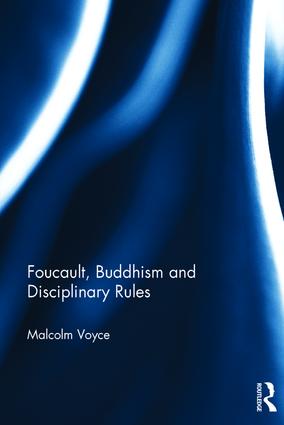
voyceMalcolm Voyce, Foucault, Buddhism and Disciplinary Rules, Routledge, 2017

About the Book
This book suggests that previous critiques of the rules of Buddhist monks (Vinaya) may now be reconsidered in order to deal with some of the assumptions concerning the legal nature of these rules and to provide a focus on how Vinaya texts may have actually operated in practice. Malcolm Voyce utilizes the work of Foucault and his notions of ‘power’ and ‘subjectivity’ in three ways. First, he examines The Buddha’s role as a lawmaker to show how Buddhist texts were a form of lawmaking that had a diffused and lateral conception of authority. While lawmakers in some religious groups may be seen as authoritative, in the sense that leaders or founders were coercive or charismatic, the Buddhist concept of authority allows for a degree of freedom for the individual to shape or form themselves. Second, he shows that the confession ritual acted as a disciplinary measure to develop a unique sense of collective governance based on self regulation, self-governance and self-discipline. Third, he argues that while the Vinaya has been seen by some as a code or form of regulation that required obedience, the Vinaya had a double nature in that its rules could be transgressed and that offenders could be dealt with appropriately in particular situations. Voyce shows that the Vinaya was not an independent legal system, but that it was dependent on the Dharmaśāstra for some of its jurisprudential needs, and that it was not a form of customary law in the strict sense, but a wider system of jurisprudence linked to Dharmaśāstra principles and precepts.

Table of contents
Introduction to the Work of Foucault and its Use in this Study
An Overview of the Vinaya
The Presentation of the Vinaya within Forms of Western Scholarship
The Vinaya and the Dharmaśāstra
The Formation of the Religious Body
From Ethics to Aesthetics
The Role of Confession and Discipline
Rules and Transgressions
Conclusion: The ‘Care of the Self’ and the Practice of the Vinaya

Malcolm Voyce graduated in law at Auckland University in 1970. In 1980 he completed a Doctorate under J.D.M. Derrett at the School of Oriental and African Studies, University of London, UK, on the topic of the rules of Buddhist monks. This Doctorate was published in five articles. While teaching law at Macquarie University in 2001, he completed a second Doctorate on Foucault. This Doctorate has been published in article form and Dr Voyce has published some 20 articles or chapters in books utilizing the work of Foucault. In the last few years Dr Voyce has published further articles on Buddhism and law in leading journals. He recently published, with Erich Kolig, an edited volume entitled Muslim Integration, Pluralism and Multiculturalism in New Zealand and Australia (2016). Dr Voyce is currently an Associate Professor of Law at Macquarie University, Australia.