Teaching English or producing docility? Foucauldian analysis of Pakistani state-mandated English textbooks
Liaquat Ali Channa, Daniel Gilhooly, Abdul Razaque Channa, Syed Abdul Manan, and John Schwieter Cogent Education Vol. 4 , Iss. 1,2017
Abstract
The scholarship of language education, particularly with reference to learning and use of English, is marked by varieties of English. One may note two broad models: (1) ENL, ESL, and EFL; (2) EIL, ELF, and WEs. Although the scholarship is replete with debates, the debates seem to only construct and maintain that learning English and its use are neutral activities that earn and equip a learner with certain capital rather than make him/her as such. This paper draws upon Foucault’s theories of discourse and disciplinary power. This paper takes Pakistani
state-mandated English textbooks of Grades 1–5 as official documents that contain qualitative data. The qualitative data are analyzed thematically. Two major themes of male body and female body are found which are analyzed and discussed through the Foucauldian lens. The paper holds that learning English and its use perpetuate and produce docility. The paper contends that neither is language a neutral tool nor are its use and learning value-free activities in any of its varieties.
Keywords: Pakistan, English textbooks, primary grades, discourse, disciplinary power, docility
Theisens, H., Hooge, E., Waslander, S.
Steering Dynamics in Complex Education Systems. An Agenda for Empirical Research
(2016) European Journal of Education, 51 (4), pp. 463-477.
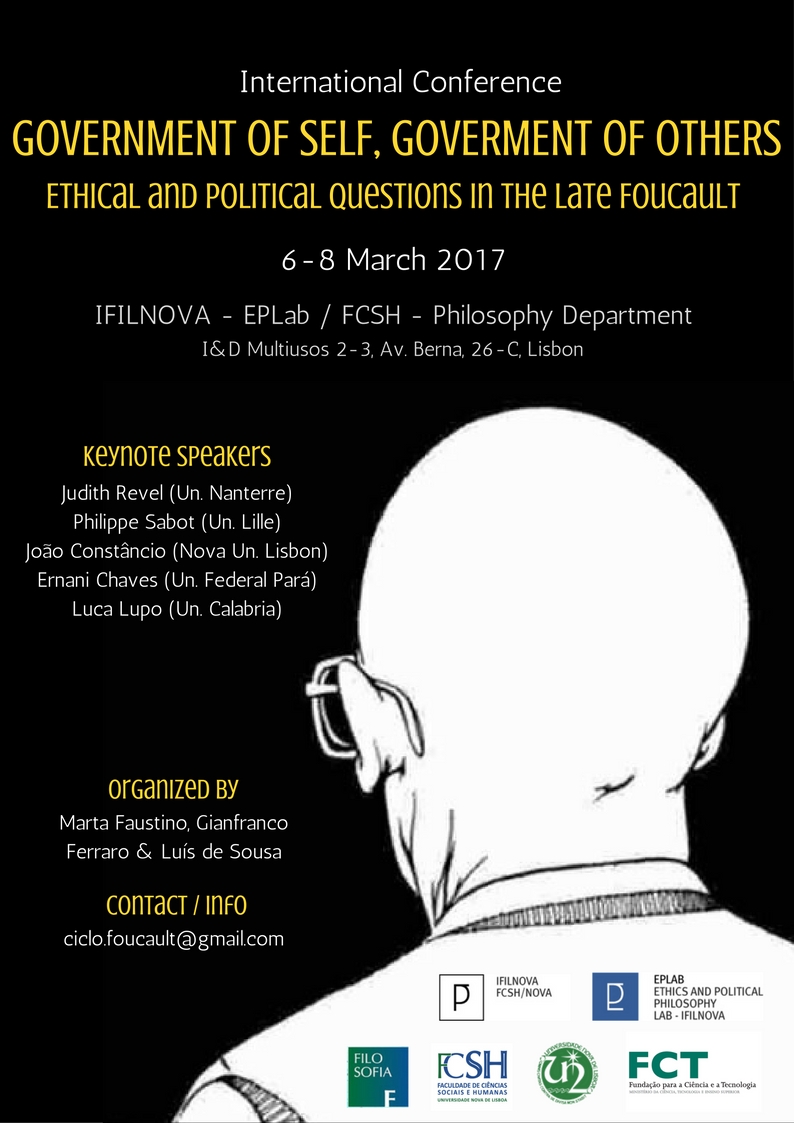
Michel Foucault’s last lecture series at Collège de France constitute a unity that testifies a shift in his thought. This shift deepens and expands the course of his preceding works concerning the genealogy of subjectivity, while, at the same time, adding to it a significant ethical and political dimension. Foucault returns to the practices of the self in antiquity and looks at the birth of the techniques of truth that allow us to understand how the Western subject has developed from the creation of particular relationships with its own body and other subjectivities. At the same time, these courses put in evidence the relationship between truth and power which lies at the core of Western forms of power and even Western democracy, thus inciting us to question our current political environment and face some political challenges of our time.
Finally, Foucault’s concern in these last years with the technologies of ethical self-formation through what he calls “care of the self” sheds new light on his philosophical endeavor as a whole and situates his reflections at the center of contemporaneous moral debates.
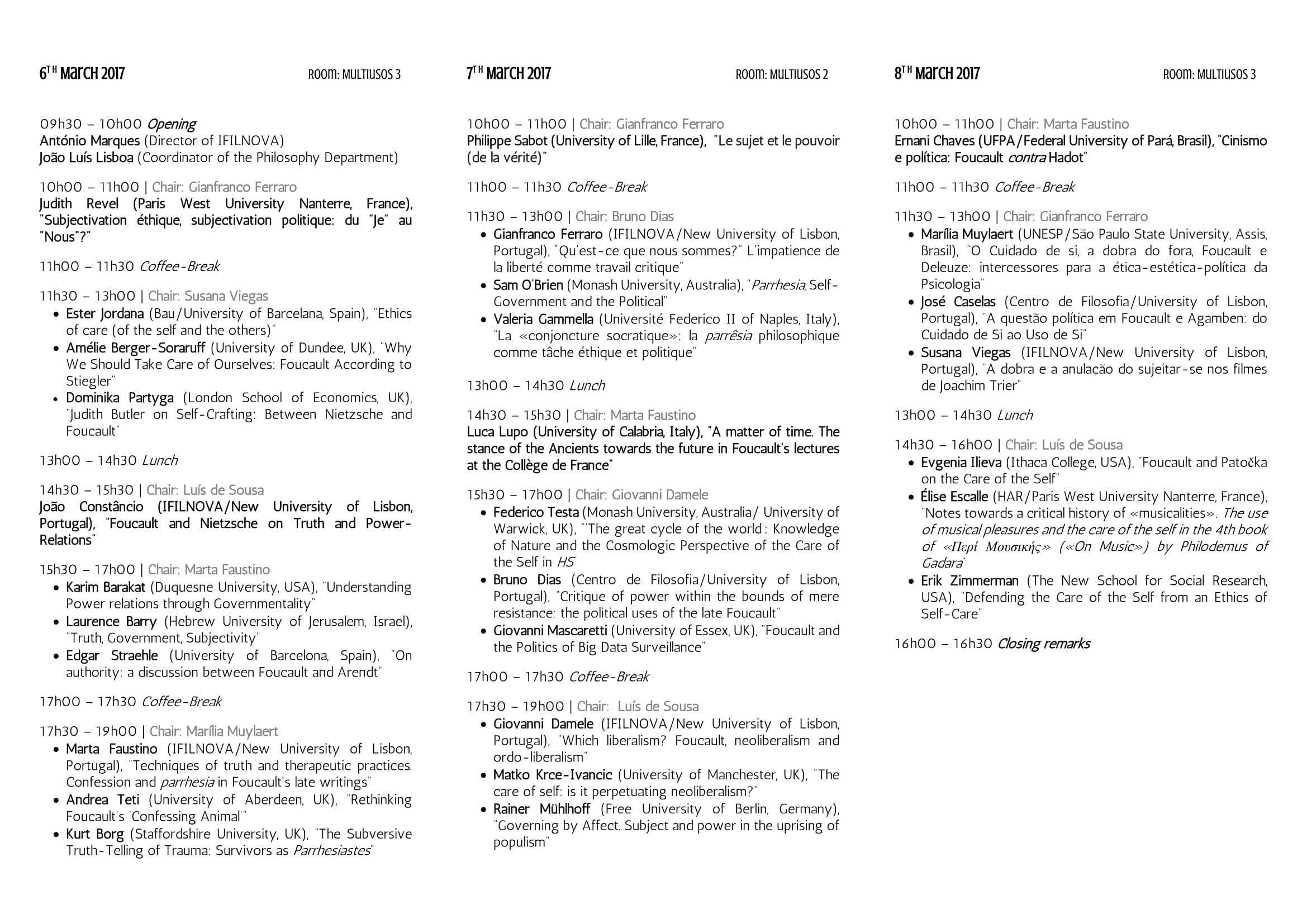
On the occasion of the 35th anniversary of The Hermeneutics of the Subject (1981-1982) and celebrating the conclusion of the publication of all the lecture courses from the 1980s – from On the Government of the Living (1979-1980) to The Courage of Truth (1984) -, this conference aims to (re)launch the critical debate on the last stage of Foucault’s thought, evaluating in what way and to which extent the perspectives that Foucault offers in this period might help us to unravel modernity and also give us tools to ethically and politically understand and transform our present.
Keynote Speakers
Judith Rével (Université Paris Ouest Nanterre)
João Constâncio (Universidade Nova de Lisboa)
Philippe Sabot (Université de Lille)
Luca Lupo (Universitá della Calabria)
Ernani Chaves (Universidade Federal do Pará)
Organizers
Marta Faustino, Gianfranco Ferraro, Luís de Sousa
Editor: To provide extra material for my Master of Education coursework students, I will be posting up quite a bit of material in the education area over the next month. These posts will be scheduled at a different time of day from other posts. The Foucault and education posts will all be tagged in the education category on the blog.
As always, please send on any Foucault related news from any arena for posting on Foucault News.
Published on Jan 25, 2017 http://www.egs.edu Wendy Brown, Professor of Philosophy at The European Graduate School / EGS. Saas-Fee Switzerland. August 13 2016.
Wendy Brown is Professor of Political Science at the University of California Berkeley. Her research interests include the history of political and social theory, Continental philosophy, and critical theory, together with the examination of contemporary capitalism. In her research into the problems that plague contemporary capitalism and neoliberalism, she employs theoretical works of Michel Foucault, Max Weber, Sigmund Freud, Friedrich Nietzsche, Karl Marx, and Frankfurt school.
In 1983, Wendy Brown received her doctoral degree from Princetown University. She subsequently taught at the University of California, Santa Cruz and also at Williams College. Since 1999, she has been teaching at the University of California, Berkeley.
Edgework: Critical Essays on Knowledge and Politics (2005) consists of seven articles which were all written for some particular occasion. Brown emphasises this trait of her book and claims that “such occasions mimic, in certain ways, the experience of the political realm: one is challenged to think here, now, about a problem that is set and framed by someone else, and to do so before a particular audience or in dialogue with others not of one’s own choosing.” Every essay in this book begins with a particular problem: what is the relationship between love, loyalty, and dissent in contemporary American political life?; how did neoliberal rationality become a form of governmentality?; what are the main problems of women’s studies programs?, etc. According to Brown, the aim of these essays is not to produce definitive answers to the given questions but “to critically interrogate the framing and naming practices, challenge the dogmas (including those of the Left and of feminism), and discern the constitutive powers shaping the problem at hand.”
In Regulating Aversion: Tolerance in the Age of Identity and Empire (2006), Wendy Brown subverts the usual and widely accepted conception that tolerance is one of the most remarkable achievements of the modern Western world. She argues that tolerance cannot be perceived as a complete opposite to violence, but that can also be used to justify violence. In order to substantiate this thesis, Brown associates tolerance with figures like George W. Bush, Jimmy Carter, Samuel Huntington, Susan Okin, Michael Ignatieff, Bernard Lewis, and Seyla Benhabib and claims that “tolerance as a political practice is always conferred by the dominant, it is always a certain expression of domination even as it offers protection or incorporation to the less powerful.”
Walled States, Waning Sovereignty (2010) examines the revival of wall-building in the contemporary world. She shows that the function of these walls is ultimately problematic because they cannot stop crimes, migration, or smuggling, cannot play a defensive role in the case of a war like they did in the past, and they cannot do anything against potential terrorist attacks. However, even if they cannot stop all these threats, walls still have an important symbolic function which Brown explores in her book.
Her most recent work Undoing the Demos: Neoliberalism’s Stealth Revolution (2015) uses Michel Foucault’s The Birth of Biopolitics to analyze the hollowing and evisceration of democracy under neoliberal rationality. Brown describes neoliberalism as a furtive attack on the very foundation of democracy. She treats “neoliberalism as a governing rationality through which everything is “economized” and in a very specific way: human beings become market actors and nothing but, every field of activity is seen as a market, and every entity (whether public or private, whether person, business, or state) is governed as a firm. Importantly, this is not merely a matter of extending commodification and monetization everywhere, as in the old Marxist depiction of capital’s transformation of everyday life. Neoliberalism construes even non-wealth generating spheres—such as learning, dating, or exercising—in market terms, submits them to market metrics, and governs them with market techniques and practices. Above all, it casts people as human capital who must constantly tend to their own present and future value.” To be saved, democracy again needs to become not only the object of theoretical rethinking but also of political struggle.
Bori, P., Petanović, J.
Constructing the entrepreneurial-self: How Catalan textbooks present the neoliberal worker to their students
(2016) Journal for Critical Education Policy Studies, 14 (3), pp. 154-174.
Co-sponsored by the Center for the Study of Law and Society, Townsend Center for the Humanities: Course Thread on Law and the Humanities, and the Institute of European Studies.
The unauthorized mass-movements of 2015, when more than a million people crossed maritime borders into European space, demonstrated more clearly than ever before that Europe’s deterrence politics had failed. The necropolitical obstacle course created by its border regime proved unable to prevent these disobedient mobilities. What we witness today, while often termed a “migrant or refugee crisis,” is in fact a crisis of the European project. Current processes of internal re-bordering along sovereign nation-state lines and logics significantly undermine Europe’s supposed post-national ethos and trans-border imaginary. In this talk Stierl explores “Europe in crisis” and relates to some of the experiences he made through his own activist involvement in “border struggles,” as part of the activist collective ‘WatchTheMed Alarm Phone’ that has created a “hotline” for people in distress at sea. Advocating the freedom of movement and seeking to democratize maritime borderzones, the collective has created a presence in spaces seemingly reserved for sovereign state actors and has facilitated the safe arrival of thousands of travelers. In this talk he also draws from three “moments” in Michel Foucault’s writing and thought that help us think conceptually through the relationship between (migrations’) excess and (borders’) control and prompt us to reflect on the ways in which “Mediterranean acts of escape” transform the European socio-political landscape and community.
Nussbaum, A.M.
“I am the Author and Must Take Full Responsibility”: Abraham Verghese, Physicians as the Storytellers of the Body, and the Renewal of Medicine
(2016) Journal of Medical Humanities, 37 (4), pp. 389-399.
Andrew Wilkins, Rescaling the local: multi-academy trusts, private monopoly and statecraft in England, Journal Of Educational Administration And History, Published online: 01 Feb 2017 10.1080/00220620.2017.1284769
Abstract
For the past six years successive UK governments in England have introduced reforms intended to usher in less aggregated, top-down, bureaucratically overloaded models of service delivery. Yet the ‘hollowing out’ of local government has not resulted in less bureaucracy on the ground or less regulation from above, nor has it diminished hierarchy as an organising principle of education governance. Monopolies and monopolistic practices dominated by powerful bureaucracies and professional groups persist, albeit realised through the involvement of new actors and organisations from business and philanthropy. In this paper I adopt a governmentality perspective to explore the political significance of large multi-academy trusts (MATs) – private sponsors contracted by central government to run publicly funded schools – to the generation of new scalar hierarchies and accountability infrastructures that assist in bringing the gaze of government to bear upon the actions of schools that are otherwise less visible under local government management.

 Foucault News