Foucault News

News and resources on French thinker Michel Foucault (1926-1984)

France: Defection of the Leftist Intellectuals
More readable PDF of document

Research Paper from the CIA archives. Sanitized Copy Approved for Release 2011/05/13
!reformation available as of 15 November 1985 was used in this report.

Scope note
Intellectuals have traditionally played an influential role in French political life. Even though they have seldom sought a direct part in formulating policy, they have conditioned the atmosphere in which politics are conducted and have frequently served as important shape s of the political and ideological trends that generate French policy. Recognizing that their influence on policy making is difficult to measure, his paper focuses on the changing attitudes of French intellectuals and gauges the probable impact on the political environment in which policy is made.

[…] With one or two exceptions, important intellectuals-such as anthropologist Michel Foucault-refused positions in Mitterrand’s government.

See Gabriel Rockhill’s commentary on this in The Philosophical Salon, 28 February 2017.

With thanks to DMF for this news!

Thoma, M.
Critical analysis of textbooks: knowledge-generating logics and the emerging image of ‘global economic contexts’
(2017) Critical Studies in Education, 58 (1), pp. 19-35.

DOI: 10.1080/17508487.2015.1111248

Abstract
This paper presents an approach to the critical analysis of textbook knowledge, which, working from a discourse theory perspective (based on the work of Foucault), refers to the performative nature of language. The critical potential of the approach derives from an analysis of knowledge-generating logics, which produce particular images of reality in the textual material. This kind of criticism creates space for didactic reflection in which something ‘other’ can be systematically highlighted. The approach is described by means of an example, an analysis of Austrian textbooks on business administration, looking specifically at the knowledge they contain about global economic contexts. © 2015 Taylor & Francis.

Author Keywords
discourse analysis; discourse theory; Foucault; global citizenship education; post-structuralism; textbook analysis

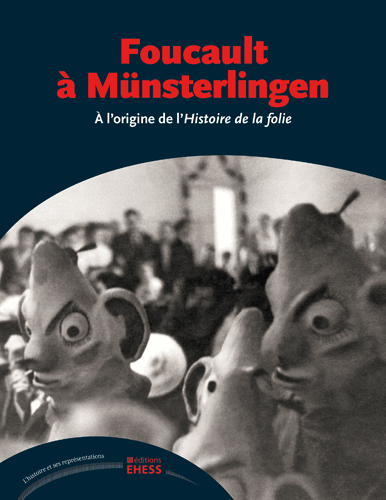
bassoFoucault à Münsterlingen. À l’origine de l’Histoire de la folie
Jean-François Bert & Elisabetta Basso (ed.)
Avec des photographies de Jacqueline Verdeaux, Éditions de l’EHESS

En 1954, Michel Foucault participe à une fête des fous à l’asile psychiatrique suisse de Münsterlingen, dont il reste des photos, inédites. Étrange cérémonie, survivance d’un rituel hérité directement du Moyen Âge, qui marqua le jeune philosophe en train d’élaborer une nouvelle manière de parler de la folie et de son histoire.

Cette visite de Michel Foucault en mars 1954 à l’asile psychiatrique suisse de Münsterlingen le jour d’un carnaval des fous nous apprend beaucoup à la fois sur le jeune philosophe – l’année 1954 est riche en événements pour lui –, mais aussi sur ce rituel qui a perduré jusqu’au milieu du xxe siècle. Photos, archives, textes éclairent ce moment trop souvent négligé par les spécialistes de Michel Foucault. Ce début des années 1950 est pourtant marqué par l’entrée de Foucault dans les asiles et par sa passion pour les innovations qui touchent la psychologie clinique.

C’est la germaniste Jacqueline Verdeaux, munie d’un Leika, qui photographie. Ces images laissent entrevoir l’étrange sensation qu’a pu ressentir Foucault lors de ce jour improbable où les fous « jouent » aux fous. Une sensation d’autant plus étrange que l’asile cantonal est, avec la clinique universitaire du Burghölzli de Zürich, l’une des plaques tournantes de la psychiatrie suisse.

Ce livre, qui aborde une période inexplorée, et non abordée dans La Pléiade à paraître, nous pousse à renverser les perspectives familières concernant Michel Foucault.

Table des matières

« Retour à Münsterlingen »
par Jean-François Bert

La « gentille dame Largactil », la « méchante dame Geigy » : la clinique psychiatrique de Münsterlingen vers 1954
Magaly Tornay, traduction de Yann Dahhaoui

Foucault et le Rorschach
Jean-François Bert & Elisabetta Basso

Foucault et le Carnaval
Emmanuel Désveaux

Foucault à Lille, 1952-1955 : entre philosophie et psychologie
Philippe Sabot

Fiches préparatoires de Michel Foucault sur l’histoire de la psychiatrie
Jean-François Bert & Elisabetta Basso

Première lecture de Traum und Existenz
Transcription Jean-François Bert, présentation Elisabetta Basso

Le rêve et de l’existence, histoire d’une traduction
Elisabetta Basso

Correspondance Foucault-Binswanger
Traduction de René Wetzel, présentation par Elisabeth Basso

De quelques sources de Maladie mentale et personnalité. Réflexologie pavlovienne et critique sociale
Luca Paltrinieri

Foucault et le savoir psychologique : retour sur deux articles rédigés en 1954
Jean-François Bert

La fête des fous de Michel Foucault
Yann Dahhaoui

Unissons-nous, soyons fous ! ». Fête des fous, carnaval et Mad Pride : Continuités, ruptures et perspectives
René Wetzel

With thanks to Stuart Elden for this news

Gerdin, G., Pringle, R.
The politics of pleasure: an ethnographic examination exploring the dominance of the multi-activity sport-based physical education model
(2017) Sport, Education and Society, 22 (2), pp. 194-213.

DOI: 10.1080/13573322.2015.1019448

Abstract
Kirk warns that physical education (PE) exists in a precarious situation as the dominance of the multi-activity sport-techniques model, and its associated problems, threatens the long-term educational survival of PE. Yet he also notes that although the model is problematic it is highly resistant to change. In this paper, we draw on the results of a year-long visual ethnography at an all-boys secondary school in Aotearoa New Zealand to examine the workings of power that legitimate this model of PE. Our findings illustrate that the school conflates PE and sport, to position PE as an appropriate masculine endeavour and valued source of enjoyment, as it articulates with good health, social development and competitiveness. We argue that student experiences of pleasure within PE—as co-constitutive with discourses of fitness, health, sport and masculinity—(re)produce the multi-activity sport-based form of PE as educationally appropriate and socioculturally relevant, thus making the model somewhat resistant to change. We stress that our study should not be read as a vindication of this PE model. © 2015 Informa UK Limited, trading as Taylor & Francis Group.

Author Keywords
Foucault; Masculinity; Physical education; Pleasure; Politics; Sport

Murphy, Michael P. A. 2017. “Pouvoir constituant betrayed: a model of abjection in power relations” Journal of Political Power (Ahead of Print): 1-9.
DOI: 10.1080/2158379X.2017.1287471

Abstract
Examination of the limit serves as a powerful tool for revealing the hidden characteristics of concepts, and also their relationship with other concepts. This article follows the processes of sovereign exceptionalism from Marx to the capitalist estrangement of labour from Marx to their limit figures. The paper builds on comparisons between the proletarian and the homo sacer; however, the focal point is not on the figures themselves, but their importance in understanding the effect of biopolitics on power relations. Building on the concept of pouvoir constituant as discussed by Carl Schmitt, this paper addresses the ways in which different types of constituent power form structures that can then be used against the constituents themselves. The limit figures suggest a process of abjection is co-created in the establishment of power structures, and that overcoming this process requires a conscious dis-agreement with the politics of policing.

Bruno Latour, Why Has Critique Run out of Steam? From Matters of Fact to Matters of Concern, Critical Inquiry 30 (Winter 2004)

Full PDF

Wars. So many wars. Wars outside and wars inside. Cultural wars, science wars, and wars against terrorism. Wars against poverty and wars against the poor. Wars against ignorance and wars out of ignorance. My question is simple: Should we be at war, too, we, the scholars, the intellectuals? Is it really our duty to add fresh ruins to fields of ruins? Is it really the task of the humanities to add deconstruction to destruction? More iconoclasm to iconoclasm? What has become of the critical spirit? Has it run out of steam?

[…] What has become of critique when DARPA uses for its Total Information Awareness project the Baconian slogan Scientia est potentia? Didn’t I read that somewhere in Michel Foucault? Has knowledge-slash-power been co-opted of late by the National Security Agency? Has Discipline and Punish become the bedtime reading of Mr. Ridge?

iao-logo

Dowd, J.
Moments that matter: Educational entanglements and ecologies of action
(2017) Review of Communication, 17 (1), pp. 3-17.

DOI: 10.1080/15358593.2016.1260761

Abstract
In this article, I argue that “the freedom to make and remake our cities and ourselves” is intimately entangled with processes of education. To understand this relationship, we need to articulate more fully the role and state of teaching and learning both within and outside of academe. I argue that education allows for a negotiation of one’s relationship within broader ecologies of action, which comprise constellations of power (and their correlate ideologies), discourses, bodies, material sites, and practices. More specifically, I elucidate three primary ways that education might serve as a powerful mode of tactical resistance to the deleterious effects of neoliberalist regimes and their exclusionary agendas: (1) research and rejuvenated public intellectualism; (2) understanding teaching as the nurturing of capacities rather than as a conduit for information transfer; and (3) centering education on the cultivation of a learning mode.2 © 2016 National Communication Association.

Author Keywords
Democracy; Education; Foucault; Lefebvre; Resistance; Urban society

Elisabetta Basso, Complicités et ambivalences de la psychiatrie, Münsterlingen et le carnaval des fous de 1954, Médecine/Sciences (Paris), Volume 33, Number 1, Janvier 2017
DOI: 10.1051/medsci/20173301019

Complicities and ambivalences of psychiatry: Münsterlingen and the 1954 feast of fools

Résumé
En mars 1954, Michel Foucault visite l’asile de Münsterlingen, dans le canton de Thurgovie, sur la rive suisse du lac de Constance. Lieu d’activité de psychiatres bien connus, notamment Hermann Rorschach, Münsterlingen est devenu célèbre dans l’histoire de la psychiatrie surtout grâce au travail de Roland Kuhn, qui fut actif à l’asile de 1939 à 1979. Grand spécialiste du test psychodiagnostique de Rorschach et découvreur au début des années 1950 du premier médicament antidépresseur, Kuhn fut également très proche de Ludwig Binswanger, dont il accueille favorablement l’approche anthropologique de la maladie mentale. C’est précisément pour rencontrer Kuhn et Binswanger que le jeune Foucault se rend en Suisse, à une époque où il s’intéresse à la psychopathologie « existentielle ». Sa visite a lieu pendant la fête du Carnaval de l’asile.

Abstract
In March 1954, Foucault visited the psychiatric asylum of Münsterlingen (Canton Thurgau), on the Swiss side of Lake Constance. Münsterlingen was the chosen place of activity for well-known psychiatrists, including Hermann Rorschach (1910-1913), and it became famous in the history of psychiatry especially through the work of Roland Kuhn, who was active in the asylum from 1939 to 1979. Kuhn was an expert in the Rorschach psycho-diagnostic test, as well as the discoverer of the first antidepressant in the early 1950s. He was also very close to Ludwig Binswanger, whose anthropological approach to mental illness had a strong influence on his own psychiatric practice. It is precisely in order to meet Kuhn and Binswanger that the young Foucault went to Switzerland, at a time when he was interested in philosophical anthropology and “existential psychopathology”. Foucault’s visit took place during the Carnival at the asylum, when the patients leave the hospital wearing the masks that they have made up and created.

Amsler, M., Shore, C.
Responsibilisation and leadership in the neoliberal university: a New Zealand perspective
(2017) Discourse, 38 (1), pp. 123-137.

DOI: 10.1080/01596306.2015.1104857

Abstract
We examine how discourses of leadership and responsibilisation are used in contemporary universities to deepen neoliberal administration and further the corporate university’s business plan by restructuring and redescribing academic work. Strategically, responsibilisation discourse, promoted as ‘distributed leadership’, is a technology of indirect management. Responsibilisation language stipulates ‘expectations’ for workers and integrates academic work (teaching, learning, research, service) into an administered regime recognising and rewarding successful conduct (‘leadership’) in the university. We intervene in this responsibilisation discourse by critically analysing texts about distributed leadership in one New Zealand university context. Linking Foucault’s analysis of earlier forms of liberal governmentality with critical discourse analysis, we explore how administrative structures, power relations, and regulating management discourse seek to reshape employee behaviour in the neoliberalised, post-democratic university. We present a case study of one university’s ‘Leadership Framework’, which exemplifies a new form of ‘post-neoliberal governmentality’ in higher education, embedding self-governance within increasingly instrumentalising centralisation. © 2015 Informa UK Limited, trading as Taylor & Francis Group.

Author Keywords
academic leadership; Critical discourse analysis; entrepreneurship in higher education; governmentality; higher education; New Zealand universities; responsibilisation

ogdenSteven G. Ogden, The Church, Authority, and Foucault. Imagining the Church as an Open Space of Freedom, Routledge, 2017

The Church, Authority, and Foucault addresses the problem of the Church’s enmeshment with sovereign power, which can lead to marginalization. Breaking new ground, Ogden uses Foucault’s approach to power and knowledge to interpret the church leader’s significance as the guardian of knowledge. This can become privileged knowledge, under the spell of sovereign power, and with the complicity of clergy and laity in search of sovereigns. Inevitably, such a culture leads to a sense of entitlement for leaders and conformity for followers. All in the name of obedience.

The Church needs to change in order to fulfil its vocation. Instead of a monarchy, what about Church as an open space of freedom? This book, then, is a theological enterprise which cultivates practices of freedom for the sake of the other. This involves thinking differently by exploring catalysts for change, which include critique, space, imagination, and wisdom. In the process, Ogden uses a range of sources, analysing discourse, gossip, ritual, territory, masculinity, and pastoral power. In all, the work of Michel Foucault sets the tone for a fresh ecclesiological critique that will appeal to theologians and clergy alike.

Table of Contents

1 The Church and the problem of sovereign power

2 Under Foucault’s gaze: the subject, freedom, and the power-knowledge concept

3 The concept of authority: guardians, gossip, and the sovereign exception

4 The spell of monarchy and the sacralization of obedience

5 The Church as an open space of freedom

6 New spaces and the imagination

7 Bearing the lightning of possible storms: critique, space, imagination, wisdom

Biography
Steven Ogden is an adjunct lecturer in theology, and a member of the Center for Public and Contextual Theology (PACT), with Charles Sturt University Australia. He is also the Rector of Holy Trinity Church, Fortitude Valley. Previously, Steven has been the Principal of St Francis Theological College Brisbane, and the Dean of St Peter’s Cathedral Adelaide.