Foucault News

News and resources on French thinker Michel Foucault (1926-1984)

Barker, D.
Ninjas, zombies and nervous wrecks? Academics in the neoliberal world of physical education and sport pedagogy
(2017) Sport, Education and Society, 22 (1), pp. 87-104.

DOI: 10.1080/13573322.2016.1195360

Abstract
Scholars have drawn some damning conclusions on the current state of the academy. They argue that neoliberal developments such as corporatization and privatization are undermining research and teaching quality, disrupting social relations and impacting negatively on the health and well-being of academic staff. Academia is, according to these scholars, coming to be peopled by hypercompetitive and combative ‘ninjas’, cynical and unmotivated ‘zombies’ and jaded and anxious ‘nervous wrecks’. Against this negative depiction of academics, the aim of this paper is to provide an illustration of an alternative identity that is formed and performed within the field of physical education and sport pedagogy (PESP). This illustration is achieved through the presentation and analysis of an account that shows some of the individuals inhabiting the world of PESP. The account is based on autoethnographic research and relies largely on reported speech and reflective notes to build a description of the author, in the early stages of mid-career, working with his colleagues to write a section of this paper. A Foucauldian framework that includes the concepts of governmentality and care of the self is employed to consider how the author becomes a neoliberal subject with some possibilities for resisting technologies of power. The paper is concluded with reflections on the process of resisting and the significance of local socio-political contexts as issues for further discussion. © 2016 Informa UK Limited, trading as Taylor & Francis Group.

Author Keywords
Academia; Autoethnography; Foucault; Neoliberal; Physical education; Sport pedagogy

Index Keywords
career, human, human experiment, identity, male, pedagogics, speech, sport

foucault-animalsFoucault and Animals
Edited by Matthew Chrulew and Dinesh Joseph Wadiwel, Brill, 2016

Foucault and Animals is the first collection of its kind to explore the relevance of Michel Foucault’s thought for the question of the animal. Chrulew and Wadiwel bring together essays from emerging and established scholars that illuminate the place of animals and animality within Foucault’s texts, and open up his highly influential range of concepts and methods to different domains of human-animal relations including experimentation, training, zoological gardens, pet-keeping, agriculture, and consumption. Touching on themes such as madness and discourse, power and biopolitics, government and ethics, and sexuality and friendship, the volume takes the fields of Foucault studies and human-animal studies into promising new directions.

Biographical note
Matthew Chrulew, Ph.D. (2011) is a research fellow in the School of Media, Culture and Creative Arts and the Centre for Culture and Technology at Curtin University. His essays have appeared in Angelaki, SubStance, New Formations, Foucault Studies and elsewhere.

Dinesh Joseph Wadiwel, Ph.D. (2006) is a Lecturer in Human rights and Socio-Legal Studies at The University of Sydney. He is author of the monograph The War against Animals (Brill, 2015).

Table of contents
Foreword
List of Contributors
Editor’s Introduction: Foucault and Animals, Matthew Chrulew and Dinesh Joseph Wadiwel

Part One: Discourse and Madness
1. Terminal Truths: Foucault’s Animals and the Mask of the Beast, Joseph Pugliese
2. Chinese Dogs and French Scapegoats: An Essay in Zoonomastics, Claire Huot
3. Violence and Animality: An Investigation of Absolute Freedom in Foucault’s History of Madness, Leonard Lawlor
4. The Order of Things: The Human Sciences are the Event of Animality, Saïd Chebili.
(Translated by Matthew Chrulew and Jeffrey Bussolini)

Part Two: Power and Discipline
5. “Taming the wild profusion of existing things”: A Study of Foucault, Power, and Human/Animal Relationships, Clare Palmer
6. Dressage: Training the Equine Body , Natalie Corinne Hansen
7. Foucault’s Menagerie: Cock Fighting, Bear Baiting, and the Genealogy of Human-Animal Power, Alex Mackintosh

Part Three: Science and Biopolitics
8. The Birth of the Laboratory Animal: Biopolitics, Animal Experimentation, and Animal Wellbeing, Robert G. W. Kirk
9. Animals as Biopolitical Subjects, Matthew Chrulew
10. Biopower, Heterogeneous Biosocial Collectivities and Domestic Livestock Breeding, Lewis Holloway and Carol Morris

Part Four: Government and Ethics
11. Apum Ordines: Of Bees and Government, Craig McFarlane
12. Animal Friendship as a Way of Life: Sexuality, Petting and Interspecies Companionship, Dinesh Joseph Wadiwel
13. Foucault and the Ethics of Eating, Chloë Taylor
Afterword, Paul Patton

Khodadadi, M., O’Donnell, H.
UK press and tourist discourses of Iran: a study in multiple realities
(2017) Leisure Studies, 36 (1), pp. 53-64.

DOI: 10.1080/02614367.2015.1085591


Abstract

The aim of this article is to investigate the competing discourses of Iran currently circulating in British society, and their influence on the tourist destination image of that country. A mixed-methods approach was adopted within a social constructionist perspective: this consisted of a Foucauldian discourse analysis of news reports in a range of British broadsheet newspapers, interviews with tourists who had visited Iran, and analysis of travel blogs written by a second group of tourists who had also previously visited the country. The findings show that the leading British broadsheets examined exclusively circulate an extremely negative discourse of Iran-as-Polity, originating in US and mediated by the British political field, whose main components are nuclear issues, danger, hostility and terrorism. Though UK tourists to the country are often drawn there initially by a largely Orientalist discourse of Iran-as-Persia, i.e. as a site of historical monuments, during and post visit, they develop a counter-discourse of Iran-as-Society which concentrates on the modernity of certain aspects of the country and above all the hospitality of its citizens, a discourse which is then further disseminated in the form of travel blogs. The article also mobilises Bourdieu’s concept of academic capital to examine the role of education in providing resources to resist the discourse of Iran-as-Polity. In its range of sources analysed, the article offers a relatively novel approach to investigating the role of media discourse and the internet–the latter framed using Foucault’s ‘genealogical’ approach–in the formation of competing tourist destination images of Iran. © 2015 Taylor & Francis.

Author Keywords
cultural tourism; destination image; discourse; Iran; news media; social media

sexographyNicholas de Villiers, Sexography.Sex Work in Documentary, University of Minnesota Press, Forthcoming 2017

A bold challenge to rethink the ways we view sex work and documentary film

The turn of the twenty-first century has witnessed an eruption of nonfiction films on sex work. The first book to examine a cross-section of this diverse and transnational body of work, Sexography confronts the ethical questions raised by ethnographic documentary and interviews with sexually marginalized subjects. Nicholas de Villiers argues that carnal and cultural knowledge are inextricably entangled in ethnographic sex work documentaries.

De Villiers offers a reading of cinema as a technology of truth and advances a theory of confessional and counterconfessional performance by the interviewed subject who must negotiate both loaded questions and stigma. He pays special attention to the tactical negotiation of power in these films and how cultural and geopolitical shifts have affected sex work and sex workers. Throughout, Sexography analyzes the films of a range of non–sex-worker filmmakers, including Jennie Livingston, Pier Paolo Pasolini, Shohini Ghosh, and Cui Zi’en, as well as films produced by sex workers. In addition, it identifies important parallels and intersections between queer and sex worker rights activist movements and their documentary historiography.

De Villiers ultimately demonstrates how commercial sex is intertwined with culture and power. He advocates shifting our approach from scrutinizing the motives of those who sell sex to examining the motives and roles of the filmmakers and transnational audiences creating and consuming films about sex work.

Bojesen, E.
I/MLEs and the uneven return of pastoral power
(2016) Educational Philosophy and Theory, pp. 1-8. Article in Press.

DOI: 10.1080/00131857.2016.1267604

Editor: I/MLE stands for Innovative/Modern Learning Environments

Abstract
Informed by the work of the work of Michel Foucault, Ian Hunter, and Ansgar Allen, this paper argues that I/MLEs are not the creation of a ‘modern’ or ‘innovative’ learning environment but rather the reclamation of an educational technique that was pioneered en masse almost two centuries ago (and based on practices many centuries older than that), where established pastoral methods were key to shaping particularly formed educated subjects. Drawing on work produced by the OECD, as well as UK and NZ education policies and school building design guidance, this argument couches two claims, the first of which is that whether or not education systems and school buildings are conforming to I/MLE models, the ubiquity of ideologically narrow conceptions of the learning subject are enforced regardless, through subtle or unsubtle means. However, the second claim is that, despite their overarching and unsurprising ideological homogeneity with other more outcome oriented forms of schooling, I/MLEs have the potential to offer a much more substantial formative experience than other schooling systems due to their implicit recovery of the traditional pastoral aspect of education. © 2016 Philosophy of Education Society of Australasia

Author Keywords
disciplinary power; I/MLEs; Michel Foucault; New Zealand education policy; Pastoral power; UK education policy

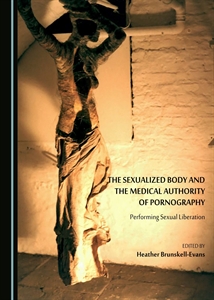
sexualized-bodyHeather Brunskell-Evans (Ed) The Sexualized Body and the Medical Authority of Pornography, Cambridge Scholars Publishing, 2016

Book Description
This edited collection examines pornography as a material practice that eroticises gender inequality and sexual violence towards women. It addresses the complex relationship between pornography and medicine (in particular, sexology and psycho-therapy) whereby medicine has historically, and currently, afforded pornography considerable legitimacy and even authority. Pornography naturalises women’s submission and men’s dominance as if gendered power is rooted in biology not politics. In contrast to the populist view that medicine is objective and rational, the contributors here demonstrate that medicine has been complicit with the construction of gender difference, and in that construction the relationship with pornography is not incidental but fundamental.

A range of theoretical approaches critically engages with this topic in the light, firstly, of radical feminist ideas about patriarchy and the politics of gender, and, secondly, of the rapidly changing conditions of global capitalism and digital-technologies. In its broad approach, the book also engages with the ideas of Michel Foucault, particularly his refutation of the liberal hypothesis that sexuality is a deep biological and psychological human property which is repressed by traditional, patriarchal discourses and which can be freed from authoritarianism, for example by producing and consuming pornography.

In taking pornography as a cultural and social phenomenon, the concepts brought to bear by the contributors critically scrutinise not only pornography and medicine, but also current media scholarship. The 21st century has witnessed a growth in (neo-)liberal academic literature which is pro-pornography. This book provides a critical counterpoint to this current academic trend, and demonstrates its lack of engagement with the politics of the multi-billion dollar pornography industry which creates the desire for the product it sells, the individualism of its arguments which analyse pornography as personal fantasy, and the paucity of theoretical analysis. In contrast, this book re-opens the feminist debate about pornography for a new generation of critical thinkers in the 21st century. Pornography matters politically and ethically. It matters in the real world as well as in fantasy; it matters to performers as well as to consumers; it matters to adults as well as to children; and it matters to men as well as to women.

Teaching English or producing docility? Foucauldian analysis of Pakistani state-mandated English textbooks
Liaquat Ali Channa, Daniel Gilhooly, Abdul Razaque Channa, Syed Abdul Manan, and John Schwieter
Cogent Education Vol. 4 , Iss. 1,2017

Abstract
The scholarship of language education, particularly with reference to learning and use of English, is marked by varieties of English. One may note two broad models: (1) ENL, ESL, and EFL; (2) EIL, ELF, and WEs. Although the scholarship is replete with debates, the debates seem to only construct and maintain that learning English and its use are neutral activities that earn and equip a learner with certain capital rather than make him/her as such. This paper draws upon Foucault’s theories of discourse and disciplinary power. This paper takes Pakistani
state-mandated English textbooks of Grades 1–5 as official documents that contain qualitative data. The qualitative data are analyzed thematically. Two major themes of male body and female body are found which are analyzed and discussed through the Foucauldian lens. The paper holds that learning English and its use perpetuate and produce docility. The paper contends that neither is language a neutral tool nor are its use and learning value-free activities in any of its varieties.

Keywords: Pakistan, English textbooks, primary grades, discourse, disciplinary power, docility

Theisens, H., Hooge, E., Waslander, S.
Steering Dynamics in Complex Education Systems. An Agenda for Empirical Research
(2016) European Journal of Education, 51 (4), pp. 463-477.

DOI: 10.1111/ejed.12187

Abstract
Many policy systems and education systems have grown more complex in the last three decades. Power has moved away from central governments in different directions: upwards towards international organisations, sideways towards private institutions and non-governmental organisations and downwards towards local governments and public enterprises such as schools. Where once we had central government, we now have governance, which can be defined as the processes of establishing priorities, formulating and implementing policies, and being accountable in complex networks with many different actors. Steering in such complex education systems emerges from the activities, tasks and responsibilities of state and non-state actors, operating at different levels and from different positions and often has un-deliberate, un-intentional and un-foreseen consequences. There are many conceptual models that encapsulate this complexity, but this article suggests that there is a real need for empirical research. Without empirical research it remains unknown whether and how steering in complex networks works out in practice, what are its effects and for whom. Moreover, it is only through empirical research that we can find out whether central government has become less dominant, or rather whether its appearance has changed and it has become less visible, but not necessarily less influential. Foucault’s governmentality perspective is a useful notion on which to build such a framework for empirical research which allows for a careful study of the interactions that signify steering. Inspired by Foucault, this article develops a trilogy of assumed conditions for steering to take effect in modern societies. Following this reasoning, ‘something’ first needs to be made thinkable, calculable and practicable by different actors for steering to occur. This trilogy is a promising starting point for empirical research into very specific phenomena which can help us to understand how steering in complex education systems works. © 2016 John Wiley & Sons Ltd

Author Keywords
complexity; education; Governance; governmentality; steering

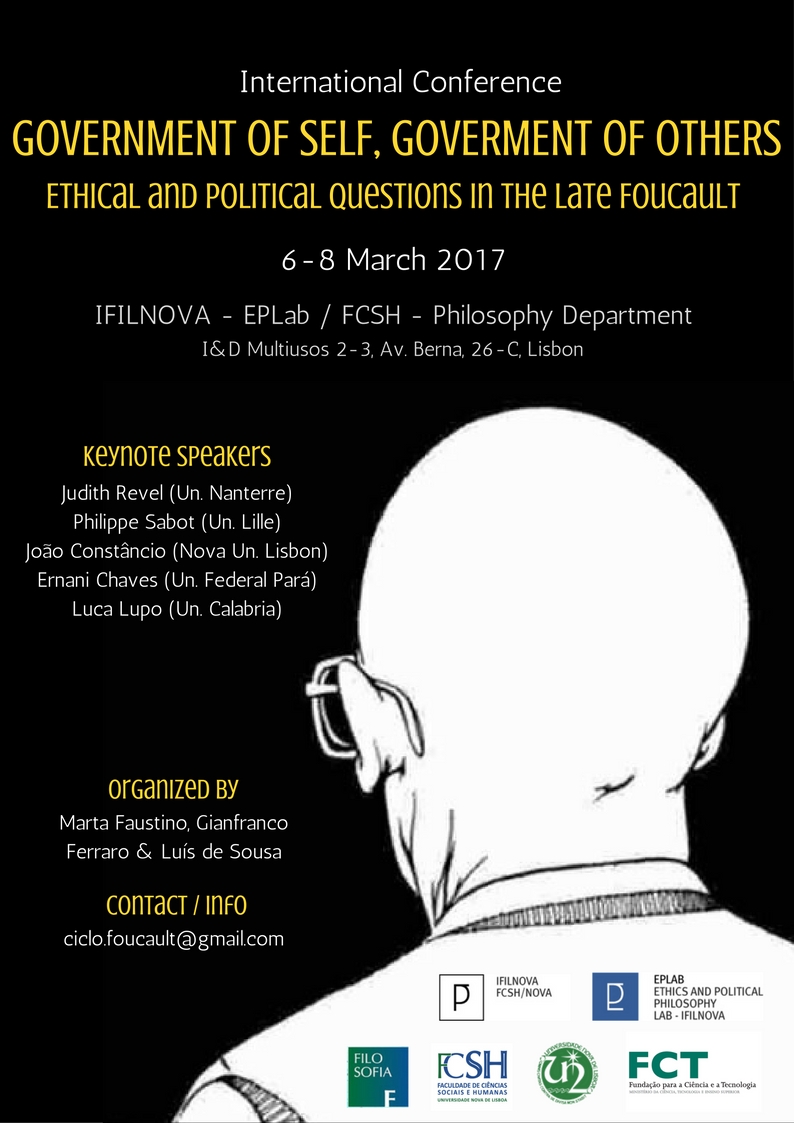
International Conference
GOVERNMENT OF SELF, GOVERNMENT OF OTHERS
Ethical and political questions in the late Foucault

govt-of-self

6-8 March 2017
IFILNOVA – EPLab / FCSH – Philosophy Department
I&D Multiusos 2-3, Av. Berna 26C, Lisbon

Web
http://www.eplab.ifilnova.pt/events/INternational-conference
http://fcsh.unl.pt/media/noticias/destaques/coloquio-internacional-sobre-foucault
https://www.facebook.com/events/228100890930886

Michel Foucault’s last lecture series at Collège de France constitute a unity that testifies a shift in his thought. This shift deepens and expands the course of his preceding works concerning the genealogy of subjectivity, while, at the same time, adding to it a significant ethical and political dimension. Foucault returns to the practices of the self in antiquity and looks at the birth of the techniques of truth that allow us to understand how the Western subject has developed from the creation of particular relationships with its own body and other subjectivities. At the same time, these courses put in evidence the relationship between truth and power which lies at the core of Western forms of power and even Western democracy, thus inciting us to question our current political environment and face some political challenges of our time.

Finally, Foucault’s concern in these last years with the technologies of ethical self-formation through what he calls “care of the self” sheds new light on his philosophical endeavor as a whole and situates his reflections at the center of contemporaneous moral debates.
On the occasion of the 35th anniversary of The Hermeneutics of the Subject (1981-1982) and celebrating the conclusion of the publication of all the lecture courses from the 1980s – from On the Government of the Living (1979-1980) to The Courage of Truth (1984) -, this conference aims to (re)launch the critical debate on the last stage of Foucault’s thought, evaluating in what way and to which extent the perspectives that Foucault offers in this period might help us to unravel modernity and also give us tools to ethically and politically understand and transform our present.

Keynote Speakers
Judith Rével (Université Paris Ouest Nanterre)
João Constâncio (Universidade Nova de Lisboa)
Philippe Sabot (Université de Lille)
Luca Lupo (Universitá della Calabria)
Ernani Chaves (Universidade Federal do Pará)

Organizers
Marta Faustino, Gianfranco Ferraro, Luís de Sousa

Contact / Info
ciclo.foucault@gmail.com

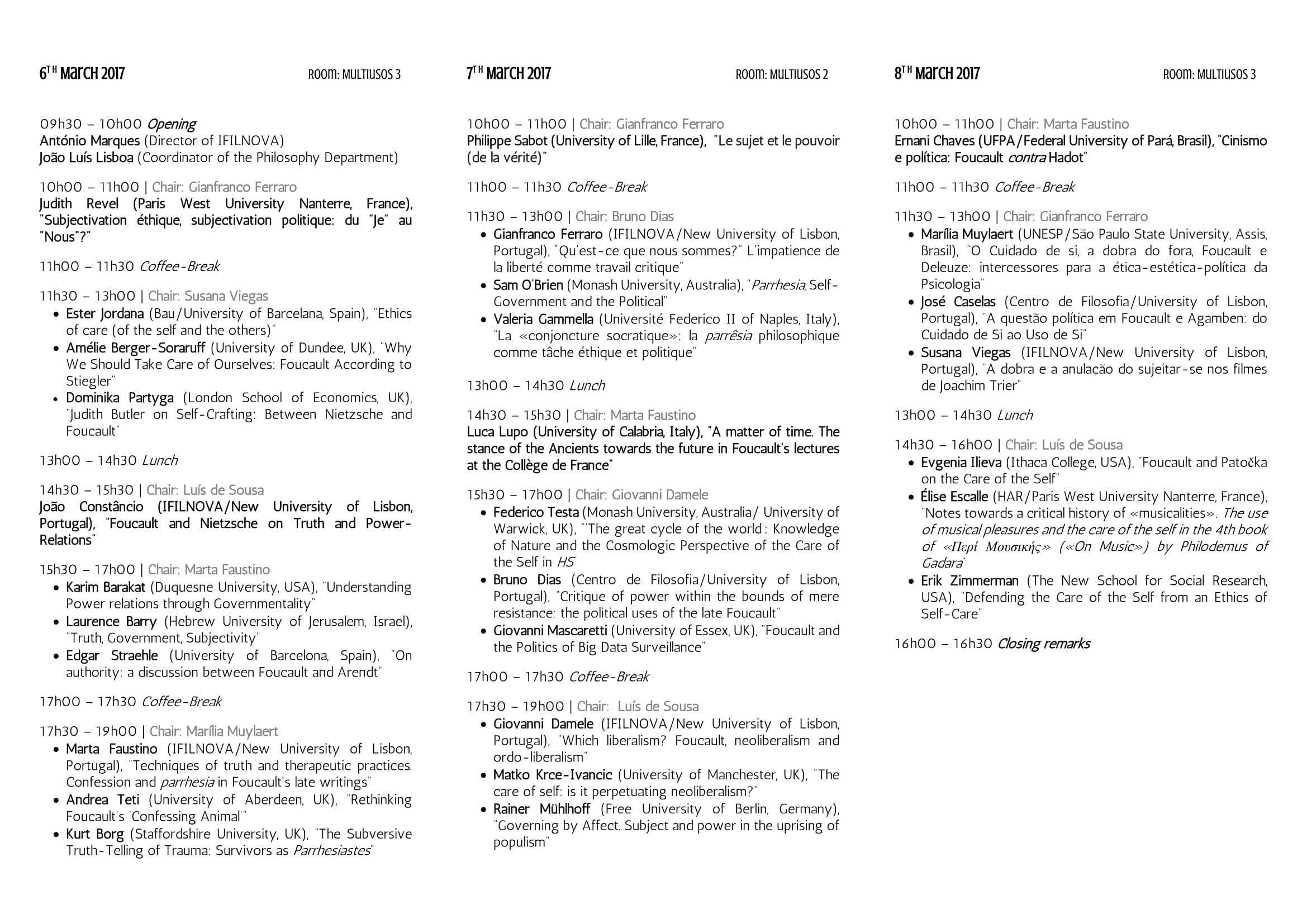
Click on picture and zoom for clearer reading

govt-of-self2

Editor: To provide extra material for my Master of Education coursework students, I will be posting up quite a bit of material in the education area over the next month. These posts will be scheduled at a different time of day from other posts. The Foucault and education posts will all be tagged in the education category on the blog.

As always, please send on any Foucault related news from any arena for posting on Foucault News.