
Foucault News

News and resources on French thinker Michel Foucault (1926-1984)

Ja’afar, Z., Md. Yusof, N., Ibrahim, N.
Revisioning history: A deconstructionist reading of a learner’s multimodal text, ‘Revenge’
(2016) Asian Social Science, 12 (8), pp. 64-73.

DOI: 10.5539/ass.v12n8p64

Abstract
Recent interest in multimodality recognizes the integration of text and image in meaning-making as representing reality. It has also been argued that with the use of digital communication, the meanings of visual and verbal data can be easily manipulated rendering them unreliable. As such, a close and critical reading of the text is required to discover what is hidden, absent, or inconsistent with it. In a deconstruction of a multimodal digital composition of a poem that involves revisioning of history, this paper privileges the absences of cultural and historical texts to signify socio-political issues. An eclectic use of theoretical concepts on meaning-making, especially those proposed by Kress and van Leeuwen, Foucault and Baudrillard, constructs the discussion of the analysis. The digital poem entitled ‘Revenge’ is deconstructed to further discover such absence in the text. The findings reveal that language and images are used by the learner as a source of power to negotiate the boundaries of identity. It has also been discovered that the message in rhetoric and visuals complement each other to support the process of meaning-making. © 2016, Canadian Center of Science and Education. All rights reserved.

Author Keywords
Absence; Deconstruction; Multimodal digital poem; Reality; Revisioning history; Socio-political
De Vries, L.A.
Politics of (in)visibility: Governance-resistance and the constitution of refugee subjectivities in Malaysia
(2016) Review of International Studies, 42 (5), pp. 876-894.

DOI: 10.1017/S0260210516000103

Abstract
This article explores the relationality of governance and resistance in the context of the constitution of refugee subjectivities in Malaysia. Whilst recognising their precarity, the article moves away from conceiving of refugees merely as victims subjected to violence and control, and to contribute to an emerging body of literature on migrant resistance. Its contribution lies in examining practices of resistance, and the specific context in which they emerge, without conceptualising power-resistance as a binary, and without conceiving of refugees as preconstituted subjects. Rather, drawing on the thought of Michel Foucault, the article examines how refugee subjectivities come into being through a play of governance-resistance, of practices and strategies that may be simultaneously affirmative, subversive, exclusionary, and oppressive. The relationality and mobility of this play is illustrated through an examination of practices surrounding UNHCR identity cards, community organisations, and education. Secondly, governance-resistance is conceptualised as a play of visibility and invisibility, understood both visually and in terms of knowledge production. What I refer to as the politics of (in)visibility indicates that refugee subjectivities are both constituted and become other than ‘the refugee’ through a continuous play of coming into being, becoming governable, claiming a presence, blending in and remaining invisible. © British International Studies Association 2016.

Author Keywords
(In)visibility; Governance; Politics; Refugees; Resistance; Subjectivity

Heffernan, A.
The Emperor’s perfect map: leadership by numbers
(2016) Australian Educational Researcher, 43 (3), pp. 377-391.

DOI: 10.1007/s13384-016-0206-7

Abstract
This paper establishes that system-generated data profiles are influencing the work of principals in three Queensland state schools. Drawing upon Foucault’s notions of governance, as well as research emphasising performative cultures and the importance placed upon numbers and data in education, this paper uses the tale of the Emperor’s map as a metaphor to explore the way principals’ work is being influenced by specific sets of data compiled by the department. These data profiles are representative of external accountabilities and high stakes testing regimes, as seen in systems that have adopted neoliberal policies which attempt to quantify the work being undertaken in schools. The paper demonstrates that principals are being constructed in part by discourses from a system that emphasises these system-generated performance data as a driver for school improvement. © 2016, The Australian Association for Research in Education, Inc.

Author Keywords
Data; Performativity; School improvement; School principals

Powell, D.
Governing the (un)healthy child-consumer in the age of the childhood obesity crisis
(2016) Sport, Education and Society, pp. 1-14. Article in Press.

DOI: 10.1080/13573322.2016.1192530

Abstract
In recent years, multinational food and drink corporations and their marketing practices have been blamed for the global childhood obesity ‘crisis’. Unsurprisingly, these corporations have been quick to refute these claims and now position themselves as ‘part of the solution’ to childhood obesity. In this paper, I examine how and why corporations fund, devise and/or implement ‘healthy lifestyles education’ programmes in schools. By using a critical ethnographic research approach alongside Foucault’s notion of governmentality, I interrogate what those with the ‘will to govern’ (such as corporations) wanted to happen (e.g. fight obesity, change marketing practices and increase consumption), but also what actually happened when these corporatised education programmes met their intended targets in three New Zealand primary schools. I critically examine these programmes by focusing on the ways in which three technologies of consumption – product placement, transforming children into marketers and sponsorship – attempt to govern children to be lifelong consumers of the corporate brand image and their allegedly ‘healthy’ corporate products. Although students were not necessarily naïve and easily coerced into becoming mindless consumers of corporate products, students and their teachers readily accepted that sponsorship, product placement and marketing in schools were normal, natural, necessary and mostly harmless. Healthy lifestyles education programmes represent a new ‘brand’ of health, health education and corporation. The child-citizen is governed to become the child-consumer. Corporations’ anxieties about being blamed for childhood obesity are fused with technologies of ‘healthy consumption’: the consumption of corporate products, corporate philanthropy, the corporate brand and corporate ‘education’. © 2016 Informa UK Limited, trading as Taylor & Francis Group

Author Keywords
childhood obesity; consumers; critical ethnography; food and drink industry; Foucault; governmentality; Health and physical education; marketing; sponsorship; technologies of consumption

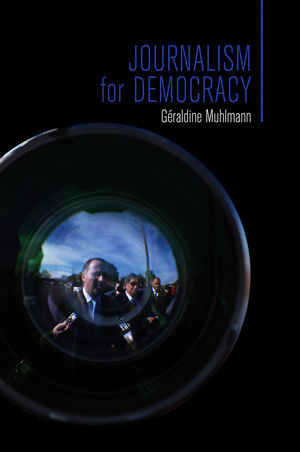
Geraldine Muhlmann Journalism for Democracy, Polity, 2010

Editor: There are some very interesting remarks on Foucault, Bourdieu and journalism in the first chapter

Description
Journalists are commonly denounced from all sides – a shameful, deceitful trade, a profession sold out to the powerful which gives a biased and misleading picture of the world. Behind the condemnation one can often detect a desire for reform, a feeling that good journalism is too important for the health of democracy to be left to languish among the tabloids. Yet the discussion rarely gets beyond the well-worn formulas of free speech and the Fourth Estate. The question of the political significance of journalism is never seriously addressed, and the question of what journalism should be is rarely posed.

This important new book by Géraldine Muhlmann addresses these gaps in our understanding and goes a long way to filling them. Putting aside the hasty diatribes against journalism, Muhlmann asks the fundamental questions: what should journalism be? What ideals should it serve? What do seeing and showing the world mean today? What direction should journalism take in order to emerge from its current crisis?

Drawing on a rich tradition of philosophical thought, Muhlmann breathes new life into the old debate about journalism and its role today. Avoiding the twin pitfalls of destructive criticism and naive celebration, she sees a double task for a reinvigorated journalism: to allow space for conflict but also to foster unity within the political community. In the practice of journalism we see the enigma of democracy itself: the coexistence of two stages, one of action and one of representations, the latter offering a symbolic resolution to the conflicts that animate the former.

Paatela-Nieminen, M., Itkonen, T., Talib, M.-T.
Reconstructing Imagined Finnishness: The Case of Art Education through the Concept of Place
(2016) International Journal of Art and Design Education, 35 (2), pp. 229-242.

DOI: 10.1111/jade.12057

Abstract
This multidisciplinary article presents a methodology, a research project and selected outcomes from an environmental art education course for teacher students. The course is part of an art education minor at the University of Helsinki, Department of Teacher Education. The students were asked to construct their place through an intertextual art method that provided them the means to study their place open-endedly as a space of plural cultural meanings. Applying the results from their intertextual process, they reconstructed their place artistically. The end product was a personal work of art that included traces of their chosen places, and created a new meaning for it. The outcome is a visual space of compacted meanings from different places. Places contain history and memories important to identity construction. The results show that the intertextual reading extends the students’ concept of place as a space for relational and plural cultural meanings. Foucault’s concept of heterotopia, as it applies to otherness of places and spaces, was used alongside the intertextual art method. © 2016 The Authors. iJADE © 2016 NSEAD/John Wiley & Sons Ltd

Author Keywords
art education; Finnishness; heteretopia; identity; intertextual art method; local/global culture; place

Sonu, D., Benson, J.
The quasi-human child: How normative conceptions of childhood enabled neoliberal school reform in the United States
(2016) Curriculum Inquiry, 46 (3), pp. 230-247.

DOI: 10.1080/03626784.2016.1168259

Abstract
This paper argues that normative conceptions of the child, as a natural quasi-human being in need of guidance, enable current school reforms in the United States to directly link the child to neoliberal aims and objectives. In using Foucault’s concept of governmentality and disciplinary power, we first present how the child is constructed as a subject of the adult world, then trace how such understandings invite school policies and practices that worked on the child, rather than with the child. In order to understand how the child comes to be known and recognized as a learner, both at the intersections of normative conceptions of childhood and material expectations of the student, we use Biesta’s three domains of education: socialization, qualification, and subjectification as an organizing framework and draw primarily from Common Core Learning Standards and related policy reports with the aim of reorienting educational work away from economic and political universals and toward a subjective response to the child as a human being with concerns, rights, and as a subject worthy of recognition. © 2016 the Ontario Institute for Studies in Education.

Author Keywords
common core; Foucault; neoliberalism; subjectification; The child

Podcast

Bryan Cooke and Mark Kelly discuss Foucault, biopolitics, modernity, the role of the intellectual in politics, and Foucault, March 18, 2016

Damien Page, The surveillance of teachers and the simulation of teaching, Journal Of Education Policy Vol. 32 , Iss. 1, 2017
https://doi.org/10.1080/02680939.2016.1209566

Full text

Abstract
Just as surveillance in general has become more sophisticated, penetrative and ubiquitous, so has the surveillance of teachers. Enacted through an assemblage of strategies such as learning walks, parental networks, student voice and management information systems, the surveillance of teachers has proliferated as a means of managing the risks of school life, driven forward by neoliberal notions of quality and competition. However, where once the surveillance of teachers was panoptic, a means of detecting the truth of teaching behind fabrications, this article argues that surveillance within schools has become a simulation in Baudrillard’s terms, using models and codes such as the Teachers’ Standards and the Schools Inspection Handbook as predictors of future outcomes, simulating practice as a means of managing risk. And if surveillance in schools has become a simulation, then so perhaps has teaching itself, moving beyond a preoccupation with an essentialist truth of teaching to the hyperreality of normalised visibility and the simulation of teaching. This article argues that surveillance – including external agencies such as Ofsted – no longer exists to find the truth of teaching, the surveillance of teachers exists only to test the accuracy of the models and codes upon which the simulation is based.

Keywords: Surveillance of teachers, education policy, teacher standards, simulation and simulacra, teacher authenticity, critical analysis

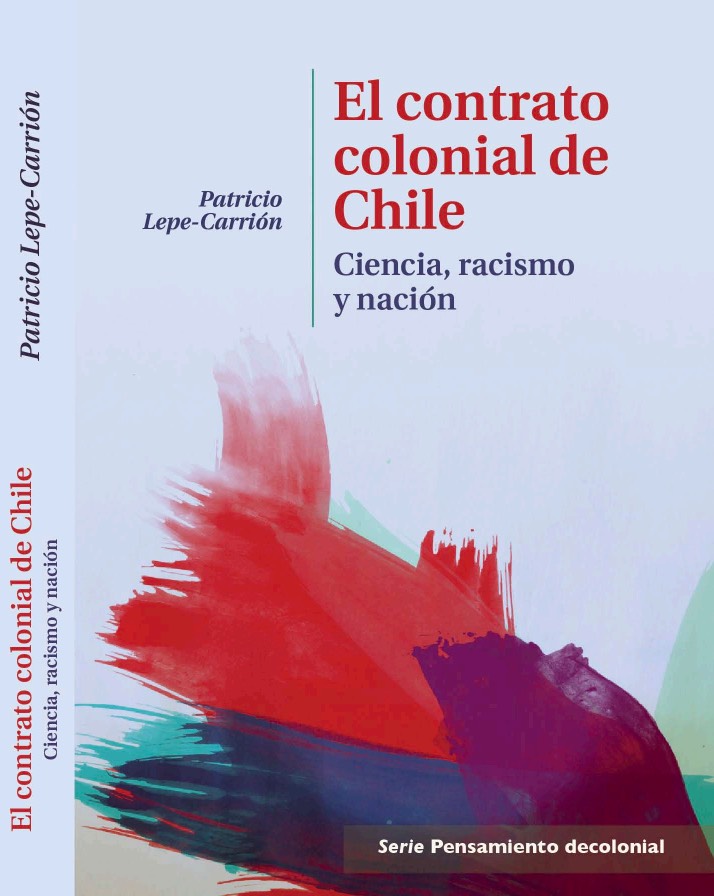
Patricio Lepe-Carrión, El contrato colonial de Chile, Sciencia, racismo, nación Abya Yala, 2016

PDF cover and table of contents

En los orígenes de la nación chilena se ocultan una serie de elementos raciales que pueden remontarse a muchos años antes de su establecimiento formal como institución política. Las ideas de “raza” y “racismo” son el eje central sobre el cual el autor intenta analizar dichas retóricas de inferiorización, provenientes tanto de la ciencia, de la política, como de las prácticas culturales de los siglos XVII, XVIII y principalmente del XIX.

Se trata de un trabajo transdisciplinario,. que se fundamenta en una revisión crítica de fuentes primarias de la época y de una extensa literatura secundaria proveniente de la historia de la cultura, de la ciencia, la antropología social y cultural, así como de la filosofía.

No se trata de una obra de historia, ni menos de antropología, solo es un intento por pensar o cartografiar nuestro pasado colonial (y poscolonial) como un ejercicio de conceptualización que nos permita cuestionar aquello que se denomina “identidad chilena”.

Serie pensamiento de colonial

Parte I

Colonialidad del poder en el reino de Chile

Capítulo I

Civilización y barbarie: la diferencia colonial

Capítulo II

La construcción del sujeto colonial en el Chile del siblo XVII

Parte II

Taxonomías Proto-Raciales de la Ilustración

Capítulo III

Epoca clásica, y el no lugar en la instrumentalización política de los saberes científicos

Capítulo IV

La historia natural en el orden y clasificación etnoracial de la humanidad

Capítulo IV

Clasificación racial en la filosofía ilustrada. El caso de Immanuel Kant

Parte III

Nobleza y plebe: residuos simbólicos durante la pos-colonia

Capítulo VI

Biopolítica borbónica en Chile: el discurso antropolótico sobre la ociosidad, el vagabundaje, y su objetivación en el mestizaje

Capítulo VII

El color de las clases sociales chilenas

Capítulo VIII

Imaginando la nación

Capítulo IX

Dimensión simbólica de las clases sociales: escenificación y apariencia

Conclusión