Foucault News

News and resources on French thinker Michel Foucault (1926-1984)

Anthony Alessandrini, “Rescuing the Revolution from Its Outcomes”, Journal of the Society for Contemporary Thought and the Islamicate World, March 23 2017

Part of a Book Symposium on Behrooz Ghamari-Tabrizi’s Foucault in Iran: Islamic Revolution after the Enlightenment, University of Minnesota Press, 2016, 272 pp., $27.00 US (pbk), ISBN 9780816699490.

Full PDF

Behrooz Ghamari-Tabrizi’s Foucault in Iran: Islamic Revolution after the Enlightenment is an exemplary book in a number of ways, but perhaps first and foremost because of what the book does not do. While it represents the most extensive and sympathetic consideration in English of Michel Foucault’s writings on the events leading up to and culminating in the Iranian Revolution, Ghamari-Tabrizi does not fall into the commonplace critical practice of arguing whether Foucault was “right” or “wrong” about the revolution and its aftermath. More admirably, Foucault in Iran is not satisfied with performing the subtler but still ultimately familiar work of simply asking what Foucault’s writings on Iran can do for us in analyzing our contemporary context. Instead, the book performs Ghamari-Tabrizi’s scrupulous allegiance to what he finds most valuable in Foucault’s work: his insistence upon recognizing “the singularity of the revolution” and the concomitant need “to liberate it from the constraints of universalist narratives” (75). By doing so, he manages to contribute not only a new and significant understanding of Foucault’s late work on ethics, but also an important re-historicizing of the Iranian Revolution for an audience that very likely needs this re-telling. It is on this notion of singularity as Ghamari-Tabrizi reads it out of Foucault’s work, as well as out of the revolution itself, that I will thus focus on in my contribution to this roundtable
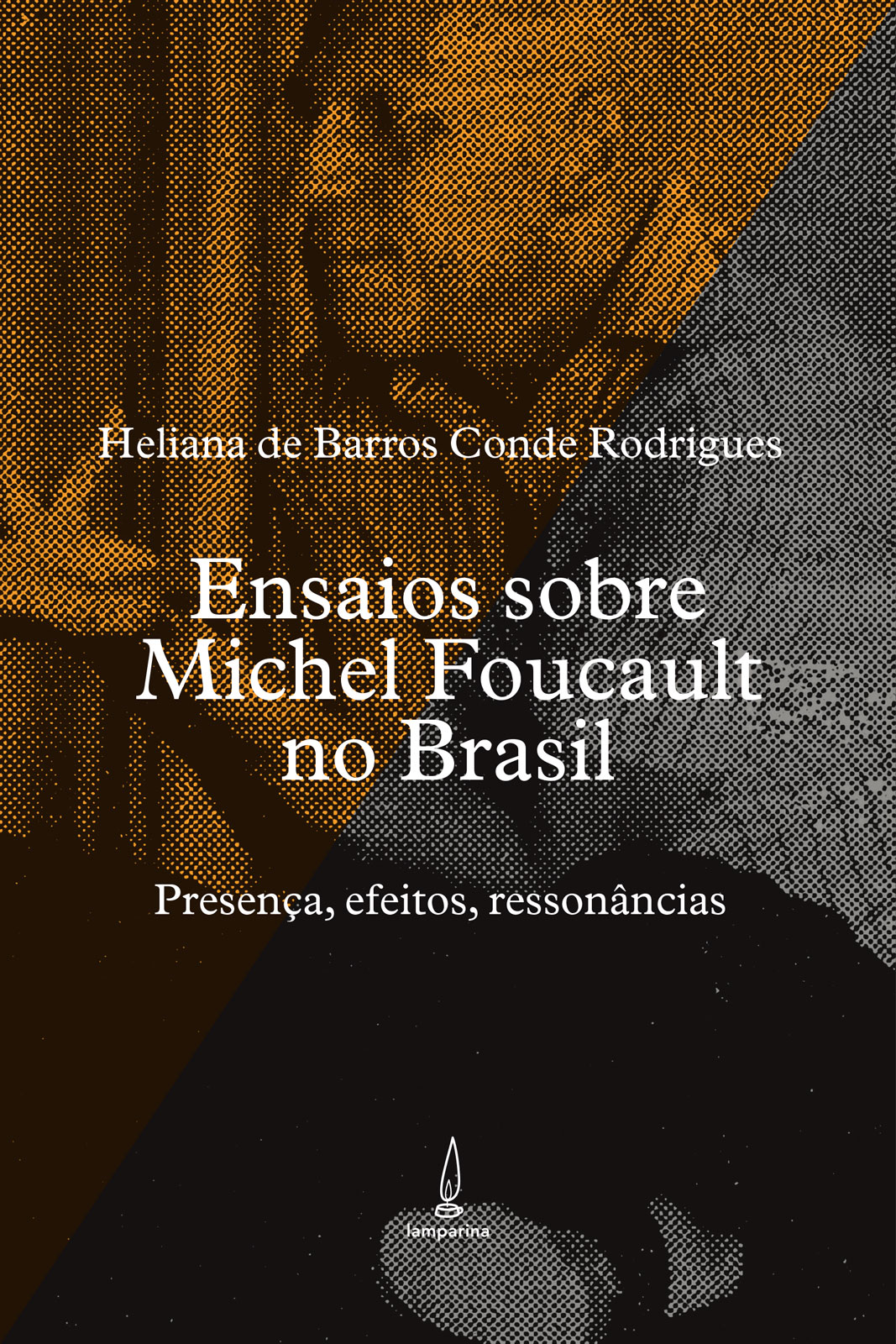
In the Shadow of Dictatorship: Foucault in Brazil

Review of Heliana de Barros Conde Rodrigues, Ensaios sobre Michel Foucault no Brasil: Presença, efeitos, ressonâncias  (Lamparina 2016), 176 pages

Reviewed by Marcelo Hoffman, Theory Culture and Society, 22 March 2017

Open access

Abstract:
Michel Foucault visited Brazil five times from 1965 to 1976 yet the details of his overall presence in the country have remained largely unexplored even in Brazil. Heliana Conde’s Ensaios sobre Michel Foucault no Brasil has the great merit of introducing readers to these details through a reliance on wide range of sources, including interviews with his interlocutors and the archives of the former secret police. While her book covers various aspects of Foucault in Brazil up to his effects and resonances in our present, she compellingly illuminates how the military dictatorship cast a long and ominous shadow over each of his visits to the country.

Keywords:
Foucault, Brazil, dictatorship, oral history, militancy, power, resistance

Michel Foucault, Dire vrai sur soi-même Conférences prononcées à l’Université Victoria de Toronto

Vrin – Philosophie du présent
296 pages – 12,5 × 18 cm
ISBN 978-2-7116-2749-3 – mars 2017

À la fin du premier semestre 1982, Michel Foucault prononce à l’Université Victoria de Toronto un cycle de conférences intitulé Dire vrai sur soi-même. Le thème de ces conférences, s’inscrivant dans le cadre du projet d’une généalogie du sujet occidental moderne, est la formation historique de l’herméneutique de soi. Après avoir analysé le type très particulier de connaissance de soi et de rapport à soi qui caractérise l’askêsis gréco-romaine, où il s’agit pour le sujet d’établir avec lui-même une relation de possession et de souveraineté, Foucault étudie le renversement qui conduit, aux premiers siècles du christianisme, et tout particulièrement dans les communautés monastiques, à la naissance d’une herméneutique de soi conçue comme l’exploration et le déchiffrement par le sujet de sa propre intériorité. Pour définir ce renversement, Foucault introduit ici une distinction inédite entre deux formes d’ascèse, l’une tournée vers la vérité, l’autre tournée vers la réalité. Parallèlement aux conférences, Foucault conduit à Toronto un séminaire consacré à l’étude détaillée de textes des auteurs anciens sur lesquels s’appuient ses analyses de la culture de soi antique. Il y présente également une esquisse des différentes significations de la notion de parrêsia dans l’Antiquité, qui allait devenir le thème principal de ses derniers travaux. Ces conférences et ce séminaire sont publiés ici pour la première fois, dans une édition critique.

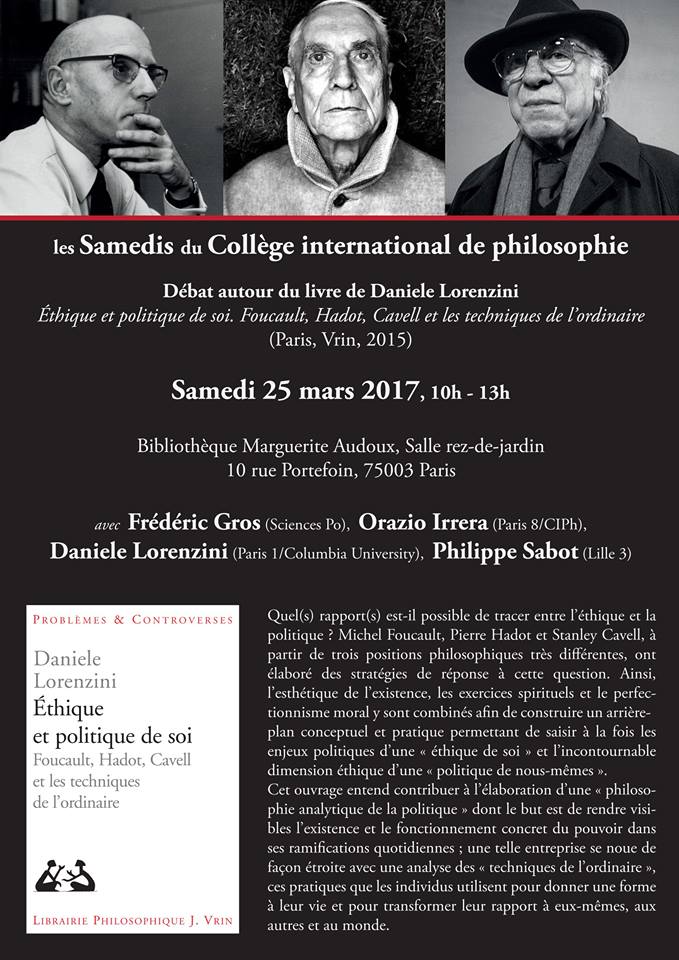
Les Samedis du Collège international de philosophie
Débat autour du livre de Daniele Lorenzini
“Éthique et politique de soi. Foucault, Hadot, Cavell et les techniques de l’ordinaire” (Paris, Vrin, 2015)

avec Frédéric Gros (Sciences Po), Orazio Irrera (Paris 8/CIPh),
Daniele Lorenzini (Paris 1/Columbia University), Philippe Sabot (Lille 3)

Samedi 25 mars 2017, 10h-13h
Bibliothèque Marguerite Audoux, Salle rez-de-jardin (10 rue Portefoin, 75003 Paris)

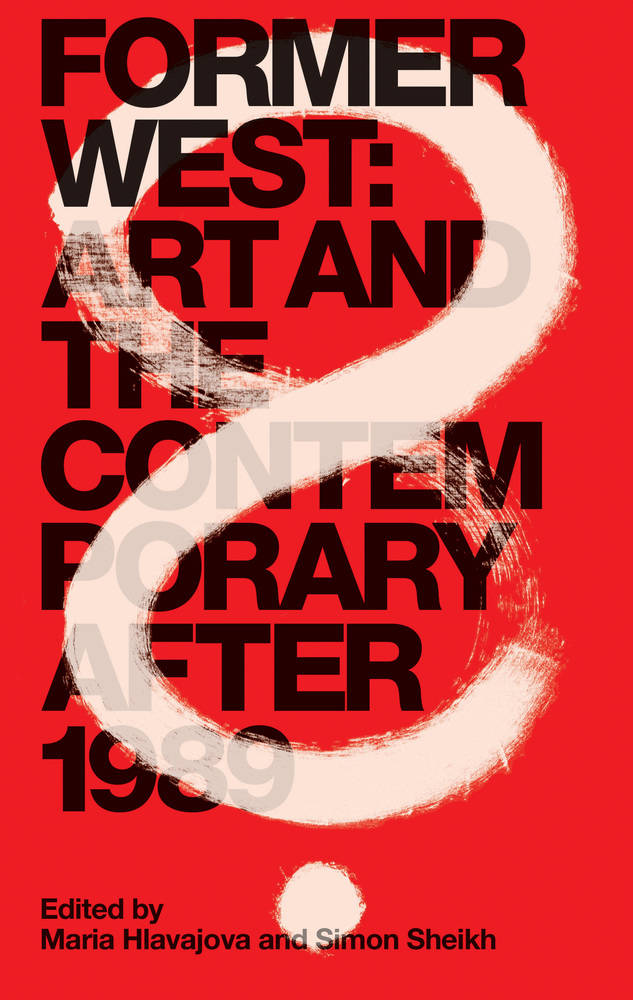
Matteo Pasquinelli “Arcana Mathematica Imperii: The Evolution of Western Computational Norms”, in: Maria Hlavajova et al. (eds) Former West. Art and the Contemporary After 1989. MIT Press, 2017.

Etymologically, statistics is knowledge of the state, of the forces and resources that characterize a state at a given moment . . . this was an explicit part of raison d’État called the arcana Imperii, the secrets of power, and for a long time statistics in particular were considered as secrets of power not to be divulged.
Michel Foucault, Security, Territory, and Population, 1978.

In the nonspace of the matrix, the interior of a given data construct possessed unlimited subjective dimension.
William Gibson, Neuromancer, 1984.

Abstract
The essay follows the metamorphosis of the symbolic form of Western power in the age of global datacenters and machine learning algorithms. Three cases studies of numerical governance (or algorithmic governance) are discussed: Compstat — a system of crime record visualization developed by the New York Police Department since 80s; SkyNet — a NSA classified program for metadata analysis of communication networks in the ‘war on terror’; Ayasdi — a company sponsored by DARPA (the research agency of the US Department of Defense) that has developed sophisticated techniques for topological data analysis.

Colin Koopman, The power thinker, Aeon, 15 March 2017

Imagine you are asked to compose an ultra-short history of philosophy. Perhaps you’ve been challenged to squeeze the impossibly sprawling diversity of philosophy itself into just a few tweets. You could do worse than to search for the single word that best captures the ideas of every important philosopher. Plato had his ‘forms’. René Descartes had his ‘mind’ and John Locke his ‘ideas’. John Stuart Mill later had his ‘liberty’. In more recent philosophy, Jacques Derrida’s word was ‘text’, John Rawls’s was ‘justice’, and Judith Butler’s remains ‘gender’. Michel Foucault’s word, according to this innocent little parlour game, would certainly be ‘power’.

read more

Colin Koopman is the author of a book on Foucault and numerous essays in The New York Times, Critical Inquiry, and elsewhere. He is currently writing a genealogy of the politics of data. He teaches philosophy at the University of Oregon.

Tea Torbenfeldt Bengtsson, & Lars Fynbo (2017). Analysing the significance of silence in qualitative interviewing: questioning and shifting power relations. Qualitative Research, February
https://doi.org/10.1177/1468794117694220

Abstract
In this article we analyse the significance of silence in qualitative interviews with 36 individuals interviewed about high-risk, illegal activities. We describe how silence expresses a dynamic power relationship between interviewer and interviewee. In the analysis, we focus on two different types of silence: ‘silence of the interviewee’ and ‘silence of the interviewer’. We analyse how silence functions as an interviewee’s resistance against being categorized as ‘social deviant’, how an interviewer may use silence strategically, and how silence stemming from an interviewer’s perplexity constructs significant data. We conclude that silence constitutes possibilities for interviewees and interviewers to handle the complex power at play in qualitative interviewing either by maintaining or by losing control of the situation.

Dušan Marinković and Dušan Ristić, Foucault’s ‘Hall of Mirrors’: an Investigation into Geo‐Epistemology
Geografiska Annaler: Series B, Human Geography Vol. 98 , Iss. 2,2016

DOI: 10.1111/geob.12092

Abstract
In this article we aim to single out a part of Foucault’s trihedrals of spatialization – discourses and practices, that is, technologies of power that have their spatialized frames. In order to analyse them we use the concept of a trihedral, not a triangle, because we noticed that several lines can be drawn from any angle and can form new spaces. In such a manner we are able to see their multiplication, separation and parallelisms. Using the trihedrals of spatialization we detect in Foucault’s work, besides the demands for a certain (spatialized) ontology, the existence of no less significant geo‐epistemology as knowledge and discourses that are formed in spaces and as the space formed through knowledge/power/discourses. We face a polyvalent character of the angles of the trihedrals and try to avoid the labyrinth into which their multiplication pulls us. The article pays special attention to Foucault’s elementary trihedral, life–work–language, in which man came to life as a being who works, speaks and reproduces in a new shape – as population. In this trihedral the angles/concepts are only seemingly separated: they overlap, mix, collide and intertwine in a game that cannot end. That is why this is only a snapshot of the many trihedrals; a possible aggregate of combinations, yet in no case coherent and homogenous. In that sense this article is not an attempt to systematize Foucault’s thought but to identify one of the many possible models/matrices for understanding the meaning of his spatial turn and his analysis of power.

Keywords: Foucault, geo‐epistemology, spaces, spatialization, trihedrals

Varea, V., Pang, B.
Using visual methodologies to understand pre-service Health and Physical Education teachers’ subjectivities of bodies
(2016) Sport, Education and Society, pp. 1-13. Article in Press.

DOI: 10.1080/13573322.2016.1228625

Abstract
Socio-cultural theorists have argued that having a diverse understanding of subjectivities of normal/ideal bodies is important for Health and Physical Education (HPE) teachers. When teachers hold a single understanding and perception of normal/ideal bodies, such as a thin body as normal or ideal body, which are usually informed by dominant discourses, they may (re)produce narrow understandings of bodies among their students. This paper focuses on how a group of pre-service HPE specialist teachers (11 females and 3 males, aged between 18 and 26 at the time of the first interview) from an Australian university, discuss issues related to subjectivities of bodies. It draws on visual methodologies and semi-structured interviews to understand how these pre-service HPE specialist teachers construct discourses of bodies. Foucault’s concepts of normalisation, surveillance and biopedagogies are used to explore discursive constructions of bodies, with a particular focus on how some discourses are normalised via surveillance techniques. The results of the study invite us to reflect on how images may promote certain ways of thinking about and considering the body among pre-service HPE specialist teachers. In light of contradictions which were found across the comments of two participants who constructed different discourses during the interviews, we posit that making sense of subjectivities of bodies is complex and often contradictory. Furthermore, the results suggest that photo elicitation is a useful visual method for theorising issues related to bodies. Results can inform teacher education and policy in how to better prepare pre-service HPE teachers to teach about bodies. © 2016 Informa UK Limited, trading as Taylor & Francis Group

Author Keywords
biopedagogies; bodies; normalisation; photo elicitation; Pre-service Health and Physical Education teachers; surveillance

Index Keywords
adult, clinical article, female, human, male, physical education, semi structured interview, teacher, thinking, university

Edwards, R.
Competence-based education and the limitations of critique
(2016) International Journal of Training Research, 14 (3), pp. 244-255.

DOI: 10.1080/14480220.2016.1254366

Abstract
Drawing upon the work of Foucault and Latour, this article reflects on 25 years of critique of competence-based education and its continuing strength as a way of framing education and training. Using an example from England, it rehearses the argument from Foucault that, despite its student-centred discourse, competence-based education can be positioned as one of the disciplining techniques in modern societies. However, beyond the research community, such critiques have had little impact. The article seeks to explore this by drawing upon Latour’s argument that conventional forms of critique have run out of steam. This indicates the need for new forms of educational critique as a means of having impact on policy and practice. The article is theoretically driven and exploratory. © 2016 Informa UK Limited, trading as Taylor & Francis Group.

Author Keywords
competence-based education; critique; Foucault; Latour; vocational education